
How many cups of peanut butter must be used in order to make exactly enough peanut butter balls for the children at the party?
Rationale
18 cups of peanut butter must be used in order to make exactly enough peanut butter balls for the children at the party.
The required amount of peanut butter is determined by the recipe and the number of children attending the party. If the recipe states that each child will receive a certain number of peanut butter balls, and each batch of these balls requires a specific amount of peanut butter, then we can calculate the total peanut butter needed by multiplying the number of batches by the peanut butter amount per batch.
A) 10 10 cups of peanut butter would not be enough to make the required number of peanut butter balls. This amount would either yield fewer balls per child or insufficient balls to serve all the children, based on the specifications of the recipe and the number of attendees.
B) 12 12 cups of peanut butter would also fall short of the amount needed to make enough peanut butter balls for every child at the party. Like with 10 cups, this amount would lead to either fewer balls per child or not enough balls for all the children.
C) 18 18 cups of peanut butter is the correct amount needed to make the exact number of peanut butter balls required for the party. This quantity meets the recipe's specifications for both the number of balls per child and the total number of children at the party.
D) 24 24 cups of peanut butter would exceed the amount necessary to make the required number of peanut butter balls. This excess peanut butter would result in either more balls per child or more total balls than needed for the number of children at the party.
Conclusion To make the exact number of peanut butter balls needed for the party, 18 cups of peanut butter are required. This amount satisfies the recipe's requirements for both the number of balls each child should receive and the total number of children attending the party. Any amount less than 18 cups would result in a shortage, while any amount more than 18 cups would result in an excess of peanut butter balls.
Which of the following must be true?
Rationale
4x-3=26 must be true.
This is the correct answer because when you solve for x in this equation, you find a valid solution.
A) 4x-3=26 To solve for x in this equation, you first add 3 to both sides, resulting in 4x = 29. Then, you divide both sides by 4 to isolate x, obtaining x = 7.25. Therefore, this equation is valid and true when x equals 7.25.
B) 4x-1=26 Attempting to solve this equation for x would result in a different value. First, you'd add 1 to both sides, simplifying to 4x = 27. Then, dividing both sides by 4, you'd find x = 6.75. However, this is not relevant to the correct answer, and as such, this equation cannot be true in the context of this question.
C) 5x-1=26 Solving this equation for x would also yield a different value. You would add 1 to both sides, simplifying to 5x = 27. After dividing both sides by 5, you'd find x = 5.4. However, this does not match the value obtained from the correct equation and therefore cannot be true in this context.
D) 5x+1=26 Once again, solving this equation would result in a different value for x. You would subtract 1 from both sides, simplifying to 5x = 25. After dividing both sides by 5, you'd find x = 5. But this is not consistent with the value from the correct equation, so this equation cannot be true in this context.
Conclusion Only the equation 4x-3=26 is correct, as it gives a valid solution for x when solved. The other equations—4x-1=26, 5x-1=26, and 5x+1=26—each yield different values for x, making them incorrect in the context of this question. Thus, only the equation 4x-3=26 must be true.
The system of equations above has how many solutions? x+4y=3, 2x+8y=4
Rationale
None is the correct number of solutions for the system of equations x+4y=3 and 2x+8y=4.
The two equations provided appear to be different, but they are actually the same equation when simplified, which leads to a paradoxical situation where we have two identical equations seeming to represent two different lines, which is not possible. Therefore, the system of equations has no solutions.
A) None This is the correct answer. The two equations in the system are actually the same when simplified. For instance, if we multiply the first equation by 2, we get 2x + 8y = 6, which is not the same as the second equation, 2x + 8y = 4. This contradiction implies that the two equations do not intersect at any point, meaning there are no solutions.
B) One This is incorrect because the system of equations does not intersect at a single point. If the system of equations did intersect at a single point, then there would be one solution. However, as explained above, these equations are actually the same when simplified, leading to a contradiction and therefore, no solutions.
C) Two This answer choice is incorrect because a system of two equations can only have two solutions if it is nonlinear (for example, one equation represents a line and the other represents a parabola). The given system of equations is linear, so it cannot have two solutions.
D) Infinitely many This answer choice is incorrect because in order for a system of linear equations to have infinitely many solutions, the equations must represent the same line. While the coefficients in the given system are proportional, the constants are not. Therefore, the system does not represent the same line and does not have infinitely many solutions.
Conclusion The system of equations provided, x+4y=3 and 2x+8y=4, are proportional to one another but do not represent the same line due to differing constants on the right side of the equation. This causes a contradiction where the system appears to represent two identical lines, which is not possible. Thus, there are no solutions to this system of equations.
The sum of n and the product 3 times n is 12. What is the value of n?
Rationale
The value of n is 3.
The equation derived from the question is n + 3n = 12. Combining like terms gives 4n = 12. Solving for n, we divide both sides by 4, resulting in n = 3.
A) 2 If we substitute n with 2 into the equation n + 3n = 12, we get 2 + 3*2 = 8. This does not equal to 12, so 2 is not the correct answer.
B) 3 Substituting n with 3 into the equation n + 3n = 12 gives 3 + 3*3 = 12. This satisfies the equation, confirming that 3 is the correct answer.
C) 4 Substituting n with 4 into the equation n + 3n = 12 results in 4 + 3*4 = 16. This does not equal to 12, so 4 is not the correct answer.
D) 4 ½ Substituting n with 4.5 into the equation n + 3n = 12 gives 4.5 + 3*4.5 = 18. This does not equal to 12, so 4.5 is not the correct answer.
Conclusion When solving for n in the equation n + 3n = 12, we find that the only value that makes the equation true is n = 3. All other options (2, 4, and 4.5) do not satisfy the equation. Hence, the correct answer is 3.
If a number from set M is selected at random, what is the probability that the number selected will be a factor of 12?
Rationale
The probability that the number selected will be a factor of 12 is 0.4.
The set M contains 10 numbers. The factors of 12 are 1, 2, 3, 4, 6, and 12. Four of these factors are included in set M, so the probability of selecting a factor of 12 from set M at random is 4/10, or 0.4.
A) 0.1 This answer would be correct if only one number from set M was a factor of 12. However, in this case, there are four factors of 12 in set M, making the probability 4/10, or 0.4, not 0.1.
B) 0.2 This answer would be correct if two numbers from set M were factors of 12. However, there are four factors of 12 in set M, making the probability 4/10, or 0.4, not 0.2.
D) 0.5 This answer would be correct if five numbers from set M were factors of 12. However, there are only four factors of 12 in set M, making the probability 4/10, or 0.4, not 0.5.
Conclusion The probability of a random event is calculated by dividing the number of favorable outcomes by the total number of outcomes. In this case, there are four factors of 12 in set M, and the total number of outcomes is 10 (the number of numbers in set M). Therefore, the correct probability that a randomly selected number from set M will be a factor of 12 is 4/10, or 0.4.
Which of the following is equivalent to 12x +8?
Rationale
4(3x+2)
Expanding the expression 4(3x+2) results in 12x + 8, making it equivalent to the given expression. This equivalence is achieved by distributing the 4 to both terms inside the parentheses, leading to 12x from 4*3x and 8 from 4*2.
A) 4(3x+2) This choice correctly represents the given expression when expanded, resulting in 12x + 8, which matches the original expression. By distributing the 4 to both terms inside the parentheses, the equivalent form is obtained.
B) 4(3x+8) Expanding 4(3x+8) leads to 12x + 32, which is not equivalent to the original expression of 12x + 8. The addition of 8*4=32 creates a different result than the given expression.
C) 4(3x+2x) When expanded, 4(3x+2x) simplifies to 12x + 8x, resulting in 20x. This outcome differs from the original expression of 12x + 8, making this choice incorrect.
D) 20x The expression 20x is not equivalent to 12x + 8. This choice represents a different mathematical operation, involving only the variable x and a coefficient of 20, rather than the sum of two terms involving x and a constant.
Conclusion Among the options provided, only choice A, 4(3x+2), is equivalent to the given expression 12x + 8 when expanded. The correct distribution of the 4 coefficient to both terms inside the parentheses yields the identical form, demonstrating the equivalence required in algebraic expressions. Choices B, C, and D result in different expressions that do not match the original form, highlighting the importance of proper simplification techniques in algebraic manipulations.
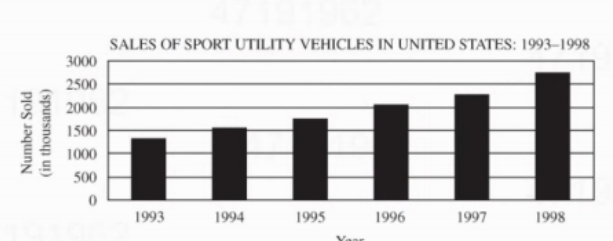
If the trend shown in the graph above continued into the next year, approximately how many sport utility vehicles were sold in 1999?
Rationale
3 million
The graph indicates a clear upward trend in sport utility vehicle sales over the years, with the number of units sold in 1998 exceeding 2 million. If this trend were to continue into the next year, a reasonable estimate would be around 3 million SUVs sold in 1999.
B) 2.5 million While 2.5 million may seem like a plausible estimate given the increasing trend, it falls short of fully capturing the likely growth based on the graph's trajectory. The significant rise in sales from the previous year suggests a higher figure for 1999.
C) 2 million Choosing 2 million as the estimate overlooks the evident upward trend in SUV sales depicted in the graph. The sales volume is visibly on the rise, indicating a more substantial number of vehicles sold in the following year compared to the 2 million mark.
D) 3 thousand Estimating 3 thousand SUVs sold in 1999 contradicts the trend displayed in the graph, which illustrates a much larger scale of sales. The graph's pattern suggests a significant increase in sales volume, making 3 thousand an implausible figure for the next year.
Conclusion Considering the consistent growth in sport utility vehicle sales shown in the graph, projecting around 3 million units sold in 1999 aligns with the trend's trajectory. This estimate takes into account the increasing demand for SUVs and anticipates a continuation of the upward sales pattern seen in the data provided.
In the figure above, what is the average (arithmetic mean) of w, x, y, and z?
Rationale
D) It cannot be determined from the information given.
The average of four variables (w, x, y, and z in this case) cannot be determined without knowing the values of these variables. The figure referenced does not provide these values, thus the average cannot be calculated.
A) 90 This answer assumes that the average of w, x, y, and z is 90. However, without knowing the individual values of these variables, this cannot be confirmed or denied. Therefore, this answer is incorrect.
B) 100 Similar to choice A, this answer assumes that the average of the variables is 100. Without the specific values of w, x, y, and z, this assumption cannot be verified as correct or incorrect. Hence, this choice is incorrect.
C) 120 This answer choice assumes that the average of the variables is 120. Yet again, without the values of w, x, y, and z, this cannot be confirmed as the correct answer. Therefore, this choice is incorrect.
Conclusion Without the specific values of w, x, y, and z, it is impossible to calculate their average. Thus, the correct answer is D) It cannot be determined from the information given. The other options (A, B, and C) make assumptions about the average of the variables, but these cannot be confirmed without the necessary information, rendering them incorrect.
The average of 4 numbers is 9. If one of the numbers is 7, what is the sum of the other 3 numbers?
Rationale
The sum of the other three numbers is 29.
The average of four numbers is calculated by adding all four numbers together and dividing by four. If the average is known to be 9, the sum of all four numbers can be calculated by multiplying 9 by 4, which equals 36. If one of the numbers is known to be 7, the sum of the other three numbers is found by subtracting 7 from 36, which equals 29.
A) 2 This is incorrect because if the sum of the other three numbers were 2, then the total sum of all four numbers would only be 9 (7 plus 2). This would not give an average of 9 because 9 divided by 4 equals 2.25, not 9.
B) 12 This is incorrect because if the sum of the other three numbers were 12, then the total sum of all four numbers would only be 19 (7 plus 12). This would not give an average of 9 because 19 divided by 4 equals 4.75, not 9.
D) 36 This is incorrect because if the sum of the other three numbers were 36, then the total sum of all four numbers would be 43 (7 plus 36). This would not give an average of 9 because 43 divided by 4 equals 10.75, not 9.
Conclusion The sum of the other three numbers is 29. This is calculated by first determining the total sum of all four numbers (which is 36, based on the given average of 9) and then subtracting the known number (7) from this total. The remaining sum must be the total of the other three numbers. The other options (2, 12, and 36) do not yield an average of 9 when combined with the known number and divided by 4.
Which of the following is a factor of u²+uv-2v²?
Rationale
(u-2v) is a factor of u²+uv-2v².
The binomial (u-2v) is a factor of the polynomial u²+uv-2v². This can be determined through the process of factoring the given polynomial.
A) (u-v) (u-v) is not a factor of the given polynomial. If we try to divide the polynomial u²+uv-2v² by (u-v), it does not divide evenly and leaves a remainder. Therefore, (u-v) cannot be a factor.
B) (2u-v) Similarly, (2u-v) does not divide the polynomial u²+uv-2v² without leaving a remainder. For a binomial to be a factor of a polynomial, the division of the polynomial by the binomial must result in a polynomial with no remainder.
C) (u-2v) When we divide the polynomial u²+uv-2v² by (u-2v), it divides evenly without leaving a remainder. This indicates that (u-2v) is indeed a factor of the polynomial.
D) (u+v) (u+v) is not a factor of u²+uv-2v². When we try to divide the polynomial by the binomial (u+v), it does not divide evenly and leaves a remainder. Therefore, (u+v) cannot be a factor of the polynomial.
Conclusion In order to confirm if a binomial is a factor of a polynomial, it must divide the polynomial to yield a quotient without any remainder. Of all the given options, only (u-2v) achieves this when divided into the polynomial u²+uv-2v², thus making it the correct answer. The other options (u-v), (2u-v), and (u+v) are not factors of the polynomial because their division results in a remainder.
You are leaving this quiz
What would you like to do with your progress?
You're in the middle of a quiz
What would you like to do before switching?
Practice complete
You finished this free practice quiz.