
12 + 67 + 153 =
Rationale
12 + 67 + 153 = 232.
The sum of these three numbers is calculated as follows: 12 plus 67 equals 79, and adding 153 results in a total of 232.
A) 212 This choice mistakenly presents a total that is lower than the actual sum. When adding 12 and 67 to 153, the resulting value exceeds 212, indicating that this option is incorrect.
B) 232 As established, adding 12 and 67 gives 79, which when combined with 153 yields a correct total of 232. This is the accurate answer to the equation provided.
C) 252 This option represents a total that is higher than the actual sum. The computations show that 12 + 67 + 153 equals 232, making 252 an incorrect choice.
D) 289 This choice is also incorrect, as it significantly exceeds the calculated total of 232. The addition of 12, 67, and 153 does not approach this figure.
E) None of the Above This option would imply that none of the listed answers are correct. However, since 232 is indeed the correct result of the addition, this choice is incorrect.
Conclusion The calculation of 12 + 67 + 153 results in 232, confirming that option B is the accurate answer. All other choices either fall short or exceed this sum, illustrating the importance of careful arithmetic in solving simple addition problems.
5361 - 1752 =
Rationale
5361 - 1752 = 3609.
To find the result of the subtraction, we subtract 1752 from 5361, which yields 3609 as the correct answer.
A) 3509 This choice is incorrect because 3509 is less than the actual result of the subtraction. If we calculate 5361 minus 1752, we find that 3509 does not match the computed value.
B) 2619 This option is incorrect as 2619 is significantly lower than the correct difference. The subtraction of 1752 from 5361 does not yield a result anywhere near this value.
C) 3609 This is the correct answer. When we perform the subtraction 5361 - 1752, we arrive at 3609, which accurately reflects the solution to the problem.
D) 3719 This choice is also incorrect. 3719 is greater than the actual result of the subtraction, indicating an error in the calculation if this were to be considered as the answer.
E) None of the Above This option is incorrect since one of the provided choices (C) is indeed the correct answer. Therefore, selecting "None of the Above" is not applicable in this case.
Conclusion To conclude, the correct result of the subtraction problem 5361 - 1752 is 3609. This answer eliminates all other options as valid choices, confirming that the subtraction calculation has been executed correctly. Thus, choice C stands as the definitive solution to the posed question.
If Marci deposited 7/8 of $320.00 in her checking account, then she deposited ____ dollars.
Rationale
Marci deposited $280.00 in her checking account.
To find the amount Marci deposited, we need to calculate 7/8 of $320. Multiplying $320 by 7/8 gives us $280, which is the amount deposited in her checking account.
A) 120 This choice is incorrect because 7/8 of $320 is not $120. If we divide $320 into 8 equal parts, each part is $40, and multiplying that by 7 gives $280, not $120.
B) 140 This choice is also incorrect as 7/8 of $320 does not equal $140. To arrive at $140, you would need to find a fraction that is less than 1/2 of $320, which is not the case here.
C) 180 Choosing $180 is incorrect because it does not represent 7/8 of $320. When calculating, 7/8 of $320 is substantially higher than $180, confirming that this choice is not viable.
D) 240 This option is incorrect as well, since 7/8 of $320 is $280, which is greater than $240. A miscalculation could lead one to consider $240, but it does not meet the criteria of 7/8 of the total.
E) 280 This is the correct answer, as we have established that 7/8 of $320 calculates to $280. This amount accurately reflects the portion of the total deposited by Marci.
Conclusion Marci deposited $280.00 in her checking account after calculating 7/8 of $320. The other options do not correctly reflect the computation, demonstrating the importance of precise calculations in determining such financial transactions. Understanding fractions and their applications in real-world scenarios, like banking, is essential for effective money management.
A cafeteria has created a healthy snack by mixing unsalted cashews and peanuts in a ratio of 2:3 respectively. If Jane has 4 pounds of cashews, how many pounds of peanuts does she have to use?
Rationale
Jane has to use 6 pounds of peanuts.
To maintain the 2:3 ratio of cashews to peanuts, if Jane has 4 pounds of cashews, she must calculate the corresponding amount of peanuts by using the ratio to determine the right balance.
A) 4 pounds Using only 4 pounds of peanuts would not maintain the 2:3 ratio. Since Jane has 4 pounds of cashews, the correct amount of peanuts must be greater to satisfy the proportion set by the ratio.
B) 6 pounds This is the correct choice. To find the amount of peanuts needed, we can set up a proportion: if 2 parts represent the cashews (4 pounds), then 3 parts represent the peanuts. Setting up the equation (2/3) = (4/x) leads to the solution of 6 pounds of peanuts, maintaining the 2:3 ratio.
C) 8 pounds Using 8 pounds of peanuts would disrupt the required ratio. The ratio of cashews to peanuts would then be 4:8, simplifying to 1:2, which does not match the original 2:3 ratio necessary for the snack.
D) 10 pounds If Jane used 10 pounds of peanuts, the ratio would become 4:10, which simplifies to 2:5. This also does not conform to the required 2:3 ratio, resulting in an incorrect proportion of ingredients.
Conclusion To keep the healthy snack's intended ratio of unsalted cashews to peanuts at 2:3, Jane must use 6 pounds of peanuts alongside her 4 pounds of cashews. This ensures the correct balance and meets the nutritional standards aimed for in the cafeteria's snack creation. Understanding ratios is essential for maintaining proportions in recipes and ensuring product consistency.
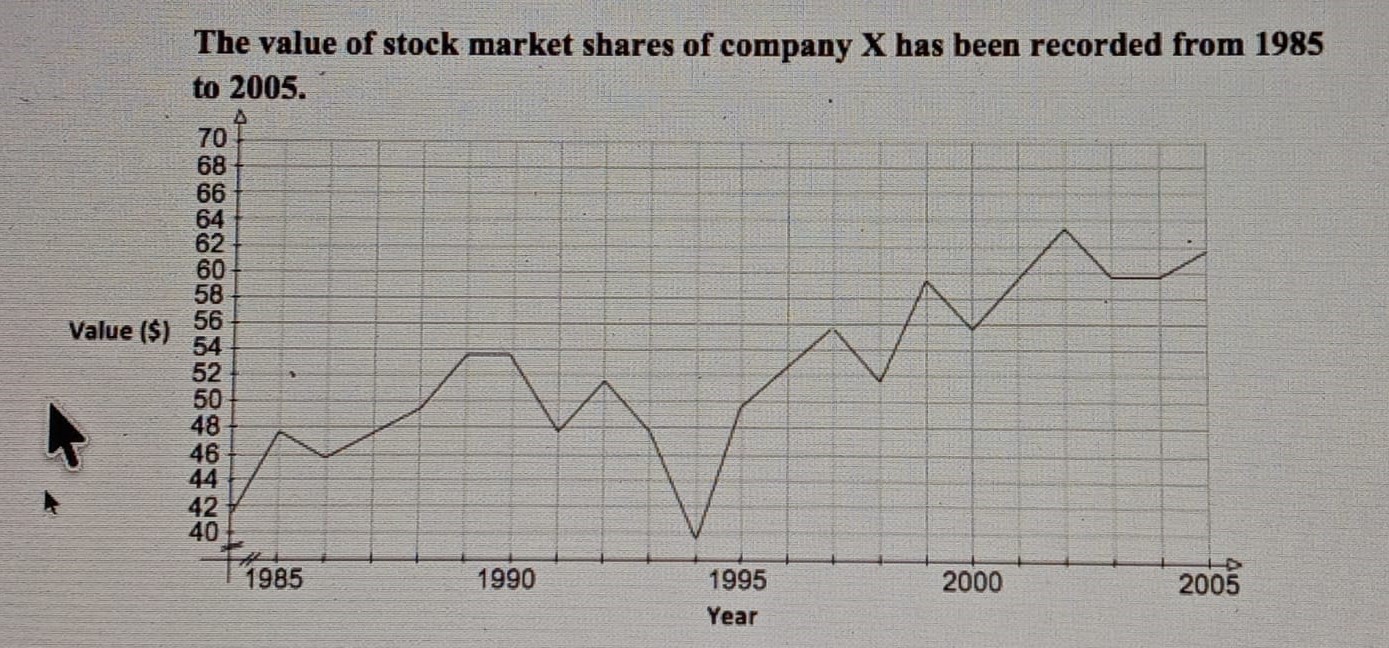
Referring to the graph, which of the following statements is TRUE?
Rationale
Year is the independent variable.
In the context of a graph, the independent variable is the one that is manipulated or changed to observe its effect on the dependent variable. Here, the year represents the time period over which data is collected, making it the independent variable that influences changes in the dependent variable.
A) Year is the dependent variable. The dependent variable is the one that is measured or observed in response to changes in the independent variable. In this case, year does not depend on any other variable; rather, it serves as the basis for plotting the data, which makes it incorrect to classify it as the dependent variable.
B) Year is the measured variable. A measured variable refers to the data collected and analyzed, typically in response to the independent variable. While the year may correlate with the measured data, it is not itself a measurement but rather a point of reference for the analysis, so this statement is incorrect.
C) Value is the independent variable. In the context of a graph, the independent variable should be the one that influences the measured outcomes. The value typically represents the dependent variable that changes in response to the years plotted, thus making this choice incorrect.
D) Year is the independent variable. Year serves as the independent variable as it provides the timeline against which changes in the measured variable can be assessed. This role is crucial in understanding trends and patterns over time, confirming that the year is indeed the independent variable.
Conclusion In graph analysis, the independent variable is critical for understanding how changes over time influence the dependent variable. In this case, year serves as the independent variable, providing a framework for interpreting the relationship between time and the values measured. Identifying the correct roles of these variables is essential for accurate data interpretation and analysis.
If n/35 = 8/5, then n =
Rationale
n equals 56.
To solve the equation n/35 = 8/5, we can cross-multiply to find the value of n. This calculation leads us to determine that n must equal 56.
A) 40 If n were 40, substituting it back into the equation gives 40/35, which simplifies to 8/7, not equal to 8/5. Therefore, 40 cannot be the correct answer.
B) 42 Substituting 42 into the equation results in 42/35, which simplifies to 6/5, again not equal to 8/5. This means 42 does not satisfy the original equation.
C) 48 When substituting 48, we calculate 48/35, which simplifies to approximately 1.37 or 12/10, also not equal to 8/5. Hence, 48 is not the correct answer.
D) 56 Plugging in 56 into the equation gives us 56/35, which simplifies directly to 8/5. This is consistent with the original equation, confirming that 56 is indeed the correct value for n.
Conclusion To find n from the equation n/35 = 8/5, cross-multiplication reveals that n must equal 56. The other options, 40, 42, and 48, do not satisfy the equation upon substitution, leaving 56 as the only viable solution. This illustrates the importance of verifying answers through substitution in algebraic equations.
If an object is moving toward a stationary observer at a constant speed, which of these graphs best represents this movement?
Rationale
Graph C best represents an object moving toward a stationary observer at a constant speed.
This graph depicts a linear increase in the distance from the observer over time, indicating that the object is consistently approaching the observer at a steady pace. The straight line illustrates the constant speed of the object, which is the key characteristic of the motion described.
A) Graph A Graph A shows a curve that does not represent constant speed; instead, it suggests that the object is accelerating or decelerating as it approaches the observer. A constant speed would require a linear representation rather than a curved line.
B) Graph B Graph B depicts a situation where the object appears to be moving away from the observer, which contradicts the premise of the object moving toward a stationary observer. This graph does not illustrate the correct direction of movement.
D) Graph D Graph D indicates a constant distance from the observer, suggesting that the object is stationary rather than moving toward the observer. To represent motion toward the observer, the graph must show a decrease in distance over time.
E) Graph E Graph E shows an increase in distance over time, which suggests that the object is moving away from the observer. This is not consistent with the required representation of an object approaching the observer.
Conclusion In summary, Graph C accurately reflects the motion of an object moving toward a stationary observer at a constant speed, characterized by a straight line with a consistent slope. The other graphs either misrepresent the direction of movement or do not depict a constant speed, making them unsuitable choices for this scenario.
4 2/5 x 2 2/3 =
Rationale
4 2/5 x 2 2/3 = 11 11/15.
To solve the multiplication of mixed numbers, we first convert them into improper fractions. The calculation yields the result of 11 11/15, confirming the accuracy of the choice.
A) 11 11/15 This choice is correct as it represents the result of multiplying 4 2/5 (which is 22/5) by 2 2/3 (which is 8/3). The product (22/5) x (8/3) simplifies to 176/15, which converts back to the mixed number 11 11/15.
B) 10 13/30 This option is incorrect because it misrepresents the product of the two mixed numbers. If we calculate the multiplication correctly, we get 176/15, which does not simplify to 10 13/30, as 10 13/30 equals 313/30, a different value altogether.
C) 8 1/2 This choice is also incorrect. The value of 8 1/2 is equivalent to 17/2, which does not match the product of 4 2/5 and 2 2/3. The correct product is 11 11/15, which is significantly larger than 8 1/2.
D) 6 4/15 This option is incorrect as well. The value of 6 4/15 converts to 94/15, which is less than the actual product of 176/15. Thus, it fails to represent the correct solution to the multiplication problem.
E) None of the Above This option is incorrect since option A provides the correct answer. Therefore, claiming that none of the above options are correct is false.
Conclusion The multiplication of the mixed numbers 4 2/5 and 2 2/3 results in 11 11/15, which is correctly expressed in option A. The other choices either miscalculate or misrepresent the final product, underscoring the importance of careful conversion and multiplication of mixed numbers in arithmetic operations.
Marie can assemble two electronic circuits in 16 minutes. In 120 minutes she can assemble
Rationale
In 120 minutes, Marie can assemble 15 circuits.
Marie takes 16 minutes to assemble 2 circuits, meaning her rate is 0.125 circuits per minute. Over 120 minutes, she can therefore assemble 15 circuits (0.125 circuits/minute × 120 minutes = 15 circuits).
A) 6 Circuits If Marie can assemble 2 circuits in 16 minutes, then in 32 minutes, she would complete 4 circuits. To assemble only 6 circuits, she would require 48 minutes, which is significantly less than the 120 minutes available. Hence, 6 circuits is an incorrect option.
B) 15 Circuits As calculated, Marie's assembly rate of 0.125 circuits per minute allows her to complete 15 circuits in 120 minutes. This option accurately reflects her productivity over the given time period.
C) 18 Circuits To assemble 18 circuits at her rate of 0.125 circuits per minute, Marie would need 144 minutes (18 circuits ÷ 0.125 circuits/minute = 144 minutes). Since 144 minutes exceeds the available 120 minutes, this option is not feasible.
D) 40 Circuits At her rate, assembling 40 circuits would take 320 minutes (40 circuits ÷ 0.125 circuits/minute = 320 minutes). This duration surpasses the 120 minutes available, making this choice impossible.
Conclusion Marie's assembly rate of 0.125 circuits per minute confirms that she can assemble 15 circuits in 120 minutes. The other options, while potentially plausible at different rates or time frames, do not align with the calculations derived from her established assembly speed. Thus, the only correct answer is that she can complete 15 circuits in the given time.
4 1/5 - 2 2/3 =
Rationale
4 1/5 - 2 2/3 equals 1 1/2.
To solve the problem, convert both mixed numbers to improper fractions. Then find a common denominator, perform the subtraction, and convert back to a mixed number, resulting in 1 1/2.
A) 2 {7/15} This option suggests a mixed number that is greater than the actual result. When subtracting 2 2/3 from 4 1/5, the correct computation does not yield a value close to 2, thus making this choice incorrect.
B) 1 {8/15} This choice is also incorrect as it underestimates the result. The subtraction yields a greater value than 1, failing to recognize the correct difference of 1 1/2.
C) 2{1/2} This option implies a result greater than the actual difference. The calculation shows that the result is less than 2, confirming that this option does not accurately reflect the outcome of the subtraction.
D) 1{1/2} This is the correct choice. The calculation of 4 1/5 - 2 2/3 simplifies to 1 1/2 after proper conversion and subtraction.
E) None of the above This option is incorrect since 1 1/2 is indeed a valid result obtained from the subtraction, directly contradicting the assertion that none of the choices are correct.
Conclusion The subtraction of 2 2/3 from 4 1/5 results in 1 1/2 after proper calculations. Each incorrect option either overestimates or underestimates the result, demonstrating the importance of accurate arithmetic operations. The correct answer confirms that careful evaluation of mixed numbers yields essential insights into basic arithmetic processes.
Which number is equal to 2.7 x 10⁻³?
Rationale
2.7 x 10⁻³ = 2.7 / 1000 = 0.0027. Option B is correct. Other options misplace the decimal.
Evaluate 6x - 2y, for x = 0.8 and y = 1.5
Rationale
Evaluating 6x - 2y with x = 0.8 and y = 1.5 yields 1.8.
By substituting the values of x and y into the expression, we calculate: 6(0.8) - 2(1.5) = 4.8 - 3 = 1.8.
A) 2.3 This result suggests a calculation error. When substituting x = 0.8 and y = 1.5, the evaluation of the expression 6x - 2y does not yield 2.3, as the proper calculation leads to 1.8.
B) 2 Choosing 2 indicates an incorrect adjustment or arithmetic mistake in the evaluation. The correct computation shows that 6(0.8) results in 4.8, and subtracting 3 (from 2(1.5)) gives us 1.8, not 2.
C) 1.8 This is the correct answer, as it accurately reflects the result of evaluating the expression 6x - 2y with the given values, confirming the calculation is 1.8.
D) 1.3 A result of 1.3 indicates a significant miscalculation. The result of the expression after substituting the given values clearly leads to 1.8, not 1.3, highlighting a potential error in arithmetic processing.
E) None of the above Selecting "None of the above" is incorrect because one of the options, specifically C, accurately represents the result of the calculation. Therefore, this choice does not apply in this context.
Conclusion The evaluation of the expression 6x - 2y for x = 0.8 and y = 1.5 is correctly calculated to be 1.8. Choices A, B, D, and E do not represent this outcome and indicate misunderstandings in the arithmetic process. Therefore, option C is the only valid answer, confirming the accuracy of the substitution and calculation.
5/8 written as a percent is
Rationale
5/8 = 0.625, so 0.625 x 100 = 62.5%. Option D is correct. Other options are incorrect.
A recipe for strawberry jam requires two pounds of berries to make five quarts of jam. To make 13 quarts of jam it will take ___ pounds of berries. (round to nearest tenth)
Rationale
To make 13 quarts of jam, it will take 5.2 pounds of berries.
To find the amount of berries needed for 13 quarts, we can set up a proportion based on the original recipe: 2 pounds of berries for 5 quarts. By calculating, we find that 13 quarts requires approximately 5.2 pounds of berries.
A) 2.5 Choosing 2.5 pounds would suggest that the recipe is being scaled down significantly, which is incorrect. This amount corresponds to just a fraction of the required berries for 13 quarts, as it only covers a little over 5 quarts based on the original recipe, falling short of the needed amount.
B) 4.8 Selecting 4.8 pounds would imply that a little less than 5 pounds of berries are sufficient to make 13 quarts. However, this choice does not meet the proportionate increase needed, as it would not yield the full 13 quarts based on the ratio of berries to quarts established in the original recipe.
D) 8.6 Choosing 8.6 pounds would overestimate the number of berries needed for 13 quarts. This amount greatly exceeds the required quantity based on the proportion, resulting in excessive output of jam beyond the targeted 13 quarts, which is unnecessary.
Conclusion To accurately scale the recipe for 13 quarts of jam, 5.2 pounds of berries is necessary based on the original proportion of berries to jam. Incorrect choices either underestimate or overestimate the needed quantity, failing to maintain the correct ratio established in the recipe. Understanding these proportions is crucial for ensuring the desired outcomes in cooking and preserving.
Referring to the graph, which of the following statements is TRUE?
Rationale
Year is the independent variable.
In the context of a graph, the independent variable is the one that is manipulated or changed to observe its effect on the dependent variable. Here, "Year" is typically plotted on the x-axis, indicating that it is the variable that is controlled or set in the context of the experiment or study.
A) Year is the dependent variable. This choice is incorrect because the dependent variable is the one that is measured or observed in response to changes in the independent variable. In most graphs, the dependent variable is plotted on the y-axis, while "Year" is commonly used to represent time on the x-axis, making it independent.
B) Year is the measured variable. This statement is misleading since "measured variable" typically refers to the dependent variable that is observed or quantified in an experiment. Year, being the context or timeframe for the analysis, does not represent a measurement in this scenario.
C) Value is the independent variable. This choice misunderstands the roles of variables in a graph. While "Value" might represent a measurement influenced by the independent variable, it is not correct to label it as independent. In the given question, the independent variable is the "Year," which is used to see how values change over time.
D) Year is the independent variable. This statement is accurate as it identifies "Year" as the variable that is not affected by other variables in the graph. It serves as the basis for assessing how other factors change in relation to time, solidifying its role as the independent variable.
Conclusion In graphs, the independent variable is typically the one that is manipulated or set, while the dependent variable is measured in response. Here, "Year" serves as the independent variable, allowing for the analysis of changes over time. Recognizing these roles is crucial for interpreting data correctly in graphical representations.
12 + 67 + 153 =
Rationale
12 + 67 + 153 = 232.
The sum of these three numbers is calculated as follows: 12 plus 67 equals 79, and adding 153 results in a total of 232.
A) 212 This choice mistakenly presents a total that is lower than the actual sum. When adding 12 and 67 to 153, the resulting value exceeds 212, indicating that this option is incorrect.
B) 232 As established, adding 12 and 67 gives 79, which when combined with 153 yields a correct total of 232. This is the accurate answer to the equation provided.
C) 252 This option represents a total that is higher than the actual sum. The computations show that 12 + 67 + 153 equals 232, making 252 an incorrect choice.
D) 289 This choice is also incorrect, as it significantly exceeds the calculated total of 232. The addition of 12, 67, and 153 does not approach this figure.
E) None of the Above This option would imply that none of the listed answers are correct. However, since 232 is indeed the correct result of the addition, this choice is incorrect.
Conclusion The calculation of 12 + 67 + 153 results in 232, confirming that option B is the accurate answer. All other choices either fall short or exceed this sum, illustrating the importance of careful arithmetic in solving simple addition problems.
5361 - 1752 =
Rationale
5361 - 1752 = 3609.
To find the result of the subtraction, we subtract 1752 from 5361, which yields 3609 as the correct answer.
A) 3509 This choice is incorrect because 3509 is less than the actual result of the subtraction. If we calculate 5361 minus 1752, we find that 3509 does not match the computed value.
B) 2619 This option is incorrect as 2619 is significantly lower than the correct difference. The subtraction of 1752 from 5361 does not yield a result anywhere near this value.
C) 3609 This is the correct answer. When we perform the subtraction 5361 - 1752, we arrive at 3609, which accurately reflects the solution to the problem.
D) 3719 This choice is also incorrect. 3719 is greater than the actual result of the subtraction, indicating an error in the calculation if this were to be considered as the answer.
E) None of the Above This option is incorrect since one of the provided choices (C) is indeed the correct answer. Therefore, selecting "None of the Above" is not applicable in this case.
Conclusion To conclude, the correct result of the subtraction problem 5361 - 1752 is 3609. This answer eliminates all other options as valid choices, confirming that the subtraction calculation has been executed correctly. Thus, choice C stands as the definitive solution to the posed question.
If Marci deposited 7/8 of $320.00 in her checking account, then she deposited ____ dollars.
Rationale
Marci deposited $280.00 in her checking account.
To find the amount Marci deposited, we need to calculate 7/8 of $320. Multiplying $320 by 7/8 gives us $280, which is the amount deposited in her checking account.
A) 120 This choice is incorrect because 7/8 of $320 is not $120. If we divide $320 into 8 equal parts, each part is $40, and multiplying that by 7 gives $280, not $120.
B) 140 This choice is also incorrect as 7/8 of $320 does not equal $140. To arrive at $140, you would need to find a fraction that is less than 1/2 of $320, which is not the case here.
C) 180 Choosing $180 is incorrect because it does not represent 7/8 of $320. When calculating, 7/8 of $320 is substantially higher than $180, confirming that this choice is not viable.
D) 240 This option is incorrect as well, since 7/8 of $320 is $280, which is greater than $240. A miscalculation could lead one to consider $240, but it does not meet the criteria of 7/8 of the total.
E) 280 This is the correct answer, as we have established that 7/8 of $320 calculates to $280. This amount accurately reflects the portion of the total deposited by Marci.
Conclusion Marci deposited $280.00 in her checking account after calculating 7/8 of $320. The other options do not correctly reflect the computation, demonstrating the importance of precise calculations in determining such financial transactions. Understanding fractions and their applications in real-world scenarios, like banking, is essential for effective money management.
A cafeteria has created a healthy snack by mixing unsalted cashews and peanuts in a ratio of 2:3 respectively. If Jane has 4 pounds of cashews, how many pounds of peanuts does she have to use?
Rationale
Jane has to use 6 pounds of peanuts.
To maintain the 2:3 ratio of cashews to peanuts, if Jane has 4 pounds of cashews, she must calculate the corresponding amount of peanuts by using the ratio to determine the right balance.
A) 4 pounds Using only 4 pounds of peanuts would not maintain the 2:3 ratio. Since Jane has 4 pounds of cashews, the correct amount of peanuts must be greater to satisfy the proportion set by the ratio.
B) 6 pounds This is the correct choice. To find the amount of peanuts needed, we can set up a proportion: if 2 parts represent the cashews (4 pounds), then 3 parts represent the peanuts. Setting up the equation (2/3) = (4/x) leads to the solution of 6 pounds of peanuts, maintaining the 2:3 ratio.
C) 8 pounds Using 8 pounds of peanuts would disrupt the required ratio. The ratio of cashews to peanuts would then be 4:8, simplifying to 1:2, which does not match the original 2:3 ratio necessary for the snack.
D) 10 pounds If Jane used 10 pounds of peanuts, the ratio would become 4:10, which simplifies to 2:5. This also does not conform to the required 2:3 ratio, resulting in an incorrect proportion of ingredients.
Conclusion To keep the healthy snack's intended ratio of unsalted cashews to peanuts at 2:3, Jane must use 6 pounds of peanuts alongside her 4 pounds of cashews. This ensures the correct balance and meets the nutritional standards aimed for in the cafeteria's snack creation. Understanding ratios is essential for maintaining proportions in recipes and ensuring product consistency.
Referring to the graph, which of the following statements is TRUE?
Rationale
Year is the independent variable.
In the context of a graph, the independent variable is the one that is manipulated or changed to observe its effect on the dependent variable. Here, the year represents the time period over which data is collected, making it the independent variable that influences changes in the dependent variable.
A) Year is the dependent variable. The dependent variable is the one that is measured or observed in response to changes in the independent variable. In this case, year does not depend on any other variable; rather, it serves as the basis for plotting the data, which makes it incorrect to classify it as the dependent variable.
B) Year is the measured variable. A measured variable refers to the data collected and analyzed, typically in response to the independent variable. While the year may correlate with the measured data, it is not itself a measurement but rather a point of reference for the analysis, so this statement is incorrect.
C) Value is the independent variable. In the context of a graph, the independent variable should be the one that influences the measured outcomes. The value typically represents the dependent variable that changes in response to the years plotted, thus making this choice incorrect.
D) Year is the independent variable. Year serves as the independent variable as it provides the timeline against which changes in the measured variable can be assessed. This role is crucial in understanding trends and patterns over time, confirming that the year is indeed the independent variable.
Conclusion In graph analysis, the independent variable is critical for understanding how changes over time influence the dependent variable. In this case, year serves as the independent variable, providing a framework for interpreting the relationship between time and the values measured. Identifying the correct roles of these variables is essential for accurate data interpretation and analysis.
If n/35 = 8/5, then n =
Rationale
n equals 56.
To solve the equation n/35 = 8/5, we can cross-multiply to find the value of n. This calculation leads us to determine that n must equal 56.
A) 40 If n were 40, substituting it back into the equation gives 40/35, which simplifies to 8/7, not equal to 8/5. Therefore, 40 cannot be the correct answer.
B) 42 Substituting 42 into the equation results in 42/35, which simplifies to 6/5, again not equal to 8/5. This means 42 does not satisfy the original equation.
C) 48 When substituting 48, we calculate 48/35, which simplifies to approximately 1.37 or 12/10, also not equal to 8/5. Hence, 48 is not the correct answer.
D) 56 Plugging in 56 into the equation gives us 56/35, which simplifies directly to 8/5. This is consistent with the original equation, confirming that 56 is indeed the correct value for n.
Conclusion To find n from the equation n/35 = 8/5, cross-multiplication reveals that n must equal 56. The other options, 40, 42, and 48, do not satisfy the equation upon substitution, leaving 56 as the only viable solution. This illustrates the importance of verifying answers through substitution in algebraic equations.
If an object is moving toward a stationary observer at a constant speed, which of these graphs best represents this movement?
Rationale
Graph C best represents an object moving toward a stationary observer at a constant speed.
This graph depicts a linear increase in the distance from the observer over time, indicating that the object is consistently approaching the observer at a steady pace. The straight line illustrates the constant speed of the object, which is the key characteristic of the motion described.
A) Graph A Graph A shows a curve that does not represent constant speed; instead, it suggests that the object is accelerating or decelerating as it approaches the observer. A constant speed would require a linear representation rather than a curved line.
B) Graph B Graph B depicts a situation where the object appears to be moving away from the observer, which contradicts the premise of the object moving toward a stationary observer. This graph does not illustrate the correct direction of movement.
D) Graph D Graph D indicates a constant distance from the observer, suggesting that the object is stationary rather than moving toward the observer. To represent motion toward the observer, the graph must show a decrease in distance over time.
E) Graph E Graph E shows an increase in distance over time, which suggests that the object is moving away from the observer. This is not consistent with the required representation of an object approaching the observer.
Conclusion In summary, Graph C accurately reflects the motion of an object moving toward a stationary observer at a constant speed, characterized by a straight line with a consistent slope. The other graphs either misrepresent the direction of movement or do not depict a constant speed, making them unsuitable choices for this scenario.
4 2/5 x 2 2/3 =
Rationale
4 2/5 x 2 2/3 = 11 11/15.
To solve the multiplication of mixed numbers, we first convert them into improper fractions. The calculation yields the result of 11 11/15, confirming the accuracy of the choice.
A) 11 11/15 This choice is correct as it represents the result of multiplying 4 2/5 (which is 22/5) by 2 2/3 (which is 8/3). The product (22/5) x (8/3) simplifies to 176/15, which converts back to the mixed number 11 11/15.
B) 10 13/30 This option is incorrect because it misrepresents the product of the two mixed numbers. If we calculate the multiplication correctly, we get 176/15, which does not simplify to 10 13/30, as 10 13/30 equals 313/30, a different value altogether.
C) 8 1/2 This choice is also incorrect. The value of 8 1/2 is equivalent to 17/2, which does not match the product of 4 2/5 and 2 2/3. The correct product is 11 11/15, which is significantly larger than 8 1/2.
D) 6 4/15 This option is incorrect as well. The value of 6 4/15 converts to 94/15, which is less than the actual product of 176/15. Thus, it fails to represent the correct solution to the multiplication problem.
E) None of the Above This option is incorrect since option A provides the correct answer. Therefore, claiming that none of the above options are correct is false.
Conclusion The multiplication of the mixed numbers 4 2/5 and 2 2/3 results in 11 11/15, which is correctly expressed in option A. The other choices either miscalculate or misrepresent the final product, underscoring the importance of careful conversion and multiplication of mixed numbers in arithmetic operations.
Marie can assemble two electronic circuits in 16 minutes. In 120 minutes she can assemble
Rationale
In 120 minutes, Marie can assemble 15 circuits.
Marie takes 16 minutes to assemble 2 circuits, meaning her rate is 0.125 circuits per minute. Over 120 minutes, she can therefore assemble 15 circuits (0.125 circuits/minute × 120 minutes = 15 circuits).
A) 6 Circuits If Marie can assemble 2 circuits in 16 minutes, then in 32 minutes, she would complete 4 circuits. To assemble only 6 circuits, she would require 48 minutes, which is significantly less than the 120 minutes available. Hence, 6 circuits is an incorrect option.
B) 15 Circuits As calculated, Marie's assembly rate of 0.125 circuits per minute allows her to complete 15 circuits in 120 minutes. This option accurately reflects her productivity over the given time period.
C) 18 Circuits To assemble 18 circuits at her rate of 0.125 circuits per minute, Marie would need 144 minutes (18 circuits ÷ 0.125 circuits/minute = 144 minutes). Since 144 minutes exceeds the available 120 minutes, this option is not feasible.
D) 40 Circuits At her rate, assembling 40 circuits would take 320 minutes (40 circuits ÷ 0.125 circuits/minute = 320 minutes). This duration surpasses the 120 minutes available, making this choice impossible.
Conclusion Marie's assembly rate of 0.125 circuits per minute confirms that she can assemble 15 circuits in 120 minutes. The other options, while potentially plausible at different rates or time frames, do not align with the calculations derived from her established assembly speed. Thus, the only correct answer is that she can complete 15 circuits in the given time.
4 1/5 - 2 2/3 =
Rationale
4 1/5 - 2 2/3 equals 1 1/2.
To solve the problem, convert both mixed numbers to improper fractions. Then find a common denominator, perform the subtraction, and convert back to a mixed number, resulting in 1 1/2.
A) 2 {7/15} This option suggests a mixed number that is greater than the actual result. When subtracting 2 2/3 from 4 1/5, the correct computation does not yield a value close to 2, thus making this choice incorrect.
B) 1 {8/15} This choice is also incorrect as it underestimates the result. The subtraction yields a greater value than 1, failing to recognize the correct difference of 1 1/2.
C) 2{1/2} This option implies a result greater than the actual difference. The calculation shows that the result is less than 2, confirming that this option does not accurately reflect the outcome of the subtraction.
D) 1{1/2} This is the correct choice. The calculation of 4 1/5 - 2 2/3 simplifies to 1 1/2 after proper conversion and subtraction.
E) None of the above This option is incorrect since 1 1/2 is indeed a valid result obtained from the subtraction, directly contradicting the assertion that none of the choices are correct.
Conclusion The subtraction of 2 2/3 from 4 1/5 results in 1 1/2 after proper calculations. Each incorrect option either overestimates or underestimates the result, demonstrating the importance of accurate arithmetic operations. The correct answer confirms that careful evaluation of mixed numbers yields essential insights into basic arithmetic processes.
Which number is equal to 2.7 x 10⁻³?
Rationale
2.7 x 10⁻³ = 2.7 / 1000 = 0.0027. Option B is correct. Other options misplace the decimal.
Evaluate 6x - 2y, for x = 0.8 and y = 1.5
Rationale
Evaluating 6x - 2y with x = 0.8 and y = 1.5 yields 1.8.
By substituting the values of x and y into the expression, we calculate: 6(0.8) - 2(1.5) = 4.8 - 3 = 1.8.
A) 2.3 This result suggests a calculation error. When substituting x = 0.8 and y = 1.5, the evaluation of the expression 6x - 2y does not yield 2.3, as the proper calculation leads to 1.8.
B) 2 Choosing 2 indicates an incorrect adjustment or arithmetic mistake in the evaluation. The correct computation shows that 6(0.8) results in 4.8, and subtracting 3 (from 2(1.5)) gives us 1.8, not 2.
C) 1.8 This is the correct answer, as it accurately reflects the result of evaluating the expression 6x - 2y with the given values, confirming the calculation is 1.8.
D) 1.3 A result of 1.3 indicates a significant miscalculation. The result of the expression after substituting the given values clearly leads to 1.8, not 1.3, highlighting a potential error in arithmetic processing.
E) None of the above Selecting "None of the above" is incorrect because one of the options, specifically C, accurately represents the result of the calculation. Therefore, this choice does not apply in this context.
Conclusion The evaluation of the expression 6x - 2y for x = 0.8 and y = 1.5 is correctly calculated to be 1.8. Choices A, B, D, and E do not represent this outcome and indicate misunderstandings in the arithmetic process. Therefore, option C is the only valid answer, confirming the accuracy of the substitution and calculation.
5/8 written as a percent is
Rationale
5/8 = 0.625, so 0.625 x 100 = 62.5%. Option D is correct. Other options are incorrect.
A recipe for strawberry jam requires two pounds of berries to make five quarts of jam. To make 13 quarts of jam it will take ___ pounds of berries. (round to nearest tenth)
Rationale
To make 13 quarts of jam, it will take 5.2 pounds of berries.
To find the amount of berries needed for 13 quarts, we can set up a proportion based on the original recipe: 2 pounds of berries for 5 quarts. By calculating, we find that 13 quarts requires approximately 5.2 pounds of berries.
A) 2.5 Choosing 2.5 pounds would suggest that the recipe is being scaled down significantly, which is incorrect. This amount corresponds to just a fraction of the required berries for 13 quarts, as it only covers a little over 5 quarts based on the original recipe, falling short of the needed amount.
B) 4.8 Selecting 4.8 pounds would imply that a little less than 5 pounds of berries are sufficient to make 13 quarts. However, this choice does not meet the proportionate increase needed, as it would not yield the full 13 quarts based on the ratio of berries to quarts established in the original recipe.
D) 8.6 Choosing 8.6 pounds would overestimate the number of berries needed for 13 quarts. This amount greatly exceeds the required quantity based on the proportion, resulting in excessive output of jam beyond the targeted 13 quarts, which is unnecessary.
Conclusion To accurately scale the recipe for 13 quarts of jam, 5.2 pounds of berries is necessary based on the original proportion of berries to jam. Incorrect choices either underestimate or overestimate the needed quantity, failing to maintain the correct ratio established in the recipe. Understanding these proportions is crucial for ensuring the desired outcomes in cooking and preserving.
Referring to the graph, which of the following statements is TRUE?
Rationale
Year is the independent variable.
In the context of a graph, the independent variable is the one that is manipulated or changed to observe its effect on the dependent variable. Here, "Year" is typically plotted on the x-axis, indicating that it is the variable that is controlled or set in the context of the experiment or study.
A) Year is the dependent variable. This choice is incorrect because the dependent variable is the one that is measured or observed in response to changes in the independent variable. In most graphs, the dependent variable is plotted on the y-axis, while "Year" is commonly used to represent time on the x-axis, making it independent.
B) Year is the measured variable. This statement is misleading since "measured variable" typically refers to the dependent variable that is observed or quantified in an experiment. Year, being the context or timeframe for the analysis, does not represent a measurement in this scenario.
C) Value is the independent variable. This choice misunderstands the roles of variables in a graph. While "Value" might represent a measurement influenced by the independent variable, it is not correct to label it as independent. In the given question, the independent variable is the "Year," which is used to see how values change over time.
D) Year is the independent variable. This statement is accurate as it identifies "Year" as the variable that is not affected by other variables in the graph. It serves as the basis for assessing how other factors change in relation to time, solidifying its role as the independent variable.
Conclusion In graphs, the independent variable is typically the one that is manipulated or set, while the dependent variable is measured in response. Here, "Year" serves as the independent variable, allowing for the analysis of changes over time. Recognizing these roles is crucial for interpreting data correctly in graphical representations.
You are leaving this quiz
What would you like to do with your progress?
You're in the middle of a quiz
What would you like to do before switching?
Practice complete
You finished this free practice quiz.