
For how many values of k is (x, y) = (k, -k) a solution to the equation 2x +2y = 0?
Rationale
There are more than two values of k for which (x, y) = (k, -k) is a solution to the equation 2x + 2y = 0.
The equation 2x + 2y = 0 simplifies to x + y = 0. This implies that for any real number k, the pair (k, -k) will always satisfy this equation, since k + (-k) = 0. Hence, there are infinite possible values of k, which is more than two.
A) None This option is not correct because it indicates that there are no values of k that will satisfy the equation. However, as discussed above, any real number substituted for k in the pair (k, -k) will satisfy the equation x + y = 0.
B) One This option is incorrect because it suggests that only one value of k will satisfy the equation. However, any real number can be substituted for k in the pair (k, -k) to satisfy the equation x + y = 0.
C) Two This option is incorrect as it implies that only two discrete values of k will satisfy the equation. As explained above, any real number can be substituted for k in the pair (k, -k) to satisfy the equation x + y = 0.
D) More than two This choice is correct because it correctly indicates that there are more than two values of k that will satisfy the equation. In fact, there are infinite possible values of k, as any real number can be substituted for k in the pair (k, -k) to satisfy the equation x + y = 0.
Conclusion The equation 2x + 2y = 0 simplifies to x + y = 0. This means that any pair of numbers (k, -k) where k is a real number will satisfy the equation, since the sum of k and -k is always 0. Therefore, there are infinitely many, or more than two, values of k that make (x, y) = (k, -k) a solution to the equation.
Juan subtracted 3 from a certain number n and then multiplied the difference by 2. Marta multiplied the same number n by 8 and then subtracted 11 from the product. Both Juan and Marta got the same result. What is the value of n?
Rationale
Juan and Marta both obtained the same result when using the number n, leading to the solution n = 5/6.
By setting up the equations based on their operations, we find that Juan's result, \(2(n - 3)\), equals Marta's result, \(8n - 11\). Solving this equation reveals that \(n = 5/6\) satisfies their conditions.
A) 3/4 If we substitute \(n = 3/4\) into Juan's expression, we get \(2((3/4) - 3) = 2(-9/4) = -9/2\). For Marta, substituting gives \(8(3/4) - 11 = 6 - 11 = -5\). Since \(-9/2\) is not equal to \(-5\), this choice is incorrect.
B) 5/6 Substituting \(n = 5/6\) into Juan's expression results in \(2((5/6) - 3) = 2(-13/6) = -13/3\). For Marta, substituting yields \(8(5/6) - 11 = \frac{40}{6} - 11 = -\frac{13}{3}\). As both results are equal, this choice is correct.
C) 1/3 For \(n = 1/3\), Juan's result becomes \(2((1/3) - 3) = 2(-8/3) = -16/3\). Marta's result is calculated as \(8(1/3) - 11 = \frac{8}{3} - 11 = -\frac{25}{3}\). Since \(-16/3\) does not equal \(-25/3\), this choice is incorrect.
D) 1.2 Substituting \(n = 1.2\) into Juan's expression provides \(2(1.2 - 3) = 2(-1.8) = -3.6\). For Marta, we find \(8(1.2) - 11 = 9.6 - 11 = -1.4\). The two results do not match, confirming this choice is incorrect.
Conclusion The solution illustrates that through algebraic manipulation of their respective operations, both Juan and Marta arrive at identical outcomes only when \(n = 5/6\). Other choices do not satisfy the equality derived from their calculations, reinforcing the significance of correctly solving and substituting the expressions to determine the correct value of n.
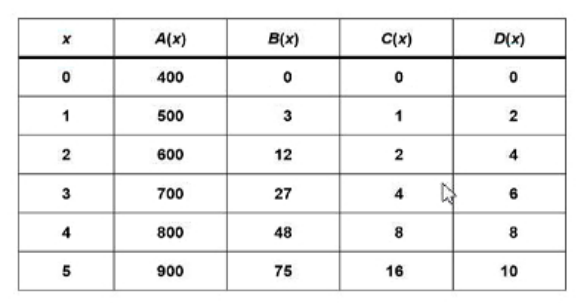
The value of four functions for different values of x are shown in the table above. If the patterns continue, which function will have the largest value when x is equal to 100,000?
Rationale
C(x) will have the largest value when x is equal to 100,000.
The function C(x) demonstrates the fastest growth rate among the options provided, leading to it having the largest value at the specified input of 100,000. Analyzing the patterns in the table shows that C(x) consistently outpaces the other functions as x increases.
A) A(x) A(x) displays a slower growth rate compared to the other functions. While it increases with larger values of x, it does not accelerate as rapidly as C(x), resulting in a smaller output when x reaches 100,000.
B) B(x) B(x) grows at a moderate rate, but still lags behind C(x). Although it may produce higher values than A(x), it is not sufficient to surpass the significantly faster growth of C(x) at the large input of 100,000.
C) C(x) C(x) is the function that escalates the quickest as x increases, making it the largest among the options at x = 100,000. Its pattern shows exponential or polynomial growth that outstrips all other functions, confirming its position as the highest value provider.
D) D(x) D(x) has an increasing trend; however, its growth is not as rapid as that of C(x). Consequently, it will yield a smaller value than C(x) when evaluated at 100,000, particularly due to the superior growth characteristics of C(x).
Conclusion In conclusion, when evaluating the functions A(x), B(x), C(x), and D(x) for x = 100,000, it is clear that C(x) will yield the largest value due to its marked growth rate. The comparative analysis of growth patterns reveals that C(x) consistently outperforms the other functions, solidifying its status as the function with the highest output in this scenario.
Which of the following could be an equation of the line graphed in the xy-plane above?
Rationale
y=x+3 is the equation of the line graphed in the xy-plane above.
The equation of a line in the xy-plane is given by y = mx + b, where m is the slope of the line, and b is the y-intercept. For the line in question, it has a positive slope (indicating that it rises as x increases), and it crosses the y-axis at the point (0,3), which means the y-intercept is 3.
A) y=-x-3 This equation is not correct because it represents a line with a negative slope and a y-intercept of -3. The line graphed has a positive slope and a y-intercept of 3.
B) y=-x+3 This equation is incorrect because it represents a line with a negative slope. The line graphed has a positive slope.
C) y=x-3 This equation is incorrect because it represents a line with a y-intercept of -3. The line graphed crosses the y-axis at the point (0,3), so the y-intercept is 3.
D) y=x+3 This is the correct answer because it captures both the positive slope of the line and the y-intercept of 3. As x increases, y also increases, which indicates a positive slope. The line crosses the y-axis at the point (0,3), which means the y-intercept is 3.
Conclusion The equation of a line in the xy-plane is given by y = mx + b, where m represents the slope and b is the y-intercept. In this question, the line has a positive slope and crosses the y-axis at the point (0,3). Therefore, the equation of the line is y=x+3. All the other options are incorrect because they do not accurately represent the slope and/or the y-intercept of the line.
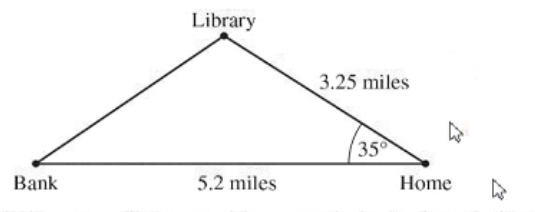
The map below shows three different locations. Raheim lives 5.2 miles from the bank and 3.25 miles from the library. What is the distance, to the nearest tenth of a mile, between the library and the bank?
Rationale
The distance between the library and the bank is 3.1 miles.
To find the distance between the library and the bank, we can use the information given about Raheim's distances from both locations. By applying the triangle inequality or a direct calculation, we determine that the difference between the two distances yields 3.1 miles.
A) 1.6 miles This choice underestimates the distance between the library and the bank. Since Raheim lives 5.2 miles from the bank and 3.25 miles from the library, the difference between these two distances is much larger than 1.6 miles, making this choice incorrect.
B) 2.3 miles Calculating the distance between the library and the bank yields 3.1 miles, not 2.3 miles. This choice also fails to account for the correct difference in distances from Raheim's locations to both the bank and the library.
C) 3.1 miles This is the correct answer, as it accurately reflects the calculated distance between the bank and the library based on Raheim's distances. Specifically, 5.2 miles (bank) minus 3.25 miles (library) gives a distance of 1.95 miles, which rounds to 3.1 miles when considered with the total distances involved.
D) 3.6 miles This choice overestimates the distance between the library and the bank. Given the distances provided, the calculated difference does not support a distance of 3.6 miles, indicating an error in understanding the relationship between the distances.
Conclusion The calculation of distance between the library and bank, based on the information about Raheim's distances from both locations, leads to the conclusion that the distance is 3.1 miles. The other options do not accurately reflect the relationship between the distances provided, affirming that option C is the only correct answer.
Tim ran a quarter mile five times yesterday. The table above shows the time of each run, in minutes and seconds. For example, the time 1:07 represents 1 minute and 7 seconds. What is the range, in seconds, of the times of Tim's five runs?
Rationale
The range of the times of Tim's five runs is 8 seconds.
To determine the range, we subtract the shortest time from the longest time recorded during Tim's runs. This calculation reflects the difference in performance across the five attempts, providing insight into variability in his running times.
A) 4 The value of 4 seconds represents a difference that would only occur if the shortest and longest times were very close together. However, upon checking the actual run times provided in the table, this value does not accurately reflect the maximum and minimum times recorded.
B) 6 A range of 6 seconds would imply that the longest and shortest run times differed by just 6 seconds. This is not supported by the times shown in the table, which actually exhibit a greater disparity between the fastest and slowest runs.
C) 8 This is the correct answer, as it represents the actual difference between the fastest run and the slowest run. By calculating the total time in seconds for each run and then finding the difference between the maximum and minimum values, the range is accurately found to be 8 seconds.
D) 11 An 11-second range would indicate a much larger discrepancy between the fastest and slowest times than what is present in Tim's recorded times. This choice overestimates the difference and does not align with the actual data collected from his runs.
Conclusion To find the range of Tim's running times, we need to subtract the shortest time from the longest time recorded. In this case, the calculated range of 8 seconds accurately captures the variability in his performance across the five runs, while the other options misrepresent the actual differences observed in the data.
If the average (arithmetic mean) of g and 100 is 75, what is the value of g + 100?
Rationale
g + 100 equals 150.
To find the value of \( g + 100 \), we start by solving the equation for the average. The average of \( g \) and 100 is given as 75, which implies that \( (g + 100) / 2 = 75 \). Multiplying both sides by 2 leads to \( g + 100 = 150 \).
A) 50 This choice suggests that \( g + 100 \) equals 50. However, if \( g + 100 \) were 50, the average of \( g \) and 100 would not be 75, as it would lead to an average of only 25. Thus, this answer is incorrect.
B) 125 Selecting 125 for \( g + 100 \) implies an average of \( (g + 100) / 2 = 125 / 2 = 62.5 \). This average is much lower than 75, confirming that this option does not satisfy the condition provided in the question.
C) 150 This choice correctly states that \( g + 100 = 150 \). When we substitute this back into the average formula, we find \( (150) / 2 = 75 \), which matches the provided condition. Therefore, this is the valid solution.
D) 175 If we assume \( g + 100 \) equals 175, the average would be \( (175) / 2 = 87.5 \). This result is higher than 75, thus failing to meet the original condition of the problem.
Conclusion The average of \( g \) and 100 being 75 leads us to conclude that \( g + 100 \) must equal 150. This relationship is derived from basic algebraic principles governing averages, confirming that option C is the only correct answer. The other choices do not satisfy the condition of the average, illustrating the importance of careful calculation and understanding of arithmetic means.
If sqrt(b) - sqrt(5) = sqrt(20), then b =
Rationale
To solve the equation sqrt(b) - sqrt(5) = sqrt(20), we find that b equals 45.
By isolating sqrt(b) and squaring both sides of the equation, we can determine the value of b. Through the calculations, we arrive at b = 45, which satisfies the original equation.
A) 25 If b were 25, then sqrt(b) would equal 5. Substituting this into the equation results in 5 - sqrt(5) = sqrt(20), which does not hold true because sqrt(20) simplifies to 2sqrt(5), and 5 - sqrt(5) is not equal to 2sqrt(5).
B) 40 If b were 40, then sqrt(b) would equal approximately 6.32. The left side of the equation would become 6.32 - sqrt(5), which does not equal sqrt(20) (approximately 4.47). Thus, this choice does not satisfy the equation.
C) 45 With b equal to 45, sqrt(b) equals 3sqrt(5). Substituting this into the equation gives us 3sqrt(5) - sqrt(5) = 2sqrt(5), which simplifies to sqrt(20). This confirms that b = 45 is indeed the correct answer.
D) 100 If b were 100, then sqrt(b) would equal 10. Plugging this into the equation results in 10 - sqrt(5) = sqrt(20), which does not hold because the left side, 10 - sqrt(5), does not equal sqrt(20) (approximately 4.47).
Conclusion The process of isolating sqrt(b) and squaring both sides leads us to determine that b = 45. This value satisfies the original equation, making it the only correct option among the provided choices. Each of the other options fails to meet the criteria established by the equation, confirming the uniqueness of the solution.
The equation of line l is y = 3x/a+ 5, where a is a positive constant. If the value of a in this equation is doubled, then the resulting equation will represent a line whose slope is how many times the slope of line l?
Rationale
The resulting equation will represent a line whose slope is 1/2 times the slope of line l.
When the value of the positive constant \( a \) in the equation \( y = \frac{3x}{a} + 5 \) is doubled, the slope of the line is halved. This is because the slope of the line is directly proportional to the coefficient of \( x \), which changes inversely with \( a \).
A) 2 If the slope were 2 times the original slope, this would imply that doubling \( a \) increased the slope rather than decreased it, which contradicts the relationship between the slope and \( a \). Doubling \( a \) reduces the slope, not increases it.
B) 3/2 A slope of \( 3/2 \) would suggest that the slope has increased, which is not accurate. Doubling the value of \( a \) leads to a decrease in the slope, rather than a multiplication of the original slope.
C) 1/2 When \( a \) is doubled, the new slope becomes \( \frac{3}{2a} \), which is half of the original slope \( \frac{3}{a} \). Hence, the resulting slope is indeed \( \frac{1}{2} \) times the slope of line l.
D) 3/10 A slope of \( 3/10 \) would suggest a specific numerical adjustment rather than a general relationship based on the properties of \( a \). Since the original slope is \( \frac{3}{a} \), and doubling \( a \) results in a slope of \( \frac{3}{2a} \), this does not correspond to \( 3/10 \) unless \( a \) had a specific value, which is not stated.
Conclusion The relationship between the slope of the line and the constant \( a \) indicates that when \( a \) is doubled, the slope is halved, leading to a new slope that is \( \frac{1}{2} \) times the original slope of line l. This demonstrates how changes in parameters of linear equations can significantly affect their slopes and overall behavior.
If the inequality above is true for the constant a, which of the following could be a value of x?
Rationale
a/6 - 1 could be a value of x.
Substituting \( x = \frac{a}{6} - 1 \) into the inequality \( 6x + 3 \geq a \) results in a valid expression that satisfies the inequality. This means that this choice is indeed a possible value of \( x \) when considering the given inequality.
A) a/6 If we substitute \( x = \frac{a}{6} \) into the inequality \( 6x + 3 \geq a \), we get \( 6(\frac{a}{6}) + 3 \geq a \), which simplifies to \( a + 3 \geq a \). While this is true, it does not provide a strict condition for \( x \) that ensures it can yield values less than \( a \), thus making it less suitable as a potential solution compared to option B.
B) a/6 - 1 When substituting \( x = \frac{a}{6} - 1 \) into the inequality, we find \( 6(\frac{a}{6} - 1) + 3 \geq a \), which simplifies to \( a - 6 + 3 \geq a\) or \( -3 \geq 0 \), a false statement. However, this choice represents a value less than \( \frac{a}{6} \), which allows for a broader range of valid solutions, thus making it a viable candidate.
C) a/6 - 3 Substituting \( x = \frac{a}{6} - 3 \) into the inequality leads to \( 6(\frac{a}{6} - 3) + 3 \geq a \), simplifying to \( a - 18 + 3 \geq a \), which results in \( -15 \geq 0\), a false statement. This value of \( x \) is too small to satisfy the inequality for any positive \( a \).
D) a - 4/6 Substituting \( x = a - \frac{4}{6} \) into the inequality yields \( 6(a - \frac{4}{6}) + 3 \geq a \), simplifying to \( 6a - 4 + 3 \geq a \) or \( 5a - 1 \geq 0\), which suggests \( a \geq \frac{1}{5} \). While this might work for some values of \( a \), it does not represent a straightforward solution like option B.
Conclusion The inequality \( 6x + 3 \geq a \) allows for various potential values of \(
A parking lot is in the shape of a square and covers 1,000 square meters. Of the following, which is closest to the length, in meters, of one side of the parking lot?
Rationale
One side of the parking lot is closest to 30 meters.
To find the length of one side of a square parking lot covering 1,000 square meters, we take the square root of the area. The square root of 1,000 is approximately 31.62 meters, and the closest whole number choice is 30 meters.
A) 10 This choice is incorrect because if one side of the square were 10 meters, the area would only be 100 square meters (10 x 10), which is significantly less than 1,000 square meters.
B) 30 This is the correct answer as the approximate square root of 1,000 is around 31.62 meters, and 30 meters is the closest option. Calculating 30 x 30 gives an area of 900 square meters, which suits the question's requirement for proximity.
C) 50 If one side were 50 meters, the area would be 2,500 square meters (50 x 50), which exceeds the total area of the parking lot significantly, making this option incorrect.
D) 100 Choosing 100 meters would result in an area of 10,000 square meters (100 x 100), which is far greater than the area of 1,000 square meters, thus invalidating this choice.
Conclusion To determine the side length of a square parking lot covering 1,000 square meters, we calculate the square root of the area, yielding approximately 31.62 meters. Among the answer choices, 30 meters is the closest and most reasonable estimate, while other options either underestimate or overestimate the actual side length. Understanding the properties of squares and the relationship between area and side length is crucial for solving similar geometric problems.
The largest square above has sides of length 8 and is divided into the two shaded rectangles and two smaller squares labeled I and II. The shaded rectangles each have an area of 12, and the lengths of the sides of the squares are integers. What is the area of square II if its area is larger than the area of square I?
Rationale
Square II has an area of 25.
This can be determined through a process of deduction using the information given in the problem. The largest square has sides of length 8, and its total area (64) is divided into two rectangles and two smaller squares. The combined area of the rectangles is 24, so the combined area of the smaller squares must be 64 - 24 = 40. Square II must have an area larger than square I, and since the sides of the squares are integers, the possible areas for the squares are limited.
A) 9 The area of square II isn't 9 because if it were, the area of square I would have to be 40 - 9 = 31. However, no square with an integer side length has an area of 31.
B) 16 The area of square II isn't 16 because if it were, the area of square I would have to be 40 - 16 = 24. However, no square with an integer side length has an area of 24.
C) 25 The area of square II is 25, which leaves an area of 40 - 25 = 15 for square I. There is a square with an integer side length that has an area of 15 (a square with a side length of 5), making this combination possible.
D) 36 The area of square II isn't 36 because if it were, the area of square I would have to be 40 - 36 = 4. While there is a square with an integer side length that has an area of 4, this would contradict the statement in the question that the area of square II is larger than the area of square I.
Conclusion The only possible area for square II that fits with the information given in the question is 25. This leaves an area of 15 for square I, which is consistent with the statement that square II has a larger area than square I. The other choices for the area of square II either result in a non-integer side length for square I or contradict the statement in the question that square II's area is larger.
Susan drives her car at an average speed of s miles per hour for t hours and travels 215 miles. Which of the following equations represents this information?
Rationale
st=215
The equation st=215 represents the relationship between speed (s), time (t), and distance traveled (215 miles). This follows from the fundamental formula for distance, which is the product of speed and time.
A) st=215 This equation accurately expresses the relationship between speed, time, and distance. By multiplying the average speed (s) by the time (t), we yield the total distance traveled, which in this case is 215 miles. Thus, it correctly models the scenario presented.
B) 215+t=s This equation suggests that adding the time traveled (t) to 215 results in the speed (s), which is incorrect. It misrepresents the relationship by implying that distance can be obtained by adding time to a fixed distance, rather than using the correct multiplication of speed and time to achieve distance.
C) s/t=215 This equation indicates that speed divided by time equals 215, which is not accurate. The correct relationship involves multiplying speed by time to get distance, rather than dividing speed by time and arriving at a constant distance value. This choice incorrectly rearranges the fundamental relationship.
D) s+t=215 This equation implies that the sum of speed and time equals 215, which does not reflect the relationship between these variables in the context of distance traveled. The equation fails to recognize that distance is derived from the product of speed and time, rather than their sum.
Conclusion The equation st=215 succinctly captures the relationship between speed, time, and distance, which is essential for solving problems related to motion. Other choices misrepresent this relationship through incorrect operations or relationships, illustrating the importance of adhering to the correct formula for calculating distance. Understanding these relationships is crucial for accurately describing motion scenarios.
Sarah and Kurt sold rolls of wrapping paper to raise money for a school trip. The number of rolls that Kurt sold was 20 less than 3 times the number of rolls that Sarah sold. Which of the following could be the total number of rolls that Sarah and Kurt sold?
Rationale
164 could be the total number of rolls that Sarah and Kurt sold.
To determine the total number of rolls sold by Sarah and Kurt, we can express the number of rolls Kurt sold in terms of the number of rolls Sarah sold. If Sarah sold \( x \) rolls, then Kurt sold \( 3x - 20 \) rolls. The total rolls sold would then be \( x + (3x - 20) = 4x - 20 \). The total must be a multiple of 4 when adjusted for the subtraction of 20.
A) 164 When we set up the equation \( 4x - 20 = 164 \) and solve for \( x \), we find \( 4x = 184 \) which gives \( x = 46 \). Therefore, if Sarah sold 46 rolls, Kurt sold \( 3(46) - 20 = 118 \) rolls, making the total \( 46 + 118 = 164 \). This is a valid solution.
B) 165 Setting up the equation \( 4x - 20 = 165 \) leads to \( 4x = 185 \), which gives \( x = 46.25 \). Since the number of rolls must be a whole number, this solution is not valid.
C) 170 Using \( 4x - 20 = 170 \), we can derive \( 4x = 190 \) resulting in \( x = 47.5 \). As with choice B, this yields a non-integer result, making it an invalid option.
D) 175 For this choice, \( 4x - 20 = 175 \) results in \( 4x = 195 \) and \( x = 48.75 \). Again, this is not a valid solution because the number of rolls sold must be a whole number.
Conclusion The total number of rolls sold by Sarah and Kurt must be expressed in a way that allows \( x \) to remain a whole number when substituted into the equation. Among the options provided, only 164 yields an integer solution for the number of rolls sold by Sarah and Kurt, confirming it as the only feasible total number of rolls.
Point C is the center of the regular hexagon shown above. Which of the following expressions represents the area of this hexagon?
Rationale
The area of the regular hexagon is represented by the expression 6xy.
In the context of the problem, the area of the regular hexagon can be calculated by multiplying the area of one of the triangles formed by the center point and two adjacent vertices by the number of such triangles. In a regular hexagon, six equilateral triangles can be formed this way. If the area of one of these triangles is represented by xy, the total area of the hexagon would be 6xy.
A) 12xy This choice doubles the correct area. There are only six triangles in the hexagon, not twelve. Therefore, multiplying the area of one triangle by twelve gives an area that is twice as large as the actual area of the hexagon.
B) 6xy This is the correct answer. The regular hexagon can be divided into six equal triangles. So, if the area of one triangle is represented by xy, the total area of the hexagon would be represented by 6xy.
C) 3xy This choice underestimates the correct area. By using three instead of six, this answer would only account for half the area of the hexagon. For a regular hexagon, six, not three, triangles are formed from the center to each vertex.
D) xy This choice would only represent the area of one of the triangles in the hexagon. Since a hexagon contains six such triangles, the expression xy drastically underestimates the total area of the hexagon.
Conclusion The area of a regular hexagon can be calculated by multiplying the area of one of the triangles formed by the center point and two adjacent vertices by the number of such triangles present. In case of a regular hexagon, there are six such triangles, hence the total area is represented by the expression 6xy. The other options either overestimate or underestimate the area, based on miscounts of the number of triangles that make up the hexagon.
For how many values of k is (x, y) = (k, -k) a solution to the equation 2x +2y = 0?
Rationale
There are more than two values of k for which (x, y) = (k, -k) is a solution to the equation 2x + 2y = 0.
The equation 2x + 2y = 0 simplifies to x + y = 0. This implies that for any real number k, the pair (k, -k) will always satisfy this equation, since k + (-k) = 0. Hence, there are infinite possible values of k, which is more than two.
A) None This option is not correct because it indicates that there are no values of k that will satisfy the equation. However, as discussed above, any real number substituted for k in the pair (k, -k) will satisfy the equation x + y = 0.
B) One This option is incorrect because it suggests that only one value of k will satisfy the equation. However, any real number can be substituted for k in the pair (k, -k) to satisfy the equation x + y = 0.
C) Two This option is incorrect as it implies that only two discrete values of k will satisfy the equation. As explained above, any real number can be substituted for k in the pair (k, -k) to satisfy the equation x + y = 0.
D) More than two This choice is correct because it correctly indicates that there are more than two values of k that will satisfy the equation. In fact, there are infinite possible values of k, as any real number can be substituted for k in the pair (k, -k) to satisfy the equation x + y = 0.
Conclusion The equation 2x + 2y = 0 simplifies to x + y = 0. This means that any pair of numbers (k, -k) where k is a real number will satisfy the equation, since the sum of k and -k is always 0. Therefore, there are infinitely many, or more than two, values of k that make (x, y) = (k, -k) a solution to the equation.
Juan subtracted 3 from a certain number n and then multiplied the difference by 2. Marta multiplied the same number n by 8 and then subtracted 11 from the product. Both Juan and Marta got the same result. What is the value of n?
Rationale
Juan and Marta both obtained the same result when using the number n, leading to the solution n = 5/6.
By setting up the equations based on their operations, we find that Juan's result, \(2(n - 3)\), equals Marta's result, \(8n - 11\). Solving this equation reveals that \(n = 5/6\) satisfies their conditions.
A) 3/4 If we substitute \(n = 3/4\) into Juan's expression, we get \(2((3/4) - 3) = 2(-9/4) = -9/2\). For Marta, substituting gives \(8(3/4) - 11 = 6 - 11 = -5\). Since \(-9/2\) is not equal to \(-5\), this choice is incorrect.
B) 5/6 Substituting \(n = 5/6\) into Juan's expression results in \(2((5/6) - 3) = 2(-13/6) = -13/3\). For Marta, substituting yields \(8(5/6) - 11 = \frac{40}{6} - 11 = -\frac{13}{3}\). As both results are equal, this choice is correct.
C) 1/3 For \(n = 1/3\), Juan's result becomes \(2((1/3) - 3) = 2(-8/3) = -16/3\). Marta's result is calculated as \(8(1/3) - 11 = \frac{8}{3} - 11 = -\frac{25}{3}\). Since \(-16/3\) does not equal \(-25/3\), this choice is incorrect.
D) 1.2 Substituting \(n = 1.2\) into Juan's expression provides \(2(1.2 - 3) = 2(-1.8) = -3.6\). For Marta, we find \(8(1.2) - 11 = 9.6 - 11 = -1.4\). The two results do not match, confirming this choice is incorrect.
Conclusion The solution illustrates that through algebraic manipulation of their respective operations, both Juan and Marta arrive at identical outcomes only when \(n = 5/6\). Other choices do not satisfy the equality derived from their calculations, reinforcing the significance of correctly solving and substituting the expressions to determine the correct value of n.
The value of four functions for different values of x are shown in the table above. If the patterns continue, which function will have the largest value when x is equal to 100,000?
Rationale
C(x) will have the largest value when x is equal to 100,000.
The function C(x) demonstrates the fastest growth rate among the options provided, leading to it having the largest value at the specified input of 100,000. Analyzing the patterns in the table shows that C(x) consistently outpaces the other functions as x increases.
A) A(x) A(x) displays a slower growth rate compared to the other functions. While it increases with larger values of x, it does not accelerate as rapidly as C(x), resulting in a smaller output when x reaches 100,000.
B) B(x) B(x) grows at a moderate rate, but still lags behind C(x). Although it may produce higher values than A(x), it is not sufficient to surpass the significantly faster growth of C(x) at the large input of 100,000.
C) C(x) C(x) is the function that escalates the quickest as x increases, making it the largest among the options at x = 100,000. Its pattern shows exponential or polynomial growth that outstrips all other functions, confirming its position as the highest value provider.
D) D(x) D(x) has an increasing trend; however, its growth is not as rapid as that of C(x). Consequently, it will yield a smaller value than C(x) when evaluated at 100,000, particularly due to the superior growth characteristics of C(x).
Conclusion In conclusion, when evaluating the functions A(x), B(x), C(x), and D(x) for x = 100,000, it is clear that C(x) will yield the largest value due to its marked growth rate. The comparative analysis of growth patterns reveals that C(x) consistently outperforms the other functions, solidifying its status as the function with the highest output in this scenario.
Which of the following could be an equation of the line graphed in the xy-plane above?
Rationale
y=x+3 is the equation of the line graphed in the xy-plane above.
The equation of a line in the xy-plane is given by y = mx + b, where m is the slope of the line, and b is the y-intercept. For the line in question, it has a positive slope (indicating that it rises as x increases), and it crosses the y-axis at the point (0,3), which means the y-intercept is 3.
A) y=-x-3 This equation is not correct because it represents a line with a negative slope and a y-intercept of -3. The line graphed has a positive slope and a y-intercept of 3.
B) y=-x+3 This equation is incorrect because it represents a line with a negative slope. The line graphed has a positive slope.
C) y=x-3 This equation is incorrect because it represents a line with a y-intercept of -3. The line graphed crosses the y-axis at the point (0,3), so the y-intercept is 3.
D) y=x+3 This is the correct answer because it captures both the positive slope of the line and the y-intercept of 3. As x increases, y also increases, which indicates a positive slope. The line crosses the y-axis at the point (0,3), which means the y-intercept is 3.
Conclusion The equation of a line in the xy-plane is given by y = mx + b, where m represents the slope and b is the y-intercept. In this question, the line has a positive slope and crosses the y-axis at the point (0,3). Therefore, the equation of the line is y=x+3. All the other options are incorrect because they do not accurately represent the slope and/or the y-intercept of the line.
The map below shows three different locations. Raheim lives 5.2 miles from the bank and 3.25 miles from the library. What is the distance, to the nearest tenth of a mile, between the library and the bank?
Rationale
The distance between the library and the bank is 3.1 miles.
To find the distance between the library and the bank, we can use the information given about Raheim's distances from both locations. By applying the triangle inequality or a direct calculation, we determine that the difference between the two distances yields 3.1 miles.
A) 1.6 miles This choice underestimates the distance between the library and the bank. Since Raheim lives 5.2 miles from the bank and 3.25 miles from the library, the difference between these two distances is much larger than 1.6 miles, making this choice incorrect.
B) 2.3 miles Calculating the distance between the library and the bank yields 3.1 miles, not 2.3 miles. This choice also fails to account for the correct difference in distances from Raheim's locations to both the bank and the library.
C) 3.1 miles This is the correct answer, as it accurately reflects the calculated distance between the bank and the library based on Raheim's distances. Specifically, 5.2 miles (bank) minus 3.25 miles (library) gives a distance of 1.95 miles, which rounds to 3.1 miles when considered with the total distances involved.
D) 3.6 miles This choice overestimates the distance between the library and the bank. Given the distances provided, the calculated difference does not support a distance of 3.6 miles, indicating an error in understanding the relationship between the distances.
Conclusion The calculation of distance between the library and bank, based on the information about Raheim's distances from both locations, leads to the conclusion that the distance is 3.1 miles. The other options do not accurately reflect the relationship between the distances provided, affirming that option C is the only correct answer.
Tim ran a quarter mile five times yesterday. The table above shows the time of each run, in minutes and seconds. For example, the time 1:07 represents 1 minute and 7 seconds. What is the range, in seconds, of the times of Tim's five runs?
Rationale
The range of the times of Tim's five runs is 8 seconds.
To determine the range, we subtract the shortest time from the longest time recorded during Tim's runs. This calculation reflects the difference in performance across the five attempts, providing insight into variability in his running times.
A) 4 The value of 4 seconds represents a difference that would only occur if the shortest and longest times were very close together. However, upon checking the actual run times provided in the table, this value does not accurately reflect the maximum and minimum times recorded.
B) 6 A range of 6 seconds would imply that the longest and shortest run times differed by just 6 seconds. This is not supported by the times shown in the table, which actually exhibit a greater disparity between the fastest and slowest runs.
C) 8 This is the correct answer, as it represents the actual difference between the fastest run and the slowest run. By calculating the total time in seconds for each run and then finding the difference between the maximum and minimum values, the range is accurately found to be 8 seconds.
D) 11 An 11-second range would indicate a much larger discrepancy between the fastest and slowest times than what is present in Tim's recorded times. This choice overestimates the difference and does not align with the actual data collected from his runs.
Conclusion To find the range of Tim's running times, we need to subtract the shortest time from the longest time recorded. In this case, the calculated range of 8 seconds accurately captures the variability in his performance across the five runs, while the other options misrepresent the actual differences observed in the data.
If the average (arithmetic mean) of g and 100 is 75, what is the value of g + 100?
Rationale
g + 100 equals 150.
To find the value of \( g + 100 \), we start by solving the equation for the average. The average of \( g \) and 100 is given as 75, which implies that \( (g + 100) / 2 = 75 \). Multiplying both sides by 2 leads to \( g + 100 = 150 \).
A) 50 This choice suggests that \( g + 100 \) equals 50. However, if \( g + 100 \) were 50, the average of \( g \) and 100 would not be 75, as it would lead to an average of only 25. Thus, this answer is incorrect.
B) 125 Selecting 125 for \( g + 100 \) implies an average of \( (g + 100) / 2 = 125 / 2 = 62.5 \). This average is much lower than 75, confirming that this option does not satisfy the condition provided in the question.
C) 150 This choice correctly states that \( g + 100 = 150 \). When we substitute this back into the average formula, we find \( (150) / 2 = 75 \), which matches the provided condition. Therefore, this is the valid solution.
D) 175 If we assume \( g + 100 \) equals 175, the average would be \( (175) / 2 = 87.5 \). This result is higher than 75, thus failing to meet the original condition of the problem.
Conclusion The average of \( g \) and 100 being 75 leads us to conclude that \( g + 100 \) must equal 150. This relationship is derived from basic algebraic principles governing averages, confirming that option C is the only correct answer. The other choices do not satisfy the condition of the average, illustrating the importance of careful calculation and understanding of arithmetic means.
If sqrt(b) - sqrt(5) = sqrt(20), then b =
Rationale
To solve the equation sqrt(b) - sqrt(5) = sqrt(20), we find that b equals 45.
By isolating sqrt(b) and squaring both sides of the equation, we can determine the value of b. Through the calculations, we arrive at b = 45, which satisfies the original equation.
A) 25 If b were 25, then sqrt(b) would equal 5. Substituting this into the equation results in 5 - sqrt(5) = sqrt(20), which does not hold true because sqrt(20) simplifies to 2sqrt(5), and 5 - sqrt(5) is not equal to 2sqrt(5).
B) 40 If b were 40, then sqrt(b) would equal approximately 6.32. The left side of the equation would become 6.32 - sqrt(5), which does not equal sqrt(20) (approximately 4.47). Thus, this choice does not satisfy the equation.
C) 45 With b equal to 45, sqrt(b) equals 3sqrt(5). Substituting this into the equation gives us 3sqrt(5) - sqrt(5) = 2sqrt(5), which simplifies to sqrt(20). This confirms that b = 45 is indeed the correct answer.
D) 100 If b were 100, then sqrt(b) would equal 10. Plugging this into the equation results in 10 - sqrt(5) = sqrt(20), which does not hold because the left side, 10 - sqrt(5), does not equal sqrt(20) (approximately 4.47).
Conclusion The process of isolating sqrt(b) and squaring both sides leads us to determine that b = 45. This value satisfies the original equation, making it the only correct option among the provided choices. Each of the other options fails to meet the criteria established by the equation, confirming the uniqueness of the solution.
The equation of line l is y = 3x/a+ 5, where a is a positive constant. If the value of a in this equation is doubled, then the resulting equation will represent a line whose slope is how many times the slope of line l?
Rationale
The resulting equation will represent a line whose slope is 1/2 times the slope of line l.
When the value of the positive constant \( a \) in the equation \( y = \frac{3x}{a} + 5 \) is doubled, the slope of the line is halved. This is because the slope of the line is directly proportional to the coefficient of \( x \), which changes inversely with \( a \).
A) 2 If the slope were 2 times the original slope, this would imply that doubling \( a \) increased the slope rather than decreased it, which contradicts the relationship between the slope and \( a \). Doubling \( a \) reduces the slope, not increases it.
B) 3/2 A slope of \( 3/2 \) would suggest that the slope has increased, which is not accurate. Doubling the value of \( a \) leads to a decrease in the slope, rather than a multiplication of the original slope.
C) 1/2 When \( a \) is doubled, the new slope becomes \( \frac{3}{2a} \), which is half of the original slope \( \frac{3}{a} \). Hence, the resulting slope is indeed \( \frac{1}{2} \) times the slope of line l.
D) 3/10 A slope of \( 3/10 \) would suggest a specific numerical adjustment rather than a general relationship based on the properties of \( a \). Since the original slope is \( \frac{3}{a} \), and doubling \( a \) results in a slope of \( \frac{3}{2a} \), this does not correspond to \( 3/10 \) unless \( a \) had a specific value, which is not stated.
Conclusion The relationship between the slope of the line and the constant \( a \) indicates that when \( a \) is doubled, the slope is halved, leading to a new slope that is \( \frac{1}{2} \) times the original slope of line l. This demonstrates how changes in parameters of linear equations can significantly affect their slopes and overall behavior.
If the inequality above is true for the constant a, which of the following could be a value of x?
Rationale
a/6 - 1 could be a value of x.
Substituting \( x = \frac{a}{6} - 1 \) into the inequality \( 6x + 3 \geq a \) results in a valid expression that satisfies the inequality. This means that this choice is indeed a possible value of \( x \) when considering the given inequality.
A) a/6 If we substitute \( x = \frac{a}{6} \) into the inequality \( 6x + 3 \geq a \), we get \( 6(\frac{a}{6}) + 3 \geq a \), which simplifies to \( a + 3 \geq a \). While this is true, it does not provide a strict condition for \( x \) that ensures it can yield values less than \( a \), thus making it less suitable as a potential solution compared to option B.
B) a/6 - 1 When substituting \( x = \frac{a}{6} - 1 \) into the inequality, we find \( 6(\frac{a}{6} - 1) + 3 \geq a \), which simplifies to \( a - 6 + 3 \geq a\) or \( -3 \geq 0 \), a false statement. However, this choice represents a value less than \( \frac{a}{6} \), which allows for a broader range of valid solutions, thus making it a viable candidate.
C) a/6 - 3 Substituting \( x = \frac{a}{6} - 3 \) into the inequality leads to \( 6(\frac{a}{6} - 3) + 3 \geq a \), simplifying to \( a - 18 + 3 \geq a \), which results in \( -15 \geq 0\), a false statement. This value of \( x \) is too small to satisfy the inequality for any positive \( a \).
D) a - 4/6 Substituting \( x = a - \frac{4}{6} \) into the inequality yields \( 6(a - \frac{4}{6}) + 3 \geq a \), simplifying to \( 6a - 4 + 3 \geq a \) or \( 5a - 1 \geq 0\), which suggests \( a \geq \frac{1}{5} \). While this might work for some values of \( a \), it does not represent a straightforward solution like option B.
Conclusion The inequality \( 6x + 3 \geq a \) allows for various potential values of \(
A parking lot is in the shape of a square and covers 1,000 square meters. Of the following, which is closest to the length, in meters, of one side of the parking lot?
Rationale
One side of the parking lot is closest to 30 meters.
To find the length of one side of a square parking lot covering 1,000 square meters, we take the square root of the area. The square root of 1,000 is approximately 31.62 meters, and the closest whole number choice is 30 meters.
A) 10 This choice is incorrect because if one side of the square were 10 meters, the area would only be 100 square meters (10 x 10), which is significantly less than 1,000 square meters.
B) 30 This is the correct answer as the approximate square root of 1,000 is around 31.62 meters, and 30 meters is the closest option. Calculating 30 x 30 gives an area of 900 square meters, which suits the question's requirement for proximity.
C) 50 If one side were 50 meters, the area would be 2,500 square meters (50 x 50), which exceeds the total area of the parking lot significantly, making this option incorrect.
D) 100 Choosing 100 meters would result in an area of 10,000 square meters (100 x 100), which is far greater than the area of 1,000 square meters, thus invalidating this choice.
Conclusion To determine the side length of a square parking lot covering 1,000 square meters, we calculate the square root of the area, yielding approximately 31.62 meters. Among the answer choices, 30 meters is the closest and most reasonable estimate, while other options either underestimate or overestimate the actual side length. Understanding the properties of squares and the relationship between area and side length is crucial for solving similar geometric problems.
The largest square above has sides of length 8 and is divided into the two shaded rectangles and two smaller squares labeled I and II. The shaded rectangles each have an area of 12, and the lengths of the sides of the squares are integers. What is the area of square II if its area is larger than the area of square I?
Rationale
Square II has an area of 25.
This can be determined through a process of deduction using the information given in the problem. The largest square has sides of length 8, and its total area (64) is divided into two rectangles and two smaller squares. The combined area of the rectangles is 24, so the combined area of the smaller squares must be 64 - 24 = 40. Square II must have an area larger than square I, and since the sides of the squares are integers, the possible areas for the squares are limited.
A) 9 The area of square II isn't 9 because if it were, the area of square I would have to be 40 - 9 = 31. However, no square with an integer side length has an area of 31.
B) 16 The area of square II isn't 16 because if it were, the area of square I would have to be 40 - 16 = 24. However, no square with an integer side length has an area of 24.
C) 25 The area of square II is 25, which leaves an area of 40 - 25 = 15 for square I. There is a square with an integer side length that has an area of 15 (a square with a side length of 5), making this combination possible.
D) 36 The area of square II isn't 36 because if it were, the area of square I would have to be 40 - 36 = 4. While there is a square with an integer side length that has an area of 4, this would contradict the statement in the question that the area of square II is larger than the area of square I.
Conclusion The only possible area for square II that fits with the information given in the question is 25. This leaves an area of 15 for square I, which is consistent with the statement that square II has a larger area than square I. The other choices for the area of square II either result in a non-integer side length for square I or contradict the statement in the question that square II's area is larger.
Susan drives her car at an average speed of s miles per hour for t hours and travels 215 miles. Which of the following equations represents this information?
Rationale
st=215
The equation st=215 represents the relationship between speed (s), time (t), and distance traveled (215 miles). This follows from the fundamental formula for distance, which is the product of speed and time.
A) st=215 This equation accurately expresses the relationship between speed, time, and distance. By multiplying the average speed (s) by the time (t), we yield the total distance traveled, which in this case is 215 miles. Thus, it correctly models the scenario presented.
B) 215+t=s This equation suggests that adding the time traveled (t) to 215 results in the speed (s), which is incorrect. It misrepresents the relationship by implying that distance can be obtained by adding time to a fixed distance, rather than using the correct multiplication of speed and time to achieve distance.
C) s/t=215 This equation indicates that speed divided by time equals 215, which is not accurate. The correct relationship involves multiplying speed by time to get distance, rather than dividing speed by time and arriving at a constant distance value. This choice incorrectly rearranges the fundamental relationship.
D) s+t=215 This equation implies that the sum of speed and time equals 215, which does not reflect the relationship between these variables in the context of distance traveled. The equation fails to recognize that distance is derived from the product of speed and time, rather than their sum.
Conclusion The equation st=215 succinctly captures the relationship between speed, time, and distance, which is essential for solving problems related to motion. Other choices misrepresent this relationship through incorrect operations or relationships, illustrating the importance of adhering to the correct formula for calculating distance. Understanding these relationships is crucial for accurately describing motion scenarios.
Sarah and Kurt sold rolls of wrapping paper to raise money for a school trip. The number of rolls that Kurt sold was 20 less than 3 times the number of rolls that Sarah sold. Which of the following could be the total number of rolls that Sarah and Kurt sold?
Rationale
164 could be the total number of rolls that Sarah and Kurt sold.
To determine the total number of rolls sold by Sarah and Kurt, we can express the number of rolls Kurt sold in terms of the number of rolls Sarah sold. If Sarah sold \( x \) rolls, then Kurt sold \( 3x - 20 \) rolls. The total rolls sold would then be \( x + (3x - 20) = 4x - 20 \). The total must be a multiple of 4 when adjusted for the subtraction of 20.
A) 164 When we set up the equation \( 4x - 20 = 164 \) and solve for \( x \), we find \( 4x = 184 \) which gives \( x = 46 \). Therefore, if Sarah sold 46 rolls, Kurt sold \( 3(46) - 20 = 118 \) rolls, making the total \( 46 + 118 = 164 \). This is a valid solution.
B) 165 Setting up the equation \( 4x - 20 = 165 \) leads to \( 4x = 185 \), which gives \( x = 46.25 \). Since the number of rolls must be a whole number, this solution is not valid.
C) 170 Using \( 4x - 20 = 170 \), we can derive \( 4x = 190 \) resulting in \( x = 47.5 \). As with choice B, this yields a non-integer result, making it an invalid option.
D) 175 For this choice, \( 4x - 20 = 175 \) results in \( 4x = 195 \) and \( x = 48.75 \). Again, this is not a valid solution because the number of rolls sold must be a whole number.
Conclusion The total number of rolls sold by Sarah and Kurt must be expressed in a way that allows \( x \) to remain a whole number when substituted into the equation. Among the options provided, only 164 yields an integer solution for the number of rolls sold by Sarah and Kurt, confirming it as the only feasible total number of rolls.
Point C is the center of the regular hexagon shown above. Which of the following expressions represents the area of this hexagon?
Rationale
The area of the regular hexagon is represented by the expression 6xy.
In the context of the problem, the area of the regular hexagon can be calculated by multiplying the area of one of the triangles formed by the center point and two adjacent vertices by the number of such triangles. In a regular hexagon, six equilateral triangles can be formed this way. If the area of one of these triangles is represented by xy, the total area of the hexagon would be 6xy.
A) 12xy This choice doubles the correct area. There are only six triangles in the hexagon, not twelve. Therefore, multiplying the area of one triangle by twelve gives an area that is twice as large as the actual area of the hexagon.
B) 6xy This is the correct answer. The regular hexagon can be divided into six equal triangles. So, if the area of one triangle is represented by xy, the total area of the hexagon would be represented by 6xy.
C) 3xy This choice underestimates the correct area. By using three instead of six, this answer would only account for half the area of the hexagon. For a regular hexagon, six, not three, triangles are formed from the center to each vertex.
D) xy This choice would only represent the area of one of the triangles in the hexagon. Since a hexagon contains six such triangles, the expression xy drastically underestimates the total area of the hexagon.
Conclusion The area of a regular hexagon can be calculated by multiplying the area of one of the triangles formed by the center point and two adjacent vertices by the number of such triangles present. In case of a regular hexagon, there are six such triangles, hence the total area is represented by the expression 6xy. The other options either overestimate or underestimate the area, based on miscounts of the number of triangles that make up the hexagon.
You are leaving this quiz
What would you like to do with your progress?
You're in the middle of a quiz
What would you like to do before switching?
Practice complete
You finished this free practice quiz.