
6[4 + 2(1 - 3)] =
Rationale
6[4 + 2(1 - 3)] = 0.
To solve the expression, we begin by simplifying inside the brackets. The term (1 - 3) equals -2, and then 2 multiplied by -2 gives -4. Adding this to 4 results in 0, which, when multiplied by 6, yields a final answer of 0.
A) 0 This choice is correct. As detailed, the expression simplifies to 6 multiplied by 0, resulting in a final answer of 0.
B) 20 This choice miscalculates the expression. It incorrectly assumes that the result of the operations within the brackets is something other than zero. The correct simplification shows that the result inside the brackets is zero, which should lead to a multiplication result of 0, not 20.
C) 24 This option also reflects an incorrect calculation. It suggests that the expression evaluates to a non-zero number, failing to account for the negative result from the operation (1 - 3) that ultimately leads to zero when multiplied by 6.
D) 48 This choice represents a significant miscalculation, likely stemming from misunderstanding the order of operations. It appears to assume that all terms are added together before multiplication, ignoring the critical steps that lead to a result of zero.
Conclusion The calculation of the expression 6[4 + 2(1 - 3)] demonstrates the importance of following the order of operations correctly. The ultimate result is 0 due to the operations within the brackets producing a zero value. Understanding how to simplify expressions accurately is key to arriving at the correct solution, which in this case is 0.
A salesperson's commission is k percent of the selling price of a car. Which of the following represents the commission, in dollars, on 2 cars that sold for $14,000 each?
Rationale
The salesperson's commission on 2 cars that sold for $14,000 each is represented by 280k.
The commission is calculated by multiplying the selling price of the car by the commission rate (k percent). Since the commission rate is given as a percentage, it is divided by 100 when used in calculations. Thus, for one car sold for $14,000, the commission would be (14000 * k/100) or 140k. Since there are 2 cars sold, the total commission would be 2 * 140k = 280k.
A) 280k This is the correct answer. The commission on one car is 140k, and since there are 2 cars, the total commission is 280k.
B) 28,000k This answer incorrectly assumes that the commission rate k is not divided by 100 when calculating the commission. This results in a commission that is 100 times larger than the correct amount.
C) 14,000/(100+2k) This answer incorrectly assumes that the selling price is divided by the sum of 100 and twice the commission rate. This is not a correct method for calculating commission.
D) (28,000+k)/100 This answer incorrectly assumes that the sum of the total selling price and the commission rate is divided by 100 to calculate the commission. This does not correctly represent the calculation of commission.
Conclusion The commission a salesperson earns is a percentage (k percent) of the selling price. Since the commission is applied to each car sold individually, the total commission from selling 2 cars at $14,000 each is 2 * (14000 * k/100), which simplifies to 280k. The other options either calculate the commission incorrectly or interpret the commission rate incorrectly.
Each of the following is a solution to the equation x- 2y = 4 EXCEPT
Rationale
The pair (0,2) is not a solution to the equation x - 2y = 4.
The equation x - 2y = 4 can be solved by substituting the x and y values from each pair into the equation. If the equation is satisfied, then the pair is a solution. However, the pair (0,2) does not satisfy the equation.
A) (-2,-3) Substituting x with -2 and y with -3 into the equation gives -2 - 2*(-3) = 4. Simplifying this yields -2 + 6 = 4, which is true. Therefore, (-2,-3) is a solution to the equation.
B) (0,2) Substituting x with 0 and y with 2 into the equation gives 0 - 2*2 = -4. Simplifying this results in -4, not 4. Therefore, the pair (0,2) is not a solution to the equation.
C) (4,0) Substituting x with 4 and y with 0 into the equation gives 4 - 2*0 = 4. Simplifying this results in 4, which matches the equation. Therefore, (4,0) is a solution to the equation.
D) (8,2) Substituting x with 8 and y with 2 into the equation gives 8 - 2*2 = 4. Simplifying this results in 4, which matches the equation. Therefore, (8,2) is a solution to the equation.
Conclusion The equation x - 2y = 4 is satisfied by the pairs (-2,-3), (4,0), and (8,2), but not by the pair (0,2). Substituting the values of each pair into the equation and checking whether the equation holds true allows us to identify which pairs are solutions. The pair (0,2) does not satisfy the equation as it yields -4, not 4.
The repeating decimal 0.111... is equivalent to
Rationale
The repeating decimal 0.111... is equivalent to 1/9.
The decimal 0.111... can be expressed as a fraction through the understanding that it represents the sum of an infinite geometric series. Specifically, it can be derived that 0.111... equals 1 divided by 9, confirming its equivalency to the fraction 1/9.
A) 1/7 The fraction 1/7 equals approximately 0.142857..., which does not match the repeating decimal 0.111... . Therefore, this option is incorrect as the decimal representation of 1/7 is distinctly different from that of 0.111....
B) 1/9 This option correctly represents the repeating decimal 0.111... . When converted into a fraction, 0.111... is derived from the infinite series 1/10 + 1/100 + 1/1000 + ... which sums to 1/9. Thus, this choice accurately reflects the equivalency.
C) 1/10 The fraction 1/10 equals 0.1, which is a terminating decimal and does not repeat. Since 0.111... is a repeating decimal, this choice does not represent the correct equivalency and is therefore incorrect.
D) 1/11 The fraction 1/11 is approximately 0.090909..., which is also a repeating decimal but distinctly different from 0.111... . Therefore, this option does not match the original decimal and is incorrect.
Conclusion The repeating decimal 0.111... fundamentally equates to the fraction 1/9, derived from an infinite geometric series. All other options present differing decimal values, demonstrating that 1/9 is the only fraction that accurately represents this repeating decimal. Understanding such relationships between decimals and fractions is essential in mathematics, particularly in number theory and rational number representation.
The population of a certain bacteria can be modeled by the function P(t)=2000(1.034)^t where t represents the number of hours after an experiment has started. What does 2,000 represent in the function?
Rationale
The population of bacteria when the experiment started.
In the function P(t) = 2000(1.034)^t, the constant 2000 represents the initial population of the bacteria at time t = 0, which is when the experiment begins. This value serves as the starting point for the exponential growth modeled by the function.
A) The amount of time the experiment lasts This option inaccurately describes a characteristic of the function. The variable t in the equation denotes the time elapsed in hours, but 2000 specifically quantifies the initial population and does not represent the duration of the experiment itself.
B) The population of bacteria when the experiment ends The value 2000 indicates the starting population, not the population at the end of the experiment. The population when the experiment concludes would depend on the duration of the experiment and the growth rate, which is determined by the function as time progresses.
C) The population of bacteria when the experiment started This is the correct interpretation of the constant 2000 in the function. It signifies the initial population size before any growth has occurred, providing a baseline for measuring changes in the population over time.
D) The percent the population of bacteria changes every hour While the function does reflect exponential growth, the factor of 1.034 indicates a growth rate of 3.4%, not the initial population size. The 2000 constant does not reflect a percentage change but rather the starting quantity of bacteria.
Conclusion In the exponential growth model P(t) = 2000(1.034)^t, the number 2000 specifically represents the initial population of bacteria at the start of the experiment. Understanding this initial value is critical for interpreting the growth dynamics characterized by the function, while the other options misinterpret or misrepresent the role of this constant in the context of the experiment.
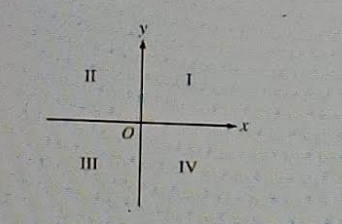
In the xy- coordinate system above, line l (not shown) does not contain points in either quadrant II or quadrant IV. Which of the following could be the equation of line l?
Rationale
Line l could be represented by the equation y=3x.
This equation describes a line that passes through the origin and has a positive slope, ensuring it does not intersect either quadrant II (where x is negative and y is positive) or quadrant IV (where x is positive and y is negative).
A) x=3 This equation represents a vertical line at x = 3, which intersects both quadrants I and IV. Therefore, it does not meet the requirement of not containing points in quadrant IV.
B) y=3x This equation describes a line that passes through the origin with a slope of 3. It only exists in quadrants I and III, as it will not contain any points where x is negative and y is positive (quadrant II) or where x is positive and y is negative (quadrant IV), fulfilling the given condition.
C) y=3x+3 This equation represents a line that has a y-intercept of 3. It intersects quadrant II (where x is negative and y is positive), which disqualifies it from being a possible equation for line l.
D) y=−3x−3 This equation describes a line with a negative slope that will pass through quadrant II and IV. It intersects quadrant IV (where x is positive and y is negative), violating the condition of line l.
Conclusion To summarize, line l must be a straight line that does not cross quadrants II or IV. The equation y=3x successfully represents such a line, existing solely in quadrants I and III. The other options either intersect the restricted quadrants or fail to meet the criteria set by the question.
If x ≠0 and x ≠-1/4, then 2x/(4x^2 + x)=
Rationale
2x/(4x^2 + x) simplifies to 2/(4x + 1).
To simplify the expression \( \frac{2x}{4x^2 + x} \), we start by factoring the denominator. This gives us \( \frac{2x}{x(4x + 1)} \), which simplifies to \( \frac{2}{4x + 1} \) after canceling the \( x \) (noting that \( x eq 0 \)).
A) 1/x + 2 This choice incorrectly suggests that the expression simplifies to a sum. The simplification involves rational expressions, and thus cannot yield a linear combination like \( \frac{1}{x} + 2 \).
B) 1/2x + 1 This option presents a fraction with \( 2x \) in the denominator and adds 1. However, the simplification does not produce this form, as the correct simplification leads to a single fraction rather than a sum of two separate terms.
C) 2/4x + 1 This choice misrepresents the simplified form. While it maintains the numerator as 2, the denominator incorrectly states \( 4x \) instead of \( 4x + 1 \). The correct simplification is \( \frac{2}{4x + 1} \).
D) 2/4x^2 + 1 This option suggests that the expression simplifies to a fraction with a quadratic term in the denominator, which is incorrect. The denominator after simplification does not yield a quadratic expression but rather a linear one.
Conclusion The expression \( \frac{2x}{4x^2 + x} \) simplifies to \( \frac{2}{4x + 1} \) upon factoring and canceling terms. Each incorrect option presents variations that either misinterpret the simplification process or misrepresent the resulting expression. Understanding these simplification steps is crucial for accurately manipulating algebraic fractions.
Maria walks x yards in 15 minutes. If she continues to walk at the same average rate, how many more yards will she walk in the next 7 minutes?
Rationale
Maria will walk 7x/15 more yards in the next 7 minutes.
To find out how many more yards Maria will walk in the next 7 minutes, we first need to calculate her walking rate and then apply it to the additional time. Since she walks x yards in 15 minutes, her rate is x/15 yards per minute. Multiplying this rate by 7 minutes gives us the distance she will walk in that time.
A) 15x/7 This choice incorrectly represents the distance walked by using the time of 15 minutes as a multiplier for the total distance walked, rather than calculating the distance for the additional 7 minutes. It does not account for the correct walking rate and thus does not reflect the distance Maria will cover in the given time frame.
B) (x/15)+7 This option miscalculates the additional distance by adding 7 to the average rate of x/15 yards per minute, rather than multiplying the rate by the time of 7 minutes. This leads to an inaccurate representation of how far she walks, as it mixes units of distance and time improperly.
C) (x+7)/15 This choice suggests averaging the distance x with the added time value of 7 and dividing by 15. This method is incorrect as it does not reflect Maria's walking rate over the specified time. Instead, it creates a nonsensical fraction that does not calculate the distance walked in 7 minutes accurately.
D) 7x/15 By applying the correct formula, we calculate Maria's distance for 7 minutes by using her verified walking rate of x/15 yards per minute and multiplying it by 7 minutes, yielding 7x/15 yards. This option accurately represents the additional distance she will cover in the specified time.
Conclusion To summarize, Maria's walking rate of x/15 yards per minute allows us to correctly calculate that she will walk an additional 7x/15 yards in the next 7 minutes. The other options fail to properly apply the walking rate or misrepresent the relationship between distance and time, leading to incorrect conclusions.
Fred, Norman, and Dave own a total of 128 comic books. If Dave owns 44 of them, what is the average (arithmetic mean) number of comic books owned by Fred and Norman?
Rationale
42 is the average number of comic books owned by Fred and Norman.
To find the average number of comic books owned by Fred and Norman, we have to first determine the total number of comic books they own together. We know that Fred, Norman, and Dave own a total of 128 comic books and Dave owns 44. Therefore, Fred and Norman together own 128 - 44 = 84 comic books. The average is then found by dividing this total by the number of people, which is 2 in this case. Hence, the average number owned by Fred and Norman is 84 ÷ 2 = 42 comic books.
A) 42 This is the correct choice because Fred and Norman together own 84 comic books, and the average number of comic books they own is found by dividing this total by the number of people, which gives us 42 comic books each.
B) 44 This answer would be correct if Dave's ownership of 44 comic books was applied to Fred and Norman. However, Dave's ownership does not affect the average number of comic books owned by Fred and Norman, as we are only interested in the average of the comic books owned by Fred and Norman.
C) 46 This answer is incorrect because it is greater than the calculated average. An average of 46 comic books each would mean Fred and Norman together own more than 128 comic books, which is not the case.
D) 48 This answer is incorrect because it is greater than the calculated average. An average of 48 comic books each would mean Fred and Norman together own more than 128 comic books, which is not the case.
Conclusion The average number of comic books owned by Fred and Norman is 42. This is calculated by first determining the total number of comic books owned by Fred and Norman, which is 84, and then dividing this total by the number of people, which is 2. The other options are incorrect because they are either based on incorrect assumptions or they are greater than the calculated average.
At a music store, the CDs Paul bought were $12 each, and the CDs Kate bought were $15 each. If together they paid a total of $78 for 6 CDs, how many CDs did Kate buy?
Rationale
Kate bought two CDs.
To solve for the number of CDs Kate bought, we can set up a system of equations based on the information given. Let \( x \) represent the number of CDs Paul bought and \( y \) represent the number of CDs Kate bought. The equations formed from the problem are \( x + y = 6 \) and \( 12x + 15y = 78 \). Solving these equations leads us to find that \( y = 2 \).
A) Two This choice correctly represents the number of CDs Kate bought. By substituting \( y = 2 \) into the equation \( x + y = 6 \), we find \( x = 4 \). Verifying with the cost equation, \( 12(4) + 15(2) = 48 + 30 = 78 \) confirms that this solution satisfies all conditions.
B) Three If Kate bought three CDs, substituting \( y = 3 \) into \( x + y = 6 \) gives \( x = 3 \). The cost would then be \( 12(3) + 15(3) = 36 + 45 = 81 \), which exceeds the total cost of $78. Therefore, this choice is incorrect.
C) Four Assuming Kate bought four CDs means substituting \( y = 4 \) leads to \( x = 2 \). The total cost then becomes \( 12(2) + 15(4) = 24 + 60 = 84 \), again exceeding the total amount paid. Hence, this option is also incorrect.
D) Five If Kate bought five CDs, substituting \( y = 5 \) results in \( x = 1 \). The cost would be \( 12(1) + 15(5) = 12 + 75 = 87 \), which is again more than the total of $78. This choice is therefore incorrect as well.
Conclusion By analyzing the equations formed from the problem's conditions, we determine that Kate bought two CDs. The other options do not satisfy the total number of CDs or the total cost equation, confirming that the only feasible solution is that Kate purchased two CDs. This solution showcases the effective use of algebra in solving real-world problems involving budgeting and purchases.
In the system of equations above, k is a constant. How many solutions could there be to the system of equations?
I. None
II. One
III. More than one
Rationale
There could be either no solutions or more than one solution to the system of equations.
The equations given are linear. The first equation can be rewritten to show that it is a line in the xy-plane. The second equation is a multiple of the first, which indicates that the two lines could be identical (resulting in infinitely many solutions) or parallel (resulting in no solutions), depending on the value of k.
A) I only This choice suggests that there are no solutions at all. However, if k is chosen such that the second equation is a multiple of the first, the system would actually have infinitely many solutions. Therefore, while it is possible for there to be no solutions, it is not the only outcome.
B) III Only This option claims that there are more than one solution. This is only true if the equations are identical. However, if k is not aligned with the relationship established by the first equation, the system may have no solutions. Thus, this option is too restrictive and does not encompass all possibilities.
C) I or II This choice implies that the system can either have no solutions or exactly one solution. However, it fails to account for the scenario in which k is a multiple of the other equation's constants, leading to infinitely many solutions. Therefore, this choice does not accurately reflect all possible outcomes.
D) I or III This option correctly identifies that there could either be no solutions (if the lines are parallel) or more than one solution (if the lines are identical). This captures all potential scenarios that can arise from the given system of equations, making it the comprehensive choice.
Conclusion In summary, the nature of the equations allows for diverse outcomes based on the value of k. The system can either yield no solutions (when the lines are parallel) or infinitely many solutions (when the lines overlap). Therefore, the correct interpretation of the problem is that there can be either no solutions or more than one solution, making option D the most accurate choice.
Jenny has a triangular flag that has two sides 18 inches long and one side 6 inches long. She is making another triangular flag with angles equal in measure to the angles of the flag she has. If the new flag will have two sides 21 inches long, what will be the length of the third side?
Rationale
The length of the third side will be 7 inches.
Jenny's original triangular flag is a scaled version of her new triangular flag. The original triangle has sides in the ratio of 18:18:6, which simplifies to 3:3:1. The new flag has two sides measuring 21 inches each. Therefore, using the same ratio, the length of the third side can be determined as 7 inches.
A) 7 inches This choice is correct because the ratio of the sides in the original triangle (3:3:1) applies to the new triangle as well. With the two sides measuring 21 inches, the corresponding third side, based on the ratio, is calculated as (21/3) = 7 inches.
B) 8 inches Choosing 8 inches does not satisfy the proportional relationship established by the original triangle. If the sides of the new triangle maintain the same ratios as the original triangle, 8 inches would not fit the calculated length derived from the ratio of the original triangle.
C) 9 inches This option is incorrect as it also fails to reflect the proportionality between the sides. The ratio derived from the original triangle does not support a length of 9 inches for the third side when the other two sides are set at 21 inches.
D) 10 inches Selecting 10 inches is inaccurate as it does not conform to the established ratio from the original triangle. The calculation based on the ratio shows that the third side must be 7 inches, making 10 inches an unsuitable choice.
Conclusion The problem illustrates how similar triangles maintain proportional relationships between their corresponding sides. By applying the ratios from Jenny's original flag, we determine that the length of the third side of the new flag must be 7 inches, ensuring that it maintains the same angular measures as the original triangle. The other options fail to satisfy this proportional relationship.
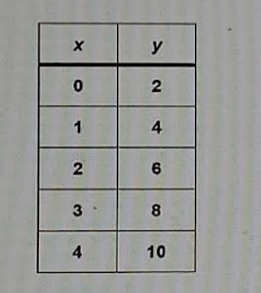
Based on the pairs of values in the table above, which of the following could express a relationship between x and y?
Rationale
y=2x+2 could express a relationship between x and y.
This equation suggests that for every unit increase in x, y increases by two units, plus an additional constant of 2, which aligns with the relationship indicated by the pairs of values in the table.
A) y=x+2 This equation implies that y increases by one unit for each unit increase in x, plus a constant of 2. However, if we analyze the pairs in the table, they do not support a linear relationship with this slope, indicating this option does not correctly represent the relationship between x and y.
B) y=2x This equation suggests that y is directly proportional to x with a slope of 2 and no constant term. While this indicates that y would double as x increases, it fails to account for any additional constant offset observed in the pairs of values, thus not accurately reflecting the relationship.
C) y=2x+2 This equation accurately describes a linear relationship where y increases by two units for every unit increase in x, with an additional constant of 2. The values in the table confirm this relationship, making it the correct expression for the relationship between x and y.
D) y=3x+2 This equation suggests an even steeper slope of 3, indicating y would increase by three units for every unit increase in x, while also adding a constant of 2. The data from the pairs do not support this steep increase; hence, it does not accurately represent the underlying relationship.
Conclusion The relationship between x and y can be effectively expressed as y=2x+2, where y changes proportionally with x while also including a constant shift. The other options either misrepresent the slope or fail to incorporate the necessary constant, confirming that option C is the only valid expression among the choices provided.
If the average (arithmetic mean) of g and 100 is 75, what is the value of g + 100?
Rationale
g + 100 equals 150.
To find the value of g + 100, we first determine g using the given average. The average of g and 100 is calculated as (g + 100) / 2, which equals 75. By solving for g, we can then easily calculate g + 100.
A) 50 This choice suggests that g + 100 equals 50, which would imply that g is -50. However, this contradicts the given average of 75, as substituting g = -50 into the average formula yields a negative result, which is inconsistent with the arithmetic mean calculated from positive numbers.
B) 125 If g + 100 were 125, it would mean that g is 25. Substituting g = 25 into the average formula results in (25 + 100) / 2 = 62.5, which does not match the stated average of 75. Thus, this choice is incorrect.
C) 150 This is the correct choice. If g + 100 equals 150, then g must be 50. Substituting g = 50 into the average formula gives (50 + 100) / 2 = 75, which confirms that this option satisfies the condition provided in the question.
D) 175 If g + 100 were 175, it would imply g is 75. Calculating the average with g = 75 results in (75 + 100) / 2 = 87.5, which is not equal to the specified average of 75. Therefore, this option is also incorrect.
Conclusion To solve for g + 100, we start with the average equation (g + 100) / 2 = 75 and find that g must equal 50. This leads directly to the conclusion that g + 100 equals 150, confirming that choice C is the accurate answer, while all other options fail to satisfy the initial average condition.
0.034*(10)^(-1) =
Rationale
The correct answer is 0.34.
This question is a simple division problem involving a number and a negative power of 10. When you divide a number by a power of 10, you move the decimal point to the left if the power is positive, and to the right if the power is negative. Since we are dividing by 10 to the power of -1, we move the decimal point one place to the right.
A) 0.0034 This choice incorrectly moves the decimal point two places to the left, which would be the result if we were multiplying 0.034 by 10^(-2), not 10^(-1).
B) 0.034 This choice does not move the decimal point at all, which would be the result if we were dividing 0.034 by 10^0, not 10^(-1).
C) 0.34 This choice correctly moves the decimal point one place to the right, which is the result of dividing 0.034 by 10^(-1).
D) 3.4 This choice incorrectly moves the decimal point two places to the right, which would be the result if we were dividing 0.034 by 10^(-2), not 10^(-1).
Conclusion The problem involves dividing a number by a negative power of 10. When dividing by 10 to the power of -1, the decimal point of the number being divided should be moved one place to the right. Therefore, 0.034 divided by 10^(-1) results in 0.34. The other choices incorrectly move the decimal point to the wrong position or do not move it at all.
6[4 + 2(1 - 3)] =
Rationale
6[4 + 2(1 - 3)] = 0.
To solve the expression, we begin by simplifying inside the brackets. The term (1 - 3) equals -2, and then 2 multiplied by -2 gives -4. Adding this to 4 results in 0, which, when multiplied by 6, yields a final answer of 0.
A) 0 This choice is correct. As detailed, the expression simplifies to 6 multiplied by 0, resulting in a final answer of 0.
B) 20 This choice miscalculates the expression. It incorrectly assumes that the result of the operations within the brackets is something other than zero. The correct simplification shows that the result inside the brackets is zero, which should lead to a multiplication result of 0, not 20.
C) 24 This option also reflects an incorrect calculation. It suggests that the expression evaluates to a non-zero number, failing to account for the negative result from the operation (1 - 3) that ultimately leads to zero when multiplied by 6.
D) 48 This choice represents a significant miscalculation, likely stemming from misunderstanding the order of operations. It appears to assume that all terms are added together before multiplication, ignoring the critical steps that lead to a result of zero.
Conclusion The calculation of the expression 6[4 + 2(1 - 3)] demonstrates the importance of following the order of operations correctly. The ultimate result is 0 due to the operations within the brackets producing a zero value. Understanding how to simplify expressions accurately is key to arriving at the correct solution, which in this case is 0.
A salesperson's commission is k percent of the selling price of a car. Which of the following represents the commission, in dollars, on 2 cars that sold for $14,000 each?
Rationale
The salesperson's commission on 2 cars that sold for $14,000 each is represented by 280k.
The commission is calculated by multiplying the selling price of the car by the commission rate (k percent). Since the commission rate is given as a percentage, it is divided by 100 when used in calculations. Thus, for one car sold for $14,000, the commission would be (14000 * k/100) or 140k. Since there are 2 cars sold, the total commission would be 2 * 140k = 280k.
A) 280k This is the correct answer. The commission on one car is 140k, and since there are 2 cars, the total commission is 280k.
B) 28,000k This answer incorrectly assumes that the commission rate k is not divided by 100 when calculating the commission. This results in a commission that is 100 times larger than the correct amount.
C) 14,000/(100+2k) This answer incorrectly assumes that the selling price is divided by the sum of 100 and twice the commission rate. This is not a correct method for calculating commission.
D) (28,000+k)/100 This answer incorrectly assumes that the sum of the total selling price and the commission rate is divided by 100 to calculate the commission. This does not correctly represent the calculation of commission.
Conclusion The commission a salesperson earns is a percentage (k percent) of the selling price. Since the commission is applied to each car sold individually, the total commission from selling 2 cars at $14,000 each is 2 * (14000 * k/100), which simplifies to 280k. The other options either calculate the commission incorrectly or interpret the commission rate incorrectly.
Each of the following is a solution to the equation x- 2y = 4 EXCEPT
Rationale
The pair (0,2) is not a solution to the equation x - 2y = 4.
The equation x - 2y = 4 can be solved by substituting the x and y values from each pair into the equation. If the equation is satisfied, then the pair is a solution. However, the pair (0,2) does not satisfy the equation.
A) (-2,-3) Substituting x with -2 and y with -3 into the equation gives -2 - 2*(-3) = 4. Simplifying this yields -2 + 6 = 4, which is true. Therefore, (-2,-3) is a solution to the equation.
B) (0,2) Substituting x with 0 and y with 2 into the equation gives 0 - 2*2 = -4. Simplifying this results in -4, not 4. Therefore, the pair (0,2) is not a solution to the equation.
C) (4,0) Substituting x with 4 and y with 0 into the equation gives 4 - 2*0 = 4. Simplifying this results in 4, which matches the equation. Therefore, (4,0) is a solution to the equation.
D) (8,2) Substituting x with 8 and y with 2 into the equation gives 8 - 2*2 = 4. Simplifying this results in 4, which matches the equation. Therefore, (8,2) is a solution to the equation.
Conclusion The equation x - 2y = 4 is satisfied by the pairs (-2,-3), (4,0), and (8,2), but not by the pair (0,2). Substituting the values of each pair into the equation and checking whether the equation holds true allows us to identify which pairs are solutions. The pair (0,2) does not satisfy the equation as it yields -4, not 4.
The repeating decimal 0.111... is equivalent to
Rationale
The repeating decimal 0.111... is equivalent to 1/9.
The decimal 0.111... can be expressed as a fraction through the understanding that it represents the sum of an infinite geometric series. Specifically, it can be derived that 0.111... equals 1 divided by 9, confirming its equivalency to the fraction 1/9.
A) 1/7 The fraction 1/7 equals approximately 0.142857..., which does not match the repeating decimal 0.111... . Therefore, this option is incorrect as the decimal representation of 1/7 is distinctly different from that of 0.111....
B) 1/9 This option correctly represents the repeating decimal 0.111... . When converted into a fraction, 0.111... is derived from the infinite series 1/10 + 1/100 + 1/1000 + ... which sums to 1/9. Thus, this choice accurately reflects the equivalency.
C) 1/10 The fraction 1/10 equals 0.1, which is a terminating decimal and does not repeat. Since 0.111... is a repeating decimal, this choice does not represent the correct equivalency and is therefore incorrect.
D) 1/11 The fraction 1/11 is approximately 0.090909..., which is also a repeating decimal but distinctly different from 0.111... . Therefore, this option does not match the original decimal and is incorrect.
Conclusion The repeating decimal 0.111... fundamentally equates to the fraction 1/9, derived from an infinite geometric series. All other options present differing decimal values, demonstrating that 1/9 is the only fraction that accurately represents this repeating decimal. Understanding such relationships between decimals and fractions is essential in mathematics, particularly in number theory and rational number representation.
The population of a certain bacteria can be modeled by the function P(t)=2000(1.034)^t where t represents the number of hours after an experiment has started. What does 2,000 represent in the function?
Rationale
The population of bacteria when the experiment started.
In the function P(t) = 2000(1.034)^t, the constant 2000 represents the initial population of the bacteria at time t = 0, which is when the experiment begins. This value serves as the starting point for the exponential growth modeled by the function.
A) The amount of time the experiment lasts This option inaccurately describes a characteristic of the function. The variable t in the equation denotes the time elapsed in hours, but 2000 specifically quantifies the initial population and does not represent the duration of the experiment itself.
B) The population of bacteria when the experiment ends The value 2000 indicates the starting population, not the population at the end of the experiment. The population when the experiment concludes would depend on the duration of the experiment and the growth rate, which is determined by the function as time progresses.
C) The population of bacteria when the experiment started This is the correct interpretation of the constant 2000 in the function. It signifies the initial population size before any growth has occurred, providing a baseline for measuring changes in the population over time.
D) The percent the population of bacteria changes every hour While the function does reflect exponential growth, the factor of 1.034 indicates a growth rate of 3.4%, not the initial population size. The 2000 constant does not reflect a percentage change but rather the starting quantity of bacteria.
Conclusion In the exponential growth model P(t) = 2000(1.034)^t, the number 2000 specifically represents the initial population of bacteria at the start of the experiment. Understanding this initial value is critical for interpreting the growth dynamics characterized by the function, while the other options misinterpret or misrepresent the role of this constant in the context of the experiment.
In the xy- coordinate system above, line l (not shown) does not contain points in either quadrant II or quadrant IV. Which of the following could be the equation of line l?
Rationale
Line l could be represented by the equation y=3x.
This equation describes a line that passes through the origin and has a positive slope, ensuring it does not intersect either quadrant II (where x is negative and y is positive) or quadrant IV (where x is positive and y is negative).
A) x=3 This equation represents a vertical line at x = 3, which intersects both quadrants I and IV. Therefore, it does not meet the requirement of not containing points in quadrant IV.
B) y=3x This equation describes a line that passes through the origin with a slope of 3. It only exists in quadrants I and III, as it will not contain any points where x is negative and y is positive (quadrant II) or where x is positive and y is negative (quadrant IV), fulfilling the given condition.
C) y=3x+3 This equation represents a line that has a y-intercept of 3. It intersects quadrant II (where x is negative and y is positive), which disqualifies it from being a possible equation for line l.
D) y=−3x−3 This equation describes a line with a negative slope that will pass through quadrant II and IV. It intersects quadrant IV (where x is positive and y is negative), violating the condition of line l.
Conclusion To summarize, line l must be a straight line that does not cross quadrants II or IV. The equation y=3x successfully represents such a line, existing solely in quadrants I and III. The other options either intersect the restricted quadrants or fail to meet the criteria set by the question.
If x ≠0 and x ≠-1/4, then 2x/(4x^2 + x)=
Rationale
2x/(4x^2 + x) simplifies to 2/(4x + 1).
To simplify the expression \( \frac{2x}{4x^2 + x} \), we start by factoring the denominator. This gives us \( \frac{2x}{x(4x + 1)} \), which simplifies to \( \frac{2}{4x + 1} \) after canceling the \( x \) (noting that \( x eq 0 \)).
A) 1/x + 2 This choice incorrectly suggests that the expression simplifies to a sum. The simplification involves rational expressions, and thus cannot yield a linear combination like \( \frac{1}{x} + 2 \).
B) 1/2x + 1 This option presents a fraction with \( 2x \) in the denominator and adds 1. However, the simplification does not produce this form, as the correct simplification leads to a single fraction rather than a sum of two separate terms.
C) 2/4x + 1 This choice misrepresents the simplified form. While it maintains the numerator as 2, the denominator incorrectly states \( 4x \) instead of \( 4x + 1 \). The correct simplification is \( \frac{2}{4x + 1} \).
D) 2/4x^2 + 1 This option suggests that the expression simplifies to a fraction with a quadratic term in the denominator, which is incorrect. The denominator after simplification does not yield a quadratic expression but rather a linear one.
Conclusion The expression \( \frac{2x}{4x^2 + x} \) simplifies to \( \frac{2}{4x + 1} \) upon factoring and canceling terms. Each incorrect option presents variations that either misinterpret the simplification process or misrepresent the resulting expression. Understanding these simplification steps is crucial for accurately manipulating algebraic fractions.
Maria walks x yards in 15 minutes. If she continues to walk at the same average rate, how many more yards will she walk in the next 7 minutes?
Rationale
Maria will walk 7x/15 more yards in the next 7 minutes.
To find out how many more yards Maria will walk in the next 7 minutes, we first need to calculate her walking rate and then apply it to the additional time. Since she walks x yards in 15 minutes, her rate is x/15 yards per minute. Multiplying this rate by 7 minutes gives us the distance she will walk in that time.
A) 15x/7 This choice incorrectly represents the distance walked by using the time of 15 minutes as a multiplier for the total distance walked, rather than calculating the distance for the additional 7 minutes. It does not account for the correct walking rate and thus does not reflect the distance Maria will cover in the given time frame.
B) (x/15)+7 This option miscalculates the additional distance by adding 7 to the average rate of x/15 yards per minute, rather than multiplying the rate by the time of 7 minutes. This leads to an inaccurate representation of how far she walks, as it mixes units of distance and time improperly.
C) (x+7)/15 This choice suggests averaging the distance x with the added time value of 7 and dividing by 15. This method is incorrect as it does not reflect Maria's walking rate over the specified time. Instead, it creates a nonsensical fraction that does not calculate the distance walked in 7 minutes accurately.
D) 7x/15 By applying the correct formula, we calculate Maria's distance for 7 minutes by using her verified walking rate of x/15 yards per minute and multiplying it by 7 minutes, yielding 7x/15 yards. This option accurately represents the additional distance she will cover in the specified time.
Conclusion To summarize, Maria's walking rate of x/15 yards per minute allows us to correctly calculate that she will walk an additional 7x/15 yards in the next 7 minutes. The other options fail to properly apply the walking rate or misrepresent the relationship between distance and time, leading to incorrect conclusions.
Fred, Norman, and Dave own a total of 128 comic books. If Dave owns 44 of them, what is the average (arithmetic mean) number of comic books owned by Fred and Norman?
Rationale
42 is the average number of comic books owned by Fred and Norman.
To find the average number of comic books owned by Fred and Norman, we have to first determine the total number of comic books they own together. We know that Fred, Norman, and Dave own a total of 128 comic books and Dave owns 44. Therefore, Fred and Norman together own 128 - 44 = 84 comic books. The average is then found by dividing this total by the number of people, which is 2 in this case. Hence, the average number owned by Fred and Norman is 84 ÷ 2 = 42 comic books.
A) 42 This is the correct choice because Fred and Norman together own 84 comic books, and the average number of comic books they own is found by dividing this total by the number of people, which gives us 42 comic books each.
B) 44 This answer would be correct if Dave's ownership of 44 comic books was applied to Fred and Norman. However, Dave's ownership does not affect the average number of comic books owned by Fred and Norman, as we are only interested in the average of the comic books owned by Fred and Norman.
C) 46 This answer is incorrect because it is greater than the calculated average. An average of 46 comic books each would mean Fred and Norman together own more than 128 comic books, which is not the case.
D) 48 This answer is incorrect because it is greater than the calculated average. An average of 48 comic books each would mean Fred and Norman together own more than 128 comic books, which is not the case.
Conclusion The average number of comic books owned by Fred and Norman is 42. This is calculated by first determining the total number of comic books owned by Fred and Norman, which is 84, and then dividing this total by the number of people, which is 2. The other options are incorrect because they are either based on incorrect assumptions or they are greater than the calculated average.
At a music store, the CDs Paul bought were $12 each, and the CDs Kate bought were $15 each. If together they paid a total of $78 for 6 CDs, how many CDs did Kate buy?
Rationale
Kate bought two CDs.
To solve for the number of CDs Kate bought, we can set up a system of equations based on the information given. Let \( x \) represent the number of CDs Paul bought and \( y \) represent the number of CDs Kate bought. The equations formed from the problem are \( x + y = 6 \) and \( 12x + 15y = 78 \). Solving these equations leads us to find that \( y = 2 \).
A) Two This choice correctly represents the number of CDs Kate bought. By substituting \( y = 2 \) into the equation \( x + y = 6 \), we find \( x = 4 \). Verifying with the cost equation, \( 12(4) + 15(2) = 48 + 30 = 78 \) confirms that this solution satisfies all conditions.
B) Three If Kate bought three CDs, substituting \( y = 3 \) into \( x + y = 6 \) gives \( x = 3 \). The cost would then be \( 12(3) + 15(3) = 36 + 45 = 81 \), which exceeds the total cost of $78. Therefore, this choice is incorrect.
C) Four Assuming Kate bought four CDs means substituting \( y = 4 \) leads to \( x = 2 \). The total cost then becomes \( 12(2) + 15(4) = 24 + 60 = 84 \), again exceeding the total amount paid. Hence, this option is also incorrect.
D) Five If Kate bought five CDs, substituting \( y = 5 \) results in \( x = 1 \). The cost would be \( 12(1) + 15(5) = 12 + 75 = 87 \), which is again more than the total of $78. This choice is therefore incorrect as well.
Conclusion By analyzing the equations formed from the problem's conditions, we determine that Kate bought two CDs. The other options do not satisfy the total number of CDs or the total cost equation, confirming that the only feasible solution is that Kate purchased two CDs. This solution showcases the effective use of algebra in solving real-world problems involving budgeting and purchases.
In the system of equations above, k is a constant. How many solutions could there be to the system of equations?
I. None
II. One
III. More than one
Rationale
There could be either no solutions or more than one solution to the system of equations.
The equations given are linear. The first equation can be rewritten to show that it is a line in the xy-plane. The second equation is a multiple of the first, which indicates that the two lines could be identical (resulting in infinitely many solutions) or parallel (resulting in no solutions), depending on the value of k.
A) I only This choice suggests that there are no solutions at all. However, if k is chosen such that the second equation is a multiple of the first, the system would actually have infinitely many solutions. Therefore, while it is possible for there to be no solutions, it is not the only outcome.
B) III Only This option claims that there are more than one solution. This is only true if the equations are identical. However, if k is not aligned with the relationship established by the first equation, the system may have no solutions. Thus, this option is too restrictive and does not encompass all possibilities.
C) I or II This choice implies that the system can either have no solutions or exactly one solution. However, it fails to account for the scenario in which k is a multiple of the other equation's constants, leading to infinitely many solutions. Therefore, this choice does not accurately reflect all possible outcomes.
D) I or III This option correctly identifies that there could either be no solutions (if the lines are parallel) or more than one solution (if the lines are identical). This captures all potential scenarios that can arise from the given system of equations, making it the comprehensive choice.
Conclusion In summary, the nature of the equations allows for diverse outcomes based on the value of k. The system can either yield no solutions (when the lines are parallel) or infinitely many solutions (when the lines overlap). Therefore, the correct interpretation of the problem is that there can be either no solutions or more than one solution, making option D the most accurate choice.
Jenny has a triangular flag that has two sides 18 inches long and one side 6 inches long. She is making another triangular flag with angles equal in measure to the angles of the flag she has. If the new flag will have two sides 21 inches long, what will be the length of the third side?
Rationale
The length of the third side will be 7 inches.
Jenny's original triangular flag is a scaled version of her new triangular flag. The original triangle has sides in the ratio of 18:18:6, which simplifies to 3:3:1. The new flag has two sides measuring 21 inches each. Therefore, using the same ratio, the length of the third side can be determined as 7 inches.
A) 7 inches This choice is correct because the ratio of the sides in the original triangle (3:3:1) applies to the new triangle as well. With the two sides measuring 21 inches, the corresponding third side, based on the ratio, is calculated as (21/3) = 7 inches.
B) 8 inches Choosing 8 inches does not satisfy the proportional relationship established by the original triangle. If the sides of the new triangle maintain the same ratios as the original triangle, 8 inches would not fit the calculated length derived from the ratio of the original triangle.
C) 9 inches This option is incorrect as it also fails to reflect the proportionality between the sides. The ratio derived from the original triangle does not support a length of 9 inches for the third side when the other two sides are set at 21 inches.
D) 10 inches Selecting 10 inches is inaccurate as it does not conform to the established ratio from the original triangle. The calculation based on the ratio shows that the third side must be 7 inches, making 10 inches an unsuitable choice.
Conclusion The problem illustrates how similar triangles maintain proportional relationships between their corresponding sides. By applying the ratios from Jenny's original flag, we determine that the length of the third side of the new flag must be 7 inches, ensuring that it maintains the same angular measures as the original triangle. The other options fail to satisfy this proportional relationship.
Based on the pairs of values in the table above, which of the following could express a relationship between x and y?
Rationale
y=2x+2 could express a relationship between x and y.
This equation suggests that for every unit increase in x, y increases by two units, plus an additional constant of 2, which aligns with the relationship indicated by the pairs of values in the table.
A) y=x+2 This equation implies that y increases by one unit for each unit increase in x, plus a constant of 2. However, if we analyze the pairs in the table, they do not support a linear relationship with this slope, indicating this option does not correctly represent the relationship between x and y.
B) y=2x This equation suggests that y is directly proportional to x with a slope of 2 and no constant term. While this indicates that y would double as x increases, it fails to account for any additional constant offset observed in the pairs of values, thus not accurately reflecting the relationship.
C) y=2x+2 This equation accurately describes a linear relationship where y increases by two units for every unit increase in x, with an additional constant of 2. The values in the table confirm this relationship, making it the correct expression for the relationship between x and y.
D) y=3x+2 This equation suggests an even steeper slope of 3, indicating y would increase by three units for every unit increase in x, while also adding a constant of 2. The data from the pairs do not support this steep increase; hence, it does not accurately represent the underlying relationship.
Conclusion The relationship between x and y can be effectively expressed as y=2x+2, where y changes proportionally with x while also including a constant shift. The other options either misrepresent the slope or fail to incorporate the necessary constant, confirming that option C is the only valid expression among the choices provided.
If the average (arithmetic mean) of g and 100 is 75, what is the value of g + 100?
Rationale
g + 100 equals 150.
To find the value of g + 100, we first determine g using the given average. The average of g and 100 is calculated as (g + 100) / 2, which equals 75. By solving for g, we can then easily calculate g + 100.
A) 50 This choice suggests that g + 100 equals 50, which would imply that g is -50. However, this contradicts the given average of 75, as substituting g = -50 into the average formula yields a negative result, which is inconsistent with the arithmetic mean calculated from positive numbers.
B) 125 If g + 100 were 125, it would mean that g is 25. Substituting g = 25 into the average formula results in (25 + 100) / 2 = 62.5, which does not match the stated average of 75. Thus, this choice is incorrect.
C) 150 This is the correct choice. If g + 100 equals 150, then g must be 50. Substituting g = 50 into the average formula gives (50 + 100) / 2 = 75, which confirms that this option satisfies the condition provided in the question.
D) 175 If g + 100 were 175, it would imply g is 75. Calculating the average with g = 75 results in (75 + 100) / 2 = 87.5, which is not equal to the specified average of 75. Therefore, this option is also incorrect.
Conclusion To solve for g + 100, we start with the average equation (g + 100) / 2 = 75 and find that g must equal 50. This leads directly to the conclusion that g + 100 equals 150, confirming that choice C is the accurate answer, while all other options fail to satisfy the initial average condition.
0.034*(10)^(-1) =
Rationale
The correct answer is 0.34.
This question is a simple division problem involving a number and a negative power of 10. When you divide a number by a power of 10, you move the decimal point to the left if the power is positive, and to the right if the power is negative. Since we are dividing by 10 to the power of -1, we move the decimal point one place to the right.
A) 0.0034 This choice incorrectly moves the decimal point two places to the left, which would be the result if we were multiplying 0.034 by 10^(-2), not 10^(-1).
B) 0.034 This choice does not move the decimal point at all, which would be the result if we were dividing 0.034 by 10^0, not 10^(-1).
C) 0.34 This choice correctly moves the decimal point one place to the right, which is the result of dividing 0.034 by 10^(-1).
D) 3.4 This choice incorrectly moves the decimal point two places to the right, which would be the result if we were dividing 0.034 by 10^(-2), not 10^(-1).
Conclusion The problem involves dividing a number by a negative power of 10. When dividing by 10 to the power of -1, the decimal point of the number being divided should be moved one place to the right. Therefore, 0.034 divided by 10^(-1) results in 0.34. The other choices incorrectly move the decimal point to the wrong position or do not move it at all.
You are leaving this quiz
What would you like to do with your progress?
You're in the middle of a quiz
What would you like to do before switching?
Practice complete
You finished this free practice quiz.