
3/5 + 3/8 =
Rationale
3/5 + 3/8 equals 0.975.
To find the sum of 3/5 and 3/8, we first convert both fractions to a common denominator and then add them together, resulting in 0.975.
A) 0.225 This value does not represent the sum of 3/5 and 3/8. Instead, it is significantly lower than the expected result, indicating a misunderstanding of the addition of fractions.
B) 0.875 While this value is closer to the correct answer, it still does not accurately reflect the sum of 3/5 and 3/8. A common mistake could involve incorrect fraction addition or decimal conversion.
C) 0.975 This is the correct answer, as it accurately represents the sum of the two fractions. After converting 3/5 to 24/40 and 3/8 to 15/40, their sum becomes 39/40, which converts to 0.975 in decimal form.
D) 1.225 This choice exceeds the correct sum and indicates an incorrect calculation. It suggests an error, possibly in misadding the fractions or misinterpreting the results of the addition.
Conclusion To correctly add 3/5 and 3/8, one must first find a common denominator, which leads to the result of 0.975. Miscalculations or errors in fraction addition can lead to incorrect answers, such as 0.225, 0.875, or 1.225, highlighting the importance of careful arithmetic procedures in obtaining accurate results.
3(1/2) * 2(1/3) =
Rationale
A) 8(1/6)
To solve this multiplication of mixed numbers, convert each mixed number to an improper fraction first. Then multiply the fractions together to get the result. In this case, 3(1/2) is equivalent to 7/2 and 2(1/3) is equivalent to 7/3. Multiplying these fractions yields 49/6, which can be simplified to 8(1/6).
B) 7(5/6) This choice does not represent the correct result of the multiplication. It seems to combine the whole number parts of the mixed numbers without correctly calculating the fractional components.
C) 6(1/6) This option does not align with the correct solution obtained by multiplying 3(1/2) and 2(1/3). It appears to be a random combination of numbers without following the proper arithmetic operations.
D) 5(5/6) This choice does not match the correct product of 3(1/2) and 2(1/3). It seems to be a result obtained from a different calculation or a misunderstanding of how to multiply mixed numbers.
Conclusion The correct answer to the multiplication of 3(1/2) and 2(1/3) is 8(1/6). By converting the mixed numbers to improper fractions and multiplying them together, the result simplifies to 8(1/6). Understanding how to work with mixed numbers and fractions is crucial for accurately solving mathematical operations involving these types of numbers.
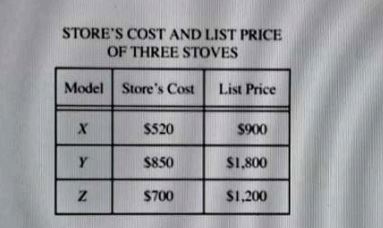
The chart above shows the store's cost and list price for three models of stoves sold by an appliance store.
During a 20 percent off sale, Gene bought a Model Y stove from this store. How much profit did the store make on Gene's purchase? (Profit = Price paid - Store's cost)
Rationale
The store made a profit of $760 on Gene's purchase of the Model Y stove.
This is calculated by subtracting the store's cost for the Model Y stove from the price Gene paid during the 20 percent off sale.
A) $260 This option is incorrect because it does not accurately reflect the difference between the price Gene paid and the store's cost for the Model Y stove. It seems to consider the 20% off sale but doesn't accurately represent the store's profit.
B) $380 This choice is incorrect as it doesn't accurately depict the profit made by the store on Gene's purchase of the Model Y stove. It may be a result of incorrectly calculating the discount or misunderstanding the profit calculation.
C) $590 This option is also incorrect. It seems to result from an incorrect calculation of the discount on the list price or an inaccurate calculation of the profit itself.
D) $760 This is the correct answer. It accurately reflects the profit made by the store on Gene's purchase of the Model Y stove after the 20% discount on the list price.
Conclusion In determining the profit made from the sale of an item, it is crucial to subtract the store's cost from the actual price paid by the customer. In this case, with Gene purchasing the Model Y stove during a 20 percent off sale, the store made a profit of $760. This amount is obtained by subtracting the store's cost from the discounted price paid by Gene. The other options are incorrect as they do not accurately represent the profit calculation based on the given information.
1 is 3 percent of what number?
Rationale
1 is 3 percent of 33,1/3.
To calculate what number a certain percentage of a number is, you divide the number by the percentage and multiply by 100. If 1 is 3% of a number, you divide 1 by 3 and multiply by 100, which gives you 33,1/3.
A) 1/3 1 is not 3 percent of 1/3. If you multiply 1/3 by 3 percent, you get 0.01, which is not equal to 1.
B) 3 1 is not 3 percent of 3. If you multiply 3 by 3 percent, you get 0.09, which is not equal to 1.
C) 30 1 is not 3 percent of 30. If you multiply 30 by 3 percent, you get 0.9, which is not equal to 1.
D) 33,1/3 1 is 3 percent of 33,1/3. If you multiply 33,1/3 by 3 percent, you get 1.
Conclusion In order to find what number a percentage of a number is, you need to divide the number by the percentage and multiply by 100. In this case, 1 divided by 3 percent and multiplied by 100 gives 33,1/3. Therefore, 1 is 3 percent of 33,1/3.
1,500 * (15 + 5) =
Rationale
A) 75 is the correct answer.
By following the order of operations, which is parentheses, exponents, multiplication and division (from left to right), addition and subtraction (from left to right) (PEMDAS), the calculation should be done as follows: First, add the numbers in the parentheses (15 + 5 = 20). Then, divide 1,500 by 20, which results in 75.
A) 75 This is the correct answer. After adding the numbers within the parentheses (15 + 5 = 20) and then dividing 1,500 by this sum, the result is 75.
B) 130 This answer would be the result if you first divided 1,500 by 15, and then added 5. However, this does not follow the order of operations (PEMDAS), which states that addition within parentheses should be performed before division.
C) 315 This answer might be reached if you first divided 1,500 by 15 and then multiplied the result by 5. However, this does not follow the order of operations (PEMDAS), which clearly states that operations inside parentheses should be performed before division.
D) 400 This answer might result from incorrectly dividing 1,500 by the sum of 15 and 5 without first adding the numbers in the parentheses, which is not in accordance with the order of operations (PEMDAS).
Conclusion The correct answer is A) 75, which is obtained by first adding the numbers within the parentheses (15 + 5) to get 20, and then dividing 1,500 by this sum. Answers B) 130, C) 315, and D) 400 are incorrect because they do not follow the order of operations (PEMDAS). To correctly solve this problem, you must perform operations in the following order: parentheses, exponents, multiplication and division (from left to right), addition and subtraction (from left to right).
½% of 20 is?
Rationale
1/10 is the correct answer.
In the context of this question, 1/2% of 20 is equivalent to 1/10. The calculation is performed by multiplying 20 by 0.005 (which is the decimal equivalent of 1/2%).
A) 1/10 This is the correct answer. You calculate 1/2% of a number by multiplying that number by 0.005. In this case, 20 times 0.005 equals 0.1, or 1/10.
B) 1/4 This is incorrect. Multiplying 20 by 0.005 results in 0.1 (or 1/10), not 1/4.
C) 5 This is incorrect. 5 would represent 25% of 20, not 1/2%. To get 1/2% of 20, you need to multiply 20 by 0.005, which equals 0.1 (or 1/10).
D) 10 This is incorrect. 10 would be half of 20, which is 50%, not 1/2%. To calculate 1/2% of 20, you should multiply 20 by 0.005, which results in 0.1 (or 1/10).
Conclusion In conclusion, 1/2% of 20 is calculated by multiplying 20 by 0.005, which results in 0.1 or 1/10. All other answer choices represent incorrect calculations of 1/2% of 20. Understanding the conversion of percentages to decimals and applying basic multiplication are crucial in solving this type of problem.
Which of the following is equivalent to 0.755?
Rationale
151/200 is equivalent to 0.755.
To determine the decimal equivalent of the fraction 151/200, divide 151 by 200, which results in 0.755. This shows that 151/200 accurately represents the decimal value in question.
A) 51/100 Calculating 51/100 gives 0.51, which is significantly less than 0.755. Therefore, this fraction does not equate to the given decimal.
B) 03\04 The fraction 03/04 simplifies to 0.75. While this value is close to 0.755, it is not equal, making this option incorrect.
C) 151/200 As previously mentioned, 151 divided by 200 equals 0.755, confirming that this fraction is indeed equivalent to the decimal value given in the question.
D) 07\10 Calculating 07/10 results in 0.7, which is less than 0.755. Thus, this option does not represent the same value as the decimal in question.
Conclusion The only fraction among the options that accurately equates to 0.755 is 151/200. The other choices yield decimal values that are either lower than or distinct from 0.755, demonstrating the importance of precise calculations in determining equivalence between fractions and their decimal representations.
7.5/0.125 =
Rationale
7.5 divided by 0.125 equals 60.
To find the result of 7.5 divided by 0.125, we can convert the division into a multiplication by the reciprocal, which gives us 7.5 * 8 = 60. This calculation confirms that the correct answer is indeed 60.
A) 60 This choice correctly represents the result of the division. When dividing 7.5 by 0.125, it is equivalent to multiplying 7.5 by 8 (the reciprocal of 0.125), which yields 60.
B) 90 This option suggests an incorrect calculation. If 7.5 were to equal 90 when divided by 0.125, it would imply that 0.125 equals 0.0833, which is not true. The actual division yields a much lower result, highlighting a misunderstanding of basic division.
C) 0.6 This answer is inaccurate since dividing a larger number (7.5) by a smaller number (0.125) cannot yield a value less than 1. The correct division straightforwardly confirms a value that is significantly higher than 0.6.
D) 01\06 This choice appears to be a typographical error or a misrepresentation of a numerical value. If intended to express a fraction or decimal, it does not provide a valid answer to the division problem. The correct answer is a whole number, further underscoring the incorrectness of this option.
Conclusion The division of 7.5 by 0.125 yields a clear and precise result of 60, demonstrating the fundamental principle of dividing numbers. The other options either miscalculate the division or present values that do not logically fit within the context of the operation, reinforcing that understanding the mechanics of division is crucial for accurate mathematical outcomes.
If 40 is 20 percent of a number, then the number is what percent of 40?
Rationale
500%
To find what percent the number is of 40, we first determine the original number. Since 40 is 20 percent of this number, we can set up the equation: \( 40 = 0.2 \times \text{number} \). Solving for the number gives us 200. Next, to find what percent 200 is of 40, we calculate \( \frac{200}{40} \times 100 = 500\% \).
A) 500% This choice is correct because 200 is indeed 500% of 40, as established by the calculation. The relationship between the two numbers confirms that 200 divided by 40 equals 5, which translates to 500% when expressed as a percentage.
B) 200% This option is incorrect because if we mistakenly considered 200 to be 200% of 40, it would imply that 40 is half of 200. In reality, 200 is actually five times greater than 40, not just double.
C) 80% This choice is incorrect because 80% of 40 would yield 32, not 200. This percentage does not reflect the relationship between the original number (200) and 40, thus failing to represent the intended calculation.
D) 20% This option is incorrect since 20% of 200 is 40, but we are asked what percent 200 is of 40. This misunderstanding leads to an incorrect conclusion about the relationship between the two numbers.
Conclusion The relationship between the numbers reveals that 200 is 500% of 40, confirming the calculations align with the original question. Understanding percentage calculations in this way clarifies how to compare values effectively, ensuring accurate interpretations of numerical relationships.
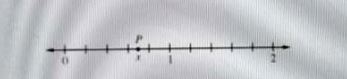
The coordinate of pointP on the number line above is x. The value of 10x is between
Rationale
The value of 10x is between 4 and 6.
The original question asks for the range of values of 10x based on the position of point P on the number line. If the value of 10x is between 4 and 6, it means that the value of x is between 0.4 and 0.6 on the number line.
A) 1 and 4 This option would imply that the value of x is between 0.1 and 0.4. However, this does not match the position of point P on the number line as shown in the question. Hence, this choice is incorrect.
B) 4 and 6 This option suggests that the value of x lies between 0.4 and 0.6. This is consistent with the position of point P on the number line. Therefore, this choice is the correct answer.
C) 6 and 8 If 10x was between 6 and 8, then x would be between 0.6 and 0.8. This range does not correspond with the position of point P on the number line. Therefore, this choice is not correct.
D) 8 and 12 This option would indicate that the value of x is between 0.8 and 1.2. However, this does not align with the position of point P on the number line as shown in the question. Hence, this choice is incorrect.
Conclusion The value of x is determined by the position of point P on the number line. By multiplying x by 10, we can find the range of values that 10x can take. Based on the position of point P, the value of 10x falls between 4 and 6, which implies that x is between 0.4 and 0.6. The other choices do not match with the position of point P, making them incorrect. Therefore, the correct answer is 'B) 4 and 6'.
2(1/2 + 1/3) =
Rationale
1(2/3)
To simplify the given expression, start by adding the two fractions inside the parentheses. Finding a common denominator of 6, you get 5/6. Multiplying this result by 2 gives 10/6, which simplifies to 1(2/3).
B) 1(5/6) Adding 2/3 and 1/3 gives 3/3, which simplifies to 1. Multiplying 1 by 1 gives the correct answer of 1(2/3), not 1(5/6).
C) 2(1/6) This choice is incorrect as it does not represent the result of simplifying the expression 2(1/2 + 1/3).
D) 2(5/6) Multiplying 2 by the sum of 1/2 and 1/3 results in 2(5/6), which is not the correct answer after simplification.
Conclusion The correct answer is 1(2/3) as the expression simplifies to 1(2/3) when the fractions are added and the result is multiplied by 2. It is essential to follow the order of operations, performing addition before multiplication, to arrive at the accurate solution.
The repeating decimal 0.111... is equivalent to
Rationale
The repeating decimal 0.111... is equivalent to 1/9.
The repeating decimal 0.111... can be expressed as a fraction by recognizing the pattern that emerges when multiplying the decimal by 10. This manipulation reveals that the decimal is equal to 1/9, as it represents a perpetual sum of 1/10, 1/100, and so on, converging to this fraction.
A) 1/7 The fraction 1/7 results in a repeating decimal of approximately 0.142857..., which does not match the repeating decimal 0.111.... Therefore, this choice is incorrect as it represents a different value altogether.
B) 1/9 This is the correct answer. The decimal 0.111... can be converted into a fraction by understanding that it represents the sum of the infinite series 1/10 + 1/100 + 1/1000 + ..., which converges to 1/9. Thus, 0.111... is indeed equal to 1/9.
C) 1/10 The fraction 1/10 equals 0.1, which clearly does not repeat and is distinctly different from 0.111.... Consequently, this choice does not represent the same value as the repeating decimal.
D) 1/11 The fraction 1/11 results in a repeating decimal of approximately 0.090909..., which is also unrelated to the decimal 0.111.... Hence, this option is incorrect because it denotes a different numerical value.
Conclusion The repeating decimal 0.111... is mathematically equivalent to the fraction 1/9, derived from the infinite series representation of the decimal. Other options, such as 1/7, 1/10, and 1/11, correspond to different repeating or terminating decimals, confirming that they do not equal 0.111.... Understanding these relationships is crucial for decimal-to-fraction conversions in mathematics.
At the factory where he works, Mr. Lopez must make a minimum of 48 circuit boards per day. On Wednesday, he made 60 circuit boards. What percent of the required minimum did he make?
Rationale
125%
Mr. Lopez made 60 circuit boards on Wednesday, exceeding the minimum requirement of 48 boards. To calculate the percentage he made over the minimum, divide the actual number made by the required minimum and multiply by 100: (60 boards / 48 boards) * 100 = 125%.
A) 125% This is the correct answer. By producing 60 circuit boards when the minimum required was 48, Mr. Lopez surpassed the target by 25%.
B) 112% This choice is incorrect. The calculation shows that Mr. Lopez made 125% of the required minimum, not 112%.
C) 80% This option is incorrect. Mr. Lopez actually made 125% of the minimum, not 80%.
D) 25% This option is incorrect. Mr. Lopez's production level was 125% of the required minimum, not 25%.
Conclusion Mr. Lopez exceeded his daily minimum production goal by making 60 circuit boards, which is 125% of the required 48 boards. This indicates that he produced 25% more than the minimum amount, showcasing his efficiency and productivity on that particular day at the factory.
Kayla has a stack of photographs that is 20 centimeters high. If each photograph is 0.04 cm thick, how many photos are there in the stack?
Rationale
There are 500 photos in Kayla's stack.
The number of photos can be calculated by dividing the total height of the stack (20 cm) by the thickness of each photograph (0.04 cm). The result is 500.
A) 8 This answer would be correct if each photograph was 2.5 cm thick, but the thickness of each photograph is given as 0.04 cm. Therefore, this option is incorrect.
B) 50 This answer would be correct if each photograph was 0.4 cm thick. However, the thickness of each photograph is given as 0.04 cm. Hence, this option is incorrect.
C) 80 This answer would make sense if each photograph was 0.25 cm thick. However, the thickness of each photo is given as 0.04 cm. Therefore, this choice is not correct.
D) 500 This is the correct answer. If each photograph is 0.04 cm thick, then 500 photographs would form a stack 20 cm high. This is derived by dividing the total height of the stack (20 cm) by the thickness of each photo (0.04 cm).
Conclusion To find the number of photographs in Kayla's stack, one must divide the total height of the stack by the thickness of each photograph. With a stack height of 20 cm and each photograph being 0.04 cm thick, the calculation results in 500 photos. Therefore, the other options (8, 50, and 80) would only be correct if the thickness of each photograph was different, which it is not.
John worked at a bookstore for two weeks. The second week he earned 20 percent more than he did the first week. If he earned $300 the second week, how much did he earn the first week?
Rationale
John earned $250 the first week.
In order to calculate how much John earned in the first week, we need to realize from the question that the second week's earnings are 120% of the first week's earnings, because he earned 20% more than he did the first week. Therefore, to find the first week's earnings, we divide the second week's earnings by 1.20 (which represents 120%).
A) 240 If we assume that John earned $240 the first week, his earnings for the second week would be $240 plus 20% of $240, which equals $288. This does not match the given information that he earned $300 the second week.
B) 250 If John earned $250 the first week, then his earnings for the second week would be $250 plus 20% of $250, which equals $300. This matches the information given in the question.
C) 280 If we assume that John earned $280 the first week, his earnings for the second week would be $280 plus 20% of $280, which equals $336. This does not match the given information that he earned $300 the second week.
D) 380 If John earned $380 the first week, then his earnings for the second week would actually decrease, not increase. The question states that John earned more in the second week, so this cannot be correct.
Conclusion Given that John's earnings in the second week were 20% higher than the first week and equaled $300, we can conclude that his earnings for the first week were $250. This is confirmed by calculating 20% of $250 and adding it to the base $250, resulting in the second week's earnings of $300. The other options either result in incorrect calculations or contradict the information given in the question.
3/5 + 3/8 =
Rationale
3/5 + 3/8 equals 0.975.
To find the sum of 3/5 and 3/8, we first convert both fractions to a common denominator and then add them together, resulting in 0.975.
A) 0.225 This value does not represent the sum of 3/5 and 3/8. Instead, it is significantly lower than the expected result, indicating a misunderstanding of the addition of fractions.
B) 0.875 While this value is closer to the correct answer, it still does not accurately reflect the sum of 3/5 and 3/8. A common mistake could involve incorrect fraction addition or decimal conversion.
C) 0.975 This is the correct answer, as it accurately represents the sum of the two fractions. After converting 3/5 to 24/40 and 3/8 to 15/40, their sum becomes 39/40, which converts to 0.975 in decimal form.
D) 1.225 This choice exceeds the correct sum and indicates an incorrect calculation. It suggests an error, possibly in misadding the fractions or misinterpreting the results of the addition.
Conclusion To correctly add 3/5 and 3/8, one must first find a common denominator, which leads to the result of 0.975. Miscalculations or errors in fraction addition can lead to incorrect answers, such as 0.225, 0.875, or 1.225, highlighting the importance of careful arithmetic procedures in obtaining accurate results.
3(1/2) * 2(1/3) =
Rationale
A) 8(1/6)
To solve this multiplication of mixed numbers, convert each mixed number to an improper fraction first. Then multiply the fractions together to get the result. In this case, 3(1/2) is equivalent to 7/2 and 2(1/3) is equivalent to 7/3. Multiplying these fractions yields 49/6, which can be simplified to 8(1/6).
B) 7(5/6) This choice does not represent the correct result of the multiplication. It seems to combine the whole number parts of the mixed numbers without correctly calculating the fractional components.
C) 6(1/6) This option does not align with the correct solution obtained by multiplying 3(1/2) and 2(1/3). It appears to be a random combination of numbers without following the proper arithmetic operations.
D) 5(5/6) This choice does not match the correct product of 3(1/2) and 2(1/3). It seems to be a result obtained from a different calculation or a misunderstanding of how to multiply mixed numbers.
Conclusion The correct answer to the multiplication of 3(1/2) and 2(1/3) is 8(1/6). By converting the mixed numbers to improper fractions and multiplying them together, the result simplifies to 8(1/6). Understanding how to work with mixed numbers and fractions is crucial for accurately solving mathematical operations involving these types of numbers.
The chart above shows the store's cost and list price for three models of stoves sold by an appliance store.
During a 20 percent off sale, Gene bought a Model Y stove from this store. How much profit did the store make on Gene's purchase? (Profit = Price paid - Store's cost)
Rationale
The store made a profit of $760 on Gene's purchase of the Model Y stove.
This is calculated by subtracting the store's cost for the Model Y stove from the price Gene paid during the 20 percent off sale.
A) $260 This option is incorrect because it does not accurately reflect the difference between the price Gene paid and the store's cost for the Model Y stove. It seems to consider the 20% off sale but doesn't accurately represent the store's profit.
B) $380 This choice is incorrect as it doesn't accurately depict the profit made by the store on Gene's purchase of the Model Y stove. It may be a result of incorrectly calculating the discount or misunderstanding the profit calculation.
C) $590 This option is also incorrect. It seems to result from an incorrect calculation of the discount on the list price or an inaccurate calculation of the profit itself.
D) $760 This is the correct answer. It accurately reflects the profit made by the store on Gene's purchase of the Model Y stove after the 20% discount on the list price.
Conclusion In determining the profit made from the sale of an item, it is crucial to subtract the store's cost from the actual price paid by the customer. In this case, with Gene purchasing the Model Y stove during a 20 percent off sale, the store made a profit of $760. This amount is obtained by subtracting the store's cost from the discounted price paid by Gene. The other options are incorrect as they do not accurately represent the profit calculation based on the given information.
1 is 3 percent of what number?
Rationale
1 is 3 percent of 33,1/3.
To calculate what number a certain percentage of a number is, you divide the number by the percentage and multiply by 100. If 1 is 3% of a number, you divide 1 by 3 and multiply by 100, which gives you 33,1/3.
A) 1/3 1 is not 3 percent of 1/3. If you multiply 1/3 by 3 percent, you get 0.01, which is not equal to 1.
B) 3 1 is not 3 percent of 3. If you multiply 3 by 3 percent, you get 0.09, which is not equal to 1.
C) 30 1 is not 3 percent of 30. If you multiply 30 by 3 percent, you get 0.9, which is not equal to 1.
D) 33,1/3 1 is 3 percent of 33,1/3. If you multiply 33,1/3 by 3 percent, you get 1.
Conclusion In order to find what number a percentage of a number is, you need to divide the number by the percentage and multiply by 100. In this case, 1 divided by 3 percent and multiplied by 100 gives 33,1/3. Therefore, 1 is 3 percent of 33,1/3.
1,500 * (15 + 5) =
Rationale
A) 75 is the correct answer.
By following the order of operations, which is parentheses, exponents, multiplication and division (from left to right), addition and subtraction (from left to right) (PEMDAS), the calculation should be done as follows: First, add the numbers in the parentheses (15 + 5 = 20). Then, divide 1,500 by 20, which results in 75.
A) 75 This is the correct answer. After adding the numbers within the parentheses (15 + 5 = 20) and then dividing 1,500 by this sum, the result is 75.
B) 130 This answer would be the result if you first divided 1,500 by 15, and then added 5. However, this does not follow the order of operations (PEMDAS), which states that addition within parentheses should be performed before division.
C) 315 This answer might be reached if you first divided 1,500 by 15 and then multiplied the result by 5. However, this does not follow the order of operations (PEMDAS), which clearly states that operations inside parentheses should be performed before division.
D) 400 This answer might result from incorrectly dividing 1,500 by the sum of 15 and 5 without first adding the numbers in the parentheses, which is not in accordance with the order of operations (PEMDAS).
Conclusion The correct answer is A) 75, which is obtained by first adding the numbers within the parentheses (15 + 5) to get 20, and then dividing 1,500 by this sum. Answers B) 130, C) 315, and D) 400 are incorrect because they do not follow the order of operations (PEMDAS). To correctly solve this problem, you must perform operations in the following order: parentheses, exponents, multiplication and division (from left to right), addition and subtraction (from left to right).
½% of 20 is?
Rationale
1/10 is the correct answer.
In the context of this question, 1/2% of 20 is equivalent to 1/10. The calculation is performed by multiplying 20 by 0.005 (which is the decimal equivalent of 1/2%).
A) 1/10 This is the correct answer. You calculate 1/2% of a number by multiplying that number by 0.005. In this case, 20 times 0.005 equals 0.1, or 1/10.
B) 1/4 This is incorrect. Multiplying 20 by 0.005 results in 0.1 (or 1/10), not 1/4.
C) 5 This is incorrect. 5 would represent 25% of 20, not 1/2%. To get 1/2% of 20, you need to multiply 20 by 0.005, which equals 0.1 (or 1/10).
D) 10 This is incorrect. 10 would be half of 20, which is 50%, not 1/2%. To calculate 1/2% of 20, you should multiply 20 by 0.005, which results in 0.1 (or 1/10).
Conclusion In conclusion, 1/2% of 20 is calculated by multiplying 20 by 0.005, which results in 0.1 or 1/10. All other answer choices represent incorrect calculations of 1/2% of 20. Understanding the conversion of percentages to decimals and applying basic multiplication are crucial in solving this type of problem.
Which of the following is equivalent to 0.755?
Rationale
151/200 is equivalent to 0.755.
To determine the decimal equivalent of the fraction 151/200, divide 151 by 200, which results in 0.755. This shows that 151/200 accurately represents the decimal value in question.
A) 51/100 Calculating 51/100 gives 0.51, which is significantly less than 0.755. Therefore, this fraction does not equate to the given decimal.
B) 03\04 The fraction 03/04 simplifies to 0.75. While this value is close to 0.755, it is not equal, making this option incorrect.
C) 151/200 As previously mentioned, 151 divided by 200 equals 0.755, confirming that this fraction is indeed equivalent to the decimal value given in the question.
D) 07\10 Calculating 07/10 results in 0.7, which is less than 0.755. Thus, this option does not represent the same value as the decimal in question.
Conclusion The only fraction among the options that accurately equates to 0.755 is 151/200. The other choices yield decimal values that are either lower than or distinct from 0.755, demonstrating the importance of precise calculations in determining equivalence between fractions and their decimal representations.
7.5/0.125 =
Rationale
7.5 divided by 0.125 equals 60.
To find the result of 7.5 divided by 0.125, we can convert the division into a multiplication by the reciprocal, which gives us 7.5 * 8 = 60. This calculation confirms that the correct answer is indeed 60.
A) 60 This choice correctly represents the result of the division. When dividing 7.5 by 0.125, it is equivalent to multiplying 7.5 by 8 (the reciprocal of 0.125), which yields 60.
B) 90 This option suggests an incorrect calculation. If 7.5 were to equal 90 when divided by 0.125, it would imply that 0.125 equals 0.0833, which is not true. The actual division yields a much lower result, highlighting a misunderstanding of basic division.
C) 0.6 This answer is inaccurate since dividing a larger number (7.5) by a smaller number (0.125) cannot yield a value less than 1. The correct division straightforwardly confirms a value that is significantly higher than 0.6.
D) 01\06 This choice appears to be a typographical error or a misrepresentation of a numerical value. If intended to express a fraction or decimal, it does not provide a valid answer to the division problem. The correct answer is a whole number, further underscoring the incorrectness of this option.
Conclusion The division of 7.5 by 0.125 yields a clear and precise result of 60, demonstrating the fundamental principle of dividing numbers. The other options either miscalculate the division or present values that do not logically fit within the context of the operation, reinforcing that understanding the mechanics of division is crucial for accurate mathematical outcomes.
If 40 is 20 percent of a number, then the number is what percent of 40?
Rationale
500%
To find what percent the number is of 40, we first determine the original number. Since 40 is 20 percent of this number, we can set up the equation: \( 40 = 0.2 \times \text{number} \). Solving for the number gives us 200. Next, to find what percent 200 is of 40, we calculate \( \frac{200}{40} \times 100 = 500\% \).
A) 500% This choice is correct because 200 is indeed 500% of 40, as established by the calculation. The relationship between the two numbers confirms that 200 divided by 40 equals 5, which translates to 500% when expressed as a percentage.
B) 200% This option is incorrect because if we mistakenly considered 200 to be 200% of 40, it would imply that 40 is half of 200. In reality, 200 is actually five times greater than 40, not just double.
C) 80% This choice is incorrect because 80% of 40 would yield 32, not 200. This percentage does not reflect the relationship between the original number (200) and 40, thus failing to represent the intended calculation.
D) 20% This option is incorrect since 20% of 200 is 40, but we are asked what percent 200 is of 40. This misunderstanding leads to an incorrect conclusion about the relationship between the two numbers.
Conclusion The relationship between the numbers reveals that 200 is 500% of 40, confirming the calculations align with the original question. Understanding percentage calculations in this way clarifies how to compare values effectively, ensuring accurate interpretations of numerical relationships.
The coordinate of pointP on the number line above is x. The value of 10x is between
Rationale
The value of 10x is between 4 and 6.
The original question asks for the range of values of 10x based on the position of point P on the number line. If the value of 10x is between 4 and 6, it means that the value of x is between 0.4 and 0.6 on the number line.
A) 1 and 4 This option would imply that the value of x is between 0.1 and 0.4. However, this does not match the position of point P on the number line as shown in the question. Hence, this choice is incorrect.
B) 4 and 6 This option suggests that the value of x lies between 0.4 and 0.6. This is consistent with the position of point P on the number line. Therefore, this choice is the correct answer.
C) 6 and 8 If 10x was between 6 and 8, then x would be between 0.6 and 0.8. This range does not correspond with the position of point P on the number line. Therefore, this choice is not correct.
D) 8 and 12 This option would indicate that the value of x is between 0.8 and 1.2. However, this does not align with the position of point P on the number line as shown in the question. Hence, this choice is incorrect.
Conclusion The value of x is determined by the position of point P on the number line. By multiplying x by 10, we can find the range of values that 10x can take. Based on the position of point P, the value of 10x falls between 4 and 6, which implies that x is between 0.4 and 0.6. The other choices do not match with the position of point P, making them incorrect. Therefore, the correct answer is 'B) 4 and 6'.
2(1/2 + 1/3) =
Rationale
1(2/3)
To simplify the given expression, start by adding the two fractions inside the parentheses. Finding a common denominator of 6, you get 5/6. Multiplying this result by 2 gives 10/6, which simplifies to 1(2/3).
B) 1(5/6) Adding 2/3 and 1/3 gives 3/3, which simplifies to 1. Multiplying 1 by 1 gives the correct answer of 1(2/3), not 1(5/6).
C) 2(1/6) This choice is incorrect as it does not represent the result of simplifying the expression 2(1/2 + 1/3).
D) 2(5/6) Multiplying 2 by the sum of 1/2 and 1/3 results in 2(5/6), which is not the correct answer after simplification.
Conclusion The correct answer is 1(2/3) as the expression simplifies to 1(2/3) when the fractions are added and the result is multiplied by 2. It is essential to follow the order of operations, performing addition before multiplication, to arrive at the accurate solution.
The repeating decimal 0.111... is equivalent to
Rationale
The repeating decimal 0.111... is equivalent to 1/9.
The repeating decimal 0.111... can be expressed as a fraction by recognizing the pattern that emerges when multiplying the decimal by 10. This manipulation reveals that the decimal is equal to 1/9, as it represents a perpetual sum of 1/10, 1/100, and so on, converging to this fraction.
A) 1/7 The fraction 1/7 results in a repeating decimal of approximately 0.142857..., which does not match the repeating decimal 0.111.... Therefore, this choice is incorrect as it represents a different value altogether.
B) 1/9 This is the correct answer. The decimal 0.111... can be converted into a fraction by understanding that it represents the sum of the infinite series 1/10 + 1/100 + 1/1000 + ..., which converges to 1/9. Thus, 0.111... is indeed equal to 1/9.
C) 1/10 The fraction 1/10 equals 0.1, which clearly does not repeat and is distinctly different from 0.111.... Consequently, this choice does not represent the same value as the repeating decimal.
D) 1/11 The fraction 1/11 results in a repeating decimal of approximately 0.090909..., which is also unrelated to the decimal 0.111.... Hence, this option is incorrect because it denotes a different numerical value.
Conclusion The repeating decimal 0.111... is mathematically equivalent to the fraction 1/9, derived from the infinite series representation of the decimal. Other options, such as 1/7, 1/10, and 1/11, correspond to different repeating or terminating decimals, confirming that they do not equal 0.111.... Understanding these relationships is crucial for decimal-to-fraction conversions in mathematics.
At the factory where he works, Mr. Lopez must make a minimum of 48 circuit boards per day. On Wednesday, he made 60 circuit boards. What percent of the required minimum did he make?
Rationale
125%
Mr. Lopez made 60 circuit boards on Wednesday, exceeding the minimum requirement of 48 boards. To calculate the percentage he made over the minimum, divide the actual number made by the required minimum and multiply by 100: (60 boards / 48 boards) * 100 = 125%.
A) 125% This is the correct answer. By producing 60 circuit boards when the minimum required was 48, Mr. Lopez surpassed the target by 25%.
B) 112% This choice is incorrect. The calculation shows that Mr. Lopez made 125% of the required minimum, not 112%.
C) 80% This option is incorrect. Mr. Lopez actually made 125% of the minimum, not 80%.
D) 25% This option is incorrect. Mr. Lopez's production level was 125% of the required minimum, not 25%.
Conclusion Mr. Lopez exceeded his daily minimum production goal by making 60 circuit boards, which is 125% of the required 48 boards. This indicates that he produced 25% more than the minimum amount, showcasing his efficiency and productivity on that particular day at the factory.
Kayla has a stack of photographs that is 20 centimeters high. If each photograph is 0.04 cm thick, how many photos are there in the stack?
Rationale
There are 500 photos in Kayla's stack.
The number of photos can be calculated by dividing the total height of the stack (20 cm) by the thickness of each photograph (0.04 cm). The result is 500.
A) 8 This answer would be correct if each photograph was 2.5 cm thick, but the thickness of each photograph is given as 0.04 cm. Therefore, this option is incorrect.
B) 50 This answer would be correct if each photograph was 0.4 cm thick. However, the thickness of each photograph is given as 0.04 cm. Hence, this option is incorrect.
C) 80 This answer would make sense if each photograph was 0.25 cm thick. However, the thickness of each photo is given as 0.04 cm. Therefore, this choice is not correct.
D) 500 This is the correct answer. If each photograph is 0.04 cm thick, then 500 photographs would form a stack 20 cm high. This is derived by dividing the total height of the stack (20 cm) by the thickness of each photo (0.04 cm).
Conclusion To find the number of photographs in Kayla's stack, one must divide the total height of the stack by the thickness of each photograph. With a stack height of 20 cm and each photograph being 0.04 cm thick, the calculation results in 500 photos. Therefore, the other options (8, 50, and 80) would only be correct if the thickness of each photograph was different, which it is not.
John worked at a bookstore for two weeks. The second week he earned 20 percent more than he did the first week. If he earned $300 the second week, how much did he earn the first week?
Rationale
John earned $250 the first week.
In order to calculate how much John earned in the first week, we need to realize from the question that the second week's earnings are 120% of the first week's earnings, because he earned 20% more than he did the first week. Therefore, to find the first week's earnings, we divide the second week's earnings by 1.20 (which represents 120%).
A) 240 If we assume that John earned $240 the first week, his earnings for the second week would be $240 plus 20% of $240, which equals $288. This does not match the given information that he earned $300 the second week.
B) 250 If John earned $250 the first week, then his earnings for the second week would be $250 plus 20% of $250, which equals $300. This matches the information given in the question.
C) 280 If we assume that John earned $280 the first week, his earnings for the second week would be $280 plus 20% of $280, which equals $336. This does not match the given information that he earned $300 the second week.
D) 380 If John earned $380 the first week, then his earnings for the second week would actually decrease, not increase. The question states that John earned more in the second week, so this cannot be correct.
Conclusion Given that John's earnings in the second week were 20% higher than the first week and equaled $300, we can conclude that his earnings for the first week were $250. This is confirmed by calculating 20% of $250 and adding it to the base $250, resulting in the second week's earnings of $300. The other options either result in incorrect calculations or contradict the information given in the question.
You are leaving this quiz
What would you like to do with your progress?
You're in the middle of a quiz
What would you like to do before switching?
Practice complete
You finished this free practice quiz.