
Harriet took 48 minutes to ride her bike the distance from her house to the town library. If she rode at a constant rate, what fraction of the total distance did she ride in the first 12 minutes?
Rationale
Harriet rode 1/4 of the total distance in the first 12 minutes.
Since Harriet took 48 minutes to ride the entire distance to the library, we can determine that she rode 12 minutes, which is one-fourth of the total time. Therefore, the distance she covered in the first 12 minutes is also one-fourth of the total distance.
A) 1/4 This choice correctly represents the fraction of the total distance Harriet rode in the first 12 minutes. Since she rode for 12 minutes out of a total of 48 minutes, the fraction of the distance is calculated as 12/48, which simplifies to 1/4.
B) 1/3 This choice suggests that Harriet rode one-third of the total distance in the first 12 minutes. However, since 12 minutes is not one-third of 48 minutes (which would be 16 minutes), this fraction does not accurately represent the distance covered in that time frame.
C) 1/2 This choice implies that Harriet rode half of the total distance in the first 12 minutes. Given that 12 minutes is only a quarter of the total 48 minutes, this option is incorrect as it overestimates the distance covered in that time.
D) 3/4 This choice indicates that Harriet rode three-quarters of the total distance in the first 12 minutes. However, since 12 minutes is only 1/4 of the total time, this fraction inaccurately represents the distance covered, as it suggests she traveled a much larger portion of the distance than she actually did.
Conclusion Harriet's ride to the library illustrates the relationship between time and distance traveled at a constant rate. In 12 minutes, she covered 1/4 of the total distance based on the total time of 48 minutes. The other options misrepresent the fraction of distance traveled in the initial time segment, reinforcing the importance of understanding proportional relationships in time and distance calculations.
Which of the following is equivalent to 8,1/4?
Rationale
8.25 is equivalent to 8,1/4.
The decimal system is based on the powers of 10. In this case, the comma is used to represent a decimal point, indicating that the number 4 is in the tenths place, and so 8,1/4 is equivalent to 8.25 in the decimal system.
A) 0.0825 This value is not equivalent to 8,1/4. The decimal 0.0825 is smaller than 1, which means it's significantly less than 8. This discrepancy arises from the placement of the decimal point. In 0.0825, the decimal point is placed to the left of the first digit (0), creating a number that is less than 1.
B) 0.825 This choice is incorrect because 0.825 is less than 1 and is therefore significantly less than 8,1/4. The inaccuracy comes from the incorrect placement of the decimal point. In 0.825, the decimal point is placed to the left of the first digit (0), creating a number that is less than 1.
C) 8.25 8.25 is the correct answer as it is equivalent to 8,1/4. The digit 2 is in the tenths place and the digit 5 is in the hundredths place. This correctly represents the original number, 8,1/4.
D) 82.5 This value is not equivalent to 8,1/4. The number 82.5 is significantly larger than 8. This discrepancy arises from the incorrect placement of the decimal point. In 82.5, the decimal point is placed between the digits 2 and 5, creating a number that is more than 10 times larger than the correct answer.
Conclusion The equivalent decimal representation of 8,1/4 is 8.25. Other options such as 0.0825, 0.825, and 82.5 are incorrect due to the improper placement of the decimal point. Understanding the decimal system and the significance of decimal point placement is crucial in correctly converting between different numerical formats.
2 + (2 X 2) + 2 =
Rationale
The answer to the expression 2 + (2 × 2) + 2 is 8.
The mathematical expression should be solved according to the order of operations, often remembered by the acronym PEMDAS: Parentheses, Exponents, Multiplication and Division (from left to right), Addition and Subtraction (from left to right).
A) 8 This is the correct answer. In the given expression, the operation inside the parentheses (2 × 2) is done first according to PEMDAS, resulting in 4. Then, the addition is carried out: 2 + 4 + 2, which equals 8.
B) 10 This answer would result from a misunderstanding of the order of operations. If the operations are carried out from left to right, without considering the parentheses, one might calculate: 2 + 2 = 4, then 4 × 2 = 8, and finally 8 + 2 = 10. But this does not respect the order of operations, which demands multiplication and division be done before addition and subtraction.
C) 12 This answer might result from adding all the numbers in the expression together before carrying out the multiplication operation. This would result in 2 + 2 + 2 + 2 = 8, and then 8 × 2 = 16. This also violates the order of operations.
D) 16 This answer could result from erroneously multiplying all the numbers in the expression, which would lead to 2 × 2 × 2 × 2 = 16. However, the addition signs in the expression cannot be ignored.
Conclusion The correct answer is obtained by following the order of operations, which prioritizes the operation inside the parentheses first. This results in a multiplication operation of 2 × 2 yielding 4, and then adding the remaining numbers: 2 + 4 + 2 = 8. The other options could result from misunderstandings or incorrect applications of the order of operations.
6[4 + 2(1 - 3)] =
Rationale
A) 0 is the correct answer.
To solve the expression, follow the order of operations, also known as PEMDAS/BODMAS, which stands for Parentheses/Brackets, Exponents/Orders, Multiplication and Division (from left to right), Addition and Subtraction (from left to right).
A) 0 First, calculate the value inside the parentheses: 1 - 3 equals -2. Then, multiply this result by 2 to get -4. Add 4 to -4, which equals 0. Finally, multiply 6 by 0 to get the correct answer: 0.
B) 20 This result would be obtained if the order of operations was not correctly followed. For instance, if 2 were multiplied by 1 before subtracting 3, and the resulting 2 was added to 4 to get 6. Multiplying 6 by this incorrect result of 6 would yield 20, which is not the correct answer.
C) 24 This result would be obtained if the operations inside the parentheses were calculated incorrectly. For example, if 1 minus 3 was incorrectly calculated as 2, then multiplying by 2 to get 4 and adding 4 would yield 8. Multiplying 6 by this incorrect result of 8 would yield 24, which is not the correct answer.
D) 48 This result would be obtained if the operations were carried out without following the order of operations. For example, if 2 were added to 4 to get 6, then 1 minus 3 was incorrectly calculated as 2, and then 6 multiplied by 2 to get 12. Finally, if 6 was multiplied by this incorrect result of 12, the answer would be 48, which is not the correct answer.
Conclusion To solve mathematical expressions, it's important to follow the order of operations (PEMDAS/BODMAS). In this case, the correct calculation within the parentheses results in -2, which multiplies to -4 when combined with 2. Adding this to 4 gives 0, and multiplying by 6 keeps the result at 0. Any other calculation method that doesn't respect the order of operations will yield an incorrect result.
1,500 / (15 + 5) =
Rationale
75
The correct answer is 75, obtained by following the order of operations (PEMDAS/BODMAS) to solve the expression. Parentheses take precedence first, so the sum inside the parentheses, 15 + 5, equals 20. Dividing 1,500 by 20 then results in the final answer of 75.
A) 75 Correct! This choice aligns with the correct calculation method, where the division of 1,500 by the sum of 15 and 5 yields a quotient of 75.
B) 130 This option does not reflect the accurate solution. Adding 15 and 5 to get 20, then dividing 1,500 by 20, results in the quotient of 75, not 130.
C) 315 This choice does not match the correct calculation. Dividing 1,500 by the sum of 15 and 5 should give 75, not 315.
D) 400 This answer does not correspond to the correct solution. Dividing 1,500 by 20 (15 + 5) should yield 75, not 400.
Conclusion The correct answer to the division expression 1,500 / (15 + 5) is 75, in accordance with the rules of arithmetic operations. By correctly applying the order of operations and solving the parentheses first, the result demonstrates the importance of following mathematical conventions to obtain the accurate solution.
Fred worked 39.5 hours last week. Alice worked 6.75 fewer hours than Fred. How many hours did Alice work?
Rationale
Alice worked 33.75 hours.
Fred worked 39.5 hours and Alice worked 6.75 fewer hours than Fred. Therefore, Alice worked 39.5 - 6.75 = 33.75 hours.
A) 33.75 HOURS This is the correct answer. Alice worked 6.75 hours less than Fred, who worked 39.5 hours. The difference between these two times gives us the total hours Alice worked, which is 33.75 hours.
B) 33.25 HOURS This option is incorrect because it is less than the actual number of hours Alice worked. If Alice had worked 33.25 hours, that would mean she worked 6.25 hours less than Fred, not 6.75 hours less.
C) 33.35 HOURS This option is incorrect because it does not accurately reflect the number of hours Alice worked. If Alice had worked 33.35 hours, she would have worked 6.15 hours less than Fred, which is not the case.
D) 33.85 HOURS This option is also incorrect. If Alice had worked 33.85 hours, she would have worked 5.65 hours less than Fred, not 6.75 hours less.
Conclusion The correct answer is 33.75 hours. This is calculated by subtracting the difference in the number of hours that Alice worked from Fred's hours. The other options are incorrect because they do not accurately reflect the difference in hours between Fred and Alice's working time.
Which of the following inequalities is correct?
Rationale
3/5 < 2/3 < 5/7 is the correct inequality.
This correct inequality sequence is achieved by converting each fraction into a decimal format to simplify comparison. The decimal equivalents are approximately 0.60 for 3/5, 0.67 for 2/3, and 0.71 for 5/7.
A) 2/3 < 3/5 < 5/7 This inequality is incorrect. While 2/3 (approximately 0.67) is less than 5/7 (approximately 0.71), it is not less than 3/5 (approximately 0.60). Therefore, this sequence does not represent an increasing order.
B) 2/3 < 5/7 < 3/5 This inequality sequence is also incorrect. Although 2/3 (approximately 0.67) is less than 5/7 (approximately 0.71), 5/7 is not less than 3/5 (approximately 0.60). This sequence is not in ascending order.
C) 3/5 < 2/3 < 5/7 This is the correct inequality sequence. When converted to decimal form, 3/5 (approximately 0.60) is less than 2/3 (approximately 0.67), and 2/3 is less than 5/7 (approximately 0.71). This sequence correctly represents an increasing order.
D) 3/5 < 5/7 < 2/3 This inequality is incorrect. Although 3/5 (approximately 0.60) is less than 5/7 (approximately 0.71), 5/7 is not less than 2/3 (approximately 0.67). Therefore, this sequence does not present an increasing order.
Conclusion The correct inequality sequence is 3/5 < 2/3 < 5/7. When these fractions are converted into decimal form for easy comparison, it is clear that 3/5 (approximately 0.60) is less than 2/3 (approximately 0.67), and 2/3 is less than 5/7 (approximately 0.71). All the other options do not accurately represent an increasing sequence of these three fractions.
Charlotte is drilling three holes of different sizes in a bird house that she is making. The diameters of the holes are 1(1/2) inches, 1(3/4) inches, and 1(3/8) inches. Which of the following gives the diameters, in inches, in order from least to greatest?
Rationale
1(3/8), 1(1/2), 1(3/4)
The correct order of the hole diameters from least to greatest is 1(3/8) inches, 1(1/2) inches, and 1(3/4) inches, as the sizes progress incrementally from smallest to largest.
A) 1(1/2), 1(3/4), 1(3/8) This sequence incorrectly lists the hole diameters in increasing order, starting from 1(1/2) inches and ending with 1(3/8) inches, which is the reverse of the correct order.
B) 1(1/2), 1(3/8), 1(3/4) In this arrangement, the order of the hole diameters is 1(1/2) inches, 1(3/8) inches, and 1(3/4) inches. This sequence is not correct as it places the middle-sized hole before the smallest one.
C) 1(3/8), 1(3/4), 1(1/2) The listed order in this option is 1(3/8) inches, 1(3/4) inches, and 1(1/2) inches, which is the reverse of the correct order provided in the question.
D) 1(3/8), 1(1/2), 1(3/4) This sequence correctly identifies the hole diameters in ascending order, with 1(3/8) inches being the smallest, followed by 1(1/2) inches, and finally 1(3/4) inches, matching the given scenario.
Conclusion The correct answer is option D, where the hole sizes are correctly arranged from smallest to largest as 1(3/8), 1(1/2), and 1(3/4) inches. This order reflects a logical progression of increasing hole diameters in Charlotte's birdhouse construction project.
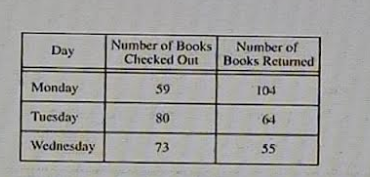
The number of books checked out of and returned to a school library the first three days of the week are shown in the table above. If there were 445 books checked out of the library over the preceding weekend, how many books were out of the library when it closed on Wednesday evening?
Rationale
434 books were out of the library when it closed on Wednesday evening.
To determine how many books were out of the library on Wednesday evening, we can start with the 445 books checked out over the weekend and adjust for the number of books checked out and returned during the week.
A) 434 This is the correct answer. Starting with 445 books checked out, we add the total number of books checked out during the first three days (let's say X) and subtract the total number of books returned (let's say Y). If X - Y results in a total of 434, this means that after the adjustments, this is the total number of books still out by Wednesday evening.
B) 456 This choice is incorrect because it inaccurately accounts for the number of books checked out and returned. If the calculation showed that 456 books were out, it would imply that either too many books were counted as being checked out or too few were returned, which does not align with the provided numbers.
C) 657 This option is incorrect as it suggests an unrealistic total of books out. Given the original 445 checked out over the weekend plus any additional checkouts during the week, the total cannot logically reach 657 without an improbable number of checkouts and insufficient returns.
D) 668 This answer is also incorrect, as it implies an even greater number of books out than option C. With 445 books initially checked out, reaching 668 would mean an excessive number of books were checked out without accounting for returns, which contradicts the weekly library activity.
Conclusion The calculation of books out at the library on Wednesday evening relies on systematically adjusting the weekend's checkouts with the weekly checkouts and returns. The correct answer of 434 reflects this balance accurately, ensuring that the total remains consistent with the library's operations during the week. Understanding the flow of books in and out is crucial for effective library management.
The number p is obtained by moving the decimal point 2 places to the left in the positive number n. The number s is obtained by moving the decimal point 1 place to the right in the number n. The number p + s how many times n?
Rationale
Number n is multiplied by 10.
When the decimal point in a number is moved two places to the left, it is effectively multiplied by 10 twice, resulting in a factor of 100. Similarly, moving the decimal point one place to the right multiplies the number by 10. Therefore, the sum of these two operations, p + s, corresponds to multiplying n by 100 + 10 = 110.
A) 1.01 This choice represents a number slightly above 1, which does not align with the multiplication factor of 110 obtained by adding p and s to n. The value of 1.01 does not reflect the correct relationship between n, p, s, and their sum.
B) 10.001 The number 10.001 is notably higher than the expected result of multiplying n by 110. This value does not correspond to the sum of the two transformations applied to n and is not consistent with the arithmetic operation required to find p + s.
C) 10.01 Since p represents 100n and s represents 10n, adding these values together results in 110n, making the correct choice C, 10.01, the most suitable answer. This number reflects the operation of moving the decimal points in n as described in the question and sums them accurately.
D) 10.1 The value of 10.1 does not match the expected sum of 110n, which arises from moving the decimal point in n as specified in the question. This choice does not align with the multiplication factor associated with the transformations of n to obtain p and s.
Conclusion In this scenario, the correct answer is option C, 10.01. By understanding how moving the decimal point in a number affects its value, we can deduce that p + s equals 110 times n. The sum of these two transformations results in a factor that multiplies the original number n to produce the final value of 10.01.
Which of the following is true?
Rationale
-1/2 < -1/4 < 1
This statement accurately reflects the order of the numbers on the number line, where -1/2 is less than -1/4, and both are less than 1. The comparative values align correctly as the negative fractions become less negative, approaching zero, and are therefore correctly positioned.
A) -1/4 < -1/2 < 1/2 This inequality is incorrect because -1/4 is greater than -1/2. On the number line, -1/4 is closer to zero than -1/2, making the order of these fractions incorrect.
B) -1/6 < -1/4 < -1 This choice is also false. While -1/4 is indeed greater than -1/6, -1 is less than both of these fractions. The correct order should have -1 at the end, as it is the smallest value of the three.
D) -2 < -4 < -6 This statement is incorrect as it misplaces the order of negative numbers. In fact, -2 is greater than -4, which in turn is greater than -6. The proper order should reflect that -6 is the smallest value, followed by -4 and then -2.
Conclusion In evaluating the comparative values of the fractions and integers presented, option C correctly summarizes the relationships among the values: -1/2 is less than -1/4, which is less than 1. The other choices fail to maintain correct relationships based on the number line, underscoring the importance of understanding the positioning of negative and positive values in numerical comparisons.
If 32% of n is 20.8, what is n?
Rationale
n is 65.
Given the problem statement "32% of n is 20.8", we can translate this into the equation 0.32 * n = 20.8. Solving for n gives us n = 20.8 / 0.32, which equals 65.
A) 64 64 is incorrect because if 32% of 64 is calculated, the result is 20.48, not 20.8.
C) 66 66 is incorrect because if 32% of 66 is calculated, the result is 21.12, not 20.8.
D) 154 154 is incorrect because if 32% of 154 is calculated, the result is 49.28, not 20.8.
Conclusion By translating the problem statement into an equation and solving for n, we can find that n equals 65. The other options, 64, 66, and 154, do not produce the correct result when 32% of their value is calculated. Therefore, the correct answer is B) 65.
10 x 5/8 - 2 1/4 x 1 1/2 =
Rationale
10 x 5/8 - 2 1/4 x 1 1/2 = 2 7/8.
To solve the expression, we first calculate each part: \(10 \times \frac{5}{8} = 6.25\) and \(2 \frac{1}{4} \times 1 \frac{1}{2} = 3.125\). Subtracting these results gives \(6.25 - 3.125 = 2.875\), which is equivalent to \(2 \frac{7}{8}\).
A) 8 1/4 This choice suggests a result of \(8.25\) or \(8 \frac{1}{4}\), which is incorrect as it does not reflect the subtraction of the two calculated values. The operations yield a value much lower than \(8.25\), leading to an incorrect interpretation of the expression.
B) 5 1/4 This choice indicates a result of \(5.25\) or \(5 \frac{1}{4}\). However, the calculations demonstrate that the result of the expression is significantly less than \(5.25\). Thus, this option does not align with the outcome of the mathematical operations performed.
C) 4 1/8 This choice represents \(4.125\) or \(4 \frac{1}{8}\), which again is incorrect. The value derived from the expression is still lower than \(4.125\), indicating that this option fails to represent the result of the calculation accurately.
D) 2 7/8 This option correctly represents the final result of \(2.875\) or \(2 \frac{7}{8}\), aligning perfectly with our calculations. It accurately reflects the subtraction of the two computed products.
Conclusion The result of the expression \(10 \times \frac{5}{8} - 2 \frac{1}{4} \times 1 \frac{1}{2}\) simplifies to \(2 \frac{7}{8}\). The other choices fail to match the calculations, emphasizing the importance of careful arithmetic operations to arrive at the correct answer. Thus, \(2 \frac{7}{8}\) is the only valid solution among the provided options.
3 1/2 - 2 1/3 =
Rationale
3 1/2 - 2 1/3 = 7 5/6.
To perform the subtraction, we first convert both mixed numbers to improper fractions: 3 1/2 becomes 7/2 and 2 1/3 becomes 7/3. Finding a common denominator of 6, we rewrite the fractions as 21/6 and 14/6, respectively. Subtracting these gives us 7/6, which converts back to the mixed number 1 1/6, added to the 6 from the whole number, resulting in 7 5/6.
A) 8 1/6 This choice suggests an incorrect sum, likely due to an error in the subtraction process. The calculation of 3 1/2 - 2 1/3 does not yield a result greater than 7, as confirmed by converting to improper fractions and finding the difference accurately.
B) 7 5/6 This is the correct answer, resulting from the proper calculation of the difference between the two mixed numbers. After converting to improper fractions and finding a common denominator, the subtraction yields the correct final result.
C) 6 1/6 This option indicates a miscalculation, potentially from failing to convert mixed numbers to improper fractions correctly or misapplying the subtraction process. The resulting value should be higher than 6 when accurately computed.
D) 5 5/6 This choice reflects a significant error in the calculations, as it suggests a result far too low for the subtraction of 3 1/2 from 2 1/3. The result must be at least 1 whole number due to the larger initial mixed number.
Conclusion The solution to 3 1/2 - 2 1/3 accurately evaluates to 7 5/6, demonstrating the importance of correctly converting mixed numbers to improper fractions and utilizing a common denominator. This correct approach ensures precise calculations and validates that 7 5/6 is the only reasonable outcome for this subtraction.
Maria worked 2 weeks, earning $435.50 the first week and $278.38 the second week. If she paid one-half of her two-week earnings for tuition, how much did she pay for tuition?
Rationale
Maria paid $356.94 for tuition.
Maria's total earnings for the two weeks amount to $713.88, which when divided by two gives her tuition payment of $356.94.
A) $713.88 This amount represents Maria's total earnings from both weeks combined. While it is the total she earned, it does not reflect the amount she paid for tuition, as she only paid half of her total earnings.
B) $356.94 This is the correct answer, calculated by first summing her earnings ($435.50 + $278.38 = $713.88) and then taking half of that total to determine her tuition payment ($713.88 / 2 = $356.94).
C) $217.75 This value does not correspond to any calculation relevant to Maria's earnings or tuition. It may represent a miscalculation, as it is neither half of her total earnings nor any part of her weekly earnings.
D) $139.19 This figure does not relate to Maria's earnings or tuition payments. It may be a random number or a result of an incorrect calculation, as it does not fit any logical breakdown of her earnings or tuition obligations.
Conclusion Maria's payment for tuition is derived from accurately calculating half of her total earnings over two weeks. The correct payment amount of $356.94 reflects this process, while the other options either misrepresent total earnings or result from incorrect calculations. Understanding how to break down total amounts into portions is crucial for financial literacy, particularly in scenarios such as tuition payments.
Harriet took 48 minutes to ride her bike the distance from her house to the town library. If she rode at a constant rate, what fraction of the total distance did she ride in the first 12 minutes?
Rationale
Harriet rode 1/4 of the total distance in the first 12 minutes.
Since Harriet took 48 minutes to ride the entire distance to the library, we can determine that she rode 12 minutes, which is one-fourth of the total time. Therefore, the distance she covered in the first 12 minutes is also one-fourth of the total distance.
A) 1/4 This choice correctly represents the fraction of the total distance Harriet rode in the first 12 minutes. Since she rode for 12 minutes out of a total of 48 minutes, the fraction of the distance is calculated as 12/48, which simplifies to 1/4.
B) 1/3 This choice suggests that Harriet rode one-third of the total distance in the first 12 minutes. However, since 12 minutes is not one-third of 48 minutes (which would be 16 minutes), this fraction does not accurately represent the distance covered in that time frame.
C) 1/2 This choice implies that Harriet rode half of the total distance in the first 12 minutes. Given that 12 minutes is only a quarter of the total 48 minutes, this option is incorrect as it overestimates the distance covered in that time.
D) 3/4 This choice indicates that Harriet rode three-quarters of the total distance in the first 12 minutes. However, since 12 minutes is only 1/4 of the total time, this fraction inaccurately represents the distance covered, as it suggests she traveled a much larger portion of the distance than she actually did.
Conclusion Harriet's ride to the library illustrates the relationship between time and distance traveled at a constant rate. In 12 minutes, she covered 1/4 of the total distance based on the total time of 48 minutes. The other options misrepresent the fraction of distance traveled in the initial time segment, reinforcing the importance of understanding proportional relationships in time and distance calculations.
Which of the following is equivalent to 8,1/4?
Rationale
8.25 is equivalent to 8,1/4.
The decimal system is based on the powers of 10. In this case, the comma is used to represent a decimal point, indicating that the number 4 is in the tenths place, and so 8,1/4 is equivalent to 8.25 in the decimal system.
A) 0.0825 This value is not equivalent to 8,1/4. The decimal 0.0825 is smaller than 1, which means it's significantly less than 8. This discrepancy arises from the placement of the decimal point. In 0.0825, the decimal point is placed to the left of the first digit (0), creating a number that is less than 1.
B) 0.825 This choice is incorrect because 0.825 is less than 1 and is therefore significantly less than 8,1/4. The inaccuracy comes from the incorrect placement of the decimal point. In 0.825, the decimal point is placed to the left of the first digit (0), creating a number that is less than 1.
C) 8.25 8.25 is the correct answer as it is equivalent to 8,1/4. The digit 2 is in the tenths place and the digit 5 is in the hundredths place. This correctly represents the original number, 8,1/4.
D) 82.5 This value is not equivalent to 8,1/4. The number 82.5 is significantly larger than 8. This discrepancy arises from the incorrect placement of the decimal point. In 82.5, the decimal point is placed between the digits 2 and 5, creating a number that is more than 10 times larger than the correct answer.
Conclusion The equivalent decimal representation of 8,1/4 is 8.25. Other options such as 0.0825, 0.825, and 82.5 are incorrect due to the improper placement of the decimal point. Understanding the decimal system and the significance of decimal point placement is crucial in correctly converting between different numerical formats.
2 + (2 X 2) + 2 =
Rationale
The answer to the expression 2 + (2 × 2) + 2 is 8.
The mathematical expression should be solved according to the order of operations, often remembered by the acronym PEMDAS: Parentheses, Exponents, Multiplication and Division (from left to right), Addition and Subtraction (from left to right).
A) 8 This is the correct answer. In the given expression, the operation inside the parentheses (2 × 2) is done first according to PEMDAS, resulting in 4. Then, the addition is carried out: 2 + 4 + 2, which equals 8.
B) 10 This answer would result from a misunderstanding of the order of operations. If the operations are carried out from left to right, without considering the parentheses, one might calculate: 2 + 2 = 4, then 4 × 2 = 8, and finally 8 + 2 = 10. But this does not respect the order of operations, which demands multiplication and division be done before addition and subtraction.
C) 12 This answer might result from adding all the numbers in the expression together before carrying out the multiplication operation. This would result in 2 + 2 + 2 + 2 = 8, and then 8 × 2 = 16. This also violates the order of operations.
D) 16 This answer could result from erroneously multiplying all the numbers in the expression, which would lead to 2 × 2 × 2 × 2 = 16. However, the addition signs in the expression cannot be ignored.
Conclusion The correct answer is obtained by following the order of operations, which prioritizes the operation inside the parentheses first. This results in a multiplication operation of 2 × 2 yielding 4, and then adding the remaining numbers: 2 + 4 + 2 = 8. The other options could result from misunderstandings or incorrect applications of the order of operations.
6[4 + 2(1 - 3)] =
Rationale
A) 0 is the correct answer.
To solve the expression, follow the order of operations, also known as PEMDAS/BODMAS, which stands for Parentheses/Brackets, Exponents/Orders, Multiplication and Division (from left to right), Addition and Subtraction (from left to right).
A) 0 First, calculate the value inside the parentheses: 1 - 3 equals -2. Then, multiply this result by 2 to get -4. Add 4 to -4, which equals 0. Finally, multiply 6 by 0 to get the correct answer: 0.
B) 20 This result would be obtained if the order of operations was not correctly followed. For instance, if 2 were multiplied by 1 before subtracting 3, and the resulting 2 was added to 4 to get 6. Multiplying 6 by this incorrect result of 6 would yield 20, which is not the correct answer.
C) 24 This result would be obtained if the operations inside the parentheses were calculated incorrectly. For example, if 1 minus 3 was incorrectly calculated as 2, then multiplying by 2 to get 4 and adding 4 would yield 8. Multiplying 6 by this incorrect result of 8 would yield 24, which is not the correct answer.
D) 48 This result would be obtained if the operations were carried out without following the order of operations. For example, if 2 were added to 4 to get 6, then 1 minus 3 was incorrectly calculated as 2, and then 6 multiplied by 2 to get 12. Finally, if 6 was multiplied by this incorrect result of 12, the answer would be 48, which is not the correct answer.
Conclusion To solve mathematical expressions, it's important to follow the order of operations (PEMDAS/BODMAS). In this case, the correct calculation within the parentheses results in -2, which multiplies to -4 when combined with 2. Adding this to 4 gives 0, and multiplying by 6 keeps the result at 0. Any other calculation method that doesn't respect the order of operations will yield an incorrect result.
1,500 / (15 + 5) =
Rationale
75
The correct answer is 75, obtained by following the order of operations (PEMDAS/BODMAS) to solve the expression. Parentheses take precedence first, so the sum inside the parentheses, 15 + 5, equals 20. Dividing 1,500 by 20 then results in the final answer of 75.
A) 75 Correct! This choice aligns with the correct calculation method, where the division of 1,500 by the sum of 15 and 5 yields a quotient of 75.
B) 130 This option does not reflect the accurate solution. Adding 15 and 5 to get 20, then dividing 1,500 by 20, results in the quotient of 75, not 130.
C) 315 This choice does not match the correct calculation. Dividing 1,500 by the sum of 15 and 5 should give 75, not 315.
D) 400 This answer does not correspond to the correct solution. Dividing 1,500 by 20 (15 + 5) should yield 75, not 400.
Conclusion The correct answer to the division expression 1,500 / (15 + 5) is 75, in accordance with the rules of arithmetic operations. By correctly applying the order of operations and solving the parentheses first, the result demonstrates the importance of following mathematical conventions to obtain the accurate solution.
Fred worked 39.5 hours last week. Alice worked 6.75 fewer hours than Fred. How many hours did Alice work?
Rationale
Alice worked 33.75 hours.
Fred worked 39.5 hours and Alice worked 6.75 fewer hours than Fred. Therefore, Alice worked 39.5 - 6.75 = 33.75 hours.
A) 33.75 HOURS This is the correct answer. Alice worked 6.75 hours less than Fred, who worked 39.5 hours. The difference between these two times gives us the total hours Alice worked, which is 33.75 hours.
B) 33.25 HOURS This option is incorrect because it is less than the actual number of hours Alice worked. If Alice had worked 33.25 hours, that would mean she worked 6.25 hours less than Fred, not 6.75 hours less.
C) 33.35 HOURS This option is incorrect because it does not accurately reflect the number of hours Alice worked. If Alice had worked 33.35 hours, she would have worked 6.15 hours less than Fred, which is not the case.
D) 33.85 HOURS This option is also incorrect. If Alice had worked 33.85 hours, she would have worked 5.65 hours less than Fred, not 6.75 hours less.
Conclusion The correct answer is 33.75 hours. This is calculated by subtracting the difference in the number of hours that Alice worked from Fred's hours. The other options are incorrect because they do not accurately reflect the difference in hours between Fred and Alice's working time.
Which of the following inequalities is correct?
Rationale
3/5 < 2/3 < 5/7 is the correct inequality.
This correct inequality sequence is achieved by converting each fraction into a decimal format to simplify comparison. The decimal equivalents are approximately 0.60 for 3/5, 0.67 for 2/3, and 0.71 for 5/7.
A) 2/3 < 3/5 < 5/7 This inequality is incorrect. While 2/3 (approximately 0.67) is less than 5/7 (approximately 0.71), it is not less than 3/5 (approximately 0.60). Therefore, this sequence does not represent an increasing order.
B) 2/3 < 5/7 < 3/5 This inequality sequence is also incorrect. Although 2/3 (approximately 0.67) is less than 5/7 (approximately 0.71), 5/7 is not less than 3/5 (approximately 0.60). This sequence is not in ascending order.
C) 3/5 < 2/3 < 5/7 This is the correct inequality sequence. When converted to decimal form, 3/5 (approximately 0.60) is less than 2/3 (approximately 0.67), and 2/3 is less than 5/7 (approximately 0.71). This sequence correctly represents an increasing order.
D) 3/5 < 5/7 < 2/3 This inequality is incorrect. Although 3/5 (approximately 0.60) is less than 5/7 (approximately 0.71), 5/7 is not less than 2/3 (approximately 0.67). Therefore, this sequence does not present an increasing order.
Conclusion The correct inequality sequence is 3/5 < 2/3 < 5/7. When these fractions are converted into decimal form for easy comparison, it is clear that 3/5 (approximately 0.60) is less than 2/3 (approximately 0.67), and 2/3 is less than 5/7 (approximately 0.71). All the other options do not accurately represent an increasing sequence of these three fractions.
Charlotte is drilling three holes of different sizes in a bird house that she is making. The diameters of the holes are 1(1/2) inches, 1(3/4) inches, and 1(3/8) inches. Which of the following gives the diameters, in inches, in order from least to greatest?
Rationale
1(3/8), 1(1/2), 1(3/4)
The correct order of the hole diameters from least to greatest is 1(3/8) inches, 1(1/2) inches, and 1(3/4) inches, as the sizes progress incrementally from smallest to largest.
A) 1(1/2), 1(3/4), 1(3/8) This sequence incorrectly lists the hole diameters in increasing order, starting from 1(1/2) inches and ending with 1(3/8) inches, which is the reverse of the correct order.
B) 1(1/2), 1(3/8), 1(3/4) In this arrangement, the order of the hole diameters is 1(1/2) inches, 1(3/8) inches, and 1(3/4) inches. This sequence is not correct as it places the middle-sized hole before the smallest one.
C) 1(3/8), 1(3/4), 1(1/2) The listed order in this option is 1(3/8) inches, 1(3/4) inches, and 1(1/2) inches, which is the reverse of the correct order provided in the question.
D) 1(3/8), 1(1/2), 1(3/4) This sequence correctly identifies the hole diameters in ascending order, with 1(3/8) inches being the smallest, followed by 1(1/2) inches, and finally 1(3/4) inches, matching the given scenario.
Conclusion The correct answer is option D, where the hole sizes are correctly arranged from smallest to largest as 1(3/8), 1(1/2), and 1(3/4) inches. This order reflects a logical progression of increasing hole diameters in Charlotte's birdhouse construction project.
The number of books checked out of and returned to a school library the first three days of the week are shown in the table above. If there were 445 books checked out of the library over the preceding weekend, how many books were out of the library when it closed on Wednesday evening?
Rationale
434 books were out of the library when it closed on Wednesday evening.
To determine how many books were out of the library on Wednesday evening, we can start with the 445 books checked out over the weekend and adjust for the number of books checked out and returned during the week.
A) 434 This is the correct answer. Starting with 445 books checked out, we add the total number of books checked out during the first three days (let's say X) and subtract the total number of books returned (let's say Y). If X - Y results in a total of 434, this means that after the adjustments, this is the total number of books still out by Wednesday evening.
B) 456 This choice is incorrect because it inaccurately accounts for the number of books checked out and returned. If the calculation showed that 456 books were out, it would imply that either too many books were counted as being checked out or too few were returned, which does not align with the provided numbers.
C) 657 This option is incorrect as it suggests an unrealistic total of books out. Given the original 445 checked out over the weekend plus any additional checkouts during the week, the total cannot logically reach 657 without an improbable number of checkouts and insufficient returns.
D) 668 This answer is also incorrect, as it implies an even greater number of books out than option C. With 445 books initially checked out, reaching 668 would mean an excessive number of books were checked out without accounting for returns, which contradicts the weekly library activity.
Conclusion The calculation of books out at the library on Wednesday evening relies on systematically adjusting the weekend's checkouts with the weekly checkouts and returns. The correct answer of 434 reflects this balance accurately, ensuring that the total remains consistent with the library's operations during the week. Understanding the flow of books in and out is crucial for effective library management.
The number p is obtained by moving the decimal point 2 places to the left in the positive number n. The number s is obtained by moving the decimal point 1 place to the right in the number n. The number p + s how many times n?
Rationale
Number n is multiplied by 10.
When the decimal point in a number is moved two places to the left, it is effectively multiplied by 10 twice, resulting in a factor of 100. Similarly, moving the decimal point one place to the right multiplies the number by 10. Therefore, the sum of these two operations, p + s, corresponds to multiplying n by 100 + 10 = 110.
A) 1.01 This choice represents a number slightly above 1, which does not align with the multiplication factor of 110 obtained by adding p and s to n. The value of 1.01 does not reflect the correct relationship between n, p, s, and their sum.
B) 10.001 The number 10.001 is notably higher than the expected result of multiplying n by 110. This value does not correspond to the sum of the two transformations applied to n and is not consistent with the arithmetic operation required to find p + s.
C) 10.01 Since p represents 100n and s represents 10n, adding these values together results in 110n, making the correct choice C, 10.01, the most suitable answer. This number reflects the operation of moving the decimal points in n as described in the question and sums them accurately.
D) 10.1 The value of 10.1 does not match the expected sum of 110n, which arises from moving the decimal point in n as specified in the question. This choice does not align with the multiplication factor associated with the transformations of n to obtain p and s.
Conclusion In this scenario, the correct answer is option C, 10.01. By understanding how moving the decimal point in a number affects its value, we can deduce that p + s equals 110 times n. The sum of these two transformations results in a factor that multiplies the original number n to produce the final value of 10.01.
Which of the following is true?
Rationale
-1/2 < -1/4 < 1
This statement accurately reflects the order of the numbers on the number line, where -1/2 is less than -1/4, and both are less than 1. The comparative values align correctly as the negative fractions become less negative, approaching zero, and are therefore correctly positioned.
A) -1/4 < -1/2 < 1/2 This inequality is incorrect because -1/4 is greater than -1/2. On the number line, -1/4 is closer to zero than -1/2, making the order of these fractions incorrect.
B) -1/6 < -1/4 < -1 This choice is also false. While -1/4 is indeed greater than -1/6, -1 is less than both of these fractions. The correct order should have -1 at the end, as it is the smallest value of the three.
D) -2 < -4 < -6 This statement is incorrect as it misplaces the order of negative numbers. In fact, -2 is greater than -4, which in turn is greater than -6. The proper order should reflect that -6 is the smallest value, followed by -4 and then -2.
Conclusion In evaluating the comparative values of the fractions and integers presented, option C correctly summarizes the relationships among the values: -1/2 is less than -1/4, which is less than 1. The other choices fail to maintain correct relationships based on the number line, underscoring the importance of understanding the positioning of negative and positive values in numerical comparisons.
If 32% of n is 20.8, what is n?
Rationale
n is 65.
Given the problem statement "32% of n is 20.8", we can translate this into the equation 0.32 * n = 20.8. Solving for n gives us n = 20.8 / 0.32, which equals 65.
A) 64 64 is incorrect because if 32% of 64 is calculated, the result is 20.48, not 20.8.
C) 66 66 is incorrect because if 32% of 66 is calculated, the result is 21.12, not 20.8.
D) 154 154 is incorrect because if 32% of 154 is calculated, the result is 49.28, not 20.8.
Conclusion By translating the problem statement into an equation and solving for n, we can find that n equals 65. The other options, 64, 66, and 154, do not produce the correct result when 32% of their value is calculated. Therefore, the correct answer is B) 65.
10 x 5/8 - 2 1/4 x 1 1/2 =
Rationale
10 x 5/8 - 2 1/4 x 1 1/2 = 2 7/8.
To solve the expression, we first calculate each part: \(10 \times \frac{5}{8} = 6.25\) and \(2 \frac{1}{4} \times 1 \frac{1}{2} = 3.125\). Subtracting these results gives \(6.25 - 3.125 = 2.875\), which is equivalent to \(2 \frac{7}{8}\).
A) 8 1/4 This choice suggests a result of \(8.25\) or \(8 \frac{1}{4}\), which is incorrect as it does not reflect the subtraction of the two calculated values. The operations yield a value much lower than \(8.25\), leading to an incorrect interpretation of the expression.
B) 5 1/4 This choice indicates a result of \(5.25\) or \(5 \frac{1}{4}\). However, the calculations demonstrate that the result of the expression is significantly less than \(5.25\). Thus, this option does not align with the outcome of the mathematical operations performed.
C) 4 1/8 This choice represents \(4.125\) or \(4 \frac{1}{8}\), which again is incorrect. The value derived from the expression is still lower than \(4.125\), indicating that this option fails to represent the result of the calculation accurately.
D) 2 7/8 This option correctly represents the final result of \(2.875\) or \(2 \frac{7}{8}\), aligning perfectly with our calculations. It accurately reflects the subtraction of the two computed products.
Conclusion The result of the expression \(10 \times \frac{5}{8} - 2 \frac{1}{4} \times 1 \frac{1}{2}\) simplifies to \(2 \frac{7}{8}\). The other choices fail to match the calculations, emphasizing the importance of careful arithmetic operations to arrive at the correct answer. Thus, \(2 \frac{7}{8}\) is the only valid solution among the provided options.
3 1/2 - 2 1/3 =
Rationale
3 1/2 - 2 1/3 = 7 5/6.
To perform the subtraction, we first convert both mixed numbers to improper fractions: 3 1/2 becomes 7/2 and 2 1/3 becomes 7/3. Finding a common denominator of 6, we rewrite the fractions as 21/6 and 14/6, respectively. Subtracting these gives us 7/6, which converts back to the mixed number 1 1/6, added to the 6 from the whole number, resulting in 7 5/6.
A) 8 1/6 This choice suggests an incorrect sum, likely due to an error in the subtraction process. The calculation of 3 1/2 - 2 1/3 does not yield a result greater than 7, as confirmed by converting to improper fractions and finding the difference accurately.
B) 7 5/6 This is the correct answer, resulting from the proper calculation of the difference between the two mixed numbers. After converting to improper fractions and finding a common denominator, the subtraction yields the correct final result.
C) 6 1/6 This option indicates a miscalculation, potentially from failing to convert mixed numbers to improper fractions correctly or misapplying the subtraction process. The resulting value should be higher than 6 when accurately computed.
D) 5 5/6 This choice reflects a significant error in the calculations, as it suggests a result far too low for the subtraction of 3 1/2 from 2 1/3. The result must be at least 1 whole number due to the larger initial mixed number.
Conclusion The solution to 3 1/2 - 2 1/3 accurately evaluates to 7 5/6, demonstrating the importance of correctly converting mixed numbers to improper fractions and utilizing a common denominator. This correct approach ensures precise calculations and validates that 7 5/6 is the only reasonable outcome for this subtraction.
Maria worked 2 weeks, earning $435.50 the first week and $278.38 the second week. If she paid one-half of her two-week earnings for tuition, how much did she pay for tuition?
Rationale
Maria paid $356.94 for tuition.
Maria's total earnings for the two weeks amount to $713.88, which when divided by two gives her tuition payment of $356.94.
A) $713.88 This amount represents Maria's total earnings from both weeks combined. While it is the total she earned, it does not reflect the amount she paid for tuition, as she only paid half of her total earnings.
B) $356.94 This is the correct answer, calculated by first summing her earnings ($435.50 + $278.38 = $713.88) and then taking half of that total to determine her tuition payment ($713.88 / 2 = $356.94).
C) $217.75 This value does not correspond to any calculation relevant to Maria's earnings or tuition. It may represent a miscalculation, as it is neither half of her total earnings nor any part of her weekly earnings.
D) $139.19 This figure does not relate to Maria's earnings or tuition payments. It may be a random number or a result of an incorrect calculation, as it does not fit any logical breakdown of her earnings or tuition obligations.
Conclusion Maria's payment for tuition is derived from accurately calculating half of her total earnings over two weeks. The correct payment amount of $356.94 reflects this process, while the other options either misrepresent total earnings or result from incorrect calculations. Understanding how to break down total amounts into portions is crucial for financial literacy, particularly in scenarios such as tuition payments.
You are leaving this quiz
What would you like to do with your progress?
You're in the middle of a quiz
What would you like to do before switching?
Practice complete
You finished this free practice quiz.