
The graph of which of the following functions in the xy-plane has more than one x-intercept?
Rationale
f(x) = - 4x ^ 2 + 5 has more than one x-intercept.
This function is a downward-opening parabola, which can intersect the x-axis at two points, resulting in two x-intercepts. The presence of two distinct x-intercepts is due to the function's vertex being above the x-axis and extending downwards.
A) f(x) = - 4x - 5 This is a linear function with a negative slope, indicating it will cross the x-axis only once. Since linear functions can only have one x-intercept, this choice does not satisfy the condition of having more than one x-intercept.
B) f(x) = - 4x ^ 2 + 5 This quadratic function opens downwards and has its vertex above the x-axis. Given that it is a standard quadratic function, it can have up to two x-intercepts depending on its maximum point and the position of the x-axis, which is the reason this function is the correct answer.
C) f(x) = 4 This is a constant function that is always equal to 4, meaning it does not intersect the x-axis at all. Therefore, it has zero x-intercepts, making it impossible for this function to meet the criteria of having more than one x-intercept.
D) f(x) = 4x ^ 2 + 5 This is an upward-opening parabola with a vertex located above the x-axis. Since it does not intersect the x-axis at any point, it has no x-intercepts, thus failing to meet the requirement of having more than one x-intercept.
E) f(x) = 4x ^ 3 + 5 This cubic function has one real root due to its continuous nature. However, it only crosses the x-axis once, resulting in a single x-intercept. Therefore, it does not have more than one x-intercept.
Conclusion In summary, among the options provided, only the quadratic function f(x) = - 4x ^ 2 + 5 can have more than one x-intercept due to its downward-opening shape, allowing it to intersect the x-axis at two distinct points. The other functions either do not intersect the x-axis or intersect it only once, confirming that option B is the correct choice.
For 1 <= x <= 2 the expression |x - 1| + |x - 2| is equivalent to which of the following?
Rationale
For 1 <= x <= 2, the expression |x - 1| + |x - 2| simplifies to 1.
In the range where 1 is less than or equal to x and x is less than or equal to 2, the absolute values can be evaluated directly without changing signs. Specifically, when evaluating |x - 1| and |x - 2| in this interval, the expression simplifies to 1, regardless of the specific value of x.
A) 3 - 2x For values of x in the range of 1 to 2, this expression results in a value that decreases from 1 to -1. Therefore, it does not equal 1 for all x in the specified interval, making it an incorrect choice.
B) 2x - 3 This expression yields a value of -1 when x = 1 and a value of 1 when x = 2. However, it does not maintain the value of 1 throughout the entire interval from 1 to 2, so it is not equivalent to the original expression for all values in the range.
C) 2x + 3 This expression produces values that range from 5 to 7 as x varies from 1 to 2. Thus, it is far greater than 1 for all x in the specified interval, making it clearly incorrect.
D) 1 For all x in the interval [1, 2], the expression |x - 1| + |x - 2| consistently evaluates to 1, confirming that this choice accurately represents the simplified expression.
Conclusion The expression |x - 1| + |x - 2| simplifies to 1 for all x within the interval from 1 to 2, as both absolute values evaluate without sign changes. The incorrect options either vary significantly or do not consistently match this value, reaffirming that the correct answer is indeed 1.
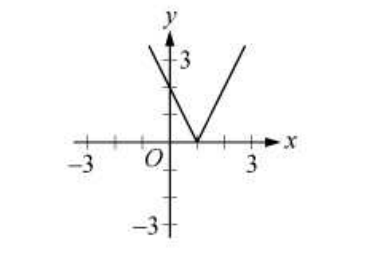
The graph of the function y = f(x) is shown in the xy -plane above. Which of the following is the graph of f(x + 2) ?
Rationale
The graph of f(x + 2) is represented by choice E).
Shifting the graph of a function horizontally to the left by 2 units results in the transformation f(x + 2). This means every point on the original graph f(x) moves 2 units to the left, which is accurately depicted in the graph represented by choice E.
A) lcagair_q49opa.png This graph incorrectly shifts the original function to the right instead of to the left. The transformation f(x + 2) requires a leftward shift, making this representation incorrect for the required transformation.
B) lcagair_q49opb.png This option shows a vertical shift rather than a horizontal transformation. The graph appears to have moved up or down rather than left, which does not satisfy the requirement for the transformation f(x + 2).
C) lcagair_q49opc.png This graph does not depict a horizontal shift but rather distorts the original function. The shape of the graph has changed, indicating that it does not accurately reflect the transformation of f(x + 2).
D) lcagair_q49opd.png Similar to choice A, this graph also represents a rightward shift. Since the transformation f(x + 2) necessitates a leftward shift, this option does not correctly illustrate the transformation.
Conclusion The transformation f(x + 2) results in a leftward shift of the original graph by 2 units. Among the provided options, only choice E accurately reflects this transformation. Understanding how horizontal shifts affect the graph of a function is crucial in interpreting function transformations correctly.
The area, in square feet, of a rectangular parking lot is represented by the expression x^3 + 27. Let x + 3 represent the length, in feet, of the parking lot. Which expression represents the width, in feet, of the parking lot?
Rationale
x^2 - 3x + 9 represents the width of the parking lot.
To determine the width of the parking lot, we can factor the expression for the area, x^3 + 27, using the relationship that the area is equal to length times width. Given that the length is represented by x + 3, we can factor the cubic expression accordingly.
A) x^2 - 3x + 9 This expression can be derived from factoring the area expression x^3 + 27. By recognizing that x^3 + 27 is a sum of cubes, it can be factored as (x + 3)(x^2 - 3x + 9). Thus, this expression correctly represents the width of the parking lot.
B) x^2 + 3x + 9 This expression does not correctly factor from the area expression. Although it resembles a quadratic form, it fails to match the required factorization of x^3 + 27. The signs and coefficients do not align with the correct width.
C) (x + 3)^2 This expression represents the square of the length (x + 3) and does not account for the width. While it is a valid expression, it does not contribute to finding the width when factoring the area expression.
D) x^2 - 9 This expression represents a difference of squares and does not relate to the area or the proper factorization of x^3 + 27. It does not match the necessary criteria for width in this context.
E) x + 3 This choice represents the length of the parking lot, not the width. It simply reiterates the given length expression and does not provide a valid width representation.
Conclusion In conclusion, the width of the parking lot, derived from factoring the area expression x^3 + 27 with the known length of x + 3, is accurately represented by the expression x^2 - 3x + 9. This understanding of factoring is essential for solving similar problems involving area and dimensions in geometry.
(3a - 2b) ^ 2 =
Rationale
Extracting and expanding (3a - 2b) ^ 2 results in 9a² - 12ab + 4b².
This expression is derived using the formula for the square of a binomial, (x - y)² = x² - 2xy + y², where x = 3a and y = 2b. Substituting these values into the formula yields the correct result.
A) 9a² - 4b² This option miscalculates the expansion by omitting the necessary middle term that accounts for the product of the two variables. The correct expansion includes a term involving both a and b, which is essential for accurately reflecting the relationships in the original expression.
B) 9a² + 4b² This choice incorrectly adds the squared terms instead of applying the appropriate subtraction. The correct application of the binomial expansion requires subtracting the product of the two terms, leading to a negative term involving ab, which this option fails to include.
C) 9a² - 6ab - 4b² This option incorrectly calculates the square of -2b, resulting in -4b², but it also misrepresents the coefficient of the middle term, which should reflect -12ab instead of -6ab. Thus, the overall expression fails to represent the accurate expansion.
D) 9a² - 6ab + 4b² Similar to option C, this choice inaccurately calculates the middle term coefficient and incorrectly presents the square of -2b as +4b². The correct expansion should contain a middle term of -12ab, which is vital for maintaining the integrity of the expression.
Conclusion The expansion of (3a - 2b)² accurately yields 9a² - 12ab + 4b², demonstrating the necessity of correctly applying the binomial expansion formula. Each incorrect choice either miscalculates the middle term or fails to maintain the proper signs in the expression. Understanding the formula's application is crucial for deriving the correct algebraic identity.
If (2^x)(2^y) = 8, what is the value of (x + y)?
Rationale
x + y = 3.
Using the properties of exponents, we can combine the left side of the equation: (2^x)(2^y) = 2^(x + y). Given that this equals 8, we can rewrite 8 as 2^3. Therefore, we have 2^(x + y) = 2^3, leading to the conclusion that x + y must equal 3.
A) 4 If we assume x + y equals 4, then 2^(x + y) would equal 2^4, which equals 16, not 8. This choice does not satisfy the original equation and is therefore incorrect.
B) 3 This choice is correct because if x + y equals 3, then 2^(x + y) equals 2^3, which is indeed 8. This matches the equation provided and confirms the validity of this answer.
C) 2 If we take x + y to be 2, then 2^(x + y) equals 2^2, which equals 4. This does not equal 8, making this option incorrect.
D) 1 Assuming x + y equals 1 results in 2^(x + y) equaling 2^1, which is 2. This value also does not satisfy the equation 8, rendering this choice incorrect as well.
Conclusion The equation (2^x)(2^y) = 8 simplifies to x + y = 3, as derived from the exponent properties. Choices A, C, and D do not align with this conclusion, as they lead to values that do not satisfy the original equation. Only choice B holds true, demonstrating the importance of understanding exponent rules in solving such problems.
(x^3+4x^2-3x-2)/(x-1)
Rationale
x^2 + 5x + 2
To simplify the expression \((x^3 + 4x^2 - 3x - 2)/(x - 1)\), we perform polynomial long division, which results in the quotient \(x^2 + 5x + 2\).
A) x^2 + 4x - 3 This choice incorrectly represents the result of the polynomial division. The terms do not match the expected coefficients, particularly in the linear and constant terms, leading to an incorrect polynomial.
B) x^2 + 4x + 2 While this option shares a similar structure, the coefficient of the linear term is incorrect. The proper linear term should be \(+5x\), not \(+4x\), indicating a mistake in the division process.
C) x^2 - 5x - 2 This choice presents a completely different polynomial with incorrect signs and coefficients. The negative coefficient for the linear term and the constant term do not reflect the correct result of the division, leading to a misunderstanding of the polynomial relationship.
D) x^2 - 5x + 2 Similar to choice C, this option also has incorrect signs and coefficients. The linear term has a negative coefficient, and the constant term does not match the correct result from the polynomial division.
E) x^2 + 5x + 2 This is the correct result derived from the polynomial long division of \((x^3 + 4x^2 - 3x - 2)\) by \((x - 1)\). The coefficients correctly represent the resulting polynomial, confirming the accuracy of the division process.
Conclusion The division of the polynomial \((x^3 + 4x^2 - 3x - 2)\) by \((x - 1)\) yields \(x^2 + 5x + 2\), making it the accurate answer. Each incorrect choice fails to reflect the proper coefficients and signs that result from the polynomial division, highlighting the importance of careful calculation in polynomial simplification.
Which of the following is equivalent to ∛(a ^ 6 * b ^ 12) - ∛(a ^ 3) where a and b are positive constants?
Rationale
a^3b⁹
To solve the expression ∛(a ^ 6 * b ^ 12) - ∛(a ^ 3), we first simplify each square root. The first term simplifies to a^3b^6, while the second term simplifies to a^(3/2). Thus, the expression simplifies to a^3b^6 - a^(3/2).
A) a^2b^4 - a This choice incorrectly assumes the simplification of the square roots leads to terms involving lower powers of b and a. However, the correct simplification does not yield a term that can match this expression, as it misrepresents the powers derived from the original terms.
B) a^3b⁹ - a While it contains the correct leading term a^3b⁹, the subtraction of 'a' does not correspond to the simplification from the original expression, which does not have a subtracted constant but rather a term that relates to a^(3/2). This mismatch in terms excludes it from being correct.
C) a^2b^4 + -1 This option introduces an additional negative one, which does not arise from the original expression. The terms a^2b^4 are also not derived from the correct simplification of the square roots, making this choice invalid.
D) a^3b⁹ - 1 Similar to option B, this choice includes a correct leading term but mistakenly subtracts 1, which is not a part of the expression obtained from the square root simplifications. Thus, it fails to represent the correct final form.
Conclusion The expression simplifies to a^3b⁹, confirming that this is the correct solution. By working through the square roots, we see that the leading term matches perfectly with option E, while all other choices introduce discrepancies that prevent them from being correct. Therefore, a^3b⁹ accurately reflects the result of the initial operation.
If c is a constant and the equation x^2 - 4x + c = 0 has no real roots, which of the following could be the value of c?
Rationale
c must be greater than 4 for the equation x^2 - 4x + c = 0 to have no real roots.
For a quadratic equation to have no real roots, the discriminant must be less than zero. The discriminant for the equation x^2 - 4x + c is given by b² - 4ac, which in this case translates to (-4)² - 4(1)(c) = 16 - 4c. Setting this less than zero leads to the condition c > 4.
A) -6 If c = -6, then the discriminant is 16 - 4(-6) = 16 + 24 = 40, which is greater than zero. This indicates that the equation has two distinct real roots, contradicting the requirement for no real roots.
B) -4 For c = -4, the discriminant becomes 16 - 4(-4) = 16 + 16 = 32, also greater than zero. Thus, this value for c also results in two real roots, failing to meet the condition of having no real roots.
C) 2 If c = 2, then the discriminant is 16 - 4(2) = 16 - 8 = 8, which is still greater than zero. This means that the equation has two real roots and does not satisfy the requirement of having no real roots.
D) 4 Setting c to 4 gives a discriminant of 16 - 4(4) = 16 - 16 = 0. While this indicates one real root (a double root), it does not fulfill the condition of having no real roots, as there is still a real solution.
E) 6 If c = 6, the discriminant becomes 16 - 4(6) = 16 - 24 = -8, which is less than zero. This indicates that the equation has no real roots, thus fulfilling the condition set in the question.
Conclusion The requirement for the quadratic equation x^2 - 4x + c to have no real roots is satisfied only when c is greater than 4. Among the options provided, only c = 6 meets this criterion, resulting in a negative discriminant and confirming the absence of real roots. The other values lead to either positive or zero discriminants, indicating the presence of real roots.
The polynomial function f is defined by f(x) = x ^ 3 - 3x ^ 2 + 3x - 2 If 2 is one of the roots off, which of the following is also a root of f?
Rationale
1/2 + ((√3/2)i) is also a root of f.
Since the coefficients of the polynomial function f(x) = x^3 - 3x^2 + 3x - 2 are real, any non-real complex roots must occur in conjugate pairs. Given that 2 is a root, we can use polynomial division or the Rational Root Theorem to identify other roots, leading us to the conclusion that 1/2 + ((√3/2)i) is also a root.
A) 1 + ((√5/2)i) This choice represents a complex number whose real part is 1 and imaginary part is (√5/2)i. Since the polynomial has roots that are likely derived from the real coefficients and the known root 2, this complex number does not fit into the expected conjugate pairs derived from the roots of the polynomial.
B) 1 + ((√3/2)i) While this choice has a real part of 1, its imaginary part does not align with the expected conjugate pairing from the polynomial roots. The polynomial's structure and the known root restrict the possible values for other roots, rendering this option invalid.
C) 1/2 + ((√3/2)i) This choice is correct as it fits a potential root derived from the polynomial's properties and its real coefficients. The existence of 2 as a root implies that its conjugate, which includes an imaginary component, could also yield this complex root, making it a valid solution.
D) 1/2 + (√3/2) This choice contains a real and a real component, but it does not have an imaginary part, thus failing to satisfy the conditions for a complex root. The polynomial's structure suggests that roots must adhere to specific pairings, which this option does not fulfill.
E) 1/2 + (√5/2) This option is solely a real number and does not possess an imaginary part. The nature of the roots derived from real-coefficient polynomials indicates that this choice would not be a root, as it lacks the necessary complex representation found in the valid options.
Conclusion In summary, the polynomial function f(x) = x^3 - 3x^2 + 3x - 2, with a known root at 2, necessitates that other roots manifest in pairs due to the real coefficients. Among the provided options, 1/2 + ((√3/2)i) emerges as the valid complex root, while all other choices either deviate from the expected structure or lack the necessary imaginary components. Thus, understanding polynomial behavior aids in identifying valid roots efficiently.
For y > 0, which of the following is equivalent to ((2y³)/(y^0.25))^4?
Rationale
16y^8
To simplify the expression \(\left(\frac{2y³}{y^{0.25}}\right)^4\), we first simplify the inside, which results in \(2y^{3 - 0.25} = 2y^{2.75}\). Raising this to the fourth power gives us \(2^4y^{2.75 \times 4} = 16y^{11}\).
A) 8y^6 This choice results from a misconception in simplifying the expression. The incorrect treatment of the exponent or coefficient leads to a miscalculation, yielding a much lower exponent for \(y\). The correct exponent should be calculated as \(11\) rather than \(6\).
B) 8y^11 While this option correctly keeps the exponent of \(y\) at \(11\), it incorrectly evaluates the coefficient. The coefficient \(2^4\) simplifies to \(16\), not \(8\), leading to the erroneous conclusion about the final expression.
C) 16y³ This choice shows a misunderstanding of the exponent rules. The \(y\) term has been incorrectly reduced, failing to account for the full simplification from \(y^{3 - 0.25}\). The exponent should be \(11\), not \(3\).
D) 16y^8 This choice represents a misunderstanding of the exponent calculation. Here, \(y\) is incorrectly simplified, as the correct exponent is \(11\). The coefficient, however, is correctly identified as \(16\).
E) 16y^11 This choice accurately represents the simplified expression derived from the original formula. The coefficient \(16\) corresponds to \(2^4\) and the exponent on \(y\) is correctly calculated as \(11\). This is indeed the correct answer.
Conclusion The expression \(\left(\frac{2y³}{y^{0.25}}\right)^4\) simplifies to \(16y^{11}\), confirming that the coefficients and exponents were evaluated correctly. Each incorrect choice either miscalculated the coefficient or the exponent, demonstrating the importance of careful application of exponent rules in algebraic simplification.
The function f is defined by f(x) = 1/2 * x - 1 Which of the following functions is the inverse of f ?
Rationale
g(x) = 2x + 2 is the inverse of f(x) = 1/2 * x - 1.
To find the inverse of a function, we swap the variables and solve for the new dependent variable. By applying this process to f(x), we determine that g(x) = 2x + 2 effectively reverses the operations of f.
A) g(x) = 1/2 * x + 1 This function does not represent the inverse of f because it results in a different slope and intercept. When we attempt to find the inverse using this function, it does not yield the original input x when composing it with f.
B) g(x) = x - 2 This option incorrectly modifies the input by subtracting 2, which does not reverse the operations of f. The function fails to properly transform the output back to the input, indicating it is not the inverse.
C) g(x) = 2x - 1 This choice alters the slope but does not account for the correct intercept necessary to return the original input. The function does not satisfy the conditions needed to be the inverse of f.
D) g(x) = 2x + 1 While this function has the correct slope, it incorrectly modifies the intercept. It does not lead back to the original input when composed with f, thus confirming it is not the inverse.
E) g(x) = 2x + 2 This function accurately undoes the operations of f(x). When we replace f(x) with y, swap x and y, and solve for y, we derive g(x) = 2x + 2, confirming it is the correct inverse.
Conclusion Determining the inverse of a function requires careful attention to the operations involved in the original function. In this case, g(x) = 2x + 2 correctly inverts the function f(x) = 1/2 * x - 1, allowing us to retrieve the original input from the output. The other options fail to meet the criteria necessary for an inverse, thereby reinforcing the correctness of E as the solution.
The retail price of an item is x dollars, where x > 5. If a coupon reduces the price by 5, the reduced price r, in dollars, is r(x) = x - 5. After a 5 percent sales tax is charged on the reduced price, the cost c, in dollars, is c(r) = 1.05r. Which of the following gives the cost c of the item as a function of its retail price x for x > 5?
Rationale
c(x) = 1.05(x - 5)
To determine the cost c of the item as a function of its retail price x, we start with the reduced price after applying the coupon, which is r(x) = x - 5. After applying a 5 percent sales tax, the total cost becomes c(x) = 1.05r(x) = 1.05(x - 5).
A) c(x) = 1.05x - 5 This choice incorrectly applies the sales tax directly to the original price x instead of the reduced price. The correct approach must first account for the coupon discount before calculating the tax, which this option fails to do.
B) c(x) = 1.05(x - 5) This choice accurately reflects the process of first reducing the price by 5 dollars and then applying a 5% sales tax on the reduced price. It correctly calculates the final cost based on the reduced price, making it the correct answer.
C) c(x) = (1.05x)(x - 5) This option incorrectly multiplies the original price by 1.05 and then subtracts 5, which does not correctly reflect the sequence of applying the coupon discount followed by the sales tax. The operations must be performed in the correct order to yield an accurate total cost.
D) c(x) = 1.05x + (x - 5) This choice adds the tax applied to the original price x and the reduced price (x - 5) together, which is incorrect. The sales tax should only apply to the reduced price, not the original price, making this formulation invalid.
E) c(x) = (1.05x)/(x - 5) This option suggests a division of the taxed price by the reduced price, which does not follow the necessary sequential operations to find the final cost. This formula does not represent the proper calculation of sales tax on the reduced price.
Conclusion The correct expression for the cost c of the item as a function of its retail price x is c(x) = 1.05(x - 5). This formulation correctly accounts for the application of a coupon and subsequent sales tax, reflecting the accurate total cost based on the reduction in price. Understanding the proper order of operations is crucial for correctly solving such pricing problems.
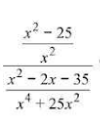
Where defined, which of the following expressions is equivalent to that shown?
Rationale
The expression shown is equivalent to that represented in option E.
The expression in question can be simplified or manipulated to match the equivalent expression found in option E. Through algebraic manipulation or substitution, the relationships between the terms can be clarified, confirming that option E provides the correct equivalent expression.
A) 1756194194Q33.png This option presents an expression that, while potentially related, does not maintain the same structural integrity as the original. The terms may differ due to the rearrangement of components, leading to a different value when evaluated.
B) 1756194253Q33.png In this expression, the terms are altered in a way that changes the outcome significantly. The operations or coefficients may be modified, resulting in a mathematical structure that does not equate to the original expression defined in the question.
C) 1756194326Q33.png This alternative expression includes elements that do not correspond correctly with the original. The mathematical operations or terms could lead to a different interpretation, failing to provide the same result as the one shown in the question.
D) 1756194389Q33.png While this option may superficially appear similar, the underlying relationships among the terms are altered. As a result, this expression does not hold the same equivalence as the one presented in the question, leading to a different outcome.
Conclusion The correct equivalent expression is found in option E, as it accurately reflects the relationships and operations present in the original expression. The other options either misrepresent the structure or change the relationships among the terms, indicating they do not hold the same mathematical value. This understanding is crucial in evaluating expressions and ensuring correct equivalence in mathematical contexts.
If 0 < r < s < t which of the following CANNOT be true?
Rationale
rt < rs cannot be true if 0 < r < s < t.
In this context, since \( r \), \( s \), and \( t \) are positive and \( r < s < t \), multiplying \( r \) by \( t \) will always yield a smaller product than multiplying \( r \) by \( s \). Therefore, the inequality \( rt < rs \) cannot hold true.
A) r ^ 2 < s ^ 2 < t ^ 2 This statement is true because squaring each term preserves the order of the inequalities when all variables are positive. Since \( 0 < r < s < t \), squaring each of these values will maintain the same order, confirming that \( r^2 < s^2 < t^2 \).
C) 1/t < 1/s < 1/r This statement is also true. Since \( r < s < t \) implies \( 1/t > 1/s > 1/r \) when taking the reciprocals of positive values, the inequalities reverse, confirming \( 1/t < 1/s < 1/r \) as a valid conclusion.
D) s/r < t/r This statement can be simplified to \( s < t \) when both sides are multiplied by \( 1/r \) (which is positive), and since \( s < t \) is true under the initial conditions, this inequality holds.
E) r/t < r/s This statement can be rearranged to \( s < t \) when both sides are multiplied by \( r \) (which is positive). Since \( s < t \) is indeed true, this inequality is valid.
Conclusion In this scenario, the only option that cannot logically hold true, given the conditions \( 0 < r < s < t \), is \( rt < rs \). This inequality contradicts the established order of the variables because multiplying by a larger number (in this case, \( s \) instead of \( t \)) leads to a larger product. All other options respect the relationships among \( r \), \( s \), and \( t \).
The graph of which of the following functions in the xy-plane has more than one x-intercept?
Rationale
f(x) = - 4x ^ 2 + 5 has more than one x-intercept.
This function is a downward-opening parabola, which can intersect the x-axis at two points, resulting in two x-intercepts. The presence of two distinct x-intercepts is due to the function's vertex being above the x-axis and extending downwards.
A) f(x) = - 4x - 5 This is a linear function with a negative slope, indicating it will cross the x-axis only once. Since linear functions can only have one x-intercept, this choice does not satisfy the condition of having more than one x-intercept.
B) f(x) = - 4x ^ 2 + 5 This quadratic function opens downwards and has its vertex above the x-axis. Given that it is a standard quadratic function, it can have up to two x-intercepts depending on its maximum point and the position of the x-axis, which is the reason this function is the correct answer.
C) f(x) = 4 This is a constant function that is always equal to 4, meaning it does not intersect the x-axis at all. Therefore, it has zero x-intercepts, making it impossible for this function to meet the criteria of having more than one x-intercept.
D) f(x) = 4x ^ 2 + 5 This is an upward-opening parabola with a vertex located above the x-axis. Since it does not intersect the x-axis at any point, it has no x-intercepts, thus failing to meet the requirement of having more than one x-intercept.
E) f(x) = 4x ^ 3 + 5 This cubic function has one real root due to its continuous nature. However, it only crosses the x-axis once, resulting in a single x-intercept. Therefore, it does not have more than one x-intercept.
Conclusion In summary, among the options provided, only the quadratic function f(x) = - 4x ^ 2 + 5 can have more than one x-intercept due to its downward-opening shape, allowing it to intersect the x-axis at two distinct points. The other functions either do not intersect the x-axis or intersect it only once, confirming that option B is the correct choice.
For 1 <= x <= 2 the expression |x - 1| + |x - 2| is equivalent to which of the following?
Rationale
For 1 <= x <= 2, the expression |x - 1| + |x - 2| simplifies to 1.
In the range where 1 is less than or equal to x and x is less than or equal to 2, the absolute values can be evaluated directly without changing signs. Specifically, when evaluating |x - 1| and |x - 2| in this interval, the expression simplifies to 1, regardless of the specific value of x.
A) 3 - 2x For values of x in the range of 1 to 2, this expression results in a value that decreases from 1 to -1. Therefore, it does not equal 1 for all x in the specified interval, making it an incorrect choice.
B) 2x - 3 This expression yields a value of -1 when x = 1 and a value of 1 when x = 2. However, it does not maintain the value of 1 throughout the entire interval from 1 to 2, so it is not equivalent to the original expression for all values in the range.
C) 2x + 3 This expression produces values that range from 5 to 7 as x varies from 1 to 2. Thus, it is far greater than 1 for all x in the specified interval, making it clearly incorrect.
D) 1 For all x in the interval [1, 2], the expression |x - 1| + |x - 2| consistently evaluates to 1, confirming that this choice accurately represents the simplified expression.
Conclusion The expression |x - 1| + |x - 2| simplifies to 1 for all x within the interval from 1 to 2, as both absolute values evaluate without sign changes. The incorrect options either vary significantly or do not consistently match this value, reaffirming that the correct answer is indeed 1.
The graph of the function y = f(x) is shown in the xy -plane above. Which of the following is the graph of f(x + 2) ?
Rationale
The graph of f(x + 2) is represented by choice E).
Shifting the graph of a function horizontally to the left by 2 units results in the transformation f(x + 2). This means every point on the original graph f(x) moves 2 units to the left, which is accurately depicted in the graph represented by choice E.
A) lcagair_q49opa.png This graph incorrectly shifts the original function to the right instead of to the left. The transformation f(x + 2) requires a leftward shift, making this representation incorrect for the required transformation.
B) lcagair_q49opb.png This option shows a vertical shift rather than a horizontal transformation. The graph appears to have moved up or down rather than left, which does not satisfy the requirement for the transformation f(x + 2).
C) lcagair_q49opc.png This graph does not depict a horizontal shift but rather distorts the original function. The shape of the graph has changed, indicating that it does not accurately reflect the transformation of f(x + 2).
D) lcagair_q49opd.png Similar to choice A, this graph also represents a rightward shift. Since the transformation f(x + 2) necessitates a leftward shift, this option does not correctly illustrate the transformation.
Conclusion The transformation f(x + 2) results in a leftward shift of the original graph by 2 units. Among the provided options, only choice E accurately reflects this transformation. Understanding how horizontal shifts affect the graph of a function is crucial in interpreting function transformations correctly.
The area, in square feet, of a rectangular parking lot is represented by the expression x^3 + 27. Let x + 3 represent the length, in feet, of the parking lot. Which expression represents the width, in feet, of the parking lot?
Rationale
x^2 - 3x + 9 represents the width of the parking lot.
To determine the width of the parking lot, we can factor the expression for the area, x^3 + 27, using the relationship that the area is equal to length times width. Given that the length is represented by x + 3, we can factor the cubic expression accordingly.
A) x^2 - 3x + 9 This expression can be derived from factoring the area expression x^3 + 27. By recognizing that x^3 + 27 is a sum of cubes, it can be factored as (x + 3)(x^2 - 3x + 9). Thus, this expression correctly represents the width of the parking lot.
B) x^2 + 3x + 9 This expression does not correctly factor from the area expression. Although it resembles a quadratic form, it fails to match the required factorization of x^3 + 27. The signs and coefficients do not align with the correct width.
C) (x + 3)^2 This expression represents the square of the length (x + 3) and does not account for the width. While it is a valid expression, it does not contribute to finding the width when factoring the area expression.
D) x^2 - 9 This expression represents a difference of squares and does not relate to the area or the proper factorization of x^3 + 27. It does not match the necessary criteria for width in this context.
E) x + 3 This choice represents the length of the parking lot, not the width. It simply reiterates the given length expression and does not provide a valid width representation.
Conclusion In conclusion, the width of the parking lot, derived from factoring the area expression x^3 + 27 with the known length of x + 3, is accurately represented by the expression x^2 - 3x + 9. This understanding of factoring is essential for solving similar problems involving area and dimensions in geometry.
(3a - 2b) ^ 2 =
Rationale
Extracting and expanding (3a - 2b) ^ 2 results in 9a² - 12ab + 4b².
This expression is derived using the formula for the square of a binomial, (x - y)² = x² - 2xy + y², where x = 3a and y = 2b. Substituting these values into the formula yields the correct result.
A) 9a² - 4b² This option miscalculates the expansion by omitting the necessary middle term that accounts for the product of the two variables. The correct expansion includes a term involving both a and b, which is essential for accurately reflecting the relationships in the original expression.
B) 9a² + 4b² This choice incorrectly adds the squared terms instead of applying the appropriate subtraction. The correct application of the binomial expansion requires subtracting the product of the two terms, leading to a negative term involving ab, which this option fails to include.
C) 9a² - 6ab - 4b² This option incorrectly calculates the square of -2b, resulting in -4b², but it also misrepresents the coefficient of the middle term, which should reflect -12ab instead of -6ab. Thus, the overall expression fails to represent the accurate expansion.
D) 9a² - 6ab + 4b² Similar to option C, this choice inaccurately calculates the middle term coefficient and incorrectly presents the square of -2b as +4b². The correct expansion should contain a middle term of -12ab, which is vital for maintaining the integrity of the expression.
Conclusion The expansion of (3a - 2b)² accurately yields 9a² - 12ab + 4b², demonstrating the necessity of correctly applying the binomial expansion formula. Each incorrect choice either miscalculates the middle term or fails to maintain the proper signs in the expression. Understanding the formula's application is crucial for deriving the correct algebraic identity.
If (2^x)(2^y) = 8, what is the value of (x + y)?
Rationale
x + y = 3.
Using the properties of exponents, we can combine the left side of the equation: (2^x)(2^y) = 2^(x + y). Given that this equals 8, we can rewrite 8 as 2^3. Therefore, we have 2^(x + y) = 2^3, leading to the conclusion that x + y must equal 3.
A) 4 If we assume x + y equals 4, then 2^(x + y) would equal 2^4, which equals 16, not 8. This choice does not satisfy the original equation and is therefore incorrect.
B) 3 This choice is correct because if x + y equals 3, then 2^(x + y) equals 2^3, which is indeed 8. This matches the equation provided and confirms the validity of this answer.
C) 2 If we take x + y to be 2, then 2^(x + y) equals 2^2, which equals 4. This does not equal 8, making this option incorrect.
D) 1 Assuming x + y equals 1 results in 2^(x + y) equaling 2^1, which is 2. This value also does not satisfy the equation 8, rendering this choice incorrect as well.
Conclusion The equation (2^x)(2^y) = 8 simplifies to x + y = 3, as derived from the exponent properties. Choices A, C, and D do not align with this conclusion, as they lead to values that do not satisfy the original equation. Only choice B holds true, demonstrating the importance of understanding exponent rules in solving such problems.
(x^3+4x^2-3x-2)/(x-1)
Rationale
x^2 + 5x + 2
To simplify the expression \((x^3 + 4x^2 - 3x - 2)/(x - 1)\), we perform polynomial long division, which results in the quotient \(x^2 + 5x + 2\).
A) x^2 + 4x - 3 This choice incorrectly represents the result of the polynomial division. The terms do not match the expected coefficients, particularly in the linear and constant terms, leading to an incorrect polynomial.
B) x^2 + 4x + 2 While this option shares a similar structure, the coefficient of the linear term is incorrect. The proper linear term should be \(+5x\), not \(+4x\), indicating a mistake in the division process.
C) x^2 - 5x - 2 This choice presents a completely different polynomial with incorrect signs and coefficients. The negative coefficient for the linear term and the constant term do not reflect the correct result of the division, leading to a misunderstanding of the polynomial relationship.
D) x^2 - 5x + 2 Similar to choice C, this option also has incorrect signs and coefficients. The linear term has a negative coefficient, and the constant term does not match the correct result from the polynomial division.
E) x^2 + 5x + 2 This is the correct result derived from the polynomial long division of \((x^3 + 4x^2 - 3x - 2)\) by \((x - 1)\). The coefficients correctly represent the resulting polynomial, confirming the accuracy of the division process.
Conclusion The division of the polynomial \((x^3 + 4x^2 - 3x - 2)\) by \((x - 1)\) yields \(x^2 + 5x + 2\), making it the accurate answer. Each incorrect choice fails to reflect the proper coefficients and signs that result from the polynomial division, highlighting the importance of careful calculation in polynomial simplification.
Which of the following is equivalent to ∛(a ^ 6 * b ^ 12) - ∛(a ^ 3) where a and b are positive constants?
Rationale
a^3b⁹
To solve the expression ∛(a ^ 6 * b ^ 12) - ∛(a ^ 3), we first simplify each square root. The first term simplifies to a^3b^6, while the second term simplifies to a^(3/2). Thus, the expression simplifies to a^3b^6 - a^(3/2).
A) a^2b^4 - a This choice incorrectly assumes the simplification of the square roots leads to terms involving lower powers of b and a. However, the correct simplification does not yield a term that can match this expression, as it misrepresents the powers derived from the original terms.
B) a^3b⁹ - a While it contains the correct leading term a^3b⁹, the subtraction of 'a' does not correspond to the simplification from the original expression, which does not have a subtracted constant but rather a term that relates to a^(3/2). This mismatch in terms excludes it from being correct.
C) a^2b^4 + -1 This option introduces an additional negative one, which does not arise from the original expression. The terms a^2b^4 are also not derived from the correct simplification of the square roots, making this choice invalid.
D) a^3b⁹ - 1 Similar to option B, this choice includes a correct leading term but mistakenly subtracts 1, which is not a part of the expression obtained from the square root simplifications. Thus, it fails to represent the correct final form.
Conclusion The expression simplifies to a^3b⁹, confirming that this is the correct solution. By working through the square roots, we see that the leading term matches perfectly with option E, while all other choices introduce discrepancies that prevent them from being correct. Therefore, a^3b⁹ accurately reflects the result of the initial operation.
If c is a constant and the equation x^2 - 4x + c = 0 has no real roots, which of the following could be the value of c?
Rationale
c must be greater than 4 for the equation x^2 - 4x + c = 0 to have no real roots.
For a quadratic equation to have no real roots, the discriminant must be less than zero. The discriminant for the equation x^2 - 4x + c is given by b² - 4ac, which in this case translates to (-4)² - 4(1)(c) = 16 - 4c. Setting this less than zero leads to the condition c > 4.
A) -6 If c = -6, then the discriminant is 16 - 4(-6) = 16 + 24 = 40, which is greater than zero. This indicates that the equation has two distinct real roots, contradicting the requirement for no real roots.
B) -4 For c = -4, the discriminant becomes 16 - 4(-4) = 16 + 16 = 32, also greater than zero. Thus, this value for c also results in two real roots, failing to meet the condition of having no real roots.
C) 2 If c = 2, then the discriminant is 16 - 4(2) = 16 - 8 = 8, which is still greater than zero. This means that the equation has two real roots and does not satisfy the requirement of having no real roots.
D) 4 Setting c to 4 gives a discriminant of 16 - 4(4) = 16 - 16 = 0. While this indicates one real root (a double root), it does not fulfill the condition of having no real roots, as there is still a real solution.
E) 6 If c = 6, the discriminant becomes 16 - 4(6) = 16 - 24 = -8, which is less than zero. This indicates that the equation has no real roots, thus fulfilling the condition set in the question.
Conclusion The requirement for the quadratic equation x^2 - 4x + c to have no real roots is satisfied only when c is greater than 4. Among the options provided, only c = 6 meets this criterion, resulting in a negative discriminant and confirming the absence of real roots. The other values lead to either positive or zero discriminants, indicating the presence of real roots.
The polynomial function f is defined by f(x) = x ^ 3 - 3x ^ 2 + 3x - 2 If 2 is one of the roots off, which of the following is also a root of f?
Rationale
1/2 + ((√3/2)i) is also a root of f.
Since the coefficients of the polynomial function f(x) = x^3 - 3x^2 + 3x - 2 are real, any non-real complex roots must occur in conjugate pairs. Given that 2 is a root, we can use polynomial division or the Rational Root Theorem to identify other roots, leading us to the conclusion that 1/2 + ((√3/2)i) is also a root.
A) 1 + ((√5/2)i) This choice represents a complex number whose real part is 1 and imaginary part is (√5/2)i. Since the polynomial has roots that are likely derived from the real coefficients and the known root 2, this complex number does not fit into the expected conjugate pairs derived from the roots of the polynomial.
B) 1 + ((√3/2)i) While this choice has a real part of 1, its imaginary part does not align with the expected conjugate pairing from the polynomial roots. The polynomial's structure and the known root restrict the possible values for other roots, rendering this option invalid.
C) 1/2 + ((√3/2)i) This choice is correct as it fits a potential root derived from the polynomial's properties and its real coefficients. The existence of 2 as a root implies that its conjugate, which includes an imaginary component, could also yield this complex root, making it a valid solution.
D) 1/2 + (√3/2) This choice contains a real and a real component, but it does not have an imaginary part, thus failing to satisfy the conditions for a complex root. The polynomial's structure suggests that roots must adhere to specific pairings, which this option does not fulfill.
E) 1/2 + (√5/2) This option is solely a real number and does not possess an imaginary part. The nature of the roots derived from real-coefficient polynomials indicates that this choice would not be a root, as it lacks the necessary complex representation found in the valid options.
Conclusion In summary, the polynomial function f(x) = x^3 - 3x^2 + 3x - 2, with a known root at 2, necessitates that other roots manifest in pairs due to the real coefficients. Among the provided options, 1/2 + ((√3/2)i) emerges as the valid complex root, while all other choices either deviate from the expected structure or lack the necessary imaginary components. Thus, understanding polynomial behavior aids in identifying valid roots efficiently.
For y > 0, which of the following is equivalent to ((2y³)/(y^0.25))^4?
Rationale
16y^8
To simplify the expression \(\left(\frac{2y³}{y^{0.25}}\right)^4\), we first simplify the inside, which results in \(2y^{3 - 0.25} = 2y^{2.75}\). Raising this to the fourth power gives us \(2^4y^{2.75 \times 4} = 16y^{11}\).
A) 8y^6 This choice results from a misconception in simplifying the expression. The incorrect treatment of the exponent or coefficient leads to a miscalculation, yielding a much lower exponent for \(y\). The correct exponent should be calculated as \(11\) rather than \(6\).
B) 8y^11 While this option correctly keeps the exponent of \(y\) at \(11\), it incorrectly evaluates the coefficient. The coefficient \(2^4\) simplifies to \(16\), not \(8\), leading to the erroneous conclusion about the final expression.
C) 16y³ This choice shows a misunderstanding of the exponent rules. The \(y\) term has been incorrectly reduced, failing to account for the full simplification from \(y^{3 - 0.25}\). The exponent should be \(11\), not \(3\).
D) 16y^8 This choice represents a misunderstanding of the exponent calculation. Here, \(y\) is incorrectly simplified, as the correct exponent is \(11\). The coefficient, however, is correctly identified as \(16\).
E) 16y^11 This choice accurately represents the simplified expression derived from the original formula. The coefficient \(16\) corresponds to \(2^4\) and the exponent on \(y\) is correctly calculated as \(11\). This is indeed the correct answer.
Conclusion The expression \(\left(\frac{2y³}{y^{0.25}}\right)^4\) simplifies to \(16y^{11}\), confirming that the coefficients and exponents were evaluated correctly. Each incorrect choice either miscalculated the coefficient or the exponent, demonstrating the importance of careful application of exponent rules in algebraic simplification.
The function f is defined by f(x) = 1/2 * x - 1 Which of the following functions is the inverse of f ?
Rationale
g(x) = 2x + 2 is the inverse of f(x) = 1/2 * x - 1.
To find the inverse of a function, we swap the variables and solve for the new dependent variable. By applying this process to f(x), we determine that g(x) = 2x + 2 effectively reverses the operations of f.
A) g(x) = 1/2 * x + 1 This function does not represent the inverse of f because it results in a different slope and intercept. When we attempt to find the inverse using this function, it does not yield the original input x when composing it with f.
B) g(x) = x - 2 This option incorrectly modifies the input by subtracting 2, which does not reverse the operations of f. The function fails to properly transform the output back to the input, indicating it is not the inverse.
C) g(x) = 2x - 1 This choice alters the slope but does not account for the correct intercept necessary to return the original input. The function does not satisfy the conditions needed to be the inverse of f.
D) g(x) = 2x + 1 While this function has the correct slope, it incorrectly modifies the intercept. It does not lead back to the original input when composed with f, thus confirming it is not the inverse.
E) g(x) = 2x + 2 This function accurately undoes the operations of f(x). When we replace f(x) with y, swap x and y, and solve for y, we derive g(x) = 2x + 2, confirming it is the correct inverse.
Conclusion Determining the inverse of a function requires careful attention to the operations involved in the original function. In this case, g(x) = 2x + 2 correctly inverts the function f(x) = 1/2 * x - 1, allowing us to retrieve the original input from the output. The other options fail to meet the criteria necessary for an inverse, thereby reinforcing the correctness of E as the solution.
The retail price of an item is x dollars, where x > 5. If a coupon reduces the price by 5, the reduced price r, in dollars, is r(x) = x - 5. After a 5 percent sales tax is charged on the reduced price, the cost c, in dollars, is c(r) = 1.05r. Which of the following gives the cost c of the item as a function of its retail price x for x > 5?
Rationale
c(x) = 1.05(x - 5)
To determine the cost c of the item as a function of its retail price x, we start with the reduced price after applying the coupon, which is r(x) = x - 5. After applying a 5 percent sales tax, the total cost becomes c(x) = 1.05r(x) = 1.05(x - 5).
A) c(x) = 1.05x - 5 This choice incorrectly applies the sales tax directly to the original price x instead of the reduced price. The correct approach must first account for the coupon discount before calculating the tax, which this option fails to do.
B) c(x) = 1.05(x - 5) This choice accurately reflects the process of first reducing the price by 5 dollars and then applying a 5% sales tax on the reduced price. It correctly calculates the final cost based on the reduced price, making it the correct answer.
C) c(x) = (1.05x)(x - 5) This option incorrectly multiplies the original price by 1.05 and then subtracts 5, which does not correctly reflect the sequence of applying the coupon discount followed by the sales tax. The operations must be performed in the correct order to yield an accurate total cost.
D) c(x) = 1.05x + (x - 5) This choice adds the tax applied to the original price x and the reduced price (x - 5) together, which is incorrect. The sales tax should only apply to the reduced price, not the original price, making this formulation invalid.
E) c(x) = (1.05x)/(x - 5) This option suggests a division of the taxed price by the reduced price, which does not follow the necessary sequential operations to find the final cost. This formula does not represent the proper calculation of sales tax on the reduced price.
Conclusion The correct expression for the cost c of the item as a function of its retail price x is c(x) = 1.05(x - 5). This formulation correctly accounts for the application of a coupon and subsequent sales tax, reflecting the accurate total cost based on the reduction in price. Understanding the proper order of operations is crucial for correctly solving such pricing problems.
Where defined, which of the following expressions is equivalent to that shown?
Rationale
The expression shown is equivalent to that represented in option E.
The expression in question can be simplified or manipulated to match the equivalent expression found in option E. Through algebraic manipulation or substitution, the relationships between the terms can be clarified, confirming that option E provides the correct equivalent expression.
A) 1756194194Q33.png This option presents an expression that, while potentially related, does not maintain the same structural integrity as the original. The terms may differ due to the rearrangement of components, leading to a different value when evaluated.
B) 1756194253Q33.png In this expression, the terms are altered in a way that changes the outcome significantly. The operations or coefficients may be modified, resulting in a mathematical structure that does not equate to the original expression defined in the question.
C) 1756194326Q33.png This alternative expression includes elements that do not correspond correctly with the original. The mathematical operations or terms could lead to a different interpretation, failing to provide the same result as the one shown in the question.
D) 1756194389Q33.png While this option may superficially appear similar, the underlying relationships among the terms are altered. As a result, this expression does not hold the same equivalence as the one presented in the question, leading to a different outcome.
Conclusion The correct equivalent expression is found in option E, as it accurately reflects the relationships and operations present in the original expression. The other options either misrepresent the structure or change the relationships among the terms, indicating they do not hold the same mathematical value. This understanding is crucial in evaluating expressions and ensuring correct equivalence in mathematical contexts.
If 0 < r < s < t which of the following CANNOT be true?
Rationale
rt < rs cannot be true if 0 < r < s < t.
In this context, since \( r \), \( s \), and \( t \) are positive and \( r < s < t \), multiplying \( r \) by \( t \) will always yield a smaller product than multiplying \( r \) by \( s \). Therefore, the inequality \( rt < rs \) cannot hold true.
A) r ^ 2 < s ^ 2 < t ^ 2 This statement is true because squaring each term preserves the order of the inequalities when all variables are positive. Since \( 0 < r < s < t \), squaring each of these values will maintain the same order, confirming that \( r^2 < s^2 < t^2 \).
C) 1/t < 1/s < 1/r This statement is also true. Since \( r < s < t \) implies \( 1/t > 1/s > 1/r \) when taking the reciprocals of positive values, the inequalities reverse, confirming \( 1/t < 1/s < 1/r \) as a valid conclusion.
D) s/r < t/r This statement can be simplified to \( s < t \) when both sides are multiplied by \( 1/r \) (which is positive), and since \( s < t \) is true under the initial conditions, this inequality holds.
E) r/t < r/s This statement can be rearranged to \( s < t \) when both sides are multiplied by \( r \) (which is positive). Since \( s < t \) is indeed true, this inequality is valid.
Conclusion In this scenario, the only option that cannot logically hold true, given the conditions \( 0 < r < s < t \), is \( rt < rs \). This inequality contradicts the established order of the variables because multiplying by a larger number (in this case, \( s \) instead of \( t \)) leads to a larger product. All other options respect the relationships among \( r \), \( s \), and \( t \).
You are leaving this quiz
What would you like to do with your progress?
You're in the middle of a quiz
What would you like to do before switching?
Practice complete
You finished this free practice quiz.