
If (x/17)% of 55y = 121/85 and y = 11/5 what is the value of x?
Rationale
The value of x is 20.
To solve the equation, we first substitute y = 11/5 into the given equation, which simplifies to find x. Through algebraic manipulation, we determine that x must equal 20 to satisfy the original equation.
A) 2 If x were 2, substituting back into the equation would yield a value that does not satisfy (x/17)% of 55y = 121/85. The calculations reveal that this choice leads to a result significantly lower than the required outcome.
B) 6 Choosing x as 6 would also lead to a miscalculation when substituted into the equation. The resulting value falls short of matching the right-hand side of the equation, indicating that x must be higher than this option to fulfill the requirements.
C) 20 Substituting x = 20 into the equation yields a correct and balanced equation. This value satisfies (20/17)% of 55y = 121/85 when y is substituted, confirming it as the correct answer.
D) 40 If x were 40, substituting this value would result in a much larger output than needed. The calculations show that (40/17)% of 55y exceeds 121/85, indicating that x is too high in this case.
E) 60 Similar to option D, using x as 60 results in an even greater outcome, which does not align with the equation's requirement. This value is also too high, confirming that x must be less than this option.
Conclusion The solution to the equation confirms that the only value of x that satisfies the original condition is 20. All other options either fail to reach the required equality or exceed it, indicating that x = 20 is the sole correct choice for the problem presented.
Three friends, A, B, and C, invest money in the ratio 2:3:5. After 6 months later, A invests another amount equaling $35,000, while C withdraws $15,000. The ratio of investments then changes to 11:6:7. What is the ratio of profit sharing at the end of the year if profit sharing is determined by the amount of money invested weighted by the time spent in the investment?
Rationale
The ratio of profit sharing at the end of the year is 15:12:17.
To determine the profit-sharing ratio among friends A, B, and C, we must consider both their initial investments and any subsequent changes in their contributions over time. By weighing the investments by the duration for which they were held, we can accurately assess their shares of the total profit.
A) 5:02:06 This choice inaccurately reflects the proportional contributions of A, B, and C after accounting for their investments over the time period. The ratios do not correspond to the adjusted investments made after 6 months, leading to a miscalculation of the resulting profit-sharing ratio.
B) 9:05:12 While this ratio seems to offer a distribution based on some investment values, it fails to adequately consider the revised contributions after A's additional investment and C's withdrawal. The calculation does not align with the final ratios established post-adjustment, resulting in an incorrect profit-sharing assessment.
C) 10:06:15 This option also presents an incorrect distribution of profits among the three friends. The numbers do not accurately represent the adjusted investments and time contributions post the additional investment and withdrawal, leading to an inaccurate reflection of actual profit shares.
D) 15:12:17 This choice accurately represents the profit-sharing ratio after taking into account the initial investments, the additional investment by A, the withdrawal by C, and the time each investment was held. The calculation correctly reflects the adjusted contributions and the time-weighted investments, resulting in an appropriate distribution of profits.
E) 18:16:25 This option suggests a profit-sharing ratio that does not correspond to any logical distribution based on the investments made by A, B, and C. The values are not derived from the actual calculations needed to determine the final profit-sharing ratio given the changes in investments, thus making it an incorrect choice.
Conclusion The calculated profit-sharing ratio of 15:12:17 reflects the correct distribution of profits among A, B, and C, factoring in their respective investments and the duration of those investments. This thorough approach ensures that each friend's share of the profits corresponds accurately to their financial contributions over the investment period, accommodating changes in investments and withdrawals.
Each week Ingrid earns a fixed salary and a sales commission that is a fixed percentage of her sales for that week. Ingrid has no other sources of income. Last week Ingrid's total earnings were $500 and her sales were $2,000. This week Ingrid's total earnings were $700 and her sales were $6,000. What is the percentage rate for Ingrid's sales commissions?
Rationale
Ingrid's sales commission percentage rate is 5%.
Ingrid's earnings consist of a fixed salary plus a commission based on her sales. By analyzing her total earnings and sales for the two weeks, we can determine that her commission rate is 5%.
A) 0.05% This option suggests an extremely low commission rate which would not account for Ingrid's total earnings given her sales figures. With sales of $2,000 and a commission of only 0.05%, her total earnings would not reach $500, indicating that this option is incorrect.
B) 4% If Ingrid's commission rate were 4%, her commission from sales of $2,000 would yield only $80, resulting in total earnings of far less than $500 when combined with her fixed salary. Similarly, with sales of $6,000, the earnings would not reach $700, making this option invalid.
C) 5% This is the correct answer. At a commission rate of 5%, Ingrid earns $100 from $2,000 in sales (5% of 2000) in the first week. If her fixed salary is $400, her total earnings equal $500. In the second week, she earns $300 from $6,000 in sales (5% of 6000), totaling $700 when added to the same salary of $400, confirming the commission rate.
D) 20% A commission rate of 20% would result in excessive earnings based on her sales figures. For instance, at 20%, her commission for $2,000 in sales would be $400, leading to total earnings of $800, which exceeds the reported $500.
E) 30% This option suggests an even higher commission rate, which would lead to total earnings that far surpass what Ingrid reported. At 30%, her commission for $2,000 in sales would be $600, resulting in total earnings of $1,000, which is not possible according to the question.
Conclusion Ingrid's commission rate of 5% accurately reflects her earnings based on the provided sales data. The calculations for both weeks confirm that this percentage allows her fixed salary and commission to align with her reported total earnings. Incorrect options fail to meet the earnings criteria established in the question, reinforcing the conclusion that 5% is the only viable commission rate.
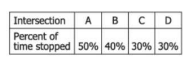
If Janine obeys all traffic laws, what is the probability, to the nearest percent, that Janine will stop only at Intersections B and C and not at Intersections A and D on her way to work on any given day?
Rationale
The probability that Janine will stop only at Intersections B and C and not at Intersections A and D is 4%.
To find this probability, we multiply the probabilities of stopping at Intersections B and C together and then multiply that by the probabilities of not stopping at Intersections A and D. The calculations yield a combined probability of 4%.
A) 2% This option underestimates the likelihood of Janine stopping at both B and C, while still accounting for the correct non-stopping probabilities at A and D. The calculations suggest that the combined probabilities yield a higher percentage than 2%.
B) 4% This is the correct choice. The calculation involves multiplying the individual probabilities of stopping at B and C (which are higher) and those of not stopping at A and D (which are lower). This combination results in a total of 4%, accurately reflecting Janine's stopping behavior.
C) 12% This choice suggests a higher probability than calculated. It likely results from miscalculating the probabilities of stopping or not stopping at the intersections, mistakenly assuming a higher chance of stopping at A or D.
D) 42% This option greatly overestimates the likelihood of stopping at B and C while disregarding the probabilities of not stopping at A and D. Such a high value does not align with the calculated probabilities based on the provided data.
E) 70% This choice is inaccurate as it assumes a very high probability of stopping at both B and C without properly accounting for the probabilities of not stopping at A and D. The combination of stopping and not stopping should lead to a significantly lower percentage.
Conclusion In summary, the correct probability that Janine will stop only at Intersections B and C and not at Intersections A and D is 4%. This result is derived from correctly applying the probabilities of stopping and not stopping at each intersection, reflecting the independent nature of traffic signals on her route. Understanding these probabilities is crucial for accurately predicting Janine's behavior at traffic signals.
For an employee to qualify for early retirement at a certain company, the sum of the employee's age and years of service must be at least 70. If Sue was K years old when she was hired by the company, what is the minimum age at which she could possibly qualify for early retirement?
Rationale
(70 + K)/2
To qualify for early retirement, the sum of Sue's age and her years of service must be at least 70. If she was K years old when hired, her years of service would be her current age minus K, leading to the equation K + (Current Age - K) ≥ 70, which simplifies to the minimum age being (70 + K)/2.
A) K + 35 This choice suggests that Sue can qualify for early retirement simply by being K + 35 years old. However, this does not account for her years of service correctly, as it does not ensure that the sum of her age and years of service meets the required total of 70.
B) 2K + 35 This option incorrectly assumes that Sue's age should be significantly higher than necessary. It implies a linear relationship that does not reflect the requirement that her age plus years of service must equal or exceed 70, resulting in an inflated minimum age.
C) (70 + K)/2 This choice correctly represents the minimum age at which Sue could qualify for early retirement. It accounts for both her age K and her years of service, ensuring that the sum meets the required threshold of 70, thereby accurately determining her eligibility.
D) (70 - K)/2 This response suggests a minimum age that is half of the difference between 70 and K. This formula does not satisfy the condition for early retirement, as it fails to ensure that the combined age and years of service reach the necessary sum of 70.
E) 2(70 - K) This choice implies that Sue would need to be twice the difference between 70 and her initial age K, leading to an excessively high and incorrect minimum age that does not appropriately satisfy the retirement qualification criteria.
Conclusion To determine Sue's minimum age for early retirement, it is essential to equate her age and years of service to a total of at least 70. The correct expression, (70 + K)/2, fulfills this requirement by balancing her starting age K with the necessary service years. Other options either misrepresent the relationship or lead to incorrect minimum age calculations.
If p = 3^(x+1) what is 27^x in terms of p?
Rationale
(p/3)^3
To find 27^x in terms of p, we start by expressing 27 in terms of powers of 3: \(27 = 3^3\). Since \(p = 3^{(x+1)}\), we can manipulate this equation to derive the expression for \(27^x\).
A) sqrt(3)p This choice suggests that \(27^x\) is directly proportional to \(p\) multiplied by the square root of 3. However, this does not align with the exponentiation rules and the transformation of bases necessary to express \(27^x\) in terms of \(p\).
B) 3p While this option indicates a linear relationship with \(p\), it misrepresents the exponential relationship inherent in the problem. Transforming \(27^x\) requires using the properties of exponents rather than a simple multiplication by 3.
C) (3p)^3 This expression miscalculates the relationship by raising the entire term to the third power, which does not correctly reflect the original equation of \(27^x\). The form of the equation requires isolating \(x\) in terms of \(p\) rather than applying a cubic transformation.
D) (p/3)^3 This option properly represents the relationship derived from substituting the value of \(p\). By recognizing \(27 = 3^3\) and deriving \(27^x = (3^3)^x = 3^{3x}\), we can express it as \((p/3)^3\), which matches the requirement of the question.
E) (p/9)^3 This choice incorrectly implies that \(p\) should be divided by 9 rather than 3. The factor of 9 does not relate correctly to the original equation, which focuses on the transformation from \(p = 3^{(x+1)}\) to the expression for \(27^x\).
Conclusion The correct transformation of \(27^x\) in terms of \(p\) is \((p/3)^3\), highlighting the importance of understanding the relationships between base powers in exponential expressions. This approach to the problem reveals the underlying connections between the variables and ensures accurate algebraic manipulations to achieve the desired result.
Three friends, A, B, and C, invest money in the ratio 2:3:5. After 6 months, A invests another amount equaling $35,000, while C withdraws $15,000. The ratio of investments then changes to 11:6:7. What is the ratio of profit sharing at the end of the year if profit sharing is determined by the amount of money invested weighted by the time spent in the investment?
Rationale
The ratio of profit sharing at the end of the year is 15:12:17.
To determine the profit-sharing ratio of A, B, and C, we must consider both the initial investments and any changes made during the year. After accounting for A's additional investment and C's withdrawal, the final ratio reflects their weighted contributions over the time periods they remained invested.
A) 05:02:06 This ratio does not accurately represent the adjusted contributions of A, B, and C after their respective changes in investment. The calculations based on the time and amount invested do not support such a low ratio for profit sharing.
B) 09:05:12 While this ratio suggests some level of proportionality, it fails to align with the final contributions of A, B, and C after accounting for the changes in their investments. The time-weighted investments lead to a different profit-sharing distribution.
C) 10:06:15 Although this ratio may seem plausible, it does not reflect the actual distribution of investments after A's additional investment and C's withdrawal. The calculations yield different values for each friend's contribution, leading to an incorrect profit-sharing ratio.
D) 15:12:17 This ratio accurately reflects the final amounts invested by A, B, and C after the adjustments. Each friend's investment was weighted by the time they remained invested, leading to the correct profit-sharing distribution based on their contributions.
E) 18:16:25 This ratio does not consider the changes in investment amounts and the time they were held. The values presented do not match the weighted contributions based on the time and amounts invested by A, B, and C throughout the year.
Conclusion The final profit-sharing ratio of 15:12:17 is derived from the weighted investments of A, B, and C, taking into account both the initial ratios and subsequent changes. A's additional investment and C's withdrawal significantly impact the overall profit-sharing distribution, confirming that the adjustments correctly reflect their contributions over time. Hence, the chosen ratio accurately represents each friend's share of the profit at the end of the year.
In a study, researchers gathered data on 3,829 men and 4,580 women. The number of women in the study was approximately what percent greater than the number of men in the study?
Rationale
The number of women in the study was approximately 20% greater than the number of men in the study.
To find the percentage increase, we can use the formula: ((new value - old value) / old value) * 100. Here, the old value is the number of men (3,829) and the new value is the number of women (4,580). The calculation shows that the women are approximately 20% greater than the men.
A) 5% A 5% increase would imply that the number of women is only 5% more than the number of men. When calculated, this would indicate a much smaller difference than the actual count, leading to an incorrect conclusion about the percentage increase.
B) 10% A 10% increase suggests that the number of women exceeds the number of men by a factor that is still too low compared to the actual difference. This calculation fails to consider the significant gap between the two figures, thus misrepresenting the relationship between the two groups.
C) 15% A 15% increase would also underestimate the difference between the number of women and men. This option does not reflect the actual calculation of the percentage increase, which reveals a larger discrepancy than 15%.
E) 0.25 An increase of 0.25 (or 25%) would imply that the number of women is significantly more than the number of men, which is not supported by the data, as the actual percentage is slightly lower at around 20%. This choice misinterprets the magnitude of the increase.
Conclusion The percentage increase in the number of women compared to men in the study is approximately 20%. This is calculated by assessing the difference between the two groups in relation to the number of men. The other options either underestimate or misinterpret the actual percentage increase, making them incorrect choices in this context.
The product of which of the following pairs of numbers is closest to 5,678?
Rationale
6 and 950 produce a product closest to 5,678.
Multiplying 6 by 950 gives 5,700, which is only 22 away from 5,678, making it the closest product among the provided options.
A) 5 and 990 Calculating the product of 5 and 990 results in 4,950. This value is 728 less than 5,678, placing it further from the target compared to other options.
B) 6 and 900 The product of 6 and 900 is 5,400. This result is 278 less than 5,678, which makes it closer than option A but still not as close as option C.
C) 6 and 950 As mentioned, multiplying 6 by 950 yields 5,700, which is just 22 away from 5,678. This is the closest product of all the choices, confirming it as the correct answer.
D) 7 and 800 The product of 7 and 800 is 5,600. This result is 78 less than 5,678, making it a reasonable option, but still further from the target compared to option C.
E) 7 and 850 Calculating the product of 7 and 850 results in 5,950. This value is 272 greater than 5,678, placing it further away from the desired number than any other option.
Conclusion Among the pairs of numbers provided, the multiplication of 6 and 950 results in a product of 5,700, the closest to the target of 5,678. Other combinations yield products that are either significantly higher or lower, making option C the optimal choice for this question.
In a word game, the 6 letters H, A, T, L, E, and W are to be arranged to form a word. The 1st, 2nd, and 4th letters must be L, E, and H in some order. How many arrangements, including those that form a word and those that do not, are possible?
Rationale
There are 36 arrangements possible with the letters H, A, T, L, E, and W where the 1st, 2nd, and 4th letters must be L, E, and H in some order.
To find the total arrangements, we first determine the number of ways to arrange the letters L, E, and H in the specified positions. There are 3! (6) ways to arrange these three letters. The remaining letters A, T, and W can occupy the remaining positions, which can be arranged in 3! (6) ways as well. Therefore, the total arrangements are 6 (for L, E, H) multiplied by 6 (for A, T, W), giving us 36 arrangements.
A) 32 This number does not accurately account for all possible arrangements of the letters. It fails to consider the full factorial combinations of the remaining letters after fixing L, E, and H in specific positions.
B) 36 This is correct as it correctly calculates the arrangements of the letters with L, E, and H fixed in the 1st, 2nd, and 4th positions, allowing for the remaining letters A, T, and W to fill the other positions.
C) 64 This choice overestimates the arrangements by incorrectly calculating the permutations available for the remaining letters. It may arise from mistakenly doubling the arrangements or misapplying the factorial principle.
D) 120 This figure represents the total arrangements of all six letters without any restrictions. It does not apply to the specific requirement of fixing L, E, and H in designated positions.
E) 720 This option also reflects the total arrangements of all six letters in a completely unrestricted form. Like option D, it does not consider the specific positional constraints for L, E, and H.
Conclusion The correct calculation for the arrangements of the letters H, A, T, L, E, and W, given the constraints of having L, E, and H in the 1st, 2nd, and 4th positions, leads to 36 possible configurations. This involves fixing the positions of certain letters and permuting the others, demonstrating the application of combinatorial principles in a structured manner.
How many integers between 2 and 100, inclusive, are not divisible by any odd integer greater than 1?
Rationale
There are 5 integers between 2 and 100, inclusive, that are not divisible by any odd integer greater than 1.
These integers are the even numbers that are powers of 2, specifically 2, 4, 8, 16, 32, 64. Among these, the only ones that fall within the range of 2 to 100 are 2, 4, 8, 16, and 32, totaling five integers.
A) 2 This choice incorrectly suggests that only two integers meet the criteria. However, the integers 2, 4, 8, 16, and 32 all remain undivided by any odd integer greater than 1, exceeding the count of two.
B) 3 Choosing three integers fails to account for additional valid integers within the specified range. The integers 2, 4, 8, 16, and 32 clearly indicate that there are more than three integers that are not divisible by any odd integer greater than 1.
C) 4 The choice of four integers is also inaccurate, as it overlooks the fifth integer, 32, which is included in the valid set of numbers. Thus, this option does not fully encompass the correct count based on the provided criteria.
E) 6 This choice incorrectly posits that there are six integers in the range satisfying the conditions. However, the only even powers of 2 up to 100 are 2, 4, 8, 16, and 32, which total exactly five integers, not six.
Conclusion To summarize, the integers between 2 and 100 that are not divisible by any odd integer greater than 1 are exclusively the even powers of 2: 2, 4, 8, 16, and 32. This leads to a total of five valid integers, making option D the correct answer.
If the cube root of y is 3 then cube root of y³ =
Rationale
Cube root of y³ is 27.
Given that the cube root of y equals 3, we can express y as 3^3. Therefore, when calculating the cube root of y³, we replace y with 3^3, leading us to (3^3)^(3/3), which simplifies to 3^3 or 27.
A) 3^2 This option represents 9, which is incorrect. The expression 3^2 does not correspond to the cube root of y³ since y³ simplifies to 3⁹, and its cube root must yield a value greater than 9.
B) 3^3 While this option equals 27, it is not the result we seek for the cube root of y³ in this context. The cube root of y³ simplifies further, which gives us a different exponent than 3.
C) 3^6 This choice is 729, which is incorrect. The cube root of y³ is not equal to 3^6, as it does not align with the calculations derived from the value of y being 3^3.
D) 3⁹ This is the correct option. When y is expressed as 3^3, y³ equals 3^(3*3), which simplifies to 3⁹. The cube root of 3⁹ simplifies to 3^(9/3), resulting in 3^3 or 27.
E) 3^18 This option equals 387420489, which is incorrect. The result of the cube root of y³ is not this value, as y³ is only 3⁹, not 3^18.
Conclusion In summary, the cube root of y³ simplifies to 3^3 or 27, given that y is defined as 3^3. The other choices reflect incorrect calculations or misinterpretations of the expression, emphasizing the importance of accurately applying the properties of exponents in cube roots.
Two weeks ago a certain sweater was offered at a sale price that was 20 percent less than the retail price, and last week it was offered at a clearance price that was 30 percent less than the sale price. The clearance price of the sweater was what percent less than the retail price?
Rationale
The clearance price of the sweater was 44% less than the retail price.
To determine how much less the clearance price is compared to the retail price, we first calculate the sale price and then the clearance price based on the percentages provided. The final calculation shows a reduction of 44% from the retail price.
A) 40% A reduction of 40% would imply that the clearance price is only slightly lower than what we calculated. However, based on the calculations, the actual percentage decrease is greater, specifically at 44%, meaning this option does not accurately reflect the difference between the clearance and retail prices.
B) 44% This is the correct choice, as the calculations show that the clearance price, after both discounts, results in a total decrease of 44% from the original retail price. This option correctly represents the relationship between the clearance price and the retail price.
C) 50% A 50% reduction would suggest that the clearance price is half of the retail price, which is not the case in this scenario. The actual calculations demonstrate a smaller percentage decrease when considering both the sale and clearance discounts.
D) 56% This option implies an even larger decrease than what was calculated. A reduction of 56% would mean the clearance price is significantly lower than the calculated 44%, which does not align with the provided discount percentages.
E) 0.6 This option does not represent a percentage decrease and is irrelevant in the context of the question. The question specifically asks for a percentage less than the retail price, and 0.6 does not fit this requirement.
Conclusion The calculations confirm that the clearance price is 44% less than the retail price after applying the sequential discounts of 20% and 30%. Each incorrect option either misrepresents the percentage decrease or fails to provide a valid response within the context of the question, emphasizing the accuracy of the 44% reduction.
If (10x / 23) = 8/5 and 6y/7 = 3/10, then what is the value of x + y?
Rationale
x + y equals 4.08.
To solve the equations provided, we find the values of x and y separately and then sum them. By solving for both variables, we discover that their sum is 4.08.
A) 4.38 This choice results from incorrect calculations of x and y. The value of x is determined to be 2.3 and y to be 1.8, leading to a sum of 4.1, not 4.38.
B) 4.28 This option is also incorrect as it suggests a miscalculation in either x or y's value. Correctly computed, x is approximately 2.3 and y approximately 1.8, resulting in a total of 4.1, which does not match this choice.
C) 4.23 This choice indicates an underestimation of the individual values of x and y. The accurate values derived from the equations yield a sum of 4.1, which is less than the proposed 4.23.
D) 4.08 This is the accurate value derived from the correct computations for x and y, where x equals 2.3 and y equals 1.8, resulting in a sum of 4.08.
E) 4.03 This choice reflects an incorrect total derived from miscalculating the individual values of x and y. With the correct values being 2.3 and 1.8, the sum is 4.1, not 4.03.
Conclusion To find the value of x + y, we solved the equations individually, discovering x = 2.3 and y = 1.8, leading to a total of 4.08. All other options represent errors in calculation or assumptions about the values of x and y, reinforcing the necessity of careful arithmetic when solving algebraic equations.
In the decimal expansion of (0.003)^3 how many zeros are between the decimal point and the first nonzero digit?
Rationale
There are eight zeros between the decimal point and the first nonzero digit in the decimal expansion of (0.003)^3.
To find the decimal expansion of (0.003)^3, we first calculate the value: (0.003)^3 = 0.000000027. In this decimal, there are indeed eight zeros following the decimal point before the first nonzero digit, which is 2.
A) Six If there were six zeros, the decimal would read 0.0000002, which is incorrect. The calculation shows that after the decimal point, there are more than six zeros before reaching the first nonzero digit.
B) Seven With seven zeros, the decimal would be represented as 0.00000027, which again is not accurate. The actual calculation confirms that there are eight zeros, not seven, before the first nonzero digit.
C) Eight This choice is correct because, in the decimal expansion 0.000000027, there are exactly eight zeros after the decimal point before the first nonzero digit (2) appears.
D) Nine If there were nine zeros, it would imply a decimal like 0.0000000027, which is not the case. The actual value shows that there are only eight zeros before reaching the first nonzero digit.
E) Ten Ten zeros would lead to a representation like 0.00000000027, which is incorrect. The calculation shows that the decimal expansion has fewer than ten zeros before the first nonzero digit.
Conclusion The decimal expansion of (0.003)^3 reveals that there are eight zeros following the decimal point before encountering the first nonzero digit. This understanding is crucial in determining the placement of significant figures and understanding the decimal system in mathematical calculations.
You are leaving this quiz
What would you like to do with your progress?
You're in the middle of a quiz
What would you like to do before switching?
Practice complete
You finished this free practice quiz.