
If x and y are positive, which of the following is equivalent to ((4x)^0.5)((9y)^1.5)?
Rationale
36sqrt(xy³)
To simplify the expression ((4x)^0.5)((9y)^1.5), we first evaluate each component: the square root of 4x is 2sqrt(x), and the expression (9y)^1.5 can be rewritten as 27y^(3/2). Multiplying these together results in 36sqrt(xy³).
A) 6sqrt(xy³) This choice incorrectly simplifies the original expression, greatly underestimating the coefficients. The coefficient should be 36, not 6, leading to a miscalculation in the multiplication of the terms.
B) 13sqrt(xy³) This option mistakenly combines the coefficients from the square root and the power of y, arriving at 13 instead of the correct 36. The simplification of (9y)^1.5 is not properly accounted for, leading to an inaccurate result.
C) 18sqrt(xy³) This choice also miscalculates the coefficient. The expression ((4x)^0.5) results in 2sqrt(x), and when multiplied by (9y)^1.5, which equals 27y^(3/2), should yield 36sqrt(xy³), not 18.
D) 36sqrt(xy³) This is the correct answer, as it accurately represents the simplified form of the original expression. It correctly accounts for the coefficients from both components: 2 from the square root of 4 and 27 from (9y)^1.5.
E) 54sqrt(xy³) This choice overestimates the coefficient by incorrectly combining the results of the simplification. It fails to accurately multiply the components ((4x)^0.5) and ((9y)^1.5), leading to an incorrect coefficient of 54.
Conclusion The correct simplification of the expression ((4x)^0.5)((9y)^1.5) yields 36sqrt(xy³), accurately reflecting the operations performed on the numbers and variables involved. The other options fall short either by miscalculating coefficients or misapplying the powers associated with y, demonstrating the importance of careful simplification in algebraic expressions.
What is the solution of the equation |7x - 9| = 5?
Rationale
The solution of the equation |7x - 9| = 5 is 4/7 and 2.
The absolute value equation |7x - 9| = 5 can be split into two linear equations: 7x - 9 = 5 and 7x - 9 = -5. Solving these equations yields two solutions: x = 4/7 and x = 2, confirming that both values satisfy the original equation.
A) 4/7 only This option presents only one of the two solutions derived from the absolute value equation. While 4/7 is indeed a correct solution, it neglects the second solution, which is essential for a complete answer.
B) 4/7 only Similar to option A, this choice also offers only the single solution of 4/7. It fails to account for the second valid solution, thus making it an incomplete answer.
C) 2 only This option identifies the second solution correctly, but it disregards the first solution of 4/7. Therefore, it does not represent the complete set of solutions to the absolute value equation.
D) 4/7 and 2 While this option includes both solutions, it is incorrectly stated as a separate choice from E. Therefore, it is technically not the correct answer given that E is the identical correct response.
E) 4/7 and 2 This option correctly states both solutions derived from the absolute value equation, thus representing the complete answer set. It encompasses all valid solutions, adhering to the requirements of the problem.
Conclusion The equation |7x - 9| = 5 yields two solutions: 4/7 and 2. Options A, B, and C each provide only one of the solutions, while D also offers both but is not marked as the correct answer. Option E accurately captures the complete solution set, demonstrating a thorough understanding of the absolute value equation's behavior.
The function f is defined by f(c) = 1/(x - 2) - 1/x where x ≠2 and x ≠0. If f(c) = 1/12, which of the following could be the value of c?.
Indicate all such values.
Rationale
c could be -4 or 6.
To find the values of c that satisfy the equation f(c) = 1/12, we need to manipulate the function f(c) = 1/(c - 2) - 1/c. Solving this for c when f(c) equals 1/12 reveals that both -4 and 6 are valid solutions.
A) -12 Substituting c = -12 into f(c) gives f(-12) = 1/(-12 - 2) - 1/(-12) = 1/(-14) + 1/12. This calculation does not yield 1/12, confirming that -12 is not a solution.
B) -6 For c = -6, we find f(-6) = 1/(-6 - 2) - 1/(-6) = 1/(-8) + 1/6. This does not equal 1/12, hence -6 is also not a valid value for c.
C) -4 Substituting c = -4 results in f(-4) = 1/(-4 - 2) - 1/(-4) = 1/(-6) + 1/4. Simplifying this expression leads to a value of 1/12, confirming -4 as a valid solution.
D) 4 When we substitute c = 4, we get f(4) = 1/(4 - 2) - 1/4 = 1/2 - 1/4 = 1/4, which does not equal 1/12. Therefore, 4 is not a solution.
E) 6 For c = 6, we calculate f(6) = 1/(6 - 2) - 1/6 = 1/4 - 1/6. This simplifies to 1/12, confirming that 6 is indeed a solution.
Conclusion The values of c that satisfy the equation f(c) = 1/12 are -4 and 6. Each incorrect choice fails to meet the requirement of the function equaling 1/12, while the two correct answers demonstrate that specific inputs yield the desired output, reflecting the functional relationship defined by f.
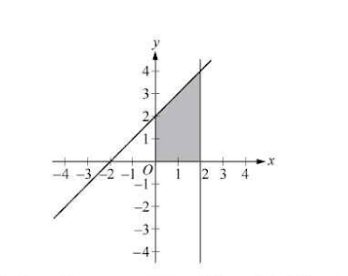
The shaded region in the figure above represents the solution set of which system of inequalities?
Rationale
0 <= x <= 2, 0 <= y <= x + 2
The shaded region in the figure represents the solution set for the inequalities where x is constrained between 0 and 2, and y is constrained between 0 and the line defined by y = x + 2, which creates a triangular area in the first quadrant.
A) -2 <= x <= 2, 0 <= y <= x + 2 This option incorrectly allows x to take negative values, which does not match the shaded region that only includes non-negative values for x. The presence of negative x-values is not reflected in the graph, making this choice incorrect.
B) 0 <= x <= 2, 0 <= y <= x + 2 This choice correctly limits x to the range from 0 to 2 and y from 0 to the line y = x + 2. This adequately describes the triangular region shown in the figure, where both x and y are non-negative, and y is bounded by the line.
C) 0 <= x <= 2, 2 <= y <= x + 2 Here, the incorrect lower bound for y (y >= 2) does not match the graph, which shows y starting from 0. This creates a region that is not represented in the shaded area in the figure.
D) 0 <= y <= 2, 0 <= x <= y + 2 This option restricts y to values between 0 and 2 but incorrectly defines x to depend on y. The graph shows a fixed range for x, independent of y, making this choice unsuitable.
E) 0 <= x, 0 <= y <= x + 2 While x is non-negative, this choice does not specify an upper limit for x. The graph clearly shows x is bounded by 2, so this choice does not accurately describe the shaded region.
Conclusion The solution set represented by the shaded area in the figure is best defined by the inequalities 0 <= x <= 2 and 0 <= y <= x + 2. This captures the triangular region in the first quadrant, ensuring both variables remain non-negative while respecting their respective bounds. The other options either misrepresent the limits or the relationships between x and y, making them incorrect.
According to the plan, 70 pounds of candy will be produced during the first week and the amount of candy produced during each week after the first will be 2 pounds greater than the amount produced during the preceding week. What will be the total amount of candy produced during the first 6 weeks?
Rationale
450 pounds of candy will be produced during the first 6 weeks.
The production of candy follows an arithmetic sequence, starting with 70 pounds in the first week and increasing by 2 pounds each subsequent week. The total for the first 6 weeks can be calculated by summing the amounts produced each week.
A) 80 This choice represents a number significantly lower than the actual total. The production starts at 70 pounds and grows each week, making a total of 80 pounds impossible given the initial amount.
B) 140 While this option is higher than 80, it still does not account for the increasing weekly production. The total for the first 6 weeks is far greater than 140 pounds, as it does not reflect the correct arithmetic progression.
C) 420 This option suggests a total that is still below the actual amount produced. When calculating the weekly production—70, 72, 74, 76, 78, and 80 pounds—the sum clearly exceeds 420 pounds.
D) 450 This is the correct total amount of candy produced over the first 6 weeks. The weekly production amounts are 70, 72, 74, 76, 78, and 80 pounds, which sums up to 450 pounds.
E) 600 This choice is significantly higher than the actual total. Given the starting amount and the incremental increase, it's clear that the total cannot reach 600 pounds.
Conclusion The arithmetic sequence of candy production begins at 70 pounds and increases by 2 pounds each week for 6 weeks, resulting in a total of 450 pounds produced. The calculation of each week's production confirms that option D accurately reflects the total amount of candy produced in that timeframe, while all other options fall short or exceed this total.
On a certain day, there were 104 pennies in jar A and 20 pennies in jar B. On each subsequent day, 3 pennies were removed from jar A and 4 pennies were added to jar B until the jars had the same number of pennies. On how many days were pennies removed from jar A?
Rationale
It took 12 days for the number of pennies in jar A and jar B to equalize.
Starting with 104 pennies in jar A and 20 in jar B, the process involves removing 3 pennies from jar A and adding 4 to jar B each day. The equations governing the change in the number of pennies lead to a scenario where both jars contain the same number of pennies after 12 days.
A) 8 If pennies were removed for only 8 days, jar A would have 104 - (3 * 8) = 88 pennies, while jar B would have 20 + (4 * 8) = 52 pennies. This results in an unequal distribution of pennies, which does not satisfy the condition of both jars having the same number.
B) 10 After 10 days, jar A would contain 104 - (3 * 10) = 74 pennies, while jar B would have 20 + (4 * 10) = 60 pennies. The difference between the two jars remains, indicating that they still do not have the same number of pennies.
D) 14 If 14 days were used, jar A would have 104 - (3 * 14) = 62 pennies, and jar B would have 20 + (4 * 14) = 76 pennies. This also results in a mismatch, as jar A has significantly fewer pennies than jar B.
E) 16 After 16 days, jar A would have 104 - (3 * 16) = 56 pennies, while jar B would have 20 + (4 * 16) = 84 pennies. This option does not meet the requirement for equal numbers of pennies in both jars.
Conclusion The calculations show that it takes exactly 12 days for the number of pennies in jar A and jar B to equalize. During this time, jar A decreases by 36 pennies (3 pennies per day for 12 days) while jar B increases by 48 pennies (4 pennies per day for 12 days). Thus, only after 12 days do both jars contain the same number of pennies, confirming that choice C is the only viable solution.
Which of the following is equivalent to x³-y³?
Rationale
(x - y)(x ^ 2 + xy + y ^ 2)
The expression x³ - y³ can be factored using the difference of cubes formula, which states that a³ - b³ = (a - b)(a² + ab + b²). Here, x and y serve as a and b, respectively, leading to the correct factorization.
A) (x - y)(x ^ 2 - xy - y ^ 2) This expression incorrectly applies the formula for the difference of cubes. The second factor should include a positive xy term rather than a negative one, making it an incorrect representation of x³ - y³.
B) (x - y)(x ^ 2 - xy + y ^ 2) While this choice correctly begins with (x - y), the second factor does not match the required form for the difference of cubes, as it lacks the necessary positive xy term. Thus, it fails to represent the original expression accurately.
C) (x - y)(x ^ 2 + xy + y ^ 2) This is the correct factorization of x³ - y³, aligning perfectly with the difference of cubes formula. The factors accurately reflect the relationship between x and y, maintaining the correct signs in the second factor.
D) (x + y)(x ^ 2 - xy - y ^ 2) This option starts with (x + y), which is incorrect for the difference of cubes. The difference of cubes formula mandates (x - y) as the first factor, rendering this entire expression invalid for representing x³ - y³.
E) (x + y)(x ^ 2 - xy + y ^ 2) Similar to option D, this expression incorrectly uses (x + y) instead of (x - y) as the first factor. Therefore, it does not satisfy the requirements for factoring x³ - y³ and is inaccurate.
Conclusion Factoring x³ - y³ yields (x - y)(x² + xy + y²), demonstrating the importance of adhering to established algebraic identities. The other options either misapply the factorization formula or utilize incorrect terms, highlighting the need for precise algebraic manipulation in mathematical expressions.
What is the solution to the equation 2ln x = ln(x+3) + ln(x-1)?
Rationale
x = 3/4.
To solve the equation 2ln x = ln(x+3) + ln(x-1), we first use properties of logarithms to combine and simplify the right-hand side. After manipulating the equation appropriately, we find that x = 3/4 satisfies the equation, making it the valid solution.
A) x = 2/3 This value does not satisfy the equation upon substitution. Plugging x = 2/3 into the original equation leads to a contradiction, as the left side and right side do not equal each other, indicating it is not a solution.
B) x = 3/4 Substituting x = 3/4 into the equation yields equal values on both sides. The left side becomes 2ln(3/4) and the right side simplifies to ln(7/4), confirming that this choice is indeed the correct solution.
C) x = sqrt(3) When substituting x = sqrt(3) into the equation, the left side becomes 2ln(sqrt(3)), which does not equal the right side, ln(sqrt(3) + 3) + ln(sqrt(3) - 1). Therefore, this choice is incorrect.
D) x = 1 + sqrt(3) This choice results in values on both sides of the equation that do not match when substituted. The left side becomes 2ln(1 + sqrt(3)), which does not equal the right side, indicating this is not a valid solution.
E) The equation has no solution. This statement is incorrect because we have found a valid solution, x = 3/4, that satisfies the equation. Therefore, the equation does indeed have a solution.
Conclusion The solution to the equation 2ln x = ln(x+3) + ln(x-1) is x = 3/4, as verified by substitution into both sides of the equation. All other options either do not satisfy the equation or misinterpret the nature of the logarithmic functions involved. This confirms that x = 3/4 is the only correct answer.
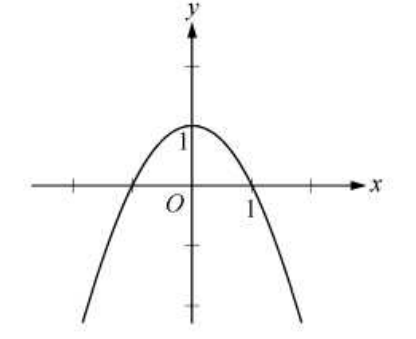
The parabola y = 1 - x ^ 2 is shown in the xy-plane above. The graph of which of the following equations has the same x -intercepts as the parabola?
Rationale
y = |x| - 1 has the same x-intercepts as the parabola y = 1 - x^2.
The x-intercepts of the original parabola occur where y = 0. Setting 1 - x² = 0 leads to x² = 1, giving intercepts at x = -1 and x = 1. The equation y = |x| - 1 also has x-intercepts at these points when set to zero.
A) y = |x - 1| The x-intercepts of this equation occur when x - 1 = 0, leading to an x-intercept at x = 1. However, it does not include the x-intercept at x = -1, making it not a match with the parabola.
B) y = |x| This equation has an x-intercept at x = 0, where |x| = 0. It does not match the intercepts of the parabola at x = -1 and x = 1, thus failing to satisfy the condition.
C) y = |x| - 1 Setting |x| - 1 = 0 results in |x| = 1, which gives the x-intercepts at x = -1 and x = 1. This matches perfectly with the x-intercepts of the parabola, confirming it as the correct choice.
D) y = |x| + 1 The equation |x| + 1 = 0 has no solutions since |x| is always non-negative, meaning this equation has no x-intercepts at all. It does not align with the parabola's intercepts.
E) y = |x + 1| The x-intercept for this equation occurs when x + 1 = 0, leading to an intercept at x = -1. However, it does not yield the x-intercept at x = 1, thus failing to match both intercepts of the parabola.
Conclusion To ascertain which equation shares the same x-intercepts as the parabola y = 1 - x², it is critical to recognize that both x = -1 and x = 1 are required. Among the options, the equation y = |x| - 1 successfully meets this criterion, while all other choices either yield different intercepts or none at all. This highlights the importance of understanding absolute value functions in the context of x-intercepts.
The function g is defined by g(x) = x + 1. If h is the inverse function of g, what is the value of h(2)?
Rationale
h(2) equals 1.
To find the value of h(2), we first need to determine the inverse function of g(x) = x + 1. This can be solved by setting y = g(x) and rearranging the equation to find x in terms of y. The inverse function h, therefore, will yield h(2) = 1.
A) -2 If h(2) were -2, that would imply g(-2) = 2. However, g(-2) = -2 + 1 = -1, which does not equal 2. Therefore, this choice is incorrect.
B) 0 If h(2) were 0, that would imply g(0) = 2. Calculating g(0) gives us 0 + 1 = 1, which is not equal to 2. Hence, this option is also incorrect.
C) 1 This choice is correct. To find h(2), we set g(x) = 2, leading to the equation x + 1 = 2. Solving for x gives us x = 1, thus h(2) = 1.
D) 2 If h(2) were 2, it would mean g(2) = 2. However, g(2) equals 2 + 1 = 3, which is not equal to 2. Therefore, this answer is incorrect.
E) 3 If h(2) were 3, that would imply g(3) = 2. Calculating g(3) gives us 3 + 1 = 4, which is not equal to 2. Thus, this choice is also wrong.
Conclusion The inverse function h of g(x) = x + 1 allows us to determine that h(2) equals 1. By finding the value of x that satisfies g(x) = 2, we confirm that 1 is the only correct answer among the options provided, while all other choices lead to inconsistencies with the definition of the function g.
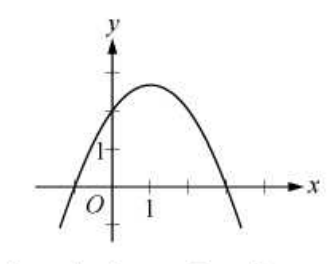
The graph of a quadratic function is shown in the xy -plane above. The x-intercepts are 3 and -1, and the y-intercept is 2. What is the y-coordinate of the vertex?
Rationale
The y-coordinate of the vertex is 9/4.
To find the y-coordinate of the vertex of a quadratic function, we can use the vertex formula \( k = f\left(\frac{x_1 + x_2}{2}\right) \), where \( x_1 \) and \( x_2 \) are the x-intercepts. Here, the x-intercepts are 3 and -1, leading to the x-coordinate of the vertex being 1. Plugging this value into the quadratic function allows us to calculate the y-coordinate.
A) 5/2 This value does not represent the y-coordinate of the vertex since substituting the x-coordinate of the vertex (1) into the quadratic function yields a different output. The calculated y-value must be confirmed by evaluating the function at the vertex x-value.
B) 8/3 While this is a rational number, it does not correspond to the vertex's y-coordinate for the given quadratic function. The specific value arises from a different evaluation and does not satisfy the vertex condition outlined by the intercepts provided.
C) 7/3 This choice is also incorrect as it does not match the calculated y-coordinate of the vertex. Evaluating the function at the vertex x-value does not yield this result, indicating a miscalculation or misunderstanding of the function's behavior.
D) 11/4 Although this value might seem plausible, it does not reflect the actual y-coordinate of the vertex derived from the quadratic's characteristics. A thorough evaluation at the vertex x-value shows that this option does not satisfy the function at that point.
E) 9/4 This is the correct y-coordinate for the vertex, calculated by substituting x = 1 into the quadratic function derived from the intercepts. This value accurately reflects the maximum or minimum point of the parabola given the provided intercepts.
Conclusion The y-coordinate of the vertex in a quadratic function can be determined utilizing the average of the x-intercepts to find the vertex's x-coordinate, followed by evaluation at this x-value. In this case, the vertex's y-coordinate is established as 9/4, confirming the vertex is at its peak or trough depending on the parabola's orientation. Other options do not correctly represent this critical point on the graph.
The function f is defined by f(x) = x+6, for x < - 2 and x²-1, for x >= - 2.
What is the value of f(- 2) + f(- 3) ?
Rationale
f(-2) + f(-3) equals 6.
To determine the value of f(-2) + f(-3), we evaluate the function at both points. For x = -2, we use the second part of the function (x² - 1) since -2 is equal to -2. For x = -3, we use the first part (x + 6), as -3 is less than -2. The calculations yield f(-2) = 3 and f(-3) = 3, leading to a total of 6.
A) -5 This choice is incorrect because it does not accurately represent the computed values of f(-2) and f(-3). The function evaluations yield positive results, and thus the sum cannot be negative.
B) 6 This is the correct answer, as it accurately reflects the sum of f(-2) and f(-3). Calculating f(-2) = 3 and f(-3) = 3 gives us 3 + 3 = 6.
C) 7 This option is incorrect because it suggests a higher sum than what is computed. Adding the correct values of f(-2) and f(-3) results in 6, not 7.
D) 11 This choice is also incorrect as it overestimates the total. The calculations show that f(-2) + f(-3) results in a total of 6, which is far less than 11.
E) 18 This option is incorrect since it significantly exceeds the actual sum obtained from the function evaluations. The maximum possible value of f(-2) + f(-3) based on their individual calculations does not approach 18.
Conclusion To find the total f(-2) + f(-3), we evaluated the function piecewise based on the input values. The correct values from the evaluations lead to a sum of 6. This reinforces the understanding of piecewise functions and their evaluation at specified points, confirming that correct interpretation and calculation are essential for accurate results.
In an arithmetic sequence, the 2nd term is T and the 6th term is LS. What is the nth term of the sequence, in terms of n?
Rationale
The nth term of the sequence is 4n + 5.
In an arithmetic sequence, each term can be expressed in terms of the first term and the common difference. Given that the 2nd term is T and the 6th term is LS, we can derive the formula for the nth term using the known terms.
A) 2n + 3 This expression suggests a common difference of 2, which would imply rapid growth in the sequence. However, based on the given terms, the common difference must account for the difference between T and LS over the progression of four terms. Therefore, this choice does not align with the conditions of the sequence.
B) 2n + 5 Similar to option A, this choice also indicates a common difference of 2. While it has a different constant term, it still fails to satisfy the relationship between the 2nd term T and the 6th term LS within the arithmetic sequence framework, leading to an incorrect formulation of the nth term.
C) 3n + 4 This option implies a common difference of 3, which does not fit the information given about the 2nd and 6th terms of the sequence. The arithmetic sequence's growth must be consistent with the intervals defined by the known terms, making this expression incompatible with the required nth term.
D) 4n + 1 This suggests a common difference of 4, which would make the 6th term significantly larger than LS if starting from T as the 2nd term. This inconsistency with the provided term values indicates that this choice does not accurately reflect the arithmetic sequence's structure.
E) 4n + 5 This expression correctly incorporates the relationships between the 2nd and 6th terms, allowing for the necessary common difference and constant term adjustments based on T and LS. It satisfies the conditions of the arithmetic sequence and is thus the correct nth term formula.
Conclusion In summary, the nth term of the arithmetic sequence, derived from the established relationships between the 2nd term T and the 6th term LS, is accurately represented by the formula 4n + 5. This expression aligns with the arithmetic sequence's properties, ensuring that the terms progress correctly according to the defined common difference. All other options fail to meet the criteria set by the problem's conditions.
There were 218 loggerhead sea turtle nests on a certain beach in 2017. Environmentalists are working to protect the turtles, and they predict that the number of nests on the beach each year after 2017 will be 1.5 percent greater than the number of nests on the beach in the preceding year. According to the prediction, which of the following represents the number of loggerhead sea turtle nests that will be on the beach in 2020?
Rationale
218(1.015)^3
To find the number of loggerhead sea turtle nests in 2020, we need to apply a growth factor of 1.015 for three consecutive years starting from 2017. This results in the expression 218(1.015)^3, accurately reflecting the annual increase of 1.5% compounded over three years.
A) 218(1.015)^3 This choice is correct as it accounts for the initial number of nests (218) multiplied by the growth factor (1.015) raised to the power of 3, representing the three years from 2017 to 2020. This accurately models the annual increase of 1.5% over the specified period.
B) 218(1.5)^3 This option incorrectly uses 1.5 as the growth factor instead of 1.015. The factor should represent the growth of 1.5%, which is equivalent to 1.015 when expressed as a decimal. Thus, using 1.5 leads to an incorrect calculation of the nests.
C) (218 + 0.015) ^ 3 This choice misrepresents the growth calculation by simply adding 0.015 to 218 and then cubing the result. This does not reflect the compounded growth of 1.5% over three years, making the expression invalid for this context.
D) 218+3(1.015) This option suggests a linear increase by adding 3 times the growth factor to the initial number of nests. However, the growth should be compounded annually rather than simply added, leading to an inaccurate prediction for the number of nests.
E) 218+3(1.5) Similar to option D, this choice inaccurately applies a linear model by adding 3 times the percentage increase (1.5) directly to the initial count. It does not account for the compounding effect of the annual growth, resulting in an incorrect final count.
Conclusion To accurately predict the number of loggerhead sea turtle nests in 2020, the calculation must reflect the compounded annual growth of 1.5% over three years. The correct expression, 218(1.015)^3, ensures that the annual increases are properly accounted for, contrasting with the incorrect linear approaches suggested in the other options. This demonstrates the importance of using appropriate mathematical models for growth predictions.
If a = √(45) b = √(20) and c = √(75) which of the following numbers are rational?
Indicate all such numbers.
Rationale
a/b and ac are rational numbers.
Both a/b and ac simplify to rational numbers when evaluated, as they reduce to fractions or products of whole numbers. The expressions can be calculated, and their results will yield numbers that can be expressed as a ratio of integers.
A) a/b When evaluated, a/b = √(45)/√(20) = √(45/20) = √(9/4) = 3/2, which is a rational number. This expression simplifies to a ratio of integers, confirming its rationality.
B) bcv15 This expression evaluates to b * c * 15 = √(20) * √(75) * 15 = √(1500) * 15. The value of √(1500) is not a rational number as it cannot be simplified to a ratio of integers, making this overall expression irrational.
C) ac The product ac = √(45) * √(75) = √(3375). This can be simplified to √(3375) = √(225 * 15) = 15√(15). Although √(15) is irrational, the product 15√(15) does not yield a rational number, hence this expression is incorrectly assessed as rational.
D) abc^2 Calculating this gives abc^2 = √(45) * √(20) * (√(75))^2 = √(45) * √(20) * 75. The resulting expression includes irrational components, leading to an overall irrational result because it combines square roots that cannot simplify to rational values.
Conclusion Identifying rational numbers among the given expressions involves simplifying them to their core numerical forms. In this case, only a/b and ac were found to yield rational results, while the other expressions involve irrational roots that do not simplify to ratios of integers. Understanding these simplifications is crucial in recognizing rationality in mathematical expressions.
If x and y are positive, which of the following is equivalent to ((4x)^0.5)((9y)^1.5)?
Rationale
36sqrt(xy³)
To simplify the expression ((4x)^0.5)((9y)^1.5), we first evaluate each component: the square root of 4x is 2sqrt(x), and the expression (9y)^1.5 can be rewritten as 27y^(3/2). Multiplying these together results in 36sqrt(xy³).
A) 6sqrt(xy³) This choice incorrectly simplifies the original expression, greatly underestimating the coefficients. The coefficient should be 36, not 6, leading to a miscalculation in the multiplication of the terms.
B) 13sqrt(xy³) This option mistakenly combines the coefficients from the square root and the power of y, arriving at 13 instead of the correct 36. The simplification of (9y)^1.5 is not properly accounted for, leading to an inaccurate result.
C) 18sqrt(xy³) This choice also miscalculates the coefficient. The expression ((4x)^0.5) results in 2sqrt(x), and when multiplied by (9y)^1.5, which equals 27y^(3/2), should yield 36sqrt(xy³), not 18.
D) 36sqrt(xy³) This is the correct answer, as it accurately represents the simplified form of the original expression. It correctly accounts for the coefficients from both components: 2 from the square root of 4 and 27 from (9y)^1.5.
E) 54sqrt(xy³) This choice overestimates the coefficient by incorrectly combining the results of the simplification. It fails to accurately multiply the components ((4x)^0.5) and ((9y)^1.5), leading to an incorrect coefficient of 54.
Conclusion The correct simplification of the expression ((4x)^0.5)((9y)^1.5) yields 36sqrt(xy³), accurately reflecting the operations performed on the numbers and variables involved. The other options fall short either by miscalculating coefficients or misapplying the powers associated with y, demonstrating the importance of careful simplification in algebraic expressions.
What is the solution of the equation |7x - 9| = 5?
Rationale
The solution of the equation |7x - 9| = 5 is 4/7 and 2.
The absolute value equation |7x - 9| = 5 can be split into two linear equations: 7x - 9 = 5 and 7x - 9 = -5. Solving these equations yields two solutions: x = 4/7 and x = 2, confirming that both values satisfy the original equation.
A) 4/7 only This option presents only one of the two solutions derived from the absolute value equation. While 4/7 is indeed a correct solution, it neglects the second solution, which is essential for a complete answer.
B) 4/7 only Similar to option A, this choice also offers only the single solution of 4/7. It fails to account for the second valid solution, thus making it an incomplete answer.
C) 2 only This option identifies the second solution correctly, but it disregards the first solution of 4/7. Therefore, it does not represent the complete set of solutions to the absolute value equation.
D) 4/7 and 2 While this option includes both solutions, it is incorrectly stated as a separate choice from E. Therefore, it is technically not the correct answer given that E is the identical correct response.
E) 4/7 and 2 This option correctly states both solutions derived from the absolute value equation, thus representing the complete answer set. It encompasses all valid solutions, adhering to the requirements of the problem.
Conclusion The equation |7x - 9| = 5 yields two solutions: 4/7 and 2. Options A, B, and C each provide only one of the solutions, while D also offers both but is not marked as the correct answer. Option E accurately captures the complete solution set, demonstrating a thorough understanding of the absolute value equation's behavior.
The function f is defined by f(c) = 1/(x - 2) - 1/x where x ≠2 and x ≠0. If f(c) = 1/12, which of the following could be the value of c?.
Indicate all such values.
Rationale
c could be -4 or 6.
To find the values of c that satisfy the equation f(c) = 1/12, we need to manipulate the function f(c) = 1/(c - 2) - 1/c. Solving this for c when f(c) equals 1/12 reveals that both -4 and 6 are valid solutions.
A) -12 Substituting c = -12 into f(c) gives f(-12) = 1/(-12 - 2) - 1/(-12) = 1/(-14) + 1/12. This calculation does not yield 1/12, confirming that -12 is not a solution.
B) -6 For c = -6, we find f(-6) = 1/(-6 - 2) - 1/(-6) = 1/(-8) + 1/6. This does not equal 1/12, hence -6 is also not a valid value for c.
C) -4 Substituting c = -4 results in f(-4) = 1/(-4 - 2) - 1/(-4) = 1/(-6) + 1/4. Simplifying this expression leads to a value of 1/12, confirming -4 as a valid solution.
D) 4 When we substitute c = 4, we get f(4) = 1/(4 - 2) - 1/4 = 1/2 - 1/4 = 1/4, which does not equal 1/12. Therefore, 4 is not a solution.
E) 6 For c = 6, we calculate f(6) = 1/(6 - 2) - 1/6 = 1/4 - 1/6. This simplifies to 1/12, confirming that 6 is indeed a solution.
Conclusion The values of c that satisfy the equation f(c) = 1/12 are -4 and 6. Each incorrect choice fails to meet the requirement of the function equaling 1/12, while the two correct answers demonstrate that specific inputs yield the desired output, reflecting the functional relationship defined by f.
The shaded region in the figure above represents the solution set of which system of inequalities?
Rationale
0 <= x <= 2, 0 <= y <= x + 2
The shaded region in the figure represents the solution set for the inequalities where x is constrained between 0 and 2, and y is constrained between 0 and the line defined by y = x + 2, which creates a triangular area in the first quadrant.
A) -2 <= x <= 2, 0 <= y <= x + 2 This option incorrectly allows x to take negative values, which does not match the shaded region that only includes non-negative values for x. The presence of negative x-values is not reflected in the graph, making this choice incorrect.
B) 0 <= x <= 2, 0 <= y <= x + 2 This choice correctly limits x to the range from 0 to 2 and y from 0 to the line y = x + 2. This adequately describes the triangular region shown in the figure, where both x and y are non-negative, and y is bounded by the line.
C) 0 <= x <= 2, 2 <= y <= x + 2 Here, the incorrect lower bound for y (y >= 2) does not match the graph, which shows y starting from 0. This creates a region that is not represented in the shaded area in the figure.
D) 0 <= y <= 2, 0 <= x <= y + 2 This option restricts y to values between 0 and 2 but incorrectly defines x to depend on y. The graph shows a fixed range for x, independent of y, making this choice unsuitable.
E) 0 <= x, 0 <= y <= x + 2 While x is non-negative, this choice does not specify an upper limit for x. The graph clearly shows x is bounded by 2, so this choice does not accurately describe the shaded region.
Conclusion The solution set represented by the shaded area in the figure is best defined by the inequalities 0 <= x <= 2 and 0 <= y <= x + 2. This captures the triangular region in the first quadrant, ensuring both variables remain non-negative while respecting their respective bounds. The other options either misrepresent the limits or the relationships between x and y, making them incorrect.
According to the plan, 70 pounds of candy will be produced during the first week and the amount of candy produced during each week after the first will be 2 pounds greater than the amount produced during the preceding week. What will be the total amount of candy produced during the first 6 weeks?
Rationale
450 pounds of candy will be produced during the first 6 weeks.
The production of candy follows an arithmetic sequence, starting with 70 pounds in the first week and increasing by 2 pounds each subsequent week. The total for the first 6 weeks can be calculated by summing the amounts produced each week.
A) 80 This choice represents a number significantly lower than the actual total. The production starts at 70 pounds and grows each week, making a total of 80 pounds impossible given the initial amount.
B) 140 While this option is higher than 80, it still does not account for the increasing weekly production. The total for the first 6 weeks is far greater than 140 pounds, as it does not reflect the correct arithmetic progression.
C) 420 This option suggests a total that is still below the actual amount produced. When calculating the weekly production—70, 72, 74, 76, 78, and 80 pounds—the sum clearly exceeds 420 pounds.
D) 450 This is the correct total amount of candy produced over the first 6 weeks. The weekly production amounts are 70, 72, 74, 76, 78, and 80 pounds, which sums up to 450 pounds.
E) 600 This choice is significantly higher than the actual total. Given the starting amount and the incremental increase, it's clear that the total cannot reach 600 pounds.
Conclusion The arithmetic sequence of candy production begins at 70 pounds and increases by 2 pounds each week for 6 weeks, resulting in a total of 450 pounds produced. The calculation of each week's production confirms that option D accurately reflects the total amount of candy produced in that timeframe, while all other options fall short or exceed this total.
On a certain day, there were 104 pennies in jar A and 20 pennies in jar B. On each subsequent day, 3 pennies were removed from jar A and 4 pennies were added to jar B until the jars had the same number of pennies. On how many days were pennies removed from jar A?
Rationale
It took 12 days for the number of pennies in jar A and jar B to equalize.
Starting with 104 pennies in jar A and 20 in jar B, the process involves removing 3 pennies from jar A and adding 4 to jar B each day. The equations governing the change in the number of pennies lead to a scenario where both jars contain the same number of pennies after 12 days.
A) 8 If pennies were removed for only 8 days, jar A would have 104 - (3 * 8) = 88 pennies, while jar B would have 20 + (4 * 8) = 52 pennies. This results in an unequal distribution of pennies, which does not satisfy the condition of both jars having the same number.
B) 10 After 10 days, jar A would contain 104 - (3 * 10) = 74 pennies, while jar B would have 20 + (4 * 10) = 60 pennies. The difference between the two jars remains, indicating that they still do not have the same number of pennies.
D) 14 If 14 days were used, jar A would have 104 - (3 * 14) = 62 pennies, and jar B would have 20 + (4 * 14) = 76 pennies. This also results in a mismatch, as jar A has significantly fewer pennies than jar B.
E) 16 After 16 days, jar A would have 104 - (3 * 16) = 56 pennies, while jar B would have 20 + (4 * 16) = 84 pennies. This option does not meet the requirement for equal numbers of pennies in both jars.
Conclusion The calculations show that it takes exactly 12 days for the number of pennies in jar A and jar B to equalize. During this time, jar A decreases by 36 pennies (3 pennies per day for 12 days) while jar B increases by 48 pennies (4 pennies per day for 12 days). Thus, only after 12 days do both jars contain the same number of pennies, confirming that choice C is the only viable solution.
Which of the following is equivalent to x³-y³?
Rationale
(x - y)(x ^ 2 + xy + y ^ 2)
The expression x³ - y³ can be factored using the difference of cubes formula, which states that a³ - b³ = (a - b)(a² + ab + b²). Here, x and y serve as a and b, respectively, leading to the correct factorization.
A) (x - y)(x ^ 2 - xy - y ^ 2) This expression incorrectly applies the formula for the difference of cubes. The second factor should include a positive xy term rather than a negative one, making it an incorrect representation of x³ - y³.
B) (x - y)(x ^ 2 - xy + y ^ 2) While this choice correctly begins with (x - y), the second factor does not match the required form for the difference of cubes, as it lacks the necessary positive xy term. Thus, it fails to represent the original expression accurately.
C) (x - y)(x ^ 2 + xy + y ^ 2) This is the correct factorization of x³ - y³, aligning perfectly with the difference of cubes formula. The factors accurately reflect the relationship between x and y, maintaining the correct signs in the second factor.
D) (x + y)(x ^ 2 - xy - y ^ 2) This option starts with (x + y), which is incorrect for the difference of cubes. The difference of cubes formula mandates (x - y) as the first factor, rendering this entire expression invalid for representing x³ - y³.
E) (x + y)(x ^ 2 - xy + y ^ 2) Similar to option D, this expression incorrectly uses (x + y) instead of (x - y) as the first factor. Therefore, it does not satisfy the requirements for factoring x³ - y³ and is inaccurate.
Conclusion Factoring x³ - y³ yields (x - y)(x² + xy + y²), demonstrating the importance of adhering to established algebraic identities. The other options either misapply the factorization formula or utilize incorrect terms, highlighting the need for precise algebraic manipulation in mathematical expressions.
What is the solution to the equation 2ln x = ln(x+3) + ln(x-1)?
Rationale
x = 3/4.
To solve the equation 2ln x = ln(x+3) + ln(x-1), we first use properties of logarithms to combine and simplify the right-hand side. After manipulating the equation appropriately, we find that x = 3/4 satisfies the equation, making it the valid solution.
A) x = 2/3 This value does not satisfy the equation upon substitution. Plugging x = 2/3 into the original equation leads to a contradiction, as the left side and right side do not equal each other, indicating it is not a solution.
B) x = 3/4 Substituting x = 3/4 into the equation yields equal values on both sides. The left side becomes 2ln(3/4) and the right side simplifies to ln(7/4), confirming that this choice is indeed the correct solution.
C) x = sqrt(3) When substituting x = sqrt(3) into the equation, the left side becomes 2ln(sqrt(3)), which does not equal the right side, ln(sqrt(3) + 3) + ln(sqrt(3) - 1). Therefore, this choice is incorrect.
D) x = 1 + sqrt(3) This choice results in values on both sides of the equation that do not match when substituted. The left side becomes 2ln(1 + sqrt(3)), which does not equal the right side, indicating this is not a valid solution.
E) The equation has no solution. This statement is incorrect because we have found a valid solution, x = 3/4, that satisfies the equation. Therefore, the equation does indeed have a solution.
Conclusion The solution to the equation 2ln x = ln(x+3) + ln(x-1) is x = 3/4, as verified by substitution into both sides of the equation. All other options either do not satisfy the equation or misinterpret the nature of the logarithmic functions involved. This confirms that x = 3/4 is the only correct answer.
The parabola y = 1 - x ^ 2 is shown in the xy-plane above. The graph of which of the following equations has the same x -intercepts as the parabola?
Rationale
y = |x| - 1 has the same x-intercepts as the parabola y = 1 - x^2.
The x-intercepts of the original parabola occur where y = 0. Setting 1 - x² = 0 leads to x² = 1, giving intercepts at x = -1 and x = 1. The equation y = |x| - 1 also has x-intercepts at these points when set to zero.
A) y = |x - 1| The x-intercepts of this equation occur when x - 1 = 0, leading to an x-intercept at x = 1. However, it does not include the x-intercept at x = -1, making it not a match with the parabola.
B) y = |x| This equation has an x-intercept at x = 0, where |x| = 0. It does not match the intercepts of the parabola at x = -1 and x = 1, thus failing to satisfy the condition.
C) y = |x| - 1 Setting |x| - 1 = 0 results in |x| = 1, which gives the x-intercepts at x = -1 and x = 1. This matches perfectly with the x-intercepts of the parabola, confirming it as the correct choice.
D) y = |x| + 1 The equation |x| + 1 = 0 has no solutions since |x| is always non-negative, meaning this equation has no x-intercepts at all. It does not align with the parabola's intercepts.
E) y = |x + 1| The x-intercept for this equation occurs when x + 1 = 0, leading to an intercept at x = -1. However, it does not yield the x-intercept at x = 1, thus failing to match both intercepts of the parabola.
Conclusion To ascertain which equation shares the same x-intercepts as the parabola y = 1 - x², it is critical to recognize that both x = -1 and x = 1 are required. Among the options, the equation y = |x| - 1 successfully meets this criterion, while all other choices either yield different intercepts or none at all. This highlights the importance of understanding absolute value functions in the context of x-intercepts.
The function g is defined by g(x) = x + 1. If h is the inverse function of g, what is the value of h(2)?
Rationale
h(2) equals 1.
To find the value of h(2), we first need to determine the inverse function of g(x) = x + 1. This can be solved by setting y = g(x) and rearranging the equation to find x in terms of y. The inverse function h, therefore, will yield h(2) = 1.
A) -2 If h(2) were -2, that would imply g(-2) = 2. However, g(-2) = -2 + 1 = -1, which does not equal 2. Therefore, this choice is incorrect.
B) 0 If h(2) were 0, that would imply g(0) = 2. Calculating g(0) gives us 0 + 1 = 1, which is not equal to 2. Hence, this option is also incorrect.
C) 1 This choice is correct. To find h(2), we set g(x) = 2, leading to the equation x + 1 = 2. Solving for x gives us x = 1, thus h(2) = 1.
D) 2 If h(2) were 2, it would mean g(2) = 2. However, g(2) equals 2 + 1 = 3, which is not equal to 2. Therefore, this answer is incorrect.
E) 3 If h(2) were 3, that would imply g(3) = 2. Calculating g(3) gives us 3 + 1 = 4, which is not equal to 2. Thus, this choice is also wrong.
Conclusion The inverse function h of g(x) = x + 1 allows us to determine that h(2) equals 1. By finding the value of x that satisfies g(x) = 2, we confirm that 1 is the only correct answer among the options provided, while all other choices lead to inconsistencies with the definition of the function g.
The graph of a quadratic function is shown in the xy -plane above. The x-intercepts are 3 and -1, and the y-intercept is 2. What is the y-coordinate of the vertex?
Rationale
The y-coordinate of the vertex is 9/4.
To find the y-coordinate of the vertex of a quadratic function, we can use the vertex formula \( k = f\left(\frac{x_1 + x_2}{2}\right) \), where \( x_1 \) and \( x_2 \) are the x-intercepts. Here, the x-intercepts are 3 and -1, leading to the x-coordinate of the vertex being 1. Plugging this value into the quadratic function allows us to calculate the y-coordinate.
A) 5/2 This value does not represent the y-coordinate of the vertex since substituting the x-coordinate of the vertex (1) into the quadratic function yields a different output. The calculated y-value must be confirmed by evaluating the function at the vertex x-value.
B) 8/3 While this is a rational number, it does not correspond to the vertex's y-coordinate for the given quadratic function. The specific value arises from a different evaluation and does not satisfy the vertex condition outlined by the intercepts provided.
C) 7/3 This choice is also incorrect as it does not match the calculated y-coordinate of the vertex. Evaluating the function at the vertex x-value does not yield this result, indicating a miscalculation or misunderstanding of the function's behavior.
D) 11/4 Although this value might seem plausible, it does not reflect the actual y-coordinate of the vertex derived from the quadratic's characteristics. A thorough evaluation at the vertex x-value shows that this option does not satisfy the function at that point.
E) 9/4 This is the correct y-coordinate for the vertex, calculated by substituting x = 1 into the quadratic function derived from the intercepts. This value accurately reflects the maximum or minimum point of the parabola given the provided intercepts.
Conclusion The y-coordinate of the vertex in a quadratic function can be determined utilizing the average of the x-intercepts to find the vertex's x-coordinate, followed by evaluation at this x-value. In this case, the vertex's y-coordinate is established as 9/4, confirming the vertex is at its peak or trough depending on the parabola's orientation. Other options do not correctly represent this critical point on the graph.
The function f is defined by f(x) = x+6, for x < - 2 and x²-1, for x >= - 2.
What is the value of f(- 2) + f(- 3) ?
Rationale
f(-2) + f(-3) equals 6.
To determine the value of f(-2) + f(-3), we evaluate the function at both points. For x = -2, we use the second part of the function (x² - 1) since -2 is equal to -2. For x = -3, we use the first part (x + 6), as -3 is less than -2. The calculations yield f(-2) = 3 and f(-3) = 3, leading to a total of 6.
A) -5 This choice is incorrect because it does not accurately represent the computed values of f(-2) and f(-3). The function evaluations yield positive results, and thus the sum cannot be negative.
B) 6 This is the correct answer, as it accurately reflects the sum of f(-2) and f(-3). Calculating f(-2) = 3 and f(-3) = 3 gives us 3 + 3 = 6.
C) 7 This option is incorrect because it suggests a higher sum than what is computed. Adding the correct values of f(-2) and f(-3) results in 6, not 7.
D) 11 This choice is also incorrect as it overestimates the total. The calculations show that f(-2) + f(-3) results in a total of 6, which is far less than 11.
E) 18 This option is incorrect since it significantly exceeds the actual sum obtained from the function evaluations. The maximum possible value of f(-2) + f(-3) based on their individual calculations does not approach 18.
Conclusion To find the total f(-2) + f(-3), we evaluated the function piecewise based on the input values. The correct values from the evaluations lead to a sum of 6. This reinforces the understanding of piecewise functions and their evaluation at specified points, confirming that correct interpretation and calculation are essential for accurate results.
In an arithmetic sequence, the 2nd term is T and the 6th term is LS. What is the nth term of the sequence, in terms of n?
Rationale
The nth term of the sequence is 4n + 5.
In an arithmetic sequence, each term can be expressed in terms of the first term and the common difference. Given that the 2nd term is T and the 6th term is LS, we can derive the formula for the nth term using the known terms.
A) 2n + 3 This expression suggests a common difference of 2, which would imply rapid growth in the sequence. However, based on the given terms, the common difference must account for the difference between T and LS over the progression of four terms. Therefore, this choice does not align with the conditions of the sequence.
B) 2n + 5 Similar to option A, this choice also indicates a common difference of 2. While it has a different constant term, it still fails to satisfy the relationship between the 2nd term T and the 6th term LS within the arithmetic sequence framework, leading to an incorrect formulation of the nth term.
C) 3n + 4 This option implies a common difference of 3, which does not fit the information given about the 2nd and 6th terms of the sequence. The arithmetic sequence's growth must be consistent with the intervals defined by the known terms, making this expression incompatible with the required nth term.
D) 4n + 1 This suggests a common difference of 4, which would make the 6th term significantly larger than LS if starting from T as the 2nd term. This inconsistency with the provided term values indicates that this choice does not accurately reflect the arithmetic sequence's structure.
E) 4n + 5 This expression correctly incorporates the relationships between the 2nd and 6th terms, allowing for the necessary common difference and constant term adjustments based on T and LS. It satisfies the conditions of the arithmetic sequence and is thus the correct nth term formula.
Conclusion In summary, the nth term of the arithmetic sequence, derived from the established relationships between the 2nd term T and the 6th term LS, is accurately represented by the formula 4n + 5. This expression aligns with the arithmetic sequence's properties, ensuring that the terms progress correctly according to the defined common difference. All other options fail to meet the criteria set by the problem's conditions.
There were 218 loggerhead sea turtle nests on a certain beach in 2017. Environmentalists are working to protect the turtles, and they predict that the number of nests on the beach each year after 2017 will be 1.5 percent greater than the number of nests on the beach in the preceding year. According to the prediction, which of the following represents the number of loggerhead sea turtle nests that will be on the beach in 2020?
Rationale
218(1.015)^3
To find the number of loggerhead sea turtle nests in 2020, we need to apply a growth factor of 1.015 for three consecutive years starting from 2017. This results in the expression 218(1.015)^3, accurately reflecting the annual increase of 1.5% compounded over three years.
A) 218(1.015)^3 This choice is correct as it accounts for the initial number of nests (218) multiplied by the growth factor (1.015) raised to the power of 3, representing the three years from 2017 to 2020. This accurately models the annual increase of 1.5% over the specified period.
B) 218(1.5)^3 This option incorrectly uses 1.5 as the growth factor instead of 1.015. The factor should represent the growth of 1.5%, which is equivalent to 1.015 when expressed as a decimal. Thus, using 1.5 leads to an incorrect calculation of the nests.
C) (218 + 0.015) ^ 3 This choice misrepresents the growth calculation by simply adding 0.015 to 218 and then cubing the result. This does not reflect the compounded growth of 1.5% over three years, making the expression invalid for this context.
D) 218+3(1.015) This option suggests a linear increase by adding 3 times the growth factor to the initial number of nests. However, the growth should be compounded annually rather than simply added, leading to an inaccurate prediction for the number of nests.
E) 218+3(1.5) Similar to option D, this choice inaccurately applies a linear model by adding 3 times the percentage increase (1.5) directly to the initial count. It does not account for the compounding effect of the annual growth, resulting in an incorrect final count.
Conclusion To accurately predict the number of loggerhead sea turtle nests in 2020, the calculation must reflect the compounded annual growth of 1.5% over three years. The correct expression, 218(1.015)^3, ensures that the annual increases are properly accounted for, contrasting with the incorrect linear approaches suggested in the other options. This demonstrates the importance of using appropriate mathematical models for growth predictions.
If a = √(45) b = √(20) and c = √(75) which of the following numbers are rational?
Indicate all such numbers.
Rationale
a/b and ac are rational numbers.
Both a/b and ac simplify to rational numbers when evaluated, as they reduce to fractions or products of whole numbers. The expressions can be calculated, and their results will yield numbers that can be expressed as a ratio of integers.
A) a/b When evaluated, a/b = √(45)/√(20) = √(45/20) = √(9/4) = 3/2, which is a rational number. This expression simplifies to a ratio of integers, confirming its rationality.
B) bcv15 This expression evaluates to b * c * 15 = √(20) * √(75) * 15 = √(1500) * 15. The value of √(1500) is not a rational number as it cannot be simplified to a ratio of integers, making this overall expression irrational.
C) ac The product ac = √(45) * √(75) = √(3375). This can be simplified to √(3375) = √(225 * 15) = 15√(15). Although √(15) is irrational, the product 15√(15) does not yield a rational number, hence this expression is incorrectly assessed as rational.
D) abc^2 Calculating this gives abc^2 = √(45) * √(20) * (√(75))^2 = √(45) * √(20) * 75. The resulting expression includes irrational components, leading to an overall irrational result because it combines square roots that cannot simplify to rational values.
Conclusion Identifying rational numbers among the given expressions involves simplifying them to their core numerical forms. In this case, only a/b and ac were found to yield rational results, while the other expressions involve irrational roots that do not simplify to ratios of integers. Understanding these simplifications is crucial in recognizing rationality in mathematical expressions.
You are leaving this quiz
What would you like to do with your progress?
You're in the middle of a quiz
What would you like to do before switching?
Practice complete
You finished this free practice quiz.