
Which of the following is a method that the president can use to circumvent the legislative process?
Rationale
Executive orders are like a president's shortcut, enacting policies without Congress. Vetoes block legislation, judicial review is for courts, and rulemaking is administrative, not a direct bypass.
Which federal law was the focus of President Lyndon Johnson's Executive Order 11246- Equal Employment Opportunity?
Rationale
Executive Order 11246 is like an employment fairness booster, tied to the Civil Rights Act of 1964, ensuring non-discrimination in federal contracting. Other acts addressed voting, safety, or environmental issues.
Which was the first written framework of democratic government in the colonies that established majority rule?
Rationale
The Mayflower Compact was like a colonial handshake, establishing majority rule for self-governance in 1620. The Covenant was religious, the Exchange economic, and the Ordinance came later.
Which of the following was a primary problem with the system of government established in the Articles of Confederation?
Rationale
The national government was weaker than the individual states.
The Articles of Confederation established a government that significantly limited the powers of the national government, resulting in a system where states retained most of their sovereignty and authority. This imbalance created difficulties in governance, such as the inability to levy taxes or regulate commerce effectively.
A) The national government was weaker than the individual states. This statement accurately captures the primary issue with the Articles of Confederation. The national government lacked the authority to enforce laws, impose taxes, or regulate trade, leading to a fragmented system where states acted independently, often to the detriment of national interests.
B) The judicial branch was too weak to check the power of the president. This option is incorrect as the Articles of Confederation did not establish a separate executive branch, including a president. Instead, the government operated through a unicameral legislature with no provisions for a judicial branch, making this claim irrelevant to the structure of the government at that time.
C) The national government held more power than all the states together. This statement is false because the national government was intentionally made weak, with limited powers allocated to it. The states retained significant authority, making it impossible for the national government to surpass state power, contrary to the assertion in this choice.
D) The judicial branch became too strong and routinely rejected states' laws. This choice misrepresents the situation under the Articles of Confederation, where there was no established judicial branch equipped to challenge state laws. The absence of a national judiciary meant there was no mechanism for resolving disputes between states or reviewing their laws, making this statement inaccurate.
Conclusion The Articles of Confederation created a national government that was intentionally weak compared to the individual states, leading to significant problems in governance and cooperation. The lack of federal authority over taxation, trade, and law enforcement resulted in a dysfunctional system that ultimately highlighted the need for a stronger central government, paving the way for the Constitutional Convention and the establishment of the U.S. Constitution.
Which of the following principles or practices was established in Marbury v. Madison?
Rationale
Marbury v. Madison is like the judiciary claiming its referee whistle, establishing judicial review to check laws against the Constitution. Executive orders, legislative supremacy, and succession weren't at stake in this landmark case.
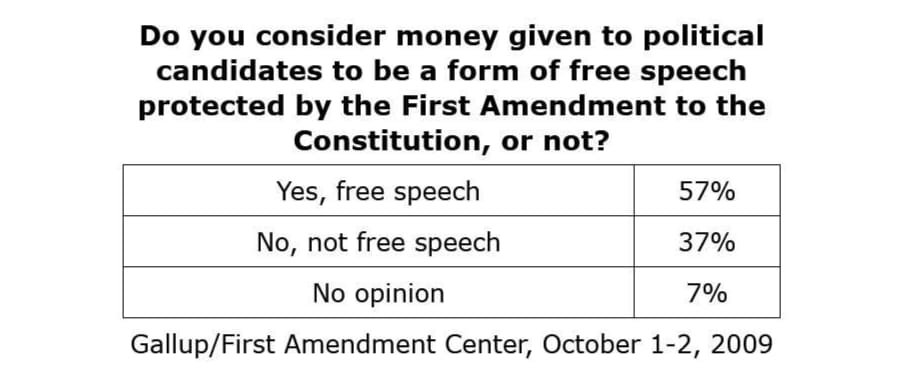
Which U.S. Supreme Court decision focuses on the issues presented in the data?
Rationale
The case Citizens United v. Federal Election Commission (2010) is directly relevant, as it ruled that the First Amendment prohibits the government from restricting independent political expenditures by corporations, unions, and associations, effectively treating such spending as a form of protected free speech. This decision sparked significant debate about campaign finance, aligning with the poll’s focus on public opinion regarding money as free speech. The other options—U.S. v. Lopez (federal commerce power), Engel v. Vitale (school prayer), and District of Columbia v. Heller (gun rights)—address unrelated constitutional issues. The 2020 data reflects ongoing public discourse influenced by this ruling, making Citizens United the most pertinent case.
In signing the Mayflower Compact, Plymouth settlers pledged to "unite into a civil body politic" and agreed to enact and abide by laws that "insured the general Good of the Colony.For which founding document did the Mayflower Compact set a precedent?
Rationale
The Mayflower Compact set a precedent for the U.S. Constitution.
The Mayflower Compact was an early form of self-government and established a framework for creating laws that would serve the collective good of the colony. This spirit of democratic governance and the emphasis on the rule of law influenced the development of the U.S. Constitution, which further formalized these principles.
A) the Declaration of Independence The Declaration of Independence primarily serves as a statement of separation from British rule and outlines the fundamental rights of individuals, rather than establishing a framework for governance. While it expresses the principles of self-governance, it does not create a system of laws or government, making it less directly related to the precedent set by the Mayflower Compact.
B) the U.S. Constitution The U.S. Constitution embodies the principles of self-government and the establishment of laws for the common good, directly reflecting the ideals set forth in the Mayflower Compact. Both documents emphasize the importance of a governing body created by the consent of the governed, thereby establishing a foundational precedent for American democracy.
C) the Magna Carta The Magna Carta established the principle of limited government and the rule of law in England but did not focus on self-governance in the same way as the Mayflower Compact. While it influenced democratic ideals, its primary purpose was to limit the powers of the monarchy rather than to create a civil body politic among a colony.
D) the Bill of Rights The Bill of Rights outlines specific rights and liberties granted to individuals and serves as an amendment to the Constitution. Although it builds upon the principles of governance established by earlier documents, it does not set a precedent for self-governance like the Mayflower Compact did in establishing laws for the colony.
Conclusion The Mayflower Compact was a groundbreaking document that initiated the concept of self-governance and collective law-making among the Plymouth settlers. Its emphasis on uniting for the common good directly influenced the later development of the U.S. Constitution, which formally established a government based on similar principles. While other documents like the Declaration of Independence and the Bill of Rights are significant, they do not encapsulate the same foundational governance precedents as the Mayflower Compact and the Constitution.
A homeowner lives in an area that is set to be redeveloped as a result of a local referendum. The local government takes the homeowner's property without a hearing in order to build a new highway. Which constitutional principle might form the basis of a lawsuit from the homeowner?
Rationale
Due process is like a legal checkpoint, requiring a hearing before property is taken via eminent domain. Liberty, natural rights, and majority rule are less directly tied to this procedural violation.
Based on this passage, which aspect of the U.S. Constitution might Paine reject?
Rationale
Paine's critique is like a jab at unchecked executive power, likely opposing a strong presidential veto, which balances Congress but mirrors the king's power he criticized. State sovereignty, rights, and legislatures align more with his views.
Which U.S. Supreme Court decision focuses on the issues presented in the data?
Rationale
The case Citizens United v. Federal Election Commission (2010) is directly relevant, as it ruled that the First Amendment prohibits the government from restricting independent political expenditures by corporations, unions, and associations, effectively treating such spending as a form of protected free speech. This decision sparked significant debate about campaign finance, aligning with the poll’s focus on public opinion regarding money as free speech. The other options—U.S. v. Lopez (federal commerce power), Engel v. Vitale (school prayer), and District of Columbia v. Heller (gun rights)—address unrelated constitutional issues. The 2020 data reflects ongoing public discourse influenced by this ruling, making Citizens United the most pertinent case.
To avoid the problems associated with direct democracies, the framers of the Constitution opted for which type of government?
Rationale
A republic is like a filtered democracy, using elected representatives to avoid mob rule, as the framers intended. Polity is vague, and monarchy or dictatorship contradicts their goals.
Which constitutional authority would allow the president to use military force in response to an invasion?
Rationale
As Commander in Chief, the president is like a military captain, authorized to direct forces against an invasion, per Article II. Declaring war is Congress's role, and raising armies or executive duties are less directly tied to immediate military action.
Which powers exist when state and national governments share authority?
Rationale
Concurrent powers are like a shared toolkit, used by both federal and state governments, such as taxing. Expressed and implied powers are federal, while exclusive powers are sole to one level.
Which was the major objection of the Anti-Federalists during the debate over the United States Constitution?
Rationale
Anti-Federalists were like rights watchdogs, objecting to the Constitution's lack of a bill of rights to protect individual liberties. The Electoral College, bicameralism, and judicial power were lesser concerns.
Which Congressional legislation increased African American participation in the political process?
Rationale
The Voting Rights Act is like a key to the ballot box, removing barriers like literacy tests to boost African American voting. Other acts addressed wages, discrimination, or housing.
You are leaving this quiz
What would you like to do with your progress?
You're in the middle of a quiz
What would you like to do before switching?
Practice complete
You finished this free practice quiz.