
Which of the following best characterizes the *polis* in ancient Greece?
Rationale
A city-state
In ancient Greece, the *polis* is best characterized as a city-state, which encompassed both an urban center and its surrounding territories, functioning as an independent political entity. This structure allowed for a distinct local government, culture, and identity, setting the *polis* apart from larger political formations.
A) A kingdom A kingdom refers to a larger political entity typically ruled by a monarch, encompassing multiple territories and often various *poleis*. The *polis*, however, was a more localized and autonomous unit, with its own governance and social organization, distinguishing it from the broader concept of a kingdom.
B) A province A province is typically a region within a larger state or empire that lacks the political independence of a *polis*. Provinces are usually subject to the authority of a central government, while the *polis* operated independently, making its governance and civic life distinct from the idea of being a mere province.
C) A city-state The *polis* was fundamentally a city-state, signifying a self-governing city that ruled over its surrounding territory. Each *polis* had its own laws, customs, and political systems, which were central to the identity of its citizens and crucial for the development of democracy and civic engagement in ancient Greece.
D) A county A county is a subdivision of a larger state, often governed by a local authority under a larger jurisdiction. In contrast, the *polis* was a sovereign entity with its own governance, culture, and social structure, independent of larger administrative divisions, thereby emphasizing its unique status.
E) A coastal district While some *poleis* were located on the coast, this term does not accurately capture the broader definition of a *polis*. A coastal district merely indicates geography without addressing the political and social complexities that defined the *polis* as an independent city-state.
Conclusion The *polis* in ancient Greece represents the concept of a city-state, embodying both urban and rural aspects of civic life with complete political autonomy. Unlike kingdoms, provinces, counties, or merely geographic districts, the *polis* functioned as a self-contained political unit with its own identity, laws, and governance, which played a crucial role in the development of Greek civilization and democratic principles.
The cult of the Persian god Mithras was popular with which of the following groups in imperial Rome?
Rationale
Soldiers were the primary followers of the cult of the Persian god Mithras in imperial Rome.
The cult of Mithras gained significant popularity among soldiers in the Roman Empire, attributed to its emphasis on loyalty, bravery, and the concept of a cosmic struggle between good and evil, which resonated deeply within military culture.
A) Patrician women While some patrician women may have participated in various religious practices, the cult of Mithras was predominantly male-oriented, focusing on themes of masculinity and warfare. This exclusivity made it less appealing to women, particularly those of the patrician class who were often involved in different religious traditions.
B) Slaves Slaves had limited social mobility and often followed different religious practices that offered hope or solace within their constrained lives. The cult of Mithras, with its focus on the warrior ethos and secretive rituals, did not attract significant interest from slaves, who were more likely to seek faiths that addressed their social status and circumstances.
C) Orators Orators, while important in Roman society, centered their lives around rhetoric and public speaking, often engaging in the political sphere. The cult of Mithras did not align with their interests or public roles, as it was more focused on the military and secretive brotherhood, rather than the arts of persuasion or public debate.
D) Soldiers The cult of Mithras was especially embraced by soldiers, who found its teachings about valor, loyalty, and the battle against evil appealing. The initiation rituals and the hierarchical structure mirrored military camaraderie, allowing soldiers to bond over shared beliefs and experiences.
E) Emperors While some emperors may have shown interest in various religious practices, the cult of Mithras was not predominantly associated with imperial leadership. Emperors often favored more state-sanctioned religions that promoted their authority, rather than the mystery cults that appealed to the military class.
Conclusion The cult of Mithras thrived among Roman soldiers who found its values reflective of their own experiences and ideals. Unlike other groups, soldiers connected deeply with the rites and symbolism of Mithraism, which emphasized strength and loyalty in the face of adversity. This unique relationship characterized Mithraism as a quintessentially military cult within the broader context of Roman religion.
Chaucer's Canterbury Tales illustrates the
Rationale
Chaucer's Canterbury Tales illustrates the crises within fourteenth-century English society.
Chaucer's work provides a vivid portrayal of various social classes, moral dilemmas, and the instability of the era, reflecting the complexities of life during the fourteenth century in England. Through the diverse characters and their stories, the text highlights issues such as class conflict, corruption, and the changing social order.
A) Innovations of King William I This choice refers to the changes instituted during the Norman Conquest, particularly by King William I in the 11th century. While these innovations laid the foundation for English society, they are not the focus of Chaucer's writing, which takes place several centuries later and deals more with contemporary societal issues rather than historical developments from the Norman period.
B) Norman/Plantagenet quarrels The conflicts between the Normans and Plantagenets are significant in English history but are not central to Chaucer's narratives. His tales are set during a time when the focus is on social critique rather than on the historical quarrels between these two dynasties.
C) Peasant uprisings in France and England While peasant uprisings did occur during the fourteenth century, they are not the primary focus of Chaucer's work. Instead, Chaucer explores a broader range of themes, including the individual experiences and moral quandaries of various social classes, rather than concentrating solely on uprisings.
D) Role of Mary as the New Eve This choice pertains to theological and literary interpretations of Mary, the mother of Jesus, as a figure of redemption. Although Chaucer touches upon religious themes, the tales do not primarily explore this aspect, making it an incorrect characterization of the work's main focus.
Conclusion Chaucer's Canterbury Tales serves as a rich commentary on the crises facing fourteenth-century English society, encompassing issues of class, morality, and social change. By illustrating the diverse experiences of various characters, the work provides a lens through which readers can understand the complexities and challenges of the time, making "crises within fourteenth-century English society" the most accurate description of its themes.
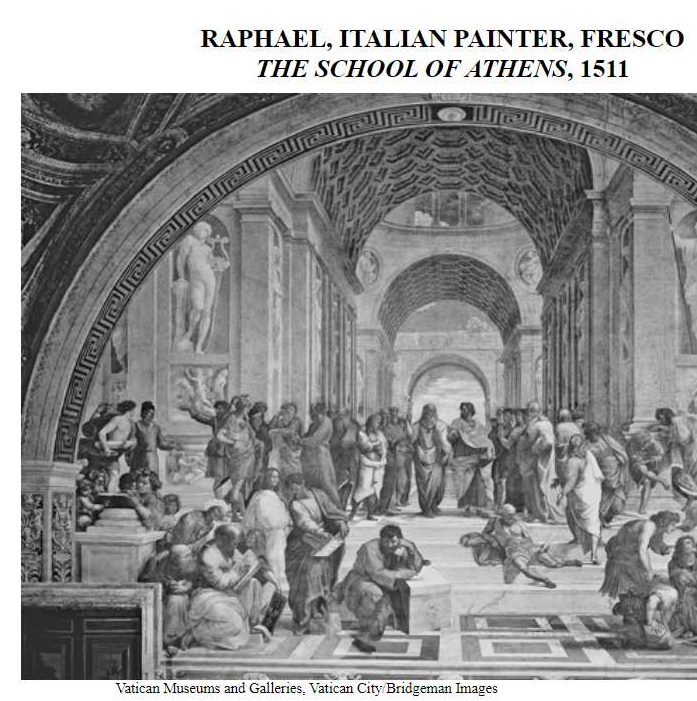
The image best illustrates which of the following features of Italian Renaissance art?
Rationale
The image best illustrates the use of naturalistic perspective.
Naturalistic perspective is a hallmark of Italian Renaissance art, characterized by the realistic representation of space and depth, creating a three-dimensional effect on a two-dimensional surface. This technique was pivotal in enhancing the viewer's experience and conveying a more lifelike representation of subjects.
A) The exaggeration of human facial expressions to portray drama and emotion While some Renaissance artists did emphasize facial expressions to evoke emotion, the image in question does not predominantly showcase this feature. Instead, the focus is on the accurate representation of space and depth, which aligns more closely with the principles of naturalistic perspective rather than emotional exaggeration.
B) The use of naturalistic perspective This choice accurately reflects the image's primary characteristic, as it demonstrates the use of techniques such as linear perspective to create an illusion of depth. Artists like Brunelleschi and Masaccio were instrumental in developing this method, leading to a more realistic portrayal of architecture and figures within their compositions.
C) The use of allegory Allegory involves symbolic representation to convey deeper meanings or moral lessons, often through visual metaphors. Although some Renaissance works include allegorical elements, the image primarily emphasizes spatial realism rather than symbolic narratives, making this option less relevant.
D) The influence of Byzantine mosaics Byzantine art is known for its flat, gold backgrounds and lack of perspective, which contrasts with the naturalism of the Renaissance. The image in question does not exhibit characteristics typical of Byzantine mosaics, such as the absence of depth or the emphasis on flatness, thus making this choice incorrect.
Conclusion The image serves as a quintessential example of Italian Renaissance art, showcasing the innovative use of naturalistic perspective that defined the era. This technique allowed artists to create more immersive and realistic representations, setting a significant departure from previous artistic traditions. Understanding this feature not only highlights the advancements in art during the Renaissance but also the profound impact it had on subsequent artistic movements.
The commissioning of works of art such as the one shown in the image most directly contributed to which of the following in the sixteenth century?
Rationale
The emergence of the Vatican as the most prominent cultural center in Europe.
The commissioning of works of art during the sixteenth century significantly transformed the Vatican into a leading cultural hub in Europe, showcasing the intersection of art, religion, and politics. This flourishing of artistic expression not only enhanced the beauty of the Vatican but also solidified its status as a center of cultural influence.
A) An increase in papal prestige that enabled the papacy to free itself from political domination by France and the Holy Roman Empire While the commissioning of art did enhance the prestige of the papacy, it did not directly lead to a liberation from political domination. The power dynamics of the time were influenced by many factors beyond artistic endeavors, including military and diplomatic actions that shaped the relationship between the papacy and these political entities.
C) Growing anger among European Christians at papal extravagance The commissioning of grand works of art was often perceived as extravagant, and while such sentiments did arise, they were not the direct result of artistic commissions. Instead, this anger was more closely tied to the Reformation and critiques of church practices, which were broader socio-political movements rather than a direct consequence of artistic patronage.
D) The growing power of Italian bankers in choosing the pope The influence of Italian bankers on papal elections was a separate issue related to finance and politics rather than the commissioning of art. While financial power played a role in the papacy, it does not connect directly to the cultural significance and impact of artistic works commissioned during the sixteenth century.
E) The permanent relocation of the papacy from Avignon to Rome The relocation of the papacy back to Rome occurred in the 14th century and was not a consequence of artistic commissions in the 16th century. Although the Vatican became a cultural center following this return, the connection to artistic works is more about the flourishing of culture than about the physical relocation itself.
Conclusion The commissioning of art in the sixteenth century was pivotal in establishing the Vatican as the foremost cultural center in Europe. The elaborate works created during this time served not only religious purposes but also demonstrated the papacy's commitment to cultural patronage, thereby enhancing its influence and prestige across the continent. This artistic flourishing contributed to the Vatican's legacy as a beacon of Renaissance culture.
The quotation above is taken from
Rationale
Pico della Mirandola, Oration on the Dignity of Man.
This quotation is famously attributed to Pico della Mirandola, who explores themes of human potential and the unique position of humanity in the universe in his work "Oration on the Dignity of Man." This text is a foundational piece of Renaissance humanism, emphasizing the capacity for self-determination and the importance of individual choice.
A) Petrarch, Lives of Illustrious Men While Petrarch is a significant figure in the development of humanism, "Lives of Illustrious Men" focuses on the biographies of notable historical figures rather than the philosophical themes found in the quotation. Therefore, this choice does not accurately reflect the content or intent of the quote.
B) Castiglione, The Book of the Courtier Castiglione's "The Book of the Courtier" deals primarily with the qualities of an ideal courtier and the manners of the nobility. Although it discusses human behavior and virtues, it lacks the specific philosophical assertions about human dignity and potential that are central to the quotation in question.
C) Machiavelli, The Prince Machiavelli's "The Prince" presents a pragmatic approach to political power and leadership, focusing on the manipulation of political situations rather than the intrinsic value of humanity or its potential. Thus, it does not align with the themes expressed in the quotation.
E) Chaucer, The Canterbury Tales Chaucer's "The Canterbury Tales" is a collection of stories that reflect various aspects of medieval life and society, primarily through the lens of narrative and character. It does not engage with the philosophical inquiries about human dignity that are present in the quotation.
Conclusion The quotation is best attributed to Pico della Mirandola's "Oration on the Dignity of Man," as it encapsulates the essence of Renaissance humanism—celebrating human potential and individuality. The other options, while significant works in their own right, do not address the same themes of human dignity and self-determination, thereby confirming the uniqueness of Mirandola's contribution to this discourse.
Which of the following best explains the importance of helots to Sparta?
Rationale
They were slaves who as farmers and servants were the economic foundation of the city-state.
Helots were a subjugated population in ancient Sparta, primarily serving as agricultural laborers and household servants. Their role was crucial for the Spartan economy, allowing Spartan citizens to focus on military training and governance while relying on helots for sustenance and domestic support.
A) They controlled the political process in the city-state. Helots did not have political power or rights; they were considered property of the Spartan state. The political system in Sparta was dominated by the ruling class of Spartan citizens who held all authority and decision-making power, rendering this statement inaccurate.
B) They were mercenary soldiers whose loyalty was essential to the survival of the city-state. Helots were not mercenaries; rather, they were bound laborers who worked the land and served the Spartan citizens. While loyalty was important for any societal structure, helots did not serve as soldiers or mercenaries in the traditional sense, and their role did not revolve around military service.
C) They were slaves who as farmers and servants were the economic foundation of the city-state. This statement accurately captures the essence of the helots' importance in Spartan society. They provided the agricultural output necessary for Spartan sustenance and served as domestic help, enabling the citizen-soldiers to dedicate their lives to military training and discipline.
D) They were Spartans who supported the Athenians in conflicts between the two city-states. Helots were not Spartans; they were a distinct subjugated class. This choice misrepresents their role and allegiance, as helots were primarily tied to the Spartan economy rather than any political allegiance to Athens or involvement in inter-city-state conflicts.
E) They infiltrated Spartan society and acted as spies for Sparta's enemies. There is no historical basis for the claim that helots acted as spies for enemies of Sparta. Instead, they were often subjected to harsh treatment and surveillance by Spartans to prevent rebellion, making this scenario highly unlikely.
Conclusion Helots served as the backbone of the Spartan economy, providing essential agricultural labor and domestic services to support Spartan citizens. Their status as enslaved individuals allowed Spartans to prioritize military training, fortifying the city-state's renowned military prowess. Understanding the role of helots is vital to comprehending the unique social structure and historical significance of Sparta in ancient Greece.
The earliest Mesopotamian gods were representations of:
Rationale
The earliest Mesopotamian gods were representations of forces of the natural world.
In ancient Mesopotamian belief systems, deities primarily embodied natural elements and phenomena such as water, wind, and earth, reflecting the importance of these forces in the daily lives and survival of the people.
A) abstract concepts While some later deities may have been associated with more abstract ideas, the earliest gods in Mesopotamia were not conceptual entities. Instead, they were directly linked to tangible, natural forces that influenced agricultural cycles and survival, making them concrete representations rather than abstract ideas.
B) powerful kings who had died This choice refers to the practice of deifying historical leaders, which occurred later in Mesopotamian history. Initially, however, the gods were not representations of deceased rulers but rather personifications of natural phenomena that were crucial for the community's well-being and prosperity.
C) forces of the natural world The earliest Mesopotamian deities, such as Enlil (god of wind) and Tiamat (goddess of salt water), were fundamentally tied to elements of nature. They personified essential forces that governed the environment, which was vital for agriculture and sustenance, thereby making this choice the most accurate.
D) celestial bodies Though celestial bodies like the sun and moon eventually became significant deities in Mesopotamian mythology, the very earliest gods were more focused on terrestrial and elemental forces. The celestial associations developed later as civilizations advanced and their cosmologies evolved.
E) predatory animals While animals did feature in Mesopotamian mythology, the earliest gods were not representations of such creatures. Instead, they symbolized natural forces that could affect human existence, making animals less central to early divine representation.
Conclusion The foundational deities of ancient Mesopotamia were primarily manifestations of the natural world, embodying essential forces that shaped the environment and human life. This connection underscores how early civilizations understood their world and its challenges, relying on these gods for guidance and support in their agricultural and daily endeavors. As such, the representation of nature through deities was critical in shaping the spiritual landscape of early Mesopotamian societies.
Which of the following developments in the third century most likely explains Eusebius' assertion about the consequences of 'distribution' in the first paragraph?
Rationale
The decline of imperial authority in numerous provinces because of civil wars between Roman generals.
This decline led to fragmentation and instability within the Roman Empire, as competing factions weakened central power and resulted in local governments gaining prominence. Such conditions likely contributed to the wars and strife that Eusebius attributed to the distribution of power among various governments.
A) The assassination of the emperors Caligula and Nero While the assassinations of these emperors were significant events, they occurred earlier and did not directly pertain to the broader civil conflicts that characterized the third century. Instead, these events were part of a pattern of instability rather than the root cause of the widespread decline of imperial authority.
B) The sack of Rome by the Visigoths The sack of Rome occurred in 410 C.E., after the period in question. It was a symptom of the decline of the Western Roman Empire, rather than a direct explanation for the civil strife and distribution of power during the third century, which was characterized by internal conflicts rather than external invasions.
D) The Persian conquest of Jerusalem This event took place in the seventh century and is unrelated to the developments in the third century. The Persian conquest did not influence the dynamics of Roman provincial authority or the internal conflicts that Eusebius discusses, making it an irrelevant choice in this context.
E) The establishment of an independent Frankish empire in Gaul The Frankish empire began to rise in the fifth century and was not a factor in the third-century issues concerning Roman authority. This choice misplaces the timeline and does not address the fragmentation and civil wars occurring within the Roman Empire at that time.
Conclusion Eusebius' assertion about the consequences of governmental distribution highlights the turmoil caused by the decline of imperial authority in the third century, primarily due to civil wars. This fragmentation fostered conflict and instability, aligning with his observations on the resulting strife and the eventual need for unity under one divine authority. Understanding this context provides insight into the historical challenges faced by the Roman Empire during this tumultuous period.
Which of the following statements about government in the Roman Republic is true?
Rationale
Members of the Roman elite dominated politics throughout the republic's existence.
Throughout the Roman Republic, a small group of wealthy families, known as the patricians, held most of the political power and influence. While plebeians gained some rights over time, the elite consistently shaped the political landscape, ensuring their dominance in governance.
A) The two consuls had little authority over the military This statement is inaccurate because the two consuls were the highest officials in the Roman Republic and held significant military authority. They commanded armies, presided over military affairs, and had the power to declare war, making their role crucial in military governance.
B) The popular assemblies consistently opposed expansionist policies This choice fails to reflect the reality of Roman political dynamics. While there were instances of debate and dissent, popular assemblies often supported expansionist policies due to the economic benefits and prestige associated with conquest. Therefore, they did not consistently oppose such policies.
D) The Romans extended citizenship to all conquered peoples This statement is misleading because Roman citizenship was not universally granted to all conquered peoples. While some groups were offered citizenship or partial rights, many others remained non-citizens, highlighting the selective nature of Roman citizenship policies.
E) Political conflict between plebeians and patricians led to the abolition of slavery This assertion is incorrect, as the political struggles between these two classes primarily focused on issues of rights and representation rather than slavery. Slavery remained a fundamental institution in Roman society throughout the Republic, with no significant movements leading to its abolition during this period.
Conclusion The Roman Republic was characterized by the dominance of the elite in political affairs, particularly the patricians. While various conflicts arose between different social classes, the political landscape remained largely controlled by the elite throughout the Republic's history. The incorrect choices reflect misunderstandings of the military authority of consuls, the role of popular assemblies, citizenship policies, and the nature of class conflicts within the Republic.
Believed by Muslims to be God's prophet, Muhammad taught that Abraham, Moses, and Jesus were all
Rationale
Earlier prophets of the same God.
Muhammad taught that Abraham, Moses, and Jesus were all prophets who received revelations from the same God, emphasizing a shared spiritual heritage among these figures in Islam. This belief highlights the continuity of prophetic messages leading to Muhammad, who is regarded as the final prophet.
A) False prophets This choice contradicts Islamic teachings, as Muslims view Abraham, Moses, and Jesus as true prophets rather than false ones. Calling them false would undermine the foundational beliefs of Islam regarding the legitimacy of previous revelations.
B) His direct ancestors While Muhammad is believed to be a descendant of Abraham through his son Ishmael, this choice inaccurately suggests a familial relationship as opposed to a shared prophetic mission. The focus of his teachings is on their spiritual roles rather than lineage.
C) Earlier prophets of the same God This statement accurately reflects Islamic belief, as Muhammad recognized Abraham, Moses, and Jesus as significant figures who preached the message of monotheism and served as prophets within the same divine tradition. This shared connection is vital to understanding the continuity of God's message in Islam.
D) God's incarnations on Earth This choice misrepresents Islamic beliefs, as Muslims do not view any prophets, including Jesus, as incarnations of God. Instead, they are seen as human messengers chosen to convey God's guidance, maintaining a clear distinction between the Creator and the created.
E) Angelic beings This option is incorrect since it implies that these figures were not human prophets but rather angels, which contradicts the fundamental Islamic understanding of their roles. Muhammad taught that these prophets were human beings chosen to guide their communities.
Conclusion In Islam, Muhammad's recognition of Abraham, Moses, and Jesus as earlier prophets of the same God underscores the interconnectedness of the Abrahamic faiths. This understanding fosters respect and acknowledgement of the shared spiritual lineage among these key figures. By highlighting their roles as prophets, Islam emphasizes the continuity of God's message throughout history, culminating in the final revelation to Muhammad.
Which of the following statements is most accurate about medieval cities in Europe?
Rationale
They were frequently surrounded by defensive walls.
Medieval cities in Europe were often established with defensive walls to protect against invasions and attacks, reflecting the instability of the period. These fortifications not only provided security but also defined the boundaries of the urban landscape, influencing the layout and development of the cities.
A) They were most often built in new locations, far removed from previous settlements While some medieval cities were established in new locations, many were built on or near existing settlements, utilizing the infrastructure and resources of earlier communities. This continuity often facilitated trade and governance, as established roads and markets were already in place.
B) They were usually laid out in a grid system Medieval cities typically did not follow a strict grid layout; instead, they evolved organically based on topography, existing structures, and the need for defense. Although some later cities adopted a grid pattern, the irregular street plans of many medieval towns reflect their historical development rather than intentional urban planning.
C) They were primarily built for religious purposes Although religion played a significant role in medieval society, cities were not primarily constructed for religious purposes. Instead, they served as centers of trade, governance, and social interaction, with churches and cathedrals often being important features rather than the sole focus of urban development.
E) They had few public buildings and only very modest residences for local leaders Contrary to this statement, many medieval cities featured a variety of public buildings, including town halls, markets, and cathedrals, which were often quite grand. Additionally, the residences of local leaders could range from modest to substantial in size, reflecting their status and wealth within the community.
Conclusion Medieval cities were characterized by their defensive walls, which served to protect inhabitants from external threats and shaped their urban form. The presence of these fortifications is a defining aspect of medieval urbanization, contrasting with other features such as grid layouts or the primary focus on religious structures. Understanding these elements helps illuminate the complex social, political, and economic dynamics that defined medieval life in Europe.
The ancient Greeks used the term "barbarian" to refer to peoples who
Rationale
did not speak Greek.
The ancient Greeks used the term "barbarian" primarily to describe peoples who spoke languages they could not understand, often denoting those who did not speak Greek. This linguistic distinction reflected their cultural perspective, whereby non-Greeks were viewed as outsiders or less civilized.
A) were still hunter-gatherers The classification of "barbarian" was not based on the lifestyle of being a hunter-gatherer. Many groups that were considered barbarians had developed complex societies and agricultural practices. Thus, this choice does not accurately reflect the Greeks' use of the term.
C) did not worship the Greek gods While religious practices varied among cultures, the term "barbarian" was not specifically applied based on worship of the Greek gods. Some groups that were considered barbarians did have their own religious beliefs but might still have been culturally or linguistically similar to the Greeks.
D) were ruled by the Persian king Being ruled by a foreign king, such as the Persian king, was not a criterion for being labeled a barbarian. Many Greeks themselves were under foreign rule at different times. The term focused more on language and cultural barriers rather than political governance.
E) lived in modern-day Germany The geographical location of a group was not the defining factor for being termed barbarian. The Greeks referred to various peoples from different regions, including those in Europe and Asia, as barbarians based on their inability to speak Greek rather than their specific locations.
Conclusion The term "barbarian" was used by the ancient Greeks to describe those who did not speak their language, highlighting a cultural and linguistic divide. While other factors such as lifestyle, religion, and governance played roles in their perceptions, the lack of the Greek language was the primary identifier for labeling others as barbarians. Understanding this linguistic basis provides insight into Greek views on civilization and culture.
Which of the following best describes a result of the Carolingian Renaissance?
Rationale
A revival of Latin scholarship at the court of Charlemagne.
The Carolingian Renaissance marked a significant revitalization of learning and culture during Charlemagne's reign, particularly through the promotion of Latin scholarship, which laid the foundation for future European intellectual life.
A) The growing influence of Gothic architecture in Frankish Gaul Gothic architecture emerged later, in the 12th century, after the Carolingian period had ended. The Carolingian Renaissance focused more on classical influences rather than the Gothic style, which is characterized by features such as pointed arches and ribbed vaults that were not prevalent during Charlemagne's time.
C) An intellectual movement emphasizing Aristotelian logic at Frankish universities While the Carolingian Renaissance did encourage the study of classical texts, including Aristotle, the emphasis on Aristotelian logic became more pronounced during the Scholastic period, which followed the Carolingian Renaissance. The primary focus during Charlemagne's reign was on reviving and preserving Latin literature and Christian texts.
D) The emergence of a school of Italian painters at the palace of Aachen The Carolingian Renaissance was not particularly noted for the development of painting schools, especially not in Italy, as the focus was on scholarship and learning. Artistic developments, including painting, were more localized and did not have the structured schools that would emerge in later periods.
E) The development of a church reform movement at Cluny under the direction of Louis the Pious Although church reform movements did occur during this time, particularly at Cluny, they developed later in the 10th century. Louis the Pious was Charlemagne's son, and while he continued his father's policies, the Cluniac reforms were not a direct result of the Carolingian Renaissance.
Conclusion The Carolingian Renaissance was characterized by a revival of Latin scholarship, driven by Charlemagne's desire to educate his court and clergy. This period laid the groundwork for the later development of universities and intellectual thought in medieval Europe. In contrast, the other options present developments or movements that either occurred later or were not significant aspects of this cultural renaissance.
The political ideology expressed in the passage most directly reflects which of the following goals of the emperor Constantine?
Rationale
To use Christianity to unite the empire culturally and politically.
The passage illustrates how the rise of Christianity under Emperor Constantine led to a unified vision for the Roman Empire, emphasizing a single God and the elimination of division through various forms of governance. This reflects Constantine's goal of fostering a cohesive cultural and political identity across the empire.
A) To counteract Persian political and cultural influence in the eastern parts of the empire This choice focuses on external geopolitical concerns, which are not addressed in the passage. The text emphasizes internal unity through Christianity rather than responding to Persian influence, making this option irrelevant to the primary theme of the excerpt.
B) To resolve theological debates about Christ's nature While theological issues were significant during Constantine's reign, the passage does not specifically address doctrinal disputes. Instead, it highlights the social and political unification achieved through Christianity, making this choice less relevant to the expressed goals.
C) To reinforce his control over the largely Christian Roman military Although strengthening ties with the military may have been a concern for Constantine, the passage primarily discusses the broader unification of the empire through Christianity rather than military control. Thus, this option does not accurately capture the focus of the passage.
E) To blend Greco-Roman and Christian ideas into a single religion While there were efforts to integrate various cultural elements, the passage does not advocate for a blend of religions. Rather, it emphasizes the supremacy of Christianity in unifying the empire, making this choice less aligned with the text's message.
Conclusion The passage asserts that the rise of Christianity under Constantine laid the groundwork for a unified Roman Empire, emphasizing cultural and political cohesion. By proclaiming one God and advocating for unity, the emperor aimed to transform the diverse and often fractious governance structures into a single, harmonious entity. This goal of unity is central to understanding the political ideology expressed in the text.
You are leaving this quiz
What would you like to do with your progress?
You're in the middle of a quiz
What would you like to do before switching?
Practice complete
You finished this free practice quiz.