
The Inca Empire had a well-engineered and elaborate road system primarily in order to
Rationale
permit the imperial army and tax collectors to travel quickly and freely through the empire and its tributaries.
The Inca Empire's road system was primarily designed to enhance military mobility and administrative efficiency, allowing for rapid movement of troops and officials across vast distances. This infrastructure was crucial for maintaining control over the empire and ensuring efficient tax collection from its diverse regions.
A) permit the imperial army and tax collectors to travel quickly and freely through the empire and its tributaries This choice accurately reflects the primary purpose of the Inca road system, which was to facilitate swift military responses and streamline the collection of tribute and taxes from various provinces. The roads enabled the Inca administration to sustain its authority and manage its resources effectively across the expansive territory.
B) facilitate merchant travel from one end of the empire to the other While the road system did support some level of trade, its main focus was not on facilitating merchant travel. Merchants did utilize the roads, but the primary intention was to serve the state's logistical and military needs rather than to promote commercial activities.
C) trade goods with Central America, the Caribbean, and the Mississippian cultures of North America This option misrepresents the geographical and historical context of the Inca Empire, which was primarily located in South America. The Inca roads did not extend to Central America or North America, thus trade with these regions was not a purpose of their road system.
D) provide full employment to its citizens Although the construction and maintenance of the road system may have created jobs, this was not its primary purpose. The Inca road network was fundamentally a strategic and administrative tool, rather than a means of ensuring employment for the populace.
Conclusion The Inca Empire's elaborate road system was primarily engineered to enhance military logistics and facilitate efficient tax collection across its vast territories. While it indirectly supported trade and provided some local employment, its core function was to enable rapid movement of state officials and military forces, a critical aspect of maintaining control over the empire.
The development of terms such as mestizo and peninsular in colonial Latin America best reflects which of the following?
Rationale
The increasing trend toward dividing society into racial and ethnic categories.
The terms mestizo and peninsular emerged during colonial Latin America as a means to categorize individuals based on racial and ethnic backgrounds, reflecting the complex social hierarchy established by the Spanish and Portuguese colonial powers. This classification system highlighted the significance of race in determining social status and identity within colonial society.
A) The growing influence of Enlightenment concepts of liberty and natural rights While the Enlightenment did introduce ideas about individual rights and equality, these concepts did not primarily drive the creation of racial and ethnic terms like mestizo and peninsular. Instead, these terms were more about societal stratification and the maintenance of colonial power structures rather than the promotion of liberty or natural rights.
B) The increasing trend toward dividing society into racial and ethnic categories The development of the terms mestizo and peninsular directly corresponds to the colonial system's emphasis on racial and ethnic divisions. These classifications were instrumental in establishing and enforcing social hierarchies, where individuals were judged and treated based on their racial lineage, thereby reflecting the colonial mindset of segregation and categorization.
C) The growing resentment toward Spanish and Portuguese rule Although resentment toward colonial rule was prevalent among various groups in Latin America, the creation of mestizo and peninsular terms was not primarily a response to this discontent. Instead, these terms were used to reinforce existing social structures and identities rather than to express opposition to colonial authority.
D) The increasing syncretism of religious beliefs and practices While syncretism occurred as indigenous and African beliefs merged with European religions, this phenomenon is not directly related to the categorization of people as mestizo or peninsular. The terms focus on racial identity rather than the blending of religious practices, making them distinct from the religious syncretism seen in colonial Latin America.
Conclusion The emergence of terms such as mestizo and peninsular in colonial Latin America serves as a clear reflection of the increasing trend to categorize society based on racial and ethnic identities. This categorization was a fundamental aspect of the colonial social hierarchy, influencing individuals' rights, roles, and statuses within the colonial framework. Understanding this classification helps illuminate the complexities of colonial society and the enduring impacts of these divisions in contemporary Latin America.
Which of the following best describes the effect of guilds on the economy of medieval Europe?
Rationale
Guilds gave merchants and artisans organizational power within the economy, allowing them to exercise control over things such as knowledge sharing and pricing in their respective industries.
Guilds were essential institutions in medieval Europe that provided merchants and artisans with the ability to regulate trade practices, set standards for quality, and control pricing. This organizational power enabled them to protect their interests and maintain economic stability within their communities.
A) Guilds gave merchants and artisans organizational power within the economy, allowing them to exercise control over things such as knowledge sharing and pricing in their respective industries. This choice accurately reflects the role of guilds in medieval Europe. By forming guilds, merchants and artisans could collectively negotiate, establish regulations, and control market dynamics, thereby strengthening their economic influence.
B) Guilds gave clergy organizational power within the economy, allowing the church to exercise control over things such as knowledge sharing and pricing throughout the economy. This statement is incorrect as guilds were primarily composed of merchants and artisans, not clergy. While the church held significant power in medieval society, it did not operate through guilds in the same way as the economic entities that guilds represented.
C) Guilds gave peasants a greater share of power within the economy through the organization of labor, increasing their control over harvests and agricultural surplus. This choice misrepresents the function of guilds, which were primarily focused on trade and craftsmanship rather than agricultural labor. Peasants typically did not benefit directly from guilds, as they were not the primary members of these organizations.
D) Guilds offered a greater concentration of economic power within the nobility, leading to an economy that was increasingly controlled by the state. This option is misleading as guilds were designed to empower merchants and artisans, not the nobility. While the nobility had significant influence in society, guilds served to bolster the economic power of the middle class, countering noble dominance.
Conclusion Guilds played a pivotal role in shaping the economy of medieval Europe by empowering merchants and artisans with organizational capabilities. This collective strength allowed them to regulate pricing and maintain industry standards, contrasting with the influence of the clergy, peasants, and nobility. Understanding the function of guilds highlights their critical role in the development of a more structured and participatory economic landscape during this period.
The conquest of Constantinople by the Ottomans in 1453 C.E. most directly resulted in which of the following?
Rationale
It brought an effective end to the Byzantine Empire.
The fall of Constantinople in 1453 marked the definitive end of the Byzantine Empire, which had existed for over a thousand years, as the Ottomans established their dominance over the region and transformed the city into a vital center of their empire.
A) It caused the Pope to call the First Crusade. The First Crusade occurred in 1095, long before the conquest of Constantinople in 1453. The fall of Constantinople did not prompt a new call for a crusade; rather, it was a culmination of centuries of conflict between Christian and Muslim powers. Thus, this choice is historically inaccurate in the context of the events surrounding 1453.
B) It cut off most trade between Europe and Asia. While the conquest did affect trade routes, it did not entirely cut off trade between Europe and Asia. The Ottomans actually controlled and facilitated trade across these regions, leading to new trade dynamics rather than a complete cessation. Therefore, this statement misrepresents the economic impact of the conquest.
C) It led to the spread of Islam into western Europe. Although the Ottomans did expand their influence into southeastern Europe following the conquest, the spread of Islam into western Europe was a gradual process influenced by various factors over centuries. The conquest itself did not directly lead to widespread conversion or significant Muslim migration into western Europe as a result.
Conclusion The conquest of Constantinople by the Ottomans in 1453 effectively ended the Byzantine Empire, marking a significant shift in power and culture in the region. While the event had various repercussions on trade and religion, the most direct and consequential result was the dissolution of the Byzantine state, paving the way for Ottoman expansion and the transformation of Constantinople into Istanbul.
Which of the following cultural innovations was most directly responsible for the significant increase in human population growth rates during the Neolithic Revolution?
Rationale
The adoption of agriculture.
The shift from nomadic lifestyles to settled agricultural practices during the Neolithic Revolution allowed for more reliable food sources, leading to increased population growth. This transition enabled communities to support larger groups, ultimately fostering the development of complex societies.
A) Improvements in stone tools and weapons While advancements in stone tools and weapons indeed enhanced hunting and gathering efficiency, they did not directly lead to the sustained population growth seen during the Neolithic Revolution. These improvements primarily facilitated the existing lifestyle rather than transforming it, as they did not provide a consistent food supply.
B) The development of rudimentary metalworking Rudimentary metalworking began to emerge during the Neolithic period but was not a primary driver of population growth. Although it eventually contributed to advancements in agriculture and tools, the immediate impact on population increase was minimal compared to the direct effects of adopting farming practices.
C) An increasing belief in monotheism The rise of monotheistic beliefs occurred later in human history and had little to do with the demographic changes of the Neolithic Revolution. Cultural and religious developments did influence societies, but they were not the catalyst for the significant population surge, which was primarily driven by agricultural practices.
Conclusion The Neolithic Revolution's pivotal change was the adoption of agriculture, which fundamentally altered human social structures by providing stable food supplies. This stability facilitated significant population growth, allowing for the establishment of permanent settlements and the development of civilization. Other innovations, while important, did not have the same direct impact on demographic expansion during this transformative period.
Nineteenth-century French political theorist Louis Blanc's proposal to create government-financed cooperative industrial workshops is best understood as an example of
Rationale
Nineteenth-century French political theorist Louis Blanc's proposal to create government-financed cooperative industrial workshops is best understood as an example of utopian socialism.
Blanc's vision emphasized the creation of cooperative enterprises managed by workers, aiming to provide equitable labor conditions and social justice. This aligns closely with the principles of utopian socialism, which seeks to establish ideal communities through cooperative means rather than through revolutionary change.
A) utopian socialism Utopian socialism is characterized by the belief in the establishment of cooperative societies that promote equality and communal ownership. Blanc's proposal for government-financed workshops embodies this ideology, as it seeks to empower workers by providing them with opportunities for collective management and shared prosperity.
B) radical Marxism Radical Marxism advocates for revolutionary change through class struggle and the overthrow of capitalist systems. While Blanc's ideas share some common ground with Marxist principles, they do not advocate for the same level of revolutionary upheaval; rather, they focus on reforming existing structures through cooperative models, thus distinguishing them from radical Marxism.
C) technocratic nationalism Technocratic nationalism emphasizes the role of technical experts in managing the economy and society, often through state control. Blanc's proposal does not focus on technical expertise or nationalistic governance; instead, it centers on cooperative labor practices and social equity, making this choice incompatible with his ideas.
D) liberal capitalism Liberal capitalism is characterized by private ownership and free-market principles. Blanc's proposal directly challenges the capitalist system by advocating for government involvement in establishing cooperatives that prioritize worker welfare over profit maximization, thus making it an unsuitable label for his vision.
Conclusion Louis Blanc's advocacy for government-financed cooperative workshops encapsulates the essence of utopian socialism, which seeks to create equitable and just labor conditions through cooperation rather than revolution. His ideas stand in contrast to radical Marxism, technocratic nationalism, and liberal capitalism, each of which diverges from the principles of communal ownership and worker empowerment that define utopian socialism.
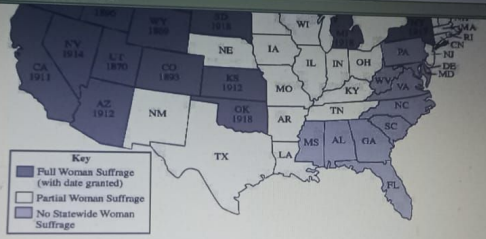
Which of the following conclusions is best supported by the map?
Rationale
The trend of granting full voting rights to women started on the West Coast and moved eastward.
The map indicates that states on the West Coast were among the first to grant women the right to vote, with a gradual progression towards the East Coast seen in subsequent years. This pattern suggests a west-to-east trend in the expansion of women's suffrage rights across the United States.
A) The Midwest offered the least support for woman suffrage before 1920. While the Midwest had varying levels of support for women's suffrage, stating it offered the least support is an overgeneralization. Several Midwestern states were early adopters of women's voting rights, making this conclusion unsupported by the evidence presented in the map.
B) The trend of granting full voting rights to women started on the West Coast and moved eastward. This conclusion is directly supported by the map, which illustrates how the first states to grant full voting rights to women were primarily located on the West Coast. The map further shows that as time progressed, more states to the east began to follow suit, reinforcing this trend.
C) Women generally had higher social status in the states of the former Confederacy than in the Northeast. This statement lacks support from the map, which does not provide any data regarding the social status of women in these regions. Social status is a complex issue influenced by various factors beyond voting rights, making this conclusion speculative and unsupported.
D) The conditions of frontier life favored the cause of woman suffrage. Although frontier life had unique challenges that may have contributed to women's advocacy for suffrage, the map does not explicitly link these conditions to voting rights. Such a conclusion requires more contextual evidence than is provided.
Conclusion The map clearly illustrates a historical trend where the movement for women's suffrage began on the West Coast and gradually spread eastward. While other statements about regional support and social status can be debated, the evidence directly supports the conclusion that the first states to grant full voting rights were located in the West, emphasizing the significance of this geographic progression in the suffrage movement.
The Immigration Acts passed by the United States Congress in 1921, 1924, and 1927 were most influenced by
Rationale
Nativist prejudices against southern and eastern Europeans primarily influenced the Immigration Acts of 1921, 1924, and 1927.
These acts were largely a response to rising nativist sentiments that sought to limit immigration from regions considered undesirable, particularly southern and eastern Europe. The legislation reflected a growing belief among some Americans that these groups were less desirable due to cultural and racial differences.
A) Labor shortages in the booming industrial economy While the industrial economy in the early 20th century did create a demand for labor, the Immigration Acts were not primarily motivated by labor shortages. In fact, the acts aimed to restrict immigration rather than encourage it, indicating that labor needs were secondary to the nativist sentiments driving the legislation.
B) Opposition to Mexican immigration Though there was some opposition to Mexican immigration during this period, it was not the primary influence behind the Immigration Acts of 1921, 1924, and 1927. The focus of these laws was predominantly on limiting immigration from southern and eastern Europe, rather than specifically targeting Mexican immigrants.
C) Nativist prejudices against southern and eastern Europeans The Immigration Acts were heavily shaped by nativist attitudes that viewed immigrants from southern and eastern Europe as undesirable. This led to the establishment of quotas that severely limited their immigration, reflecting a broader cultural fear and prejudice that these groups would undermine American society.
D) Land shortages following the closing of the frontier The closing of the frontier in 1890 did influence American attitudes toward immigration, but it was not a direct cause of the Immigration Acts. The legislation was more focused on social and racial prejudices rather than concerns about land availability, which were less pressing by the 1920s.
Conclusion The Immigration Acts of the 1920s were significantly influenced by nativist prejudices against southern and eastern Europeans, reflecting a societal push to restrict immigration from these groups. While other factors like labor needs and land shortages played roles in the broader immigration narrative, the legislation primarily aimed to enforce cultural and racial homogeneity in the United States during this period.
Which of the following had a social system most similar to European feudalism?
Rationale
Japan under the Tokugawa shoguns had a social system most similar to European feudalism.
The Tokugawa shogunate established a hierarchical system where power was concentrated in the hands of the shogun, while local lords (daimyos) held significant authority over their lands, resembling the feudal structures of medieval Europe.
A) China under the Ming and Qing dynasties During the Ming and Qing dynasties, China operated under a centralized bureaucratic system rather than a feudal one. While landowners held power, the emperor maintained ultimate authority, and the social structure was defined by Confucian ideals, differing significantly from the decentralized power dynamics of European feudalism.
B) The Inca Empire before the Spanish conquest The Inca Empire had a highly centralized system that was organized around state control and a labor tax system known as mit'a. Unlike European feudalism, which involved lords granting land to vassals, the Inca utilized a system of direct governance and communal land ownership, making their social organization distinct from feudal structures.
C) The Ottoman Empire in the fifteenth and sixteenth centuries The Ottoman Empire featured a complex administrative system with a strong central authority led by the sultan. While it included elements of local governance, such as the millet system, it did not exhibit the same feudal obligations and landholding practices characteristic of European feudalism, thus setting it apart from that model.
D) Japan under the Tokugawa shoguns The Tokugawa shogunate exemplified a feudal system where daimyos governed their domains with considerable autonomy while owing loyalty and military service to the shogun. This structure mirrors the European feudal system's vassal-lord relationships and land tenure, establishing a clear parallel between the two societies.
Conclusion Japan under the Tokugawa shoguns displayed a social hierarchy with features strikingly similar to European feudalism, characterized by a decentralized power structure where local lords held land and loyalty to a central authority. In contrast, the other options reflect centralized or distinct governance systems that differ fundamentally from the feudal model, reinforcing the uniqueness of Tokugawa Japan in this historical context.
Based on the passage, it can be concluded that relations between Christians and Muslims in the Crusader states of the 1100s were characterized by
Rationale
a continued sense of a deep cultural divide, despite occasionally amicable personal relations.
The passage reveals sentiments of disapproval towards Christians, signifying a broader cultural divide between Muslims and Christians in the Crusader states. Yet, the mention of personal relations suggests that while there may be animosity, there are instances of amicability, indicating complex interactions rather than outright hostility.
A) mutual contempt and voluntary self-segregation, with little interpersonal contact This choice implies total separation and hostility, which is not supported by the passage. The speaker acknowledges a personal connection and interaction with a Christian figure, suggesting that while there may be contempt, there is also some degree of contact and dialogue.
B) a continued sense of a deep cultural divide, despite occasionally amicable personal relations This choice accurately reflects the complexity of relationships as described in the passage. The speaker recognizes a significant cultural divide due to differing values, but also acknowledges the ability to engage in personal dialogue, showcasing the dual nature of these interactions.
C) a shared respect for the two religions' common heritage, despite sharply differing views on matters related to family life While the passage discusses familial connections, it does not indicate shared respect for a common heritage. Instead, it emphasizes the negative view the speaker has towards Christians, which contradicts the idea of mutual respect.
D) widespread cultural and religious borrowing and the emergence of a shared elite culture that fused elements of Islam and Christianity This choice suggests a blending of cultures that is not evident in the passage. The speaker's words reflect a clear distinction and disapproval rather than an integration of cultural elements, indicating that such borrowing did not characterize their relationship.
Conclusion The relationships between Christians and Muslims in the Crusader states during the 1100s were marked by a notable cultural divide, as indicated by the speaker's reluctance to allow his son into Christian lands. While there were instances of personal interaction, they did not erase the underlying tensions and differences that defined their respective cultures. Thus, the answer captures the nuanced and often contradictory nature of intercultural relations during this period.
Which of the following statements best describes the historical significance of the Russo-Japanese War of 1904-1905?
Rationale
It was the first war in the modern period that demonstrated that a non-European power could become a legitimate rival to European powers through a government-led modernization and industrialization program.
The Russo-Japanese War marked a pivotal moment in history, showcasing Japan's success in transforming itself into a modern industrial nation. This victory signaled to the world that non-European nations could achieve military and economic parity with traditional Western powers, thus altering global power dynamics.
A) It was the first war in the modern period in which a non-European power was forced to abandon its policy of economic protectionism and accept a free-trade regime with Europe against its will. This statement misrepresents the outcome of the war, as it was Japan's triumph that reinforced its economic independence and growth rather than forcing it into a free-trade regime. Japan's victory allowed it to maintain control over its trade policies and expand its influence in East Asia.
C) It was the first war in the modern period in which nationalism was an important factor on both sides. While nationalism played a role, particularly in Russia's motivations, it was not the defining feature of this conflict. The war's significance lies more in Japan's emergence as a formidable military power rather than the nationalist sentiments present in both nations.
D) It was the first war in the modern period that resulted in the near-total economic mobilization of civilian workers at the home front in support of the military effort. Although both nations did mobilize their economies, this statement does not capture the war's historical significance. The focus should be on Japan's ability to project power and modernize effectively, rather than on civilian mobilization, which was a common aspect of many conflicts during this period.
Conclusion The Russo-Japanese War demonstrated that a non-European power could challenge and defeat a European rival through strategic modernization and industrialization. Japan's victory not only reshaped perceptions of Asian nations but also established a precedent for future global power dynamics, marking a significant shift in the balance of power during the early 20th century.
One important similarity in the physical environments of the early civilizations in Mesopotamia, Egypt, India, and China was their location near
Rationale
Fertile river valleys, where annual floods enriched the soil with nutrients and increased agricultural yields.
The early civilizations in Mesopotamia, Egypt, India, and China thrived primarily due to their proximity to fertile river valleys. These river systems provided essential irrigation and nutrient-rich silt, which supported agriculture and enabled population growth, leading to the rise of complex societies.
A) Large deposits of metal ores, which provided the raw materials for their metalworking industries While some early civilizations did have access to metal ores, this was not a universal similarity among Mesopotamia, Egypt, India, and China. Their development relied more heavily on agriculture rather than metalworking industries, which were secondary to the primary agricultural economies supported by fertile land.
B) Deepwater harbors on the coasts, which allowed for the development of large merchant fleets Not all of these civilizations were located near coastlines with deepwater harbors. For instance, Mesopotamia was landlocked and relied more on river transport. While trade was important, it was not the primary factor in their early development compared to agriculture supported by fertile lands.
C) Fertile river valleys, where annual floods enriched the soil with nutrients and increased agricultural yields This is the key similarity among the early civilizations. Each civilization developed along major rivers—such as the Tigris and Euphrates, Nile, Indus, and Yellow River—benefiting from the annual floods that deposited nutrient-rich silt, which enhanced agricultural productivity and supported larger populations.
D) Extensive grasslands supporting herds of large game animals, which encouraged the formation of complex societies based on hunting and gathering While some regions may have had grasslands, the dominant economic systems of these civilizations were based on agriculture rather than hunting and gathering. The reliance on fertile valleys for crop cultivation was far more significant in supporting their societal structures than the presence of grasslands.
Conclusion The early civilizations of Mesopotamia, Egypt, India, and China shared the critical feature of being situated near fertile river valleys. This geographic advantage provided the necessary conditions for agriculture, which was fundamental to their development and societal complexity. The annual floods enriched the soil, leading to increased agricultural yields that enabled these civilizations to thrive and evolve.
Which of the following was Mao Zedong's term for his radical 1958 farmland-collectivization program?
Rationale
The Great Leap Forward
Mao Zedong's radical 1958 farmland-collectivization program was termed the Great Leap Forward, aimed at rapidly transforming China from an agrarian society into a socialist society through rapid industrialization and collectivization.
A) The Great Proletarian Cultural Revolution This term refers to a sociopolitical movement initiated by Mao in 1966 aimed at preserving Chinese communism by purging remnants of capitalist and traditional elements from Chinese society. It occurred after the Great Leap Forward and focused on ideological purity rather than agricultural collectivization.
B) The Great Leap Forward This choice correctly identifies the program launched by Mao in 1958, which sought to increase agricultural and industrial production through collectivization. However, it seems there was a typographical error in the original question's answer key.
C) The National Liberation Front The National Liberation Front is associated with the struggle for independence and unification in various countries, particularly in Vietnam, where it fought against U.S. intervention. It does not relate to Mao's agricultural policies or the collectivization efforts in China.
D) The Down to the Countryside Movement This movement started in the late 1960s and aimed to send urban youth to rural areas to learn from peasants and contribute to agricultural production. While it relates to Mao's policies, it is not the term for the 1958 farmland-collectivization program.
Conclusion The Great Leap Forward was Mao Zedong's ambitious initiative aimed at transforming China's economy through radical agricultural collectivization and industrialization efforts. The other options either refer to different events or movements associated with Mao's policies, thus highlighting the specific nature of the Great Leap Forward in the context of agricultural reforms.
In the period from 1970 to 2000, which ofthe following regions of the United States experienced the fastest population growth?
Rationale
Southwest experienced the fastest population growth from 1970 to 2000.
During the period from 1970 to 2000, the Southwest region of the United States saw significant population increases due to factors such as economic opportunities, favorable climate, and migration trends. This growth outpaced that of other regions, making it the fastest-growing area in the country during this timeframe.
A) Southwest The Southwest, comprising states like Arizona and Nevada, experienced a population boom driven by job creation in industries such as technology, tourism, and services. Additionally, the region attracted new residents seeking a warmer climate and affordable housing, which significantly contributed to its rapid growth.
B) Midwest The Midwest faced population stagnation and, in some cases, decline during this period, primarily due to economic shifts and the decline of manufacturing jobs. Many residents moved out of the region in search of better employment opportunities elsewhere, leading to slower population growth compared to the Southwest.
C) Northeast The Northeast also experienced minimal growth from 1970 to 2000, as many urban areas dealt with economic challenges and high living costs. While some suburban areas saw slight increases, the overall trend was one of limited population expansion, contrasting sharply with the Southwest's growth trajectory.
D) Northwest The Northwest did see some population growth during this period, particularly in urban centers like Seattle. However, it was not as pronounced as the rapid expansion in the Southwest, which benefited from more robust economic factors and migration patterns.
Conclusion The Southwest region's combination of economic opportunities, favorable living conditions, and significant migration led to it being the fastest-growing area in the United States from 1970 to 2000. In contrast, the Midwest, Northeast, and Northwest experienced slower growth rates due to varying economic and demographic challenges. Understanding these trends is crucial for analyzing population dynamics and regional development in the U.S.
Which of the following statements most accurately explains the attitude reflected in the quotation?
Rationale
Neoconfucian values influenced Tokugawa Japan.
The quotation reflects the strong emphasis on filial piety, a core principle of Neoconfucianism, which was a dominant ideology during the Tokugawa period in Japan. This philosophy stressed the importance of duty and respect towards one's parents and ancestors, shaping the roles and responsibilities of women within the family structure.
A) Samurai women were expected to adhere to the same code of conduct as their male relatives. While samurai women did have specific expectations regarding behavior, the quotation focuses primarily on the duty of girls in the parental household to practice filial piety. This obligation is rooted in familial respect rather than a shared code with male relatives, making this choice less accurate in capturing the essence of the statement.
B) Neoconfucian values influenced Tokugawa Japan. This choice accurately reflects the influence of Neoconfucianism on societal norms and values during the Tokugawa era. The emphasis on filial piety illustrates how these values permeated family dynamics and expectations, particularly for women, aligning closely with the quotation's focus on a girl's duty to her parents.
C) Christian missionaries had a strong influence on Tokugawa Japan. While Christian missionaries were present in Japan during this period, their influence was limited, especially compared to Neoconfucianism. The quotation does not indicate any Christian values or teachings; rather, it underscores traditional Japanese familial expectations, making this option misleading.
D) Tokugawa Japan was isolated from foreign influences. Although Japan did isolate itself during the Tokugawa period, this choice does not accurately reflect the content of the quotation. The statement emphasizes traditional values that were already entrenched in Japanese culture, particularly those stemming from Neoconfucianism, rather than a comment on the isolationist policies of the era.
Conclusion The quotation highlights the significance of filial piety, a concept deeply rooted in Neoconfucian thought, which was pivotal in shaping the social fabric of Tokugawa Japan. By focusing on the responsibilities of girls towards their parents, it illustrates how these values influenced gender roles and familial expectations during this time. Other choices either misinterpret the quotation's intent or fail to recognize the prevailing cultural context, underscoring the relevance of Neoconfucian values in understanding historical attitudes.
You are leaving this quiz
What would you like to do with your progress?
You're in the middle of a quiz
What would you like to do before switching?
Practice complete
You finished this free practice quiz.