
An eraser weighs 20 grams. Which of the following represents the weight of the eraser in milligrams?
Rationale
The weight of the eraser in milligrams is 20,000 mg.
To convert grams to milligrams, you multiply the weight in grams by 1,000, since 1 gram is equivalent to 1,000 milligrams. Therefore, an eraser weighing 20 grams would weigh 20,000 milligrams.
A) 1.002 This choice represents a value that is far too low for the weight of the eraser in milligrams. To convert grams to milligrams, multiplying by 1,000 is necessary, meaning 1.002 mg would not even be a plausible conversion from 20 grams.
B) 0.02 This option also represents a weight that is incorrect when converting from grams to milligrams. Similar to option A, this value is vastly lower than the correct conversion, indicating a misunderstanding of the conversion factor between grams and milligrams.
C) 2,000 While this choice is closer than the previous options, it is still incorrect. The accurate conversion of 20 grams to milligrams requires multiplying by 1,000, yielding 20,000 mg, not 2,000 mg. This indicates a significant miscalculation.
D) 20 This choice is misleading as it presents the weight in grams rather than milligrams. The correct conversion of 20 grams to milligrams is 20,000 mg, indicating that while the number is correctly stated as 20, it fails to reflect the necessary unit conversion.
Conclusion The correct conversion of 20 grams to milligrams results in 20,000 mg, a direct application of the metric system's conversion factor. The other options fail either due to miscalculations or unit misrepresentation, reinforcing the importance of proper conversions for accurate weight measurements. Thus, understanding these conversions is crucial in scientific contexts where precise measurements are required.
Each of the digits 3,5,7, and 8 is written on its own card. The four cards are given to a student, and then the student is asked to use the cards to form the largest three-digit number that is greater than 300 and less than 700. In the number formed, what digit will be in the tens place?
Rationale
5 will be in the tens place of the largest three-digit number formed.
To create the largest three-digit number between 300 and 700 using the digits 3, 5, 7, and 8, the hundreds digit must be 5 or 3. Choosing 5 as the hundreds digit allows for the highest number, and using the remaining digits strategically places 8 in the units position and 7 in the tens position, resulting in 578.
A) 3 If 3 is chosen as the hundreds digit, the largest possible three-digit number that can be formed would be 378. In this case, the tens digit would be 7, which does not yield the largest possible option. Therefore, 3 cannot be in the tens place for the largest number greater than 300 and less than 700.
B) 5 Choosing 5 as the hundreds digit, the largest combination of the remaining digits (7 and 8) allows for 578. Here, the tens digit is indeed 7, but 5 itself is the hundreds digit, leading to confusion on its placement. However, 5 serves as the determining factor for forming the largest number as the hundreds digit.
C) 7 If 7 is selected as the hundreds digit, the largest number that can be formed is 738, which exceeds the upper limit of 700. Thus, 7 cannot be the hundreds digit in any valid number between 300 and 700, eliminating it from consideration.
D) 8 Similar to 7, if 8 is chosen for the hundreds digit, the number exceeds 700, as the largest configuration possible would be 837. Therefore, 8 cannot be the hundreds digit for a valid three-digit number within the specified range.
Conclusion In forming the largest three-digit number greater than 300 and less than 700 from the digits 3, 5, 7, and 8, the hundreds digit must be 5, allowing for the tens digit to be 7 and the units digit to be 8. The resulting number, 578, highlights that while 5 is critical as the hundreds digit, the tens place remains occupied by 7, ensuring clarity in the formation of the largest eligible number.
Which of the following operations are associative? Select ALL that apply.
Rationale
Addition and multiplication are associative operations.
Both addition and multiplication satisfy the associative property, which states that the grouping of numbers does not affect the result of the operation. For example, (a + b) + c = a + (b + c) for addition, and (a × b) × c = a × (b × c) for multiplication.
A) Addition Addition is associative because changing the grouping of addends does not change the sum. For instance, regardless of how you group the numbers, the total remains consistent, hence confirming the associative property for addition.
B) Subtraction Subtraction is not associative, as changing the grouping can lead to different results. For example, (5 - 3) - 2 equals 0, while 5 - (3 - 2) equals 4. This inconsistency in results shows that subtraction fails to satisfy the associative property.
C) Multiplication Multiplication is associative, similar to addition. Rearranging the grouping of factors does not change the product; for instance, (2 × 3) × 4 equals 24, and 2 × (3 × 4) also equals 24. This consistency verifies multiplication as an associative operation.
D) Division Division is not associative, as altering the grouping of numbers can yield different results. For example, (8 ÷ 4) ÷ 2 equals 1, while 8 ÷ (4 ÷ 2) equals 4. The discrepancy in outcomes demonstrates that division does not satisfy the associative property.
E) Exponentiation Exponentiation is not associative either, as the grouping affects the result. For example, (2²)² equals 16, while 2²² equals 4. This difference in results indicates that exponentiation is not an associative operation.
Conclusion In summary, addition and multiplication are the only operations among the options that exhibit the associative property, allowing for flexible grouping without altering the outcome. Subtraction, division, and exponentiation fail to meet this criterion due to their dependency on the order of operations, leading to different results based on how the numbers are grouped.
Which of the following three-dimensional figures has five vertices and five faces?
Rationale
A rectangular pyramid has five vertices and five faces.
A rectangular pyramid consists of a rectangular base and four triangular faces that converge at a single apex, resulting in a total of five faces and five vertices. This geometric structure uniquely satisfies the criteria of having five vertices and five faces among the options provided.
A) A rectangular pyramid This figure has one rectangular base and four triangular faces, making it a five-faced figure. Its five vertices consist of the four corners of the base and the apex where the triangular faces meet. Thus, it perfectly matches the requirement of having five vertices and five faces.
B) A triangular pyramid Also known as a tetrahedron, a triangular pyramid has four faces, all of which are triangles, and four vertices. Since it does not meet the condition of having five faces or five vertices, it cannot be the correct choice.
C) A rectangular prism A rectangular prism has six faces (all rectangles) and eight vertices, which exceeds the specified number of five. Therefore, it does not fulfill the criteria presented in the question.
D) A triangular prism A triangular prism features five faces (two triangular and three rectangular), but it contains six vertices. Although it has five faces, the number of vertices disqualifies it from being the correct answer.
Conclusion The only three-dimensional figure among the choices that has exactly five vertices and five faces is the rectangular pyramid. This unique configuration allows it to stand out from the other options, which either have fewer faces or vertices or exceed the specified counts. Understanding these properties is essential in geometry for classifying and distinguishing different three-dimensional shapes.
Liz received some money for her birthday. On Monday, she spent half of the money on a new video game; on Tuesday, she spent a third of what was left on a shirt; and on Wednesday, she spent a fourth of what was left on a new book. If she has $15 remaining. How much money did Liz receive for her birthday?
Rationale
Liz received $60 for her birthday.
By working through the problem step-by-step, it can be determined that Liz initially had $60, which allows for the expenditures made on the video game, shirt, and book while leaving her with $15.
A) $360 If Liz had received $360, she would have spent $180 on the video game, leaving her with $180. Spending a third of that ($60) on a shirt would leave her with $120. Then, spending a fourth of that ($30) on a book would leave her with $90, not $15. Therefore, this amount does not satisfy the condition given in the problem.
B) $180 Starting with $180, Liz would spend $90 on the video game, leaving her with $90. Spending a third of that ($30) on a shirt would leave her with $60. After spending a fourth of that ($15) on a book, she would have $45 left, which contradicts the remaining amount of $15. Thus, this choice is incorrect.
C) $120 If Liz had $120, she would spend $60 on the video game, leaving her with $60. Spending a third of that ($20) on a shirt would leave her with $40. Spending a fourth of that ($10) on a book would leave her with $30, which does not match the $15 remaining. This choice is therefore not valid.
D) $60 Starting with $60, Liz spends $30 on the video game, leaving her with $30. She then spends a third of that ($10) on a shirt, leaving her with $20. Finally, spending a fourth of that ($5) on a book leaves her with exactly $15 remaining, confirming that this amount is correct.
Conclusion The mathematical breakdown clearly shows that Liz received $60 for her birthday, as it is the only amount that reconciles with her spending pattern and the final amount left. Other options lead to amounts that do not match the remaining balance of $15, confirming the correctness of the answer.
Which of the following is a way to quickly multiply 24 by 16 without a calculator?
Rationale
Multiply 20 by 20 and subtract 4 times 4.
This method effectively utilizes the difference of squares to simplify the multiplication of 24 by 16. By calculating 20 squared and then correcting for the difference between 24 and 20 and 16 and 20, this approach yields the accurate result without direct multiplication.
A) Multiply 20 by 20 and subtract 4 times 4. This option correctly uses the principle of adjusting a rounded value. By multiplying 20 by 20, you get 400. Then, since 24 is 4 more than 20 and 16 is 4 less than 20, subtracting 4 times 4 (16) results in 384, which is indeed the product of 24 and 16.
B) Multiply 20 by 20. While this calculation gives a result of 400, it does not complete the necessary adjustments to reach the correct product of 24 and 16. This option fails to account for the specific differences that arise from using rounded values instead of the actual numbers.
C) Multiply 20 by 10 and add 4 times 6. This choice produces 200 from 20 times 10, and adding 24 (4 times 6) results in 224. This is incorrect as it does not reflect the multiplication of 24 by 16, leading to a significant underestimation of the product.
D) Multiply 25 by 10 and add 4 times 15. This option results in 250 from 25 times 10, and adding 60 (4 times 15) gives 310. This method diverges even further from the target product of 384, as the base numbers and adjustments are not aligned with the multiplication of 24 and 16.
Conclusion To quickly multiply 24 by 16 without a calculator, the best approach is to use a rounded number and adjust accordingly, as shown in option A. This method takes advantage of simple arithmetic adjustments to arrive at the correct answer efficiently. The other choices either miss necessary adjustments or lead to incorrect results entirely, highlighting the effectiveness of option A in this context.
Quadrilateral ABCD is formed by connecting points A (1,0), B(4,4), C(6,4), and D(3,0) in the coordinate plane. Which of the following statements is true about ABCD?
Rationale
ABCD is a parallelogram that is neither a rectangle nor a rhombus.
The vertices A(1,0), B(4,4), C(6,4), and D(3,0) form a parallelogram because opposite sides are equal and parallel, but the angles are not right angles, nor are all sides equal, confirming that it is neither a rectangle nor a rhombus.
A) ABCD is a square. A square is a specific type of rectangle where all sides are equal and all angles are right angles. In quadrilateral ABCD, the sides have different lengths, and the angles are not right angles, which disqualifies it as a square.
B) ABCD is a rectangle that is not a square. For ABCD to be classified as a rectangle, it must have four right angles. The coordinates of the vertices indicate that the angles are not right angles, so ABCD cannot be categorized as a rectangle.
C) ABCD is a rhombus that is not a square. A rhombus requires all sides to be of equal length. However, the lengths of the sides of ABCD differ, indicating that it does not meet the criteria for a rhombus, thus it cannot be a rhombus that is not a square.
D) ABCD is a parallelogram that is neither a rectangle nor a rhombus. As established, ABCD does exhibit properties of a parallelogram—opposite sides are parallel and equal in length—while lacking the characteristics of a rectangle (right angles) and a rhombus (equal sides).
Conclusion The analysis of the vertices A(1,0), B(4,4), C(6,4), and D(3,0) confirms that quadrilateral ABCD is a parallelogram due to its parallel and equal opposite sides. It does not meet the criteria to be a rectangle or a rhombus, as it lacks right angles and equal side lengths, respectively. Thus, the most accurate classification of ABCD is as a parallelogram that is neither a rectangle nor a rhombus.
Sam was told that twice the difference of a number and four is twelve. If x x x stands for the unknown number, which equation could Sam solve to find the number?
Rationale
2(x - 4) = 12
This equation accurately represents the statement "twice the difference of a number and four is twelve." It captures the necessary operations of finding the difference between the unknown number and four, and then multiplying that difference by two to equal twelve.
A) 2x - 4 = 12 This choice incorrectly states that two times the unknown number (2x) minus four equals twelve. It does not represent the difference between the number and four, leading to an incorrect equation that does not follow the problem's requirements.
B) 2(x - 4) = 12 This is the correct answer as it directly reflects the problem statement. It calculates twice the difference between the unknown number (x) and four, equating that to twelve, thus accurately modeling the scenario described.
C) x - 4 = (2)(12) This option suggests that the difference between the unknown number and four equals twenty-four (which is 2 times 12). This does not correctly interpret the phrase "twice the difference," omitting the multiplication of the difference by two.
D) (2)(x) - (2)(4) = (2)(12) While this expression is mathematically valid, it complicates the problem unnecessarily. It expands the operations without directly addressing the phrasing of the original scenario. It suggests a different relationship than what is intended by the original statement.
Conclusion The equation 2(x - 4) = 12 correctly translates the verbal problem into mathematical form, allowing for the determination of the unknown number. The other options either misinterpret the relationship, introduce unnecessary complexity, or fail to capture the required operations, thereby failing to represent the original problem accurately.
Which of the following is a composite number?
Rationale
27 is a composite number.
A composite number is defined as a positive integer that has at least one positive divisor other than one and itself. In this case, 27 can be divided evenly by 1, 3, 9, and 27, confirming its status as a composite number.
A) 7 The number 7 is a prime number, meaning it has only two distinct positive divisors: 1 and 7 itself. Since it cannot be divided evenly by any other integer, it does not meet the criteria for being a composite number.
B) 17 Similar to 7, the number 17 is also a prime number. Its only divisors are 1 and 17, which means it cannot be expressed as a product of smaller positive integers. Thus, it cannot be classified as a composite number.
C) 27 The number 27 is a composite number because it has divisors other than 1 and itself. Specifically, it can be factored into 3 × 3 × 3, or 3^3, demonstrating that it has multiple divisors (1, 3, 9, and 27) and meets the definition of a composite number.
D) 37 The number 37 is a prime number, as it has only two positive divisors: 1 and 37. It cannot be divided evenly by any other integers, confirming that it does not qualify as a composite number.
Conclusion A composite number is characterized by having more than two positive divisors, while prime numbers have exactly two. In this case, 27 stands out as a composite number due to its multiple divisors, whereas 7, 17, and 37 are all prime numbers with only two divisors each. Understanding these definitions is crucial in distinguishing between composite and prime numbers in mathematics.
What is the difference between the greatest and least recorded temperature, in "F, for the day?
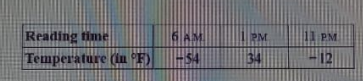
Rationale
The difference between the greatest and least recorded temperature for the day is 88°F.
To find the difference, we subtract the lowest temperature recorded from the highest temperature. This results in a temperature range of 88°F, which accurately reflects the variation throughout the day.
A) 46 This choice likely represents a miscalculation, possibly confusing the temperature readings. The actual difference between the highest and lowest temperatures is significantly larger than 46°F, indicating that this option does not accurately reflect the data presented.
B) 80 Choosing 80°F may arise from an incorrect subtraction of the recorded temperatures. While it suggests a notable temperature change, it fails to account for the full extent of the temperature range that was actually measured, which is greater than 80°F.
C) 88 The correct answer, 88°F, is determined by subtracting the minimum recorded temperature from the maximum recorded temperature. This calculation provides the accurate temperature difference for the day, reflecting the full range of observed temperatures.
D) 89 This option represents a value that exceeds the actual difference calculated from the recorded temperatures. It may stem from a misinterpretation of the highest and lowest readings, as the true difference is less than 89°F.
Conclusion The temperature difference of 88°F is the accurate representation of the range between the highest and lowest temperatures recorded throughout the day. The other options reflect either miscalculations or misunderstandings of the data. Understanding the temperature range is crucial for various practical applications, such as weather forecasting and climate analysis.
In the number shown, which of the following is the value of the underlined digit?
Rationale
Assume 392, 9 in hundreds: 9 x 100 = 9 x 10^2 (B). Others misrepresent place value. This tests exponential notation. Number is assumed.
Sam was told that twice the difference of a number and four is twelve. If x stands for the unknown number which equation could Sam solve to find the number?
Rationale
(2)(x) - (2)(4) = (2)(12)
This equation accurately represents the statement "twice the difference of a number and four is twelve." It translates the verbal expression into a mathematical equation by multiplying the difference of the unknown number \(x\) and 4 by 2, and setting it equal to 12.
A) 2x - 4 = 12 This equation suggests that the entire number \(x\) is being doubled and then reduced by 4, which does not match the original problem's phrasing. The phrase "the difference of a number and four" indicates that the subtraction should occur before the multiplication, making this choice incorrect.
B) 2(x - 9) = 12 This equation incorrectly uses 9 instead of 4 in the difference. The original statement specifies the difference between the unknown number and 4, thus this choice does not represent the problem accurately, leading to an incorrect solution.
C) x - 4 = (2)(12) This equation incorrectly equates the difference of \(x\) and 4 to \(2 \times 12\). The phrase "twice the difference" indicates that multiplication should occur after finding the difference, not before, making this choice incorrect.
D) (2)(x) - (2)(4) = (2)(12) This equation captures the essence of the problem by clearly showing that the difference of \(x\) and 4 is multiplied by 2, aligning perfectly with the original statement. It sets the left-hand side equal to 24, which is accurate based on the problem's condition.
Conclusion The equation \( (2)(x) - (2)(4) = (2)(12) \) correctly formulates the problem Sam faced, reflecting the operation of finding the difference and multiplying by two. The other options fail to represent the original problem's structure and intent, highlighting the importance of accurately translating verbal expressions into mathematical statements.
Which of the following types of graphs is most appropriate to display data on the age and blood pressure of several individuals and to determine whether a correlation exists between age and blood pressure?
Rationale
Scatterplot is the most appropriate type of graph to display data on the age and blood pressure of several individuals.
A scatterplot is ideal for visualizing the relationship between two continuous variables, in this case, age and blood pressure, allowing for the assessment of any correlation between them.
A) Bar graph Bar graphs are typically used to display categorical data and compare different groups. Since both age and blood pressure are continuous variables, a bar graph would not effectively illustrate the potential correlation between them, as it fails to show the relationship and distribution of the data points.
B) Scatterplot A scatterplot is specifically designed to illustrate the relationship between two continuous variables. By plotting individual data points for age and blood pressure, it allows for a clear visualization of any correlation, whether positive, negative, or none at all, making it the most suitable choice for this data analysis.
C) Circle graph Circle graphs, or pie charts, are used to represent proportions of a whole, focusing on categorical data. They do not provide the capability to illustrate relationships between continuous variables like age and blood pressure, making them unsuitable for this particular analysis.
D) Box-and-whisker plot Box-and-whisker plots are useful for displaying the distribution of a dataset and identifying outliers. However, they do not effectively show the relationship between two continuous variables, which is necessary for determining correlation between age and blood pressure.
Conclusion To explore the correlation between age and blood pressure, a scatterplot is the most effective graph type, as it presents each individual's data point clearly, enabling the identification of trends and relationships. Other graph types, such as bar graphs, circle graphs, and box-and-whisker plots, do not provide the necessary framework for analyzing the correlation between these two continuous variables.
Ray is paid $15 for each hour he works. His total wages are w dollars, and his total hours worked are hours. One way to represent Ray's total wages is w=15h. Which of the following statements is true?
Rationale
The dependent variable is the total wages earned.
In the equation w = 15h, the total wages (w) depend on the number of hours worked (h). Since wages are calculated based on hours worked and a fixed hourly rate, the total wages earned represent the dependent variable in this relationship.
A) The dependent variable is the total wages earned. This statement accurately identifies the total wages (w) as the dependent variable because it varies based on the number of hours worked (h). In mathematical terms, the dependent variable is the outcome influenced by the independent variable, which in this case is the hours worked.
B) The dependent variable is the hourly rate. The hourly rate of $15 is a constant value in this scenario and does not change based on the number of hours Ray works. Therefore, it is not dependent on any other variable, making it an independent variable rather than a dependent one.
C) The dependent variable is the total hours worked. Total hours worked (h) serves as the independent variable in this context. The hours worked determine the total wages earned, thus making total hours worked a factor that influences the outcome rather than the outcome itself.
D) The dependent variables are both the hourly rate and the total hours worked. This statement is incorrect because only the total wages earned (w) is a dependent variable. The hourly rate and total hours worked are independent variables that contribute to calculating the total wages but do not change based on each other.
Conclusion In the equation w = 15h, the total wages earned by Ray is the dependent variable, as it is determined by the number of hours he works. The hourly rate and total hours worked act as independent variables, influencing the dependent variable but remaining unchanged themselves. Understanding this relationship is crucial for analyzing linear equations and their applications in real-world scenarios like wage calculations.
Students are determining all of the ways that a collection of 36 pencils can be split into equal-sized groups. Which THREE numbers could be the size of one of the groups?
Rationale
3, 4, and 8 are all factors of 36.
These numbers can divide 36 evenly, allowing for equal-sized groups of pencils without any remainder. Factors are important when determining how a quantity can be partitioned into equal parts, making 3, 4, and 8 valid choices.
A) 3 The number 3 is a factor of 36 because 36 divided by 3 equals 12, resulting in 12 equal groups of 3 pencils each. This division confirms that 3 is a viable group size.
B) 4 Similarly, 4 is also a factor of 36, as 36 divided by 4 equals 9, which means 9 equal groups of 4 pencils can be formed. This shows that 4 is a valid choice for group size.
C) 5 The number 5 is not a factor of 36 because dividing 36 by 5 results in 7.2, which does not yield an integer group size. Therefore, 5 cannot be used to divide the pencils into equal groups.
D) 6 The number 6 is another factor of 36 since 36 divided by 6 equals 6, allowing for 6 equal groups of 6 pencils. Thus, 6 is a valid option for the size of one of the groups.
E) 8 Finally, 8 is a factor of 36 because 36 divided by 8 equals 4.5, which is not an integer. Therefore, 8 cannot be used to create equal groups of pencils.
Conclusion In conclusion, the numbers 3, 4, and 6 are all valid factors of 36, allowing the pencils to be divided into equal groups without any remainder. Conversely, 5 and 8 do not divide evenly into 36, eliminating them as possible group sizes. Understanding factors is essential for solving problems related to equal distribution, ensuring that only numbers that can evenly divide the total are considered.
You are leaving this quiz
What would you like to do with your progress?
You're in the middle of a quiz
What would you like to do before switching?
Practice complete
You finished this free practice quiz.