
Which TIIREE of the following agricultural practices are most likely to have a negative impact on the environment?
Rationale
Increasing the amount of fertilizer applied to a field to maximize crop yields, providing a field with excessive amounts of water to maintain ground saturation, and applying nonselective herbicides to a field at the end of the growing season to eliminate weeds are most likely to have a negative impact on the environment.
These practices can lead to environmental degradation through nutrient runoff, waterlogging, and harm to non-target species, respectively. Such impacts can result in water pollution, soil degradation, and loss of biodiversity.
A) Increasing the amount of fertilizer applied to a field to maximize crop yields Excessive fertilizer application can cause nutrient runoff into nearby water bodies, leading to eutrophication, which depletes oxygen in water and harms aquatic life. This practice not only degrades water quality but also contributes to soil acidification and nutrient imbalances.
B) Providing a field with excessive amounts of water to maintain ground saturation Over-irrigation can result in waterlogging, which harms root systems and reduces crop yields. It can also lead to salinization of soil, where the accumulation of salts from evaporating water degrades soil health and reduces agricultural productivity over time.
C) Applying nonselective herbicides to a field at the end of the growing season to eliminate weeds Nonselective herbicides can kill a wide range of plants, not just weeds, which can disrupt local ecosystems by eliminating beneficial plants and reducing biodiversity. This practice can also lead to the development of herbicide-resistant weed populations, creating long-term agricultural challenges.
D) Planting crops in a field with minimal disturbance of the surface soil to reduce soil erosion This practice, known as conservation tillage, generally has a positive impact on the environment by preserving soil structure, reducing erosion, and enhancing water retention. It promotes sustainable agriculture and mitigates environmental degradation, making it a responsible practice.
Conclusion Agricultural practices such as excessive fertilizer use, over-irrigation, and nonselective herbicide application can significantly harm the environment through various mechanisms, including pollution and biodiversity loss. In contrast, methods that minimize soil disturbance, like conservation tillage, foster environmental health and sustainability in agricultural systems. Understanding these impacts is crucial for adopting environmentally friendly agricultural practices.
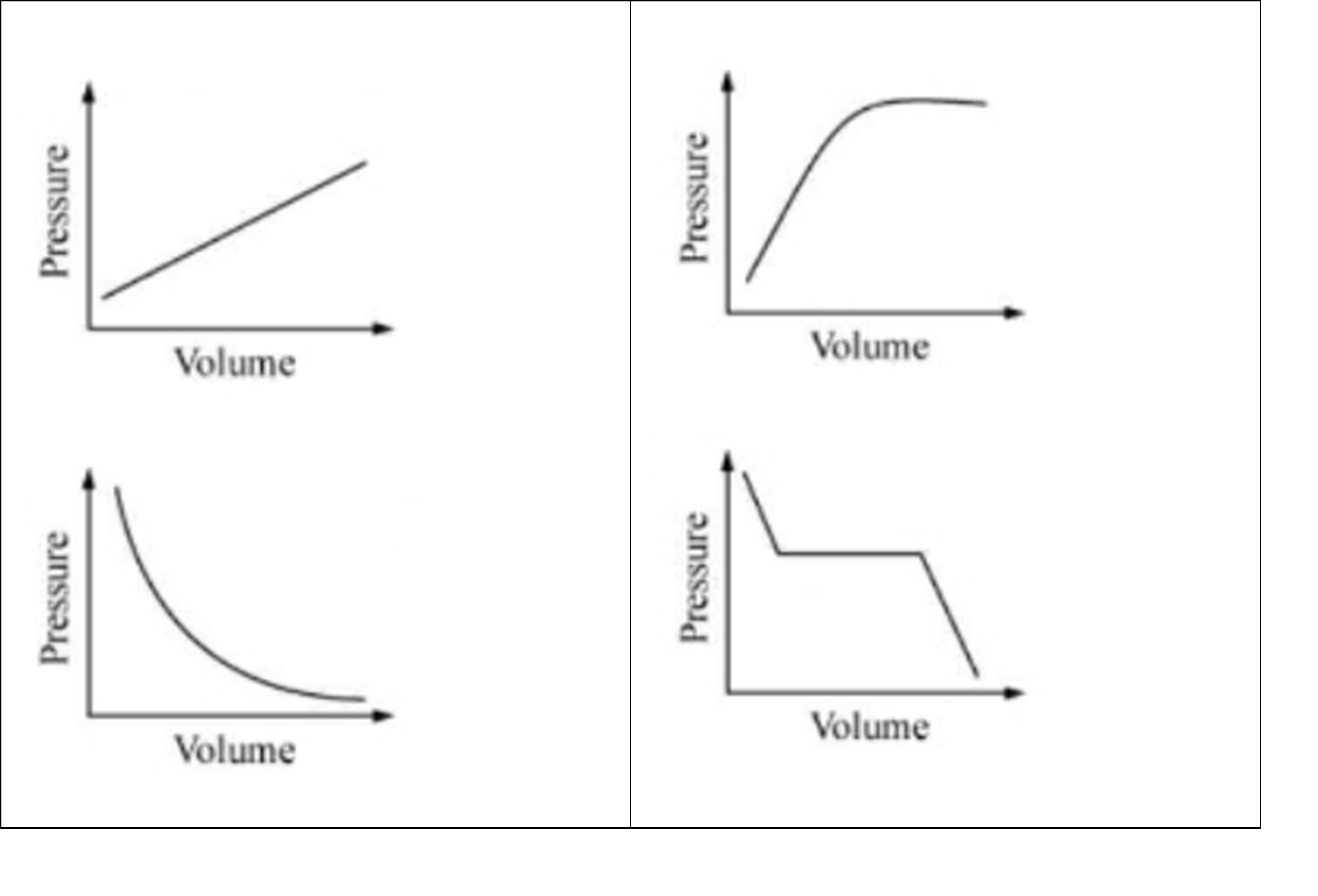
Which of the following graphs best illustrates Boyle's law, which indicates that the volume occupied by a fixed number of gas molecules is inversely proportional to the pressure, at a constant temperature?
Rationale
Graph C best illustrates Boyle's law, demonstrating the inverse relationship between pressure and volume.
Boyle's law states that for a given mass of gas at constant temperature, the volume of the gas is inversely proportional to its pressure. This means that as pressure increases, volume decreases, and vice versa, resulting in a hyperbolic curve on a graph.
A) Graph A Graph A likely depicts a direct relationship between pressure and volume, which contradicts Boyle's law. In such a graph, an increase in pressure would correspond with an increase in volume, failing to illustrate the core principle of the inverse relationship.
B) Graph B Graph B may represent a linear relationship, which is not characteristic of Boyle's law. A linear graph would suggest that changes in pressure directly correlate with changes in volume, rather than exhibiting the expected hyperbolic behavior indicative of an inverse proportionality.
D) Graph D Graph D might display a constant volume despite varying pressure, which does not align with Boyle's law. This scenario would imply that volume remains unchanged regardless of pressure changes, contradicting the fundamental principle that volume should decrease as pressure increases.
Conclusion In summary, Boyle's law illustrates the inverse relationship between pressure and volume for a fixed amount of gas at constant temperature. Graph C accurately represents this relationship through a hyperbolic curve, while the other graphs fail to depict the essential characteristics of Boyle's law, either by showing direct relationships or maintaining constant volume. Understanding this relationship is crucial in various scientific and practical applications, including gas behavior under different pressure conditions.
Fossils are typically found in which of the following types of rock?
Rationale
Fossils are typically found in sedimentary rock.
Sedimentary rocks form through the accumulation and compression of mineral and organic particles, creating the ideal conditions for fossilization. These rocks preserve the remains of organisms, allowing paleontologists to study ancient life forms and their environments.
A) Metamorphic Metamorphic rocks originate from the alteration of existing rocks due to heat, pressure, and chemical processes. This transformation generally destroys any fossils that may have been present in the original rock, making it an unsuitable environment for fossil preservation.
B) Sedimentary Sedimentary rocks, as mentioned, are the primary type of rock where fossils are found. They form in layers and can encapsulate the remains of plants and animals, providing essential evidence for understanding Earth's history and the evolution of life.
C) Igneous Igneous rocks form from the cooling and solidification of molten rock, either magma or lava. The intense heat involved in this process typically destroys organic materials, preventing the formation of fossils within these types of rocks.
D) Basalt Basalt is a specific type of igneous rock formed from lava that cools quickly at the Earth's surface. Similar to other igneous rocks, it lacks the necessary conditions for fossil preservation, as the high temperatures involved eliminate any biological remnants.
Conclusion Fossils are primarily found in sedimentary rocks, which provide the necessary conditions for preservation of organic materials. In contrast, metamorphic, igneous, and basalt rocks involve processes that either destroy fossils or do not allow for their formation, highlighting the unique role of sedimentary rocks in the fossil record. Understanding these rock types is crucial for paleontological studies and reconstructing Earth's biological history.
Which of the following types of pathogen is responsible for the common cold?
Rationale
Virus is responsible for the common cold.
The common cold is primarily caused by viruses, with rhinoviruses being the most common culprits. These pathogens invade the upper respiratory tract, leading to the typical symptoms associated with the cold.
A) Bacterium Bacteria are single-celled microorganisms that can cause various infections; however, they are not responsible for the common cold. While bacterial infections can lead to respiratory illnesses, they are distinct from the viral infections that characterize the common cold.
B) Virus Viruses, specifically rhinoviruses, are the primary agents responsible for causing the common cold. They spread easily from person to person and replicate within the host's cells, leading to the symptoms commonly associated with colds, such as a runny nose, cough, and sore throat.
C) Fungus Fungi are a different class of organisms, primarily involved in infections like athlete's foot or ringworm, rather than respiratory illnesses like the common cold. They thrive in warm, damp environments and do not cause the viral symptoms associated with the cold.
D) Protozoan Protozoans are single-celled eukaryotic organisms that can cause diseases such as malaria or giardiasis. They are not implicated in the common cold, which is specifically a viral infection, making this option irrelevant to the question.
Conclusion The common cold is caused by viruses, with rhinoviruses being the most prevalent. This distinguishes it from other types of pathogens such as bacteria, fungi, and protozoans, which are responsible for different kinds of infections. Understanding the nature of the pathogen involved is crucial for effective treatment and prevention strategies.
Which of the following examples best illustrates sexual reproduction?
Rationale
A bee transfers pollen between the flowers of different plants of the same species.
This example illustrates sexual reproduction as it involves the transfer of genetic material between two different plants, leading to the formation of seeds and new plant offspring. In contrast to other options, this process requires the fusion of gametes from two parent organisms.
A) A single bacterium increases in size and divides into two bacteria. This describes a process called binary fission, which is a form of asexual reproduction. In binary fission, a single organism replicates its genetic material and divides into two identical daughter cells, thus not involving any genetic exchange or variation typical of sexual reproduction.
C) A small bud forms on a yeast cell, slowly grows, and separates from the original cell. This example depicts budding, a method of asexual reproduction where a new organism develops from an outgrowth or bud on the parent organism. Like binary fission, budding does not involve the fusion of gametes and results in genetically identical offspring, thereby failing to meet the criteria for sexual reproduction.
D) A flatworm's body fragments into different parts, which all become fully formed adults. This process is known as fragmentation, another type of asexual reproduction. In fragmentation, an organism can regenerate and grow into new individuals from fragments of the parent, which does not include genetic recombination or the involvement of gametes, thus not representing sexual reproduction.
Conclusion Sexual reproduction is characterized by the exchange and combination of genetic material from two different parent organisms, leading to genetic diversity in offspring. The example of a bee transferring pollen highlights this process, as it involves cross-pollination between different plants. The other options illustrate various forms of asexual reproduction, which do not contribute to genetic variation in the same way that sexual reproduction does.
Which of the following best helps to explain why stars appear to revolve around Polaris, as viewed from the Northern Hemisphere?
Rationale
Earth rotates on its axis.
The apparent movement of stars around Polaris, as seen from the Northern Hemisphere, is primarily due to the Earth's rotation on its axis. This rotation causes the night sky to appear to shift, creating the illusion that stars are revolving around the North Star.
A) Earth and the rest of the solar system revolve around Polaris. This statement is incorrect because the solar system does not revolve around Polaris. Instead, the solar system orbits the center of the Milky Way galaxy, and the motion of stars around Polaris is a result of Earth's rotation, not an orbit around the star itself.
B) All stars revolve around Polaris. While many stars appear to move in a circular pattern around Polaris, not all stars revolve around it. The apparent motion is a consequence of Earth's rotation, and stars that are not in close proximity to Polaris will have different trajectories in the sky.
C) Polaris is at the center of the universe. Polaris is not at the center of the universe; it is simply a prominent star located near the North Celestial Pole. The universe is vast and does not have a defined center, making this statement misleading in the context of stellar motion.
Conclusion The motion of stars around Polaris, as observed from the Northern Hemisphere, is fundamentally a result of Earth's axial rotation. This rotation creates the illusion of stars circling Polaris, while in reality, they are all part of a dynamic and expansive universe, with Earth as the rotating observer. Understanding this principle is crucial for comprehending celestial movements and navigation based on stellar positions.
Which of the following statements best explains the presence of seashell fossils in the Andes Mountains in South America?
Rationale
The Andes Mountains were at one time under the Pacific Ocean and have since been pushed upward.
This statement accurately explains the geological history of the Andes, which were formed by tectonic processes that lifted marine sediments, including seashell fossils, from the ocean floor to their current heights.
A) While flying over the Andes Mountains, seagulls excreted the undigested remains of the shelled animals they had eaten. This explanation is implausible as it suggests a highly unlikely mechanism for the presence of seashell fossils. While animal excretion can contribute to sediment, it would not account for the large fossilized deposits found throughout the Andes, which require a much more substantial geological process.
B) The Andes Mountains are the highest in South America. While it is true that the Andes are the highest mountain range in South America, this statement does not explain the presence of seashell fossils. The height of the mountains does not inherently relate to the historical marine environments that could have deposited such fossils.
C) The Andes Mountains were at one time under the Pacific Ocean and have since been pushed upward. This is the correct statement, as it reflects the geological history of the region. The uplift of the Andes is a result of the Nazca Plate subducting beneath the South American Plate, which raised marine sediments, including seashells, from oceanic depths to form the current mountain range.
D) Populations of marine invertebrates migrated out of the Pacific Ocean and into the Andes Mountains. This statement misrepresents the geological processes involved. Marine invertebrates cannot migrate to such heights, as the Andes are far above sea level. The fossils found in the mountains are remnants of organisms that lived in the ocean when the area was submerged, not organisms that migrated after the uplift.
Conclusion The presence of seashell fossils in the Andes Mountains is best explained by the geological history of the region, specifically that these mountains were once submerged under the Pacific Ocean and have been raised through tectonic forces. This process preserved the marine life in the form of fossils, illustrating the dynamic nature of Earth's geology and the impact of plate tectonics on the landscape.
Which TWO of the following are examples of structural adaptations?
Rationale
Some birds have long, curved beaks that they use to extract nectar from flowers and some birds have webbed feet that allow them to swim and dive efficiently in water.
Structural adaptations are physical features of an organism that enhance its ability to survive and reproduce in its environment. In this case, the long, curved beaks and webbed feet are specific traits that serve direct functional roles in feeding and locomotion, respectively.
A) Some birds travel in large migratory flocks that may discourage attacks by predators. This choice describes a behavioral adaptation rather than a structural one. Traveling in flocks is a strategy that helps reduce predation risk, but it does not involve any physical characteristics of the birds themselves.
B) Some birds have long, curved beaks that they use to extract nectar from flowers. This is a clear example of a structural adaptation. The long, curved beak is a physical trait that has evolved specifically to allow these birds to access nectar, which is a crucial food source for them.
C) Some birds are active mainly at night, which reduces competition for limited resources. This option also refers to a behavioral adaptation. Being nocturnal allows birds to avoid competition and predation, but it does not involve any physical changes to their body structure.
D) Some birds have webbed feet that allow them to swim and dive efficiently in water. This choice exemplifies a structural adaptation as well. Webbed feet are a physical trait that enables birds to move effectively in aquatic environments, thus enhancing their survival and feeding capabilities.
Conclusion Structural adaptations are essential traits that improve an organism's chances of survival in its environment. The long, curved beaks and webbed feet serve critical functions that enable birds to access food and navigate their habitats effectively. In contrast, the other options reflect behavioral strategies, which, while important, do not involve physical modifications to the birds themselves.
Which of the following layers of Earth is the most dense?
Rationale
The inner core is the most dense layer of Earth.
The inner core consists primarily of iron and nickel and reaches densities exceeding 12 grams per cubic centimeter, making it the most compact and dense layer of the Earth. This high density is due to the immense pressure at the Earth's center and the metallic nature of its composition.
A) The inner core The inner core is the densest layer of the Earth, primarily composed of solid iron and nickel. Due to the extremely high pressures found at this depth, the atoms are closely packed together, resulting in a very high density.
B) The mantle The mantle is less dense than the inner core, with densities typically ranging from 3.5 to 5.5 grams per cubic centimeter. It is composed of silicate rocks that are more spread out compared to the metals in the inner core, resulting in a lower overall density.
C) The oceanic crust The oceanic crust is the outer layer of the Earth beneath the oceans and has a density of about 2.9 to 3.0 grams per cubic centimeter. While denser than the continental crust, it is significantly less dense than the inner core and mantle, as it is primarily composed of basaltic rock.
D) The continental crust The continental crust is the least dense of all the layers listed, with densities averaging around 2.7 grams per cubic centimeter. It is primarily composed of lighter granitic rocks, which contribute to its lower density compared to the denser layers beneath it.
Conclusion The inner core, comprising solid iron and nickel, stands out as the most dense layer of Earth due to the intense pressure and metallic composition at such depths. In contrast, the mantle, oceanic crust, and continental crust exhibit progressively lower densities, highlighting the unique characteristics of each Earth layer. Understanding these differences is crucial for grasping the Earth's internal structure and its geological processes.
Water stored in aquifers is found in which of the following locations?
Rationale
Water stored in aquifers is found beneath Earth's surface.
Aquifers are geological formations that can store and transmit water, primarily located underground. They play a crucial role in providing freshwater to wells and springs, making them vital for drinking water and irrigation.
A) Beneath Earth's surface Aquifers are specifically defined as layers of permeable rock or sediment that hold water underground. This characteristic distinguishes them from other water sources and highlights their essential role in the hydrological cycle, as they are a primary reservoir for groundwater.
B) In rivers and lakes While rivers and lakes are important sources of surface water, they do not qualify as aquifers. These bodies of water are above ground and are subject to evaporation and other surface processes. Their water is not stored within geological formations like aquifers, which is where groundwater resides.
C) In ice caps and glaciers Ice caps and glaciers contain freshwater in solid form, but they are not classified as aquifers. The water in these icy formations is stored above ground and is part of the cryosphere. When melted, this water can contribute to surface water but does not reside in the subsurface layers characteristic of aquifers.
D) In the oceans Oceans hold the majority of Earth's water, but they are saline and not a source of freshwater like aquifers. The water in oceans is located on the surface and is not contained within geological formations, which is essential for defining an aquifer.
Conclusion Aquifers are integral components of the hydrological system, storing freshwater beneath the Earth's surface, which is crucial for various human activities. Understanding the location and nature of aquifers is vital for water resource management, as they provide essential groundwater supplies that are distinct from surface water sources like rivers, lakes, glaciers, and oceans.
Which of the following biomes is characterized by an extremely cold climate, low-growing plants, and a layer of permanently frozen subsoil called permafrost?
Rationale
Tundra is characterized by an extremely cold climate, low-growing plants, and a layer of permanently frozen subsoil called permafrost.
The tundra biome is defined by its harsh, cold climate and unique vegetation that includes mosses, lichens, and small shrubs. The presence of permafrost distinguishes this biome, as it affects the types of plants that can thrive in such an extreme environment.
A) Rain forest Rain forests are characterized by warm temperatures and high levels of precipitation, which support a dense canopy of tall trees and a rich diversity of plant and animal life. The warm and moist conditions are in stark contrast to the cold and dry environment of the tundra, making this choice incorrect.
B) Tundra The tundra biome is indeed marked by extremely low temperatures, minimal precipitation, and low-growing vegetation adapted to survive in cold conditions. Permafrost, a layer of permanently frozen subsoil, is a defining feature of the tundra, allowing only certain types of plants to thrive, thereby making this the correct answer.
C) Savanna Savannas are characterized by a mix of grasslands and scattered trees, typically found in warm climates with seasonal rainfall. They do not have the extreme cold or permafrost associated with the tundra, making them unsuitable for the conditions described in the question.
D) Temperate forest Temperate forests experience moderate climates with distinct seasons, including warm summers and cold winters. These forests have a diverse range of trees and plants but lack the extreme cold and permafrost found in tundra biomes. Thus, this choice does not fit the biome described.
Conclusion The tundra biome is the only option that accurately reflects the conditions of extreme cold, low-growing vegetation, and the presence of permafrost. Other biomes like rain forests, savannas, and temperate forests have distinct climates and ecological characteristics that do not align with the features of tundra. Understanding these differences is crucial for studying global ecology and the adaptations of organisms within various biomes.
The tendency of objects to resist a change in motion is known as which of the following?
Rationale
Inertia is the tendency of objects to resist a change in motion.
Inertia is a fundamental property of matter that describes an object's resistance to any change in its state of motion, whether that means starting, stopping, or changing direction. This principle is a key concept in Newtonian physics and directly relates to an object's mass; the greater the mass, the greater the inertia.
A) Acceleration Acceleration refers to the rate of change of velocity of an object over time. It is the result of an applied force acting on an object, rather than a property that describes the object's resistance to motion. Thus, it does not capture the concept of resisting changes in motion.
B) Displacement Displacement is the vector quantity that describes the change in position of an object. It measures how far an object has moved from its starting point, but it does not reflect any resistance to motion. Therefore, it is unrelated to the concept of inertia.
D) Force Force is defined as any interaction that, when unopposed, will change the motion of an object. While force can cause changes in motion, it does not describe the inherent property of matter that opposes such changes. Therefore, it does not accurately represent the concept of inertia.
Conclusion Inertia, as the resistance of an object to changes in its motion, is a foundational concept in physics that explains why objects remain at rest or in uniform motion unless acted upon by an external force. The other options—acceleration, displacement, and force—do not encapsulate this property, highlighting the unique and essential nature of inertia in understanding motion.
Which of the following best explains how a child can inherit a genetic disorder from parents who exhibit no symptoms of the disorder?
Rationale
The disorder is caused by a recessive allele, and each parent carries only a single copy of the allele.
A genetic disorder can be inherited when both parents are carriers of a recessive allele, even though they do not exhibit symptoms themselves. Each parent can pass on the recessive allele to the child, resulting in the child expressing the disorder if they inherit the recessive allele from both parents.
A) The disorder is caused by a recessive allele, and each parent carries only a single copy of the allele. This choice correctly explains that both parents can be asymptomatic carriers of a recessive allele. If each parent contributes one copy of the recessive allele to the child, the child will express the genetic disorder, even though neither parent shows symptoms.
B) The disorder is caused by a dominant allele, and each parent carries at least one copy of the allele. This option is incorrect because if the disorder were caused by a dominant allele, at least one parent would typically exhibit symptoms of the disorder. A dominant allele requires only one copy to manifest the disorder, meaning at least one parent would show signs if they carried the allele.
C) The disorder is caused by multiple genes, and both parents acquired mutations in those genes before the child was born. This statement is misleading since it suggests that the parents must have mutations in multiple genes, which is not necessary for recessive disorders. The disorder can arise from a single pair of recessive alleles, thus making this explanation incomplete for the scenario described.
D) The disorder is caused by a toxin in the environment, and the parents were exposed to the toxin after the child was born. This choice is incorrect because it implies that the environmental exposure to a toxin occurs postnatally, thus cannot result in the child inheriting a genetic disorder. Genetic disorders are passed through alleles, not environmental toxins.
Conclusion Genetic disorders can be transmitted from asymptomatic parents to their children through recessive alleles. In this case, both parents may carry a single copy of the recessive allele without showing any symptoms themselves. Only when the child inherits the recessive allele from both parents does the disorder manifest, highlighting the importance of understanding recessive inheritance patterns in genetics.
In humans, gametes are produced by which of the following?
Rationale
Gametes in humans are produced by the gonads.
The gonads, which include the ovaries in females and the testes in males, are the organs responsible for producing gametes—ova and sperm, respectively. This specialized function is essential for sexual reproduction and the continuation of genetic material.
A) Spleen The spleen is primarily involved in filtering blood and managing immune responses, but it does not play a role in the production of gametes. Rather, it is associated with the recycling of blood cells and the storage of immune cells, making it unrelated to reproductive functions.
B) Thymus The thymus is essential for the development of T-cells, which are vital for the immune system, particularly during childhood and adolescence. However, it does not produce gametes; its role is strictly related to immune cell maturation and does not involve reproductive processes.
C) Gonads The gonads are the primary reproductive organs in humans, responsible for the production of gametes. In males, the testes generate sperm, while in females, the ovaries produce eggs. This is the critical function of the gonads, making them the correct answer for the production of gametes.
D) Kidneys The kidneys are crucial for filtering blood and excreting waste products through urine, but they do not contribute to the production of gametes. Their primary functions are related to maintaining fluid balance, electrolyte levels, and blood pressure, entirely separate from reproduction.
Conclusion In humans, the gonads are the organs specifically designed for the production of gametes, which are necessary for sexual reproduction. The spleen, thymus, and kidneys serve other vital functions in the body but do not partake in gamete formation. Understanding the distinct roles of these organs highlights the specialized nature of reproductive anatomy and physiology in humans.
Which of the following is a way the human body responds to cold environmental temperatures?
Rationale
Involuntary muscular contractions
When exposed to cold temperatures, the human body responds primarily through shivering, which consists of involuntary muscular contractions. This process generates heat as muscles contract rapidly, helping to maintain body temperature in a cold environment.
A) Increased deposits of fat around the internal organs While the body can adapt to cold over time by increasing fat deposits for insulation, this is not an immediate response to cold temperatures. Fat accumulation occurs gradually and is more related to long-term changes in environmental conditions or metabolism rather than a direct, acute response to cold.
C) Irregular heartbeat An irregular heartbeat is not a typical physiological response to cold temperatures. In fact, exposure to cold can lead to a decrease in heart rate due to peripheral vasoconstriction, which is the body's attempt to preserve heat. An irregular heartbeat could indicate a health issue rather than a standard response to cold.
D) Increased perspiration Increased perspiration is generally associated with heat rather than cold. The body's primary response to cold is to conserve heat, which includes reducing blood flow to the skin and decreasing sweating. Perspiration is counterproductive in cold environments as it could lead to further heat loss.
Conclusion The human body primarily reacts to cold environments through involuntary muscular contractions, commonly known as shivering, which serves to generate heat. Other options such as increased fat deposits, irregular heartbeat, and increased perspiration do not accurately describe the immediate physiological responses to low temperatures. Understanding these responses is crucial for maintaining homeostasis and ensuring survival in cold conditions.
You are leaving this quiz
What would you like to do with your progress?
You're in the middle of a quiz
What would you like to do before switching?
Practice complete
You finished this free practice quiz.