
Establishing procedures for students to use active listening skills while engaging in small-group discussions allows the students to
Rationale
Establishing procedures for students to use active listening skills while engaging in small-group discussions allows the students to focus on acquiring the exact message a speaker is trying to present.
Active listening is a key skill that enables individuals to fully understand and interpret the messages conveyed by others. By focusing on the speaker's message, students can enhance their comprehension and foster more effective communication within small-group discussions.
A) communicate personal feelings through tone of voice and body language While tone of voice and body language are important aspects of communication, they do not directly relate to the active listening process focused on understanding a speaker's message. This choice emphasizes personal expression rather than the core goal of acquiring information during discussions.
C) plan out exactly what they want to say while another person is speaking Planning responses while someone else is speaking detracts from active listening. This behavior often leads to distraction and misunderstanding, as the listener is not fully engaged with the speaker's message. Effective active listening requires attention to the speaker rather than formulating a reply.
D) make inferences and predictions about what a speaker is trying to say Making inferences and predictions can be a part of the listening process, but it is not the primary focus of active listening. This choice implies that the listener is speculating rather than concentrating on accurately understanding the speaker's intended message, which is essential for effective communication.
Conclusion Active listening skills are fundamental for successful communication in small-group discussions, allowing students to concentrate on understanding the exact message presented by speakers. While personal expression, planning responses, and making inferences play roles in communication, they do not align with the core objective of active listening, which is to ensure comprehension and clarity in discussions.
Which of the following strategies is most appropriate for supporting vocabulary acquisition for English learners (ELs) in kindergarten?
Rationale
Labeling items in the classroom in English and in the children's primary language.
This strategy actively integrates both English and the children's primary languages, creating a bilingual environment that supports vocabulary acquisition by making meaningful connections between words and their meanings in both languages.
A) Labeling items in the classroom in English and in the children's primary language This approach directly supports vocabulary acquisition by allowing English learners to make connections between new vocabulary in English and familiar terms in their native language. It reinforces understanding and retention of new words in a context they can relate to, facilitating bilingual learning.
B) Giving the children an opportunity to copy weekly spelling words in English While copying spelling words can help with memorization, it often lacks context and may not engage English learners effectively. This method does not promote active vocabulary usage or comprehension, which are crucial for language acquisition, making it less effective for supporting ELs.
C) Encouraging the children to read while listening to audiobooks written in English Listening to audiobooks can enhance listening skills and exposure to pronunciation; however, without accompanying visual aids or opportunities for interaction in their primary language, this strategy may not fully support vocabulary acquisition. It primarily focuses on auditory skills rather than active vocabulary development.
D) Providing the children with books written in their native language instead of English While reading in their native language is beneficial for comprehension and connection to prior knowledge, it does not directly facilitate English vocabulary acquisition. This strategy may inadvertently limit exposure to English vocabulary, which is essential for learning the language.
Conclusion Supporting vocabulary acquisition for English learners in kindergarten is most effectively achieved through bilingual strategies, like labeling classroom items in both English and the children's primary languages. This method fosters an inclusive environment where vocabulary can be acquired in a meaningful context, enhancing both understanding and retention. Other options, while valuable in their own right, do not provide the same level of direct support for English vocabulary development.
A teacher posts the following words from a reading selection on a word wall. Boil, Oil, Coin, Join. Which of the following vowel sounds is present in each word?
Rationale
Diphthong is the vowel sound present in each word.
Each of the words—Boil, Oil, Coin, and Join—contains a diphthong, which is a complex vowel sound that begins with one vowel sound and glides into another within the same syllable. In these examples, the vowel combinations create a distinct sound that characterizes each word.
A) Short vowel Short vowels are single vowel sounds that are pronounced quickly and do not glide into another sound. Examples include the 'a' in "cat" or the 'e' in "bed." The words listed do not contain such short vowel sounds; rather, they feature more complex vowel sounds.
B) Schwa The schwa sound is represented by an unstressed and neutral vowel sound, often found in unstressed syllables, such as the 'a' in "sofa" or the 'e' in "taken." None of the words in the list contain a schwa sound; they all showcase distinct vowel sounds that are stressed and pronounced clearly.
C) Diphthong Diphthongs are characterized by a combination of two vowel sounds within a single syllable, as seen in the words "Boil," "Oil," "Coin," and "Join." Each word features a smooth transition between vowel sounds, which is the defining quality of a diphthong, making this the correct choice.
D) Long vowel Long vowels are pronounced the same as their letter name, such as the 'a' in "cake" or the 'e' in "see." While the words may contain vowel sounds that are elongated, they do not fit the definition of long vowels since they involve a transition between sounds rather than a singular long sound.
Conclusion The words Boil, Oil, Coin, and Join all feature diphthongs, which are complex vowel sounds that glide from one vowel to another within the same syllable. This differentiates them from short vowels, schwa sounds, and long vowels. Understanding these sound patterns aids in phonetic recognition and enhances reading skills.
I have a cat my cat nam is powdapuff. My cat is whit. My cat set in the sum and sleep in the sum and play wi my ball. I lov my whit cat. The End. Which of the following responses by the teacher is likely to be most helpful to the first-grade student who wrote the story above for homework?
Rationale
Suggesting self- and peer-editing is like guiding a young writer to improve their work collaboratively, building skills. Rubrics or parent checks are less hands-on, and error-hunting alone may frustrate a first-grader.
Which of the following is the conceptional focus of the lesson?
Rationale
Erosion is the conceptual focus of the lesson.
The lesson primarily centers on the processes and impacts of erosion, exploring how soil and rock materials are worn away and transported by natural forces such as water, wind, and ice.
A) Erosion This choice correctly identifies the main topic of the lesson, which delves into various aspects of erosion, including its causes, effects, and significance in environmental science. Understanding erosion is crucial for comprehending landscape changes and soil conservation methods.
B) Solubility While solubility may be related to the movement of materials in water, it does not encompass the broader theme of the lesson focused on erosion. Solubility pertains specifically to how substances dissolve in solvents, which is a narrower topic not aligned with the overarching focus.
C) Water density Water density, though relevant to discussions about physical properties of water, does not directly relate to the concept of erosion. The lesson does not emphasize water's density characteristics but rather the dynamics of material displacement and landscape alteration through erosion.
D) Composting Composting involves the breakdown of organic matter into nutrient-rich soil, which is entirely different from the concept of erosion. This choice reflects a specific ecological process that does not connect with the lesson's primary focus on the physical processes of erosion and material transport.
Conclusion The lesson's emphasis on erosion underlines its importance in understanding environmental changes and geological processes. While other choices like solubility, water density, and composting address relevant scientific concepts, they do not represent the primary focus of the lesson. Erosion serves as a foundational topic for grasping how natural forces shape landscapes and affect ecosystems.
A third-grade teacher has students draft their writing pieces using a Web-based word processor that allows students to provide feedback to one another. The primary purpose of using the digital tool in the writing process is to
Rationale
A Web-based word processor for feedback is like a digital workshop, enabling collaborative peer revision. It's not primarily about audience variety, external communication, or plagiarism prevention.
Which of the following best describes the goal of this activity?
Rationale
Students observe and value the merits of artwork.
The primary objective of this activity is for students to critically engage with artwork, appreciating its artistic value and significance. This process enhances their ability to analyze and interpret various forms of art.
A) Students evaluate a variety of subject matter. While evaluating subject matter may be a component of the activity, it does not encapsulate the main goal. The focus is more on appreciating and understanding the merits of the artwork rather than merely assessing different subjects presented within it.
B) Students observe and value the merits of artwork. This choice accurately reflects the essence of the activity, as it emphasizes the importance of observation and appreciation of the artwork's qualities. Students learn to recognize and articulate the artistic elements and intentions behind various pieces, fostering a deeper connection with the art.
C) Students understand and apply a variety of art techniques in different media. This option suggests a practical, hands-on approach to art-making rather than a focus on observation and appreciation. While understanding techniques is important, the primary goal here is not about application but about valuing and interpreting existing artworks.
D) Students demonstrate knowledge of art elements from different cultures. Although knowledge of cultural art elements can play a role in the activity, the central aim is not simply to demonstrate knowledge. Instead, it revolves around the appreciation and valuation of the artwork itself, regardless of cultural context.
Conclusion The activity's main goal is for students to observe and value the merits of artwork, fostering a critical appreciation of artistic expression. While evaluating subject matter, understanding techniques, and cultural knowledge may enhance the experience, they do not replace the fundamental aim of engaging with art on a deeper, more appreciative level.
Which of the following statements best explains the relationship between a child's academic success and time spent in physical education or in physical activity?
Rationale
The relationship between a child's academic success and time spent in physical education or in physical activity is positive.
Research indicates that increased physical activity can enhance cognitive function, leading to better academic performance. Engaging in physical education not only improves physical health but also promotes concentration, memory, and classroom behavior, contributing positively to academic outcomes.
A) There is no relationship. This choice suggests that time spent in physical education or physical activity has no impact on academic success. However, numerous studies have shown that physical activity is linked to improved cognitive function and academic achievement, making this statement inaccurate and unsupported by research.
B) The relationship is positive. This is the correct answer as it reflects the findings of various studies demonstrating that children who engage more in physical education and physical activities tend to perform better academically. The positive relationship is attributed to enhanced concentration, memory, and overall cognitive function that result from regular physical activity.
C) The relationship is negative. This option implies that increased time spent in physical education or physical activity detracts from academic success, which contradicts established research. While some may argue that time spent on physical activities takes away from academic study, evidence shows that physical activity actually supports rather than hinders academic performance.
D) The relationship is skewed. Choosing this option suggests that the relationship between physical activity and academic success is distorted or misrepresented. However, studies have consistently shown a clear positive correlation, indicating a straightforward relationship rather than one that is skewed or misleading.
Conclusion The relationship between a child's academic success and time spent in physical education or physical activity is indeed positive. Engaging in physical activities contributes to better cognitive functioning, improving concentration and facilitating academic achievements. Therefore, promoting physical education in schools is essential for fostering both physical and academic development in children.
Which of the following concepts does this activity best demonstrate?
Rationale
The Sun's position in the sky changes constantly over the course of a day.
This activity illustrates the daily movement of the Sun across the sky, demonstrating how its position shifts due to the Earth's rotation. As the Earth spins on its axis, different areas experience varying angles of sunlight, leading to observable changes in the Sun's location throughout the day.
A) The sunrise and sunset are due to Earth's rotation. While this statement is true, it does not fully encapsulate the essence of the activity. The activity is more focused on the continuous change in the Sun's position during the day rather than just the events of sunrise and sunset, which are specific moments rather than an ongoing process.
B) The Sun is the most massive part of our solar system. This choice addresses the mass of the Sun, which is indeed a significant characteristic, but it does not relate to the activity in question. The activity aims to showcase the dynamic changes in the Sun's position, not its mass or gravitational influence within the solar system.
C) Earth is tilted, and the tilt spreads out the Sun's energy. This option refers to the axial tilt of Earth and its effects on seasonal variations in sunlight intensity and duration. However, the activity specifically demonstrates the day-to-day changes in the Sun's trajectory in the sky, making this choice less relevant to the immediate observation being made.
Conclusion The activity primarily demonstrates how the Sun's position in the sky changes throughout the day, a result of Earth's rotation. While other aspects of the Sun and Earth are true, they do not directly address the implications of this specific activity. Understanding the daily movement of the Sun is essential for comprehending basic concepts of astronomy and our planet's dynamics.
The revision of the sentence shown best reflects a change in word choice that demonstrates which of the following characteristics of formal academic writing?
Rationale
Avoiding use of clichés.
The revision of the sentence showcases a deliberate effort to eliminate overused phrases, thereby enhancing clarity and originality in formal academic writing. This approach aligns with the expectation that academic discourse should be precise and free from linguistic shortcuts that may dilute the intended message.
A) Using concrete language Concrete language refers to the use of specific and tangible terms that evoke clear imagery. While this characteristic is essential for clarity in writing, the revision in question does not primarily focus on enhancing the specificity of the language. Instead, it emphasizes the importance of fresh expressions over tired phrases, which is a different aspect of effective writing.
B) Choosing passive voice The choice of passive voice involves structuring sentences where the subject receives the action rather than performs it. Although passive voice can be a feature of formal writing, the revision does not specifically aim to implement this grammatical structure. Instead, it prioritizes the avoidance of clichés, showing that the emphasis is on originality rather than voice construction.
C) Replacing euphemisms Euphemisms are mild or indirect expressions used in place of harsher or more direct terms. While the revision may inadvertently replace euphemisms, its primary focus is on discarding clichéd phrases. Thus, the act of eliminating clichés is not synonymous with replacing euphemisms, which makes this choice incorrect.
D) Avoiding use of clichés The revision specifically highlights the removal of clichés, which are phrases that have become overly familiar and lack impact. By avoiding such expressions, the writing gains in originality and effectiveness, aligning well with the formal academic standard that values fresh and precise language to convey ideas.
Conclusion Effective formal academic writing prioritizes clarity and originality, which is achieved by avoiding clichés. The revision in question exemplifies this principle by replacing overused phrases with more unique expressions, thus enhancing the overall quality of the writing. This characteristic is essential in academic contexts, where the goal is to communicate complex ideas clearly and engagingly.
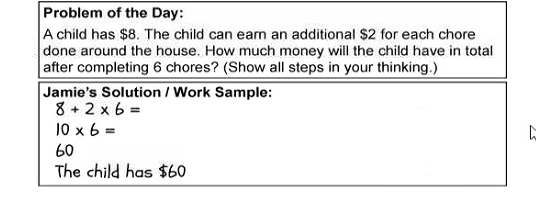
According to the work sample shown, Jamie would most benefit from additional instruction in which of the following?
Rationale
Jamie would most benefit from additional instruction in following the order of operations.
Understanding the order of operations is crucial for solving mathematical expressions correctly, as it dictates the sequence in which calculations should be performed. Mastery of this concept enables Jamie to approach more complex problems with confidence and accuracy.
A) Learning basic math facts While knowing basic math facts is important for foundational skills, Jamie's work sample indicates a need for advanced problem-solving techniques. If Jamie already has a grasp of basic facts, additional instruction would be more effective when focused on the order of operations rather than reiterating basic calculations.
B) Writing a number sentence Writing a number sentence is a useful skill for expressing mathematical relationships, but it does not directly address the procedural aspect of solving equations. Jamie's challenges seem to stem from executing the correct operations in a given problem rather than from formulating the sentences themselves.
C) Working backward Working backward is a valuable strategy for problem-solving, especially in certain contexts, but it relies on a solid understanding of how to apply operations correctly. If Jamie struggles with the order of operations, focusing on this technique may not yield the desired improvement in solving problems accurately.
D) Following the order of operations This choice directly addresses the issues observed in Jamie's work sample, where errors in applying the order of operations led to incorrect answers. Mastery of this concept will help Jamie perform calculations in the correct sequence, thus improving overall mathematical understanding and performance.
Conclusion To enhance Jamie's mathematical skills and problem-solving capabilities, instruction should focus on the order of operations. This foundational concept is essential for accurately solving equations and is critical for Jamie's progression in mathematics. By strengthening this understanding, Jamie will be better equipped to tackle more complex mathematical challenges in the future.
The focus of the lesson is most likely on which of the following mathematical strategies?

Rationale
Adding by counting on is the most likely mathematical strategy focused on in the lesson.
This strategy emphasizes the process of incrementally increasing a number to find a total, which is a fundamental concept in addition, often taught in early mathematics.
A) Subtracting by taking away This strategy involves removing a certain quantity from a total. While it is a valid method of subtraction, the question specifically asks for strategies related to addition, making this choice irrelevant to the lesson's focus.
B) Subtracting when the change is unknown This approach addresses situations where the difference must be determined to find an initial quantity. However, this choice pertains to subtraction, not addition, thus it does not align with the primary focus of the lesson on mathematical strategies.
C) Adding by counting on This strategy involves starting with one number and counting up to find the total when adding another number. It is a common method taught in early education, making it the most relevant strategy in the context of the lesson focused on addition.
D) Adding when one of the parts is unknown This strategy refers to scenarios where one of the addends is missing, requiring problem-solving to find the total. While it does relate to addition, it is not as foundational as the counting on strategy, which is more likely to be emphasized in introductory lessons.
Conclusion The lesson is primarily centered on the strategy of adding by counting on, highlighting a crucial addition technique often introduced early in mathematical education. Other choices, while related to addition or subtraction, do not capture the essential focus of the lesson as effectively as counting on, which strengthens students' understanding of addition fundamentals.
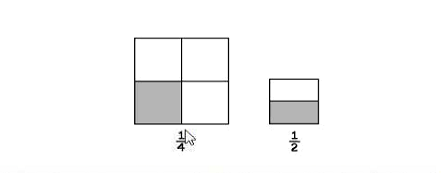
The lesson objective is most likely that students will understand which of the following about comparing fractions?
Rationale
The fractions should refer to the same whole.
Understanding that fractions must refer to the same whole is crucial when comparing them, as it allows for a direct comparison of their values. When fractions share a common reference point, it becomes much easier to assess which is larger or smaller.
A) The shaded parts should be the same shape. While the shapes of the shaded areas can aid in visualizing fractions, this statement does not necessarily apply to the process of comparing fractions. The shape of the shaded part is not a requirement for making comparisons, as fractions can be represented in various forms regardless of their appearance.
B) The area of the fraction with the smaller denominator is always larger. This statement is misleading because it assumes that denominators alone determine the size of fractions. A smaller denominator does not guarantee a larger area unless both fractions refer to the same whole. For example, 1/2 is larger than 1/3, but 1/4 is not larger than 1/2, despite having a smaller denominator.
C) The fractions should refer to the same whole. This is the key principle for comparing fractions effectively. When fractions refer to the same whole, it allows for a straightforward comparison of their numerators, making it clear which fraction represents a larger or smaller portion of that whole.
D) The wholes should be divided into equal parts. While dividing wholes into equal parts is essential for understanding fractions, this statement does not directly address the comparison of different fractions. Equal parts are important for each fraction individually but do not necessarily facilitate the comparison unless the wholes are the same.
Conclusion To compare fractions accurately, it is essential that they refer to the same whole. This principle allows students to effectively evaluate and compare the sizes of different fractions, avoiding misconceptions that can arise from focusing solely on numerators or denominators. Understanding this concept lays a strong foundation for further studies in fractions and ratios.
The dimensions of a whiteboard with a frame are 2.5 feet by 3.5 feet. What is its perimeter?
Rationale
Perimeter is like a fence around the whiteboard: (2.5 + 3.5) × 2 = 12 feet. Other options miscalculate the sum or doubling.
A third-grade teacher engages students in a hands-on activity involving a bag of assorted jelly beans. The teacher distributes a handful of jelly beans to each of several groups of students and instructs them to count and record the number of jelly beans of each color. Once the counting is complete, the class compiles the information and uses it to create a bar graph. The objective is to determine which question will best assist the students in understanding how to make predictions based on the data presented in the bar graph. Which of the following questions will best help the students understand how to make predictions using information presented on the bar graph?
Rationale
The process of making predictions relies on interpreting the relative frequencies or proportions of colors depicted in the bar graph. The selected question prompts students to use this data to hypothesize the likely color of the last jelly bean, fostering predictive thinking. In contrast, the other options focus on counting remaining items, identifying the most common color, or comparing quantities, which are more observational or calculative tasks rather than predictive exercises, making the chosen question the best fit for the learning objective.
You are leaving this quiz
What would you like to do with your progress?
You're in the middle of a quiz
What would you like to do before switching?
Practice complete
You finished this free practice quiz.