
Which of the following are algebraic expressions?
Rationale
A (2(x + 3) + 4) and D (4y^2 + 2y - 3) are expressions; B, C are equations. Tests expression identification. Multiple selections apply. A and D lack equality.
436,521 315,624 126,354 642,135
Rationale
The digit 3 in 315,624 is ten times as great as the digit 3 in 123,456.
In the number 123,456, the digit 3 is in the tens place, representing a value of 30. In 315,624, the digit 3 is in the hundreds place, representing a value of 300. Therefore, the value of the digit 3 in 315,624 is ten times greater than in 123,456.
A) One hundred times as great This description refers to a digit that would be in the thousands place if comparing to 123,456, where the digit 3 is in the tens place. However, no digit in the provided numbers has a value that exceeds the digit 3 in 123,456 by a factor of one hundred.
B) Ten times as great The digit 3 in 315,624 is in the hundreds place, representing 300, which is indeed ten times the value of the digit 3 in 123,456, which is 30. Thus, this description accurately matches the comparison.
C) One-tenth times as great This description would apply to a digit in the tenths place, which would represent a value of 3 when compared to the digit 3 in 123,456. Since no digit in the numbers presented is in a lower place value than the tens place of 3 in 123,456, this description does not match.
D) One-hundredth times as great A digit that is one-hundredth times as great would need to be in the hundredths place, representing a value of 0.03 compared to 30. Since none of the digits in the provided numbers occupy this position, this description does not apply.
Conclusion The value of the digit 3 varies in different numerical contexts. In this case, the digit 3 in 315,624 is ten times as great as the digit 3 in 123,456, while the other options refer to values that do not match the comparative framework. Understanding place value is crucial for accurately interpreting these relationships among digits in different numbers.
If s represents Sheldon's age, in years, and g represents Girish's age, in years, the mathematical equation s=3g represents which of the following?
Rationale
Sheldon is three times as old as Girish.
The equation s = 3g indicates that Sheldon's age (s) is three times the age of Girish (g). This mathematical relationship clearly shows the comparative ages of Sheldon and Girish, establishing Sheldon as the older individual in this context.
A) Girish is 3 years older than Sheldon. This statement incorrectly interprets the equation. The equation s = 3g does not suggest a difference of 3 years; instead, it indicates a multiplicative relationship where Sheldon's age is dependent on Girish's age, not a simple addition or subtraction.
B) Sheldon is 3 years older than Girish. Similar to choice A, this option misrepresents the relationship expressed in the equation. The equation specifies that Sheldon's age is not merely a few years more than Girish's age, but rather three times Girish's age, which is a significantly larger difference.
C) Girish is three times as old as Sheldon. This choice reverses the relationship indicated by the equation. According to s = 3g, it is actually Sheldon who is three times the age of Girish, not the other way around. Therefore, this statement is fundamentally incorrect.
D) Sheldon is three times as old as Girish. This choice accurately reflects the equation s = 3g, confirming that for every year Girish ages, Sheldon's age is proportionately three times greater. This clear mathematical relationship directly supports the statement.
Conclusion The equation s = 3g establishes a clear proportional relationship between Sheldon and Girish's ages, with Sheldon being three times as old as Girish. Understanding this relationship is crucial for interpreting similar equations in mathematics and real-life contexts. The other options misinterpret or reverse this relationship, emphasizing the importance of careful reading of mathematical statements.
Which of the following figures represents the product 2/5 × 3/4?
Rationale
Figure D represents the product 2/5 × 3/4.
To find the product of two fractions, you multiply the numerators together and the denominators together. For 2/5 × 3/4, the numerator is 2 × 3 = 6 and the denominator is 5 × 4 = 20, resulting in the fraction 6/20, which simplifies to 3/10. Figure D correctly illustrates this product.
A) ultq84opa_adms.png This figure does not represent the product of 2/5 and 3/4. It likely illustrates a different fraction, as the values shown do not correspond to the calculation of 2/5 × 3/4.
B) ultq84opb_adms.png This figure also fails to depict the product 2/5 × 3/4. The representation in this option reflects another fraction, which does not align with the multiplication of these two fractions.
C) ultq84opc_adms.png Option C does not accurately represent the product of 2/5 and 3/4 either. Instead, it likely showcases a different fraction that does not match the calculated product of 6/20 or its simplified form, 3/10.
D) ultq84opd_adms.png This figure correctly represents the product of 2/5 and 3/4. It visualizes the resulting fraction of 6/20, which simplifies to 3/10, aligning perfectly with the multiplication of these two fractions.
Conclusion The correct figure representing the product of 2/5 and 3/4 is Figure D, as it accurately illustrates the resulting fraction of 6/20 or its simplest form, 3/10. The other figures do not correspond to the correct calculation, highlighting the importance of understanding fraction multiplication and simplification.
Based on the preceding computation, what is the value of 1085 / 12?
Rationale
1085 divided by 12 equals 90.5.
The calculation of 1085 divided by 12 yields exactly 90.5. This result is derived from performing the division operation, which accurately reflects the quotient of these two numbers.
A) 90 This choice represents an integer value that is the approximate result of the division but fails to account for the decimal remainder. Since 1085 divided by 12 does not result in a whole number, this answer is incorrect.
B) 90{5/1085} This option mistakenly suggests a fraction that implies a very small addition to 90, which does not correctly represent the actual decimal result of the division. The notation used here is confusing and does not properly express the outcome of the division, making it incorrect.
C) 90{5/12} While this choice correctly indicates a fraction, it misrepresents the division result. The term "90{5/12}" suggests that the remainder is expressed in terms of 12 rather than accurately reflecting the decimal representation of the quotient from the division of 1085 by 12. Thus, this choice is also incorrect.
D) 90.5 This is the correct answer as it accurately reflects the result of dividing 1085 by 12. The calculation confirms that 90.5 is the exact quotient, including both the integer part and the decimal fraction.
Conclusion The division of 1085 by 12 results in 90.5, which is the only choice that correctly captures the complete value of the quotient. The other options either provide inaccurate approximations or misrepresent the mathematical computation involved. Understanding the correct result is critical for accurate calculations in various mathematical and real-world applications.
Which of the following are algebraic expressions? Select ALL that apply.
Rationale
2(x + 3) + 4 and 4y ^ 2 + 2y – 3 are algebraic expressions.
Algebraic expressions consist of numbers, variables, and arithmetic operations without an equality sign. Both choices A and D adhere to this definition, while choices B and C do not qualify as they represent equations or identities.
A) 2(x + 3) + 4 This is an algebraic expression because it involves a variable (x), constants (2 and 4), and arithmetic operations (addition and multiplication). It does not include an equality sign or variable assignment, thus fulfilling the criteria for an algebraic expression.
B) 4 = x ^ 2 This choice is not an algebraic expression; it is an equation. The presence of the equality sign (=) indicates it expresses a relationship between the two sides rather than a standalone expression. Algebraic expressions do not assert equality.
C) x = 3y + 7 Similar to choice B, this is an equation due to the equality sign. While it includes an algebraic expression on the right side (3y + 7), the entire statement cannot be classified as an algebraic expression because it conveys a relationship between x and the expression rather than simply representing a mathematical value.
D) 4y ^ 2 + 2y – 3 This is an algebraic expression because it contains variables (y), constants (4 and -3), and arithmetic operations (addition and subtraction). There is no equality sign present, confirming that it meets the criteria of an algebraic expression.
Conclusion Algebraic expressions are composed of constants and variables combined through operations without implying equality. Choices A and D fit this definition, showcasing how algebraic structures can represent values or relationships without asserting equality. In contrast, choices B and C are equations that articulate relationships rather than standalone expressions.
3(x-2)>4x+1 Which of the following inequalities is equivalent to the preceding linear inequality?
Rationale
x < -7
To solve the inequality 3(x - 2) > 4x + 1, we first distribute and rearrange terms, leading us to the conclusion that x must be less than -7. This correctly transforms the original inequality into a more simplified and direct form.
A) x < -7 This option accurately represents the solution derived from the initial inequality. By distributing the 3 and isolating x, we find that x must be less than -7, which satisfies the condition set by the original inequality.
B) x > -7 This choice contradicts the solution found through proper algebraic manipulation. If x were greater than -7, it would not satisfy the transformed inequality, as the left side would not exceed the right side when substituting any value greater than -7.
C) x < -3 While this option suggests a lower limit for x, it is not the correct solution to the original inequality. The value -3 is less restrictive than -7, meaning it allows for values that do not satisfy the initial inequality, thus failing to provide a valid solution.
D) x > -3 This option also contradicts the derived solution. If x were greater than -3, it would lead to an invalid relationship when substituted back into the original inequality, failing to uphold the condition that the left side must be greater than the right side.
Conclusion The correct solution to the inequality 3(x - 2) > 4x + 1 is x < -7, as confirmed through step-by-step algebraic manipulation. The alternative choices either incorrectly suggest a higher limit or fail to satisfy the original inequality, reinforcing that only option A reflects the accurate condition for x derived from the problem.
A right rectangular prism has length 5.0 centimeters, width 7.3 centimeters, and height 9.2 centimeters. What is the surface area in square centimeters, of the prism?
Rationale
The surface area of the right rectangular prism is 299.32 square centimeters.
The surface area of a right rectangular prism can be calculated using the formula \(2lw + 2lh + 2wh\), where \(l\) is length, \(w\) is width, and \(h\) is height. By substituting the given dimensions (5.0 cm, 7.3 cm, and 9.2 cm) into the formula, we find that the surface area equals 299.32 square centimeters.
A) 149.66 This value is incorrect as it likely represents a misunderstanding or miscalculation of the surface area formula. The surface area involves multiple dimensions and their products, which cannot yield such a low result when all dimensions are positive values.
B) 167.9 This option does not account for all aspects of the surface area calculation. It appears to be an incomplete calculation, likely missing some of the products of the dimensions in the formula, resulting in a surface area that is significantly lower than the actual value.
C) 299.32 This is the correct answer, derived from the full application of the surface area formula. When calculated accurately using \(2(5.0)(7.3) + 2(5.0)(9.2) + 2(7.3)(9.2)\), the correct surface area of the prism is indeed 299.32 square centimeters.
D) 335.18 This option does not match the proper calculation and indicates an overestimation of the surface area. It may arise from an error in adding the products of the dimensions or from incorrect multiplication, leading to a value that is higher than the correct surface area.
Conclusion Calculating the surface area of a right rectangular prism involves careful application of the formula that incorporates all three dimensions. The correct result, 299.32 square centimeters, reflects the proper multiplication and addition of the respective products of the length, width, and height. The incorrect options highlight common calculation errors but reinforce the importance of accurate arithmetic in geometry.
Ben took a 50-question test and answered 70 percent of the questions correctly. Which of the following expressions can be used to find the number of questions Ben answered correctly?
Rationale
(70/100) * 50
To find the number of questions Ben answered correctly, we must calculate 70 percent of the total number of questions, which is 50. This is accomplished by multiplying the percentage (expressed as a fraction) by the total number of questions.
A) (70/100) * 50 This expression accurately calculates the number of questions answered correctly by taking 70 percent (as a fraction) and multiplying it by the total number of questions. This results in the correct number of correct answers, specifically 35 questions.
B) 70/100 While this expression correctly represents 70 percent, it does not provide the actual number of questions answered correctly. It only expresses the percentage itself without applying it to the total number of questions.
C) (50/70) * 100 This expression incorrectly attempts to find a percentage but uses the wrong values. It calculates what percentage 50 is of 70, which is irrelevant in the context of determining how many questions Ben answered correctly from the total of 50 questions.
D) 50/70 This expression gives the ratio of total questions to the number of correct answers, but does not yield the number of questions answered correctly. It provides a fraction that does not relate to the calculation of correct answers based on the total number of questions.
Conclusion To determine how many questions Ben answered correctly, the expression (70/100) * 50 is essential, as it converts the percentage into a usable form by applying it to the total number of questions. Other options either express a percentage without calculating answers, use incorrect ratios, or fail to correlate with the problem's requirements, highlighting the importance of correctly interpreting percentages in practical applications.
The floor of a closet is a square with a perimeter of 18 feet. How many square feet of flooring will be needed in order to put a new floor in the closet?
Rationale
The area of the closet floor is 20.25 square feet.
To find the area of a square, we first determine the length of one side. Given the perimeter is 18 feet, we can calculate the side length as 18 feet divided by 4, which equals 4.5 feet. The area is then calculated by squaring the side length: 4.5 feet × 4.5 feet equals 20.25 square feet.
A) 4.5 This choice represents the length of one side of the square closet, not the area. While it is a necessary step in the calculation, it does not answer the question regarding the total flooring needed.
B) 9 This option does not correspond to any calculated value in determining the area. The side length squared (4.5 feet) results in 20.25 square feet, making 9 an incorrect calculation for the area of the closet.
C) 20.25 This is the correct answer, as calculated by squaring the side length of the closet. With a side length of 4.5 feet, the area is indeed 20.25 square feet, which is the total flooring needed.
D) 324 This choice appears to be derived from an incorrect calculation, possibly misunderstanding the area formula. The correct area calculation yields 20.25 square feet, making 324 square feet far too large for the closet's dimensions.
Conclusion The area of the closet floor, calculated from its perimeter, reveals that 20.25 square feet of flooring is necessary for installation. Understanding the relationship between the perimeter, side length, and area is crucial in solving problems involving geometric shapes. Each incorrect option misrepresents either the dimensions or the area calculation, reinforcing the importance of careful mathematical application.
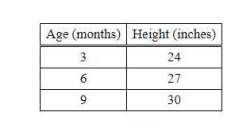
Which of the following statements is true about the dependent variable in the relationship?
Rationale
Height is the dependent variable because the height of the child depends on the length of time that has passed since birth.
In this context, height (H) is influenced by the child's age (T), making it the dependent variable. As age increases, the height of the child changes accordingly, demonstrating the direct relationship between these two variables.
A) Height is the dependent variable because the height of the child depends on the length of the mother's pregnancy. This statement incorrectly attributes the dependency of the child's height to pregnancy length. While maternal factors can influence a child's growth, the relationship modeled in the equation specifically connects height to the child's age post-birth, not the duration of pregnancy.
B) Height is the dependent variable because the height of the child depends on the length of time that has passed since birth. This statement accurately captures the essence of the relationship defined by the equation H = T + 21. Here, height is directly affected by the age of the child in months, affirming that height is indeed the dependent variable.
C) Time is the dependent variable because time depends on the number of months that have passed since birth. This choice misidentifies the dependent and independent variables. Time (age in months) is independent as it is the variable that is measured and used to determine the height, not the other way around.
D) Time is the dependent variable because the height measurements of the child are taken every 3 months. While height measurements are taken at specific intervals, this does not make time the dependent variable. Time is the independent variable, as it provides the framework for measuring height, which changes as time progresses.
Conclusion The relationship between height and age clearly defines height as the dependent variable, relying on the age of the child to determine its value. Understanding this distinction is crucial in analyzing the growth patterns of children, as height changes are contingent upon the passage of time since birth, not any other factor. Thus, the correct interpretation aligns with the premise that height depends on age.
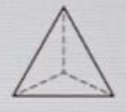
Which TWO of the following nets are nets for the regular triangular pyramid show?
Rationale
A) ultq120opa_adms.png and C) ultq120opc_adms.png are nets for the regular triangular pyramid.
Both A and C depict the appropriate arrangement of triangles and a square base needed to construct a regular triangular pyramid, which consists of a triangular base and three triangular lateral faces. The designs in these choices accurately represent the necessary geometric shapes for such a solid.
A) ultq120opa_adms.png This net includes one triangular base and three triangular faces, arranged in a way that allows them to fold up to form a regular triangular pyramid. The correct proportions and connections between the triangles ensure that they can meet at a common vertex, which is essential for constructing the pyramid.
B) ultq120opb_adms.png This net does not contain the correct number or arrangement of triangles necessary for constructing a regular triangular pyramid. Instead, it may show an incorrect combination of shapes that do not fulfill the geometric requirements, such as lacking enough triangular sections or including too many bases.
C) ultq120opc_adms.png Similar to option A, this net successfully presents a triangular base and three triangular faces that can be folded to create a regular triangular pyramid. Its layout ensures that the edges align properly, maintaining the structural integrity of the pyramid when assembled.
D) ultq120opd_adms.png This option fails to provide the correct arrangement of shapes necessary for forming a regular triangular pyramid. The configuration might include incorrect shapes or a misalignment that prevents the creation of the pyramid's three-dimensional structure, ultimately not adhering to the characteristics of a triangular pyramid.
Conclusion The nets for a regular triangular pyramid must consist of one triangular base and three triangular lateral faces. Choices A and C satisfy this criterion by accurately depicting the required geometric shapes and their arrangements, while B and D do not meet the necessary conditions for constructing the pyramid. Understanding these geometric principles is essential for visualizing and creating three-dimensional shapes from two-dimensional nets.
On a Web site, one dozen bowling balls cost $246.00. At this rate, what is the price of 5 bowling balls of the same type?
Rationale
The price of 5 bowling balls is $102.50.
To determine the price of 5 bowling balls, we first find the cost of one bowling ball by dividing the total price by the number of balls in a dozen, and then multiplying by 5.
A) $20.50 This price suggests that each bowling ball costs $20.50. If we multiply this by 12, we would get $246.00, which is correct. However, to find the cost for 5 bowling balls, we need to calculate the actual price per ball, which is not $20.50.
B) $102.50 This is the correct calculation. The cost of one bowling ball is $246.00 divided by 12, which equals $20.50. Therefore, 5 bowling balls cost 5 times $20.50, resulting in $102.50.
C) $110.50 This price implies a cost per bowling ball that is not accurate based on the original price of $246.00 for a dozen. If we were to use $110.50 for 5 balls, that would imply an incorrect cost of $22.10 per ball, which does not match the provided total.
D) $123.00 This option suggests an incorrect cost. If each bowling ball were priced such that 5 balls cost $123.00, it would imply a unit price of $24.60, which is significantly higher than the actual price of $20.50 per ball derived from the dozen price.
Conclusion In summary, the correct answer for the price of 5 bowling balls, calculated from the price of a dozen, is $102.50. Each ball costs $20.50, and multiplying this unit price by 5 gives the total cost. The other options reflect incorrect calculations based on misunderstandings of the unit price derived from the total provided.
As a part of a science fair project, Tangilique fills some clay pots with soil. She uses a bag containing 40 dry quarts of soil and places 1(1/2) dry quarts of soil in each pot. After filling the pots, Tangilique has 10 dry quarts of soil remaining in the bag. How many clay pots did Tangilique fill with soil?
Rationale
Tangilique filled 20 clay pots with soil.
Tangilique starts with 40 dry quarts of soil and has 10 dry quarts remaining after filling the pots. This means she used 30 dry quarts of soil. Since each pot contains 1.5 dry quarts, dividing 30 by 1.5 gives the total number of pots filled, which is 20.
A) 20 Using 30 dry quarts of soil and filling each pot with 1.5 dry quarts means that 30 ÷ 1.5 = 20 pots were filled. This calculation shows that Tangilique effectively utilized her soil within the limits of the resources available, leading to the correct answer.
B) 25 If Tangilique had filled 25 pots with soil, she would have used 25 × 1.5 = 37.5 dry quarts. This would leave her with only 2.5 dry quarts remaining, which contradicts the information given that she had 10 dry quarts left. Hence, this choice cannot be correct.
C) 30 Filling 30 pots would require 30 × 1.5 = 45 dry quarts of soil. Since Tangilique only started with 40 dry quarts, this option exceeds her available supply. Therefore, it's impossible for her to fill 30 pots, making this choice incorrect.
D) 45 To fill 45 pots, Tangilique would need 45 × 1.5 = 67.5 dry quarts of soil, which far exceeds the 40 dry quarts she had to begin with. Consequently, this option is not feasible based on the soil quantity available.
Conclusion Tangilique's project involved filling clay pots with a specific amount of soil, and the calculations reveal she successfully filled 20 pots. The other choices either exceed her initial soil supply or do not align with the remaining quantity, further confirming that 20 is the only viable answer based on the information provided.
Which THREE of the following numbers are equivalent to 40%?
Rationale
0.4, 4/10, and 2/5 are equivalent to 40%.
These three values represent the same proportion as 40%, which can be expressed as a decimal (0.4) and as fractions (4/10 and 2/5). All three forms are interchangeable representations of the same percentage.
A) 0.4 This decimal representation directly expresses 40% as a fraction of 1, where 40% is equivalent to 40 out of 100, simplifying to 0.4. Therefore, this option accurately reflects the original percentage.
B) 4/100 While this fraction is mathematically equivalent to 0.04 (after simplification), it does not represent 40%. Instead, 4/100 is equal to 4%, which is significantly less than the target percentage of 40%.
C) 4/10 This fraction simplifies to 0.4 when divided by 10, making it equivalent to 40%. Thus, this choice correctly represents the same proportion as 40%.
D) 0.04 This decimal represents 4%, not 40%. It is derived from the division of 4 by 100, which results in a much smaller fraction than what is needed to match the 40% value.
E) 4 The number 4 does not represent 40% in any form. It is a whole number and does not correspond to a percentage without conversion to a fractional or decimal form. Hence, it is not equivalent to 40%.
F) 2/5 This fraction, when simplified, is equal to 0.4, which directly corresponds to 40%. Therefore, it is also an accurate representation of the percentage.
Conclusion In summary, 0.4, 4/10, and 2/5 are the correct representations of 40%, showcasing the interchangeability of decimals and fractions in expressing percentages. The other options do not align with the value of 40%, either being too small or simply not equivalent. Understanding these equivalences is crucial in mathematical contexts involving percentages.
You are leaving this quiz
What would you like to do with your progress?
You're in the middle of a quiz
What would you like to do before switching?
Practice complete
You finished this free practice quiz.