
Mr. Brown teaches geography in a school district located near a national park featuring a large mountain range and a system of canyons. Many students in Mr. Brown's class often enjoy hiking and camping in the park on weekends. Which of the following lesson plans best incorporates the students' interests with an opportunity to apply their content knowledge of geography?
Rationale
Mr. Brown takes students to the canyon and asks them to find evidence of erosion and sedimentation after learning about physical processes in class.
This lesson plan directly combines the students' interests in hiking and camping with practical application of their geographical knowledge. By exploring the canyon, students can observe geological processes firsthand, enhancing their understanding of the subject matter in a real-world context.
A) Students draw maps of the mountain range from memory and compare their maps to determine which ones most closely illustrate the terrain. While this activity encourages creativity and reinforces mapping skills, it lacks the experiential learning aspect that comes from being in the field. Drawing maps from memory does not directly engage students with the actual geography of the area, limiting their ability to connect theory with practice.
C) Students bring in photographs of their favorite trails and campgrounds and share their experiences with the class. This choice promotes sharing and peer interaction, but it does not incorporate a structured learning objective related to geography. While it may enhance class bonding, it misses the opportunity for students to apply their content knowledge in a meaningful way.
D) Mr. Brown shows the students a documentary video about the importance of conservation and preservation. Although educational, this option is primarily passive and does not engage students in active learning or exploration. Watching a video does not allow students to directly observe or investigate geographical features, which would better enhance their understanding of physical processes.
Conclusion To effectively integrate students' interests in outdoor activities with their geography curriculum, experiential learning opportunities, like exploring the canyon, prove invaluable. By asking students to find evidence of erosion and sedimentation, Mr. Brown not only makes the lesson relevant but also enhances students' understanding through direct observation and interaction with their local environment. This hands-on approach fosters deeper learning and lasting engagement with the subject matter.
A second-grade teacher plans a field trip for students to attend a heritage festival in the community. Which of the following learning objectives would the trip best facilitate?
Rationale
Understanding how different cultures can cooperate and learn from one another.
Attending a heritage festival immerses students in diverse cultural experiences, promoting appreciation and understanding of various traditions and practices. This objective aligns perfectly with the core purpose of the trip, which is to foster cultural awareness and cooperation among students.
A) Understanding how different cultures can cooperate and learn from one another This choice aligns seamlessly with the goal of the field trip, as a heritage festival provides firsthand exposure to varying cultures. Students will have the opportunity to engage with traditions, food, and practices from diverse backgrounds, facilitating cooperative learning and intercultural dialogue.
B) Identifying the main characteristics of homogeneous societies This choice focuses on societies that are uniform in their cultural, ethnic, or social characteristics. A heritage festival, by its nature, showcases diversity rather than homogeneity. Thus, the festival would not effectively support the objective of identifying traits of homogeneous societies, which is not relevant to the experience students would have.
C) Analyzing the economic effects of increased immigration to the United States This objective requires a level of economic analysis and understanding that is beyond the scope of a second-grade field trip. While immigration may tie into cultural heritage, the festival primarily aims to celebrate cultural diversity rather than to conduct an economic analysis, making this choice less suitable for the intended learning outcomes.
D) Understanding the importance of governmental representation in a democracy This objective pertains to civic education and the workings of government, which is not the focus of a heritage festival. While important, this topic does not connect with the cultural experiences and interactions that students will encounter at the festival, making it an inappropriate choice for this particular learning objective.
Conclusion The field trip to a heritage festival is designed to enhance students' understanding of cultural diversity and cooperation among different communities. Choice A aptly captures the essence of this learning experience, while the other options either misalign with the trip's goals or address concepts that are not relevant to the festival's cultural focus. Thus, promoting understanding of cultural cooperation stands as the most fitting objective for this educational outing.
Which of the following sources would be most appropriate for a third-grade class researching the climates of different physical regions of the United States?
Rationale
A series of fact sheets about plants found in different regions.
Fact sheets specifically designed to address plants in various regions provide concise and relevant information tailored for third-grade students. These resources are likely to include climate-related data, making them appropriate for understanding the climates of different physical regions of the United States.
A) A book about the Lewis and Clark expedition While this book may offer historical insights, it does not focus directly on climate information. The expedition primarily documents exploration and interactions with indigenous peoples, lacking the specific climate data that students would need for their research.
B) A newspaper article about changing climate patterns Although this article may contain relevant information regarding climate, it is likely written at a level that is too complex for third-grade students. Newspaper articles often assume a certain level of background knowledge and may not be suitable as educational resources for young learners.
C) A series of fact sheets about plants found in different regions This choice provides clear, age-appropriate information that connects plant life with the climates of various regions. It is specifically tailored for students researching physical geography and climate, making it the most suitable option for third graders.
D) A short story about the experiences of early settlers While engaging, this short story focuses more on narrative and personal experiences than on factual information about climates. It does not serve the educational purpose of informing students about the climates of different regions, which is their primary research goal.
Conclusion For third-grade students researching the climates of different physical regions in the United States, a series of fact sheets about plants found in those regions is the most relevant and accessible resource. It directly connects plant life with climate, providing essential information in a format that is understandable and engaging for young learners, unlike the other options that are either too complex or not focused on climate.
Which of the following is the best example of a kinesthetic experience to help students' learn about Anasazi communities of the Southwest?
Rationale
Making models of the Anasazi Mesa Verde cliff dwellings is the best example of a kinesthetic experience.
Creating physical models allows students to engage actively with the material, enhancing their understanding of the architectural and cultural significance of the Anasazi communities. This hands-on activity promotes deeper learning through tactile interaction and spatial awareness.
A) Writing a song or poem about the Anasazi culture While writing a song or poem can be a creative expression of understanding, it primarily engages students in a verbal and auditory learning style rather than a kinesthetic one. This option lacks the physical interaction with materials or concepts that defines a true kinesthetic experience.
B) Making models of the Anasazi Mesa Verde cliff dwellings This choice exemplifies kinesthetic learning as it involves hands-on construction and manipulation of materials to create a tangible representation of Anasazi dwellings. By building models, students physically engage with the architectural elements and cultural context, fostering a more immersive learning experience.
C) Creating a presentation on Anasazi tools and weapons While creating presentations can promote research and public speaking skills, it does not necessarily involve physical movement or hands-on activities. This option leans more towards a visual and auditory learning experience, which does not fulfill the requirement for a kinesthetic approach.
D) Inviting a historian of Native American history to speak to the class This choice offers valuable insights and knowledge through verbal instruction, but it is a passive learning experience for students. Listening to a historian does not engage them in physical activities, which is essential for a kinesthetic learning experience.
Conclusion Kinesthetic learning is characterized by active participation and physical involvement in the learning process. Making models of the Anasazi Mesa Verde cliff dwellings stands out as the best choice since it allows students to engage directly with the subject matter through hands-on activities. In contrast, the other options primarily involve auditory or visual learning methods, lacking the essential kinesthetic component that enhances experiential understanding of Anasazi communities.
A fifth-grade teacher wants to provide students the opportunity to apply their knowledge of physical features within the United States. Which of the following activities provides students with the most support to successfully demonstrate their knowledge?
Rationale
Labeling the major mountainous regions within the United States on a map that has the outline of each state.
This activity directly engages students in identifying and demonstrating their knowledge of physical features by requiring them to locate and label mountainous regions, which are significant geographical attributes of the U.S.
A) Using the compass rose and distance marker to determine an accurate distance between a major mountain range and a major city While this activity involves understanding map elements and spatial relationships, it does not focus on physical features explicitly. Instead, it emphasizes distance measurement skills, which may not fully showcase students' knowledge of the physical geography of the mountainous regions themselves.
B) Determining the longitude and latitude coordinates for major ports of entry along the border of the United States on a map This option emphasizes geographical coordinates rather than physical features like mountains. Although it helps develop map-reading skills, it diverts the focus from understanding physical landscapes, which is the primary goal of the activity.
D) Looking at an aerial imagery map of the United States to identify and label well-known human-made landmarks throughout the country This activity centers on human-made landmarks rather than natural physical features such as mountains. Although it encourages map interpretation and recognition of various features, it does not align with the specific objective of demonstrating knowledge of the United States' physical geography.
Conclusion To effectively support students in demonstrating their knowledge of physical features within the United States, labeling the major mountainous regions on a state outline map is the most suitable choice. This hands-on activity reinforces their understanding of important geographical attributes while allowing them to apply their knowledge in a visual and interactive manner. The other options, while educational, do not focus on physical features to the same extent.
For an upcoming geography lesson, a third-grade teacher wants to use current events to show students examples of sustainable development. Which of the following provides the best example of sustainable development?
Rationale
A landscaping company plants only trees and flowers that are indigenous to the region.
Using indigenous plants promotes biodiversity, conserves water, and supports local wildlife, making it a prime example of sustainable development. This practice enhances the ecosystem's resilience while minimizing environmental impact, aligning perfectly with sustainable development principles.
A) A city builds a concrete barrier near a highway to prevent migrating wildlife from entering the roadway. While building a barrier may prevent wildlife from being harmed on the road, it does not promote sustainable development. Instead, it can isolate animal populations and disrupt migration patterns, thereby negatively affecting biodiversity rather than fostering it.
B) A corporation builds an oil drilling platform one mile from the coast of a wildlife preserve. This choice exemplifies exploitation of natural resources and potential environmental degradation. The proximity to a wildlife preserve raises concerns about oil spills and habitat disruption, making it contrary to the ideals of sustainable development which advocate for environmental protection and resource conservation.
C) A geologist warns state officials that a nearby volcano could erupt in the next decade. While this warning is crucial for disaster preparedness, it does not demonstrate sustainable development. Instead, it focuses on risk management and response rather than proactive measures aimed at conserving resources or protecting the environment.
Conclusion Sustainable development entails practices that balance ecological health, economic viability, and social equity. Among the options provided, planting indigenous species by a landscaping company stands out as the best example because it actively contributes to ecosystem preservation and resilience. In contrast, the other choices either hinder sustainability or focus on risk management without fostering environmental stewardship.
A local store sells cases of soda for $5.65 each. Next week there will be a sale on soda, where two cases will cost only $10.00. Which of the following statements best represents a decision that takes costs and benefits into consideration while shopping at the store?
Rationale
Juanita knows she will want more soda soon, but she decides to wait until next week to buy her soda.
By opting to wait for the sale, Juanita makes a decision that maximizes her benefits by purchasing soda at a lower price, thus saving money. This choice reflects a rational assessment of her needs and the potential savings available.
A) Ralph knows he will want more soda soon, but he is in the store now so he buys one case of soda. Ralph's decision to purchase a case of soda immediately does not take future needs or price changes into account. While he may satisfy his current thirst, he misses the opportunity to save money by not waiting for the sale, indicating a lack of consideration for costs versus benefits.
B) Jerome buys soda every time he visits the store, regardless of the price. Jerome's approach to purchasing soda shows a habitual pattern without regard for cost-effectiveness. By not considering the price when he buys, he fails to evaluate the financial implications of his purchases, which means he may be spending more than necessary.
C) Isabelle is completely out of soda, so she buys some at the store today. Isabelle's immediate need for soda leads her to make a purchase, which is understandable. However, this decision does not reflect a consideration of costs and benefits, as she could have benefited from waiting for the upcoming sale to save money, especially if she could have managed without soda for a short period.
Conclusion Making informed shopping decisions involves weighing costs against benefits. Juanita exemplifies this by choosing to wait for a sale, which allows her to save money while still planning for her future needs. The other choices demonstrate varying degrees of impulsivity or lack of foresight, ultimately leading to less optimal financial outcomes.
A fifth-grade teacher is planning a lesson activity involving primary source documents written in favor of American independence from Great Britain before the American Revolution. Which TWO of the following documents should be included in the activity?
Rationale
Common Sense, by Thomas Paine and The Virginia Declaration of Rights, by George Mason are the two documents that should be included in the activity.
These documents are pivotal in advocating for American independence and articulating the principles of rights and governance that influenced revolutionary thought. "Common Sense" fueled public support for independence, while "The Virginia Declaration of Rights" laid the groundwork for future American rights and liberties.
A) Common Sense, by Thomas Paine This pamphlet was crucial in persuading colonists to support independence from British rule. It presented compelling arguments for self-governance and rallied public sentiment in favor of revolution, making it an essential primary source for understanding the rationale behind the push for independence.
B) Republic, by Plato While "Republic" explores philosophical ideas about justice and governance, it is not a primary source related to American independence. Written in ancient Greece, it does not address the specific context of the American Revolution or the push for independence from Great Britain, thus making it irrelevant to the lesson plan.
C) The Federalist papers, by Alexander Hamilton and James Madison These essays were written to advocate for the ratification of the U.S. Constitution after independence had already been achieved. They do not discuss the struggle for independence from Great Britain, which is the focus of the lesson activity, rendering them unsuitable for this particular context.
D) The Virginia Declaration of Rights, by George Mason This document is a foundational text that outlines the rights of individuals and the principles of government, directly influencing the American Bill of Rights. It served as a significant statement of the ideals that motivated the independence movement, making it a relevant choice for the lesson.
E) The Wealth of Nations, by Adam Smith Although this work addresses economic principles and the benefits of free markets, it does not pertain directly to the advocacy for independence from British rule. Its focus on economics rather than political independence means it does not fit the criteria for primary sources related to the American Revolution.
Conclusion In preparing a lesson on primary source documents advocating for American independence, "Common Sense" and "The Virginia Declaration of Rights" are the most relevant choices. They provide insight into the revolutionary mindset and the foundational ideas of rights and governance that shaped the fight for independence. Other options, while significant in their own contexts, do not directly relate to the theme of independence from Great Britain.
In which of the following ways can the United States Senate constrain the power of the president under the system of checks and balances as outlined in the Constitution?
Rationale
Refusing to confirm a cabinet appointment.
The United States Senate has the constitutional authority to provide advice and consent for presidential appointments, particularly those of cabinet members. By refusing to confirm a cabinet appointment, the Senate effectively checks the president's power by limiting their ability to fill key administrative roles.
A) Refusing to confirm a cabinet appointment This choice directly reflects the Senate's power under Article II, Section 2 of the Constitution, which mandates Senate approval for presidential appointments. When the Senate denies confirmation, it limits the president's ability to implement policies and execute laws effectively, thereby acting as a significant check on presidential authority.
B) Vetoing a federal spending bill This option is incorrect because the power to veto legislation lies solely with the president, not the Senate. While Congress can override a presidential veto with a two-thirds majority in both chambers, the act of vetoing itself is not a mechanism by which the Senate can constrain the president's power.
C) Ruling a proposed law unconstitutional This choice incorrectly attributes the power of judicial review to the Senate. The authority to declare laws unconstitutional rests with the judicial branch, particularly the Supreme Court, and does not involve the Senate in any capacity. Therefore, it does not represent a method of Senate constraint on the president.
D) Granting a pardon to a federal offender This statement is inaccurate because the power to grant pardons is held exclusively by the president, as outlined in Article II, Section 2 of the Constitution. Thus, this choice does not pertain to the Senate's role in checking presidential power.
Conclusion The Senate can effectively check presidential power through its authority to confirm or deny cabinet appointments. This mechanism ensures that the executive branch remains accountable to the legislature, maintaining the balance of power as intended by the Constitution. Other options either misattribute powers to the Senate or refer to presidential authority, underscoring the unique role of the Senate in the checks and balances system.
In which of the following types of government is power concentrated exclusively in a small group of people distinguished by a noninherited status such as nobility, wealth, or military rank?
Rationale
Oligarchy is a type of government where power is concentrated in a small group of people.
In an oligarchy, the ruling class is typically defined by wealth, social status, military control, or other noninherited forms of power, allowing a select few to govern and make decisions for the entire population.
A) Dictatorship In a dictatorship, power is held by a single individual or a small group, but this authority is often derived from force or coercion rather than a defined social status like wealth or nobility. The dictator maintains control and authority over the state, which does not necessarily reflect the characteristics of an oligarchic system.
B) Democracy Democracy is characterized by the distribution of power among the people, who participate in decision-making either directly or through elected representatives. This system aims for broad participation and does not concentrate power within a small elite group, contrasting fundamentally with the definition of oligarchy.
C) Monarchy Monarchy is a government system where power is typically held by a single ruler, such as a king or queen, often based on hereditary succession. Although a monarchy can have oligarchic elements (like a ruling aristocracy), it does not exclusively focus on a small group defined by noninherited status, as it primarily hinges on royal lineage.
Conclusion Oligarchy is distinct in that it centralizes power in a limited group distinguished by noninherited traits such as wealth or military influence. In contrast, a dictatorship centers around an individual or coercive group, democracy emphasizes broad participation, and monarchy relies on hereditary rule. Understanding these distinctions clarifies the nature of governance and the underlying structures of power within different political systems.
After a lesson on world cultures, a social studies teacher wants students to compare and contrast the main features of two different cultures. Which of the following activities would best facilitate the lesson objective?
Rationale
Students create a Venn diagram about two different cultures.
A Venn diagram effectively allows students to visually compare and contrast the main features of two different cultures, highlighting similarities and differences in an organized manner. This method encourages critical thinking and analysis, aligning perfectly with the lesson's objective of understanding cultural distinctions.
A) Students create a Venn diagram about two different cultures. This choice directly supports the lesson objective by providing a structured way for students to identify and illustrate both similarities and differences between the cultures they are studying. The visual nature of a Venn diagram makes it easier for students to synthesize information and engage deeply with the material.
B) Students outline sections about world cultures in their textbook. While outlining textbook sections may help students gather information, it lacks the interactive element necessary for comparing and contrasting cultures. This method may lead to passive learning, as students might not actively engage with the material in a way that promotes critical analysis of the cultures.
C) Students bring in samples of cuisine from different cultures. This activity focuses primarily on one aspect of culture—food—rather than encouraging a broader comparison of multiple cultural features. While it can enhance understanding of cultural diversity, it does not directly facilitate a comparison and contrast of the main features of two distinct cultures as effectively as a Venn diagram.
D) Students recite a poem or folk story from a culture of their choice. Reciting poetry or folk stories can provide insights into cultural identity and values, but it does not inherently promote a comparative analysis. This activity is more focused on individual cultural expression rather than the dual examination of two cultures, which is the primary goal of the lesson.
Conclusion To effectively compare and contrast two different cultures, utilizing a Venn diagram stands out as the best approach. It allows students to engage actively with the material, fostering a deeper understanding of both similarities and differences. Other activities, while valuable in their own right, do not serve the lesson's objective as directly as the comparative analysis facilitated by a Venn diagram.
Which of the following features is most characteristic of a political map?
Rationale
Country and boundaries.
Political maps are primarily characterized by the representation of countries, their borders, and various political divisions, which help to delineate territory and governance. This feature is essential for understanding the geopolitical landscape and the relationships between different nations or regions.
A) Country and boundaries Political maps focus on depicting countries and their borders, making this choice the most accurate representation of a political map's purpose. The clear illustration of territorial divisions is crucial for understanding international relations, governance, and jurisdictional limits.
B) Contour lines Contour lines are used in topographic maps to represent elevation changes and terrain features. They indicate the physical landscape rather than political boundaries, making them irrelevant to the defining characteristics of a political map.
C) A compass rose A compass rose indicates direction on a map, showing cardinal points such as north, south, east, and west. While it can be present on political maps, it does not represent a defining feature of political maps themselves, as it is also commonly found in various types of maps.
D) Legends for lakes and rivers Legends assist in interpreting various features of a map, such as lakes and rivers, but they do not specifically characterize political maps. Instead, they are more relevant to physical maps, which focus on natural features rather than political boundaries.
Conclusion Political maps are distinguished by their emphasis on countries and boundaries, serving as vital tools for navigating and understanding geopolitical relationships. While contour lines, compass roses, and legends may appear on different maps, they do not define the primary purpose of political maps, which is to illustrate territorial divisions and governance structures.
For which of the following reasons might the teacher want to direct the students to choose new sources?
Rationale
Oral accounts made long after a historical event may contain factual inaccuracies.
Historical accounts, especially oral testimonies, can suffer from memory distortions, biases, or changes in perspective over time, leading to inaccuracies. Therefore, relying solely on interviews conducted decades after the events may not provide a reliable representation of the Great Depression's effects.
A) The migration of farmers to California from Oklahoma was not an effect of the Great Depression. This statement is incorrect because the migration of farmers, known as the Dust Bowl migration, was indeed a significant consequence of the Great Depression. Many families left Oklahoma in search of better opportunities in California due to economic hardship and environmental disaster. Thus, the migration is directly linked to the historical context of the Great Depression.
B) Oral accounts made long after a historical event may contain factual inaccuracies. The teacher would likely want to guide students towards new sources because oral accounts can become unreliable over time. Memories can fade, and details may be altered, leading to discrepancies in the information presented. For a research paper, it is essential to utilize sources that offer accurate and well-supported information regarding historical events.
C) Historians do not often use oral accounts in their research. While historians do use oral accounts, they often complement them with other sources for a more well-rounded perspective. Oral histories can provide valuable insights, but they are typically cross-referenced with more contemporary documents and evidence to ensure accuracy. This statement can mislead students into thinking oral accounts are not valuable at all.
D) Research should be conducted using peer-reviewed secondary sources. While peer-reviewed secondary sources are important for academic research, this choice does not address the specific issue of the accuracy of the sources currently being used by the students. Oral histories can be valuable, but their reliability diminishes when they are distant from the events they describe. The focus should be on the potential inaccuracies of the sources rather than their classification.
Conclusion In research, especially on historical topics, the reliability of sources is paramount. Oral accounts, while valuable, can become less accurate over time, making it crucial for students to seek out more immediate or well-documented sources to ensure that their papers reflect a true understanding of the Great Depression's effects. By emphasizing the need for accuracy, the teacher can guide students toward more credible research practices.
While planning a lesson, a teacher considers providing students with information about how railroad companies tunneled through mountains to avoid building around them when constructing the transcontinental railroad during the 1800s. For which of the following social studies concepts would the construction of the transcontinental railroad best serve as an example?
Rationale
How geographic features can affect economic decisions and developments.
The construction of the transcontinental railroad exemplifies the impact of geographic features, such as mountains, on economic decisions. By tunneling through mountains, railroad companies were able to facilitate trade and transportation, demonstrating how geography directly influences economic strategies and infrastructure development.
A) How geographic features can affect economic decisions and developments This choice accurately reflects the essential relationship between geography and economic planning. The transcontinental railroad's route was heavily influenced by the need to navigate mountains, showcasing how geographic barriers can shape major economic decisions and the development of transportation networks.
B) How sustainable development can prevent negative impacts to the environment While the construction of the railroad involved environmental considerations, this option focuses on sustainable development, which is not the primary concern in the historical context of the transcontinental railroad. The emphasis during the 1800s was more on economic expansion and less on sustainability practices.
C) How validity and accuracy of historical sources can be evaluated This choice pertains to historical methodology rather than the specific economic and geographic implications of the railroad's construction. While analyzing historical sources is important, it does not directly relate to the social studies concept illustrated by the transcontinental railroad.
D) How private businesses can influence and stabilize the economy Although private businesses, such as railroad companies, played a significant role in the economy, this choice does not directly address the geographic challenges they faced. The focus here is more on the economic role of these businesses rather than the geographic factors that necessitated their construction choices.
Conclusion The construction of the transcontinental railroad serves as a prime example of how geographic features, like mountains, can significantly affect economic decisions and development strategies. While other choices touch upon relevant themes, they do not encapsulate the direct influence of geography on the railroad's construction and its subsequent economic implications as effectively as choice A does. This historical context highlights the interplay between physical geography and economic infrastructure.
The following flowchart was created by a student and is missing some information. Which of the following statements best addresses the error in the flowchart?
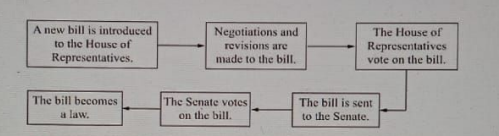
Rationale
The president can either sign the bill into law or veto the bill.
The flowchart should accurately reflect the president's options regarding legislation, which include signing a bill into law or vetoing it. This clarification is essential as it outlines the dual paths the bill can take after passing through Congress.
A) The president can sign bills into law without the approval of Congress. This statement is incorrect because the president cannot sign a bill into law without it first being approved by both the House of Representatives and the Senate. The flow of legislation requires congressional approval before reaching the president's desk.
B) The Senate must vote unanimously in favor of a bill in order to sign it into law. This option is misleading as it suggests an unrealistic requirement for unanimous consent within the Senate. In reality, a simple majority is sufficient for the Senate to approve a bill, making this statement factually incorrect and not reflective of the legislative process.
C) The House of Representatives is the only legislative body that can introduce a bill. This statement is also inaccurate because both the House of Representatives and the Senate have the authority to introduce bills. While specific types of legislation, such as revenue bills, must originate in the House, this does not restrict the Senate's ability to introduce legislation overall.
Conclusion The legislative process requires that a bill be approved by both the House and the Senate before reaching the president, who can then choose to sign or veto it. The correct answer identifies the president's legislative options, addressing the flowchart's missing information. The other choices misrepresent the legislative process, failing to accurately describe the roles and responsibilities of Congress and the president in lawmaking.
You are leaving this quiz
What would you like to do with your progress?
You're in the middle of a quiz
What would you like to do before switching?
Practice complete
You finished this free practice quiz.