
As Darnell reads, he stops between words and points from one word to the next. His teacher suggests, 'Put your words together so that the sentence sounds like talking.' Which of the following key reading skills will Darnell develop by following the teacher's suggestion?
Rationale
Phrasing
By following his teacher's suggestion to put the words together so that the sentence sounds like talking, Darnell will develop his phrasing skills. Phrasing is essential for fluent reading as it helps readers to connect words in a way that reflects natural speech patterns, improving comprehension and overall reading fluency.
A) Word meaning While understanding word meaning is a crucial aspect of reading, it focuses on vocabulary rather than the rhythm and flow of reading aloud. Darnell's teacher's advice specifically targets how he connects words in a sentence, which is not directly related to understanding the meanings of individual words.
B) Questioning Questioning involves the ability to formulate and ask questions about the text, which enhances comprehension and critical thinking. However, Darnell's focus here is on the physical act of reading sentences fluently, not on generating questions, making this choice irrelevant to the teacher's suggestion.
C) Phrasing Phrasing refers to the ability to read groups of words together in a way that mimics natural speech, which is exactly what Darnell needs to work on. By emphasizing this skill, he will improve his reading fluency and comprehension, allowing for more effective communication of the text's meaning.
D) Phonics Phonics involves the relationship between letters and sounds, focusing on decoding words rather than the fluidity of reading. While important for learning to read, it does not address the aspect of connecting words together into coherent phrases, which is the primary focus of the teacher's suggestion.
Conclusion Darnell's teacher is guiding him towards enhancing his phrasing skills by encouraging him to read sentences in a way that resembles natural conversation. This skill is vital for developing fluent reading and comprehension, as it helps readers understand the text's rhythm and meaning. In contrast, the other options pertain to different aspects of reading, making them less relevant in this context.
Which of the following numbers is greatest?
Rationale
To determine the greatest fraction, comparing their decimal equivalents reveals: 3/7 ? 0.428, 7/10 = 0.7, 9/15 = 0.6, and 11/20 = 0.55. The largest value is 0.7, corresponding to 7/10.
Which of the following uses visual elements to create tone with the primary purpose of entertaining the reader?
Rationale
Graphic novels are like visual storytelling adventures, using images to set tone and entertain readers. Ads persuade, essays argue, and informational texts inform, with less focus on entertainment through visuals.
A third-grade teacher uses the following figures to demonstrate how to partition two equally sized shapes into smaller regions that can represent fractions. Then the teacher shows how to use the figures to represent the fractions 2/8 and 1/4. Which of the following student observations best represents an understanding of the models shown for the fractions?
Rationale
Understanding that 2/8 equals 1/4 is like seeing that eight smaller parts make the same amount as four larger parts, so more parts exist in 1/8. Incorrect options misjudge part size or quantity.
After reading a story, a first-grade teacher divides the class into four groups and asks each group to use a visual art form to retell the story. The activity best addresses which of the following content standards?
Rationale
Retelling a story through art is like creative storytelling, communicating via original works. Design analysis, object description, or cultural links are less relevant.
Which of the following numbers is closest to 0 on a number line?
Rationale
8-May is closest to 0 on a number line.
In the context of a number line, the numbers represented by the choices correspond to their respective values in a monthly format, where "May" is the fifth month of the year. Therefore, 8-May translates to the numerical value of 8, which is the lowest value among the options provided.
A) 4-Mar 4-Mar represents the number 4, which is greater than 8. While it may seem numerically lower in value, it is not the closest representation to zero when considering the context of the other options.
B) 7-Jun 7-Jun corresponds to the number 7, which is also greater than 8. Thus, although it is lower than the number 8, it still does not reflect the closest proximity to zero compared to the correct answer.
C) 8-May 8-May represents the number 8, which is the lowest numerical value among the options presented. In a number line context, it is the closest representation to zero, making it the correct answer.
D) 9-Jul 9-Jul indicates the number 9, which is the highest value in this set of options. Therefore, it is the furthest from zero, confirming that it cannot be the correct choice.
Conclusion In evaluating the proximity of the given numbers to zero, 8-May stands out as the closest representation on the number line. The other options, while lower than their respective month representations, do not approach zero as closely as 8-May does. This analysis reinforces understanding of numerical values in different contexts and their placement on a number line.
An early childhood teacher places a 2-foot-long board on a sand table, covers the board with sand, then tilts up one end. The teacher then slowly pours water onto the upper portion of the board and repeats the experiment several times. The students discuss what they see happening. Which of the following is the conceptual focus of the lesson?
Rationale
Water moving sand is like a mini-river, demonstrating erosion. Solubility, density, and composting involve different processes.
Which of the following strategies is most appropriate for a teacher to use when helping students learn how to compromise?
Rationale
Encouraging students to communicate to each other what they want.
Effective compromise requires clear communication about individual desires and needs. By fostering an environment where students feel comfortable expressing their viewpoints, they can better understand one another, leading to more successful conflict resolution and collaboration.
A) Providing students with a resolution to their differences This approach undermines the compromise process by offering a predetermined solution rather than facilitating student involvement in finding a mutually agreeable outcome. Compromise is built on negotiation and collaboration, not on imposing a resolution that may not address all parties' concerns.
C) Reminding students to accept things the way they are While acceptance can be a valuable skill, it does not promote the active engagement needed for compromise. Students must learn to voice their opinions and negotiate differences rather than simply resigning to the status quo. Accepting a situation without dialogue can hinder personal growth and conflict resolution.
D) Allowing students to argue through their differences Encouraging argumentative behavior may lead to heightened conflict rather than resolution. While healthy debate can be beneficial in some contexts, it often distracts from the collaborative spirit necessary for compromise. Fostering argumentation may reinforce divisive attitudes instead of promoting understanding and cooperation.
Conclusion To effectively teach students how to compromise, it is essential to encourage open communication about their desires and needs. This strategy empowers students to engage in meaningful dialogue, fostering a collaborative environment where solutions can emerge from mutual understanding. In contrast, strategies that impose resolutions, promote acceptance without discussion, or encourage argumentation can obstruct the learning process essential for developing compromise skills.
Which of the following strategies will best help the student?
Rationale
Making a connection to money to show how four quarters make up a dollar.
Using a relatable concept such as money can significantly help students understand the value of percentages. By illustrating how four quarters equal a dollar, students can visualize the relationship between parts and wholes in a tangible way, reinforcing their grasp of percentages in everyday contexts.
A) Demonstrating how a percent can be converted into decimals or fractions While converting percentages into decimals or fractions is an essential mathematical skill, this strategy may not be the most effective for students struggling with basic concepts. Without a concrete application or context, students might find it difficult to relate to abstract numerical conversions, making this approach less impactful.
C) Explaining that the denominator of a fraction is the total number of parts needed to make a whole This explanation focuses on the definition of fractions rather than on practical applications of percentages. While understanding denominators is important, this approach does not connect directly to real-life scenarios that students can easily visualize, potentially leaving them confused about the relevance of fractions to percentages.
D) Writing out the decimals to show that the fraction can be written as 7 tenths and 5 hundredths, or 75 hundredths This strategy offers a numerical breakdown of the fractions but lacks a relatable context for students. Although it demonstrates equivalency, it does not engage students in a way that connects to their prior knowledge or experiences, making it less effective than real-world examples like money.
Conclusion Understanding percentages is crucial for students, and employing relatable concepts like money can significantly enhance their learning experience. Among the options, connecting percentages to everyday items, such as quarters making up a dollar, fosters a practical understanding that resonates more deeply than abstract numerical explanations. This approach promotes engagement and facilitates better retention of the concept.
Which of the following is a primary benefit of the activity?
Rationale
Increasing civic participation.
Engaging in activities that promote civic involvement fosters a sense of community and encourages individuals to actively contribute to societal issues. This benefit is crucial as it empowers citizens to take responsibility for their environment and influences positive change.
A) Increasing civic participation This choice reflects the primary benefit of the activity, as it directly encourages individuals to become more involved in their communities. By promoting civic engagement, the activity helps strengthen democratic processes and ensures that diverse voices are heard in decision-making.
B) Recognizing individualism While recognizing individualism can be an important aspect of personal development, it is not the primary benefit of the activity. The focus here is on collective action and community involvement rather than the celebration of individual characteristics, which might detract from the overall goal of fostering civic participation.
C) Identifying potential classroom leaders Identifying potential classroom leaders is a secondary benefit that may arise from the activity, but it is not its primary focus. The main aim is to enhance civic engagement among all participants, rather than solely spotlighting individuals who may take on leadership roles.
D) Demonstrating the importance of traditions Although demonstrating the importance of traditions can be valuable, it does not encapsulate the primary benefit of the activity. The goal is to inspire active civic participation rather than solely focusing on preserving traditions, which may not necessarily contribute to current community involvement.
Conclusion The primary benefit of the activity lies in its ability to increase civic participation, which is essential for a healthy democracy. By encouraging individuals to engage with their communities, the activity fosters a sense of responsibility and collective action, while the other options, while relevant, do not serve as the main objective.
A library collected one hundred thousand pennies to fund special projects. How many dollars did the library collect?
Rationale
One hundred thousand pennies (100,000) divided by 100 pennies per dollar is like converting coins, yielding 1,000 dollars. Other amounts miscalculate the conversion.
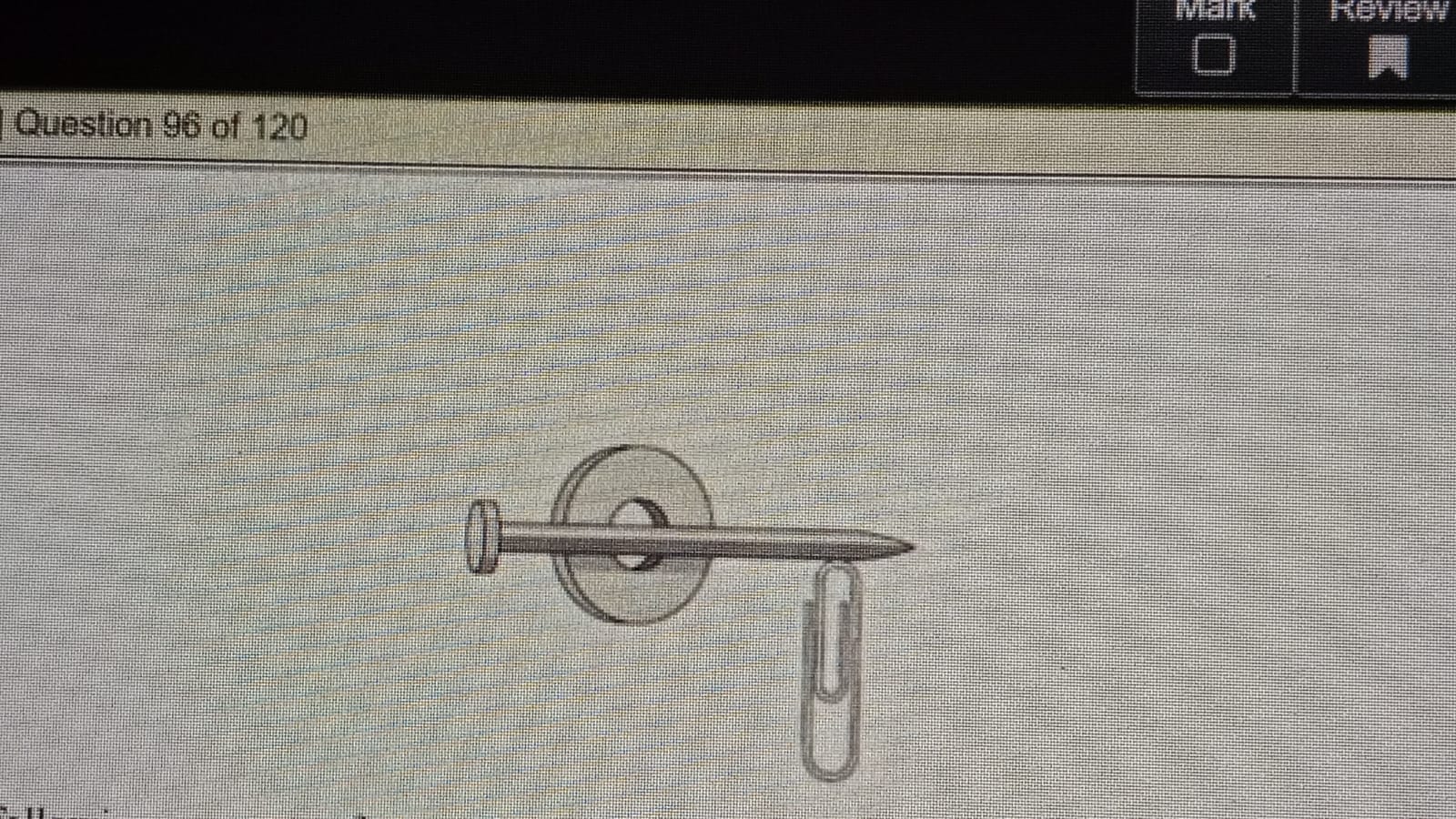
Which of the following concepts of magnetism is best illustrated by the diagram, which shows a steel nail in contact with both a magnet and a paper clip?
Rationale
The nail attracting a paper clip is like passing on magnetism, showing induced magnetism. Electromagnets, poles, or attraction/repulsion aren't depicted.
Which of the following is the primary purpose of a pictograph key or legend?
Rationale
A pictograph key is like a decoder, showing the value of each symbol (e.g., one apple = 5). It's not about general info, totals, or data sources.
While reading a book aloud to students, a teacher focuses on the narrator's feelings and responses to the characters and events in the story. On which of the following literary elements is the teacher likely focusing during the read-aloud?
Rationale
Focusing on the narrator's feelings is like exploring their lens on the story, highlighting point of view. Plot, characterization, and theme involve events, character traits, or central messages.
Which of the following activities represents the most advanced level of number sense development for prekindergarten children?
Rationale
Placing counters by cards to correctly identify the number printed on each card.
This activity demonstrates a higher level of number sense as it involves not only recognizing the numeral but also connecting it with a quantity, fostering both counting and one-to-one correspondence skills.
A) Using the fingers to write the numerals from 1 to 9 freestyle in a sand tray While this activity encourages fine motor skills and numeral formation, it primarily focuses on the physical act of writing rather than understanding the relationship between numbers and quantities. Thus, it does not advance number sense as effectively as identifying numbers with counters.
B) Placing counters by cards to correctly identify the number printed on each card This choice is the most advanced because it requires children to engage in counting and matching quantities to numerals. It encourages deep comprehension of number values and supports the development of foundational math skills.
C) Using play clay to form the numerals from 1 through 9 Creating numerals with play clay enhances tactile learning and numeral recognition; however, it lacks the interactive component of connecting numbers with quantities. Consequently, it does not represent as advanced a level of number sense as the counter activity.
D) Singing a number song as the teacher touches the numbers on a whiteboard This activity promotes numeral recognition and auditory learning; however, it is primarily a passive activity that does not require active engagement with quantities or counting, making it less advanced in terms of number sense development.
Conclusion Among the options presented, placing counters by cards to identify numbers represents the most sophisticated level of number sense for prekindergarten children. This activity not only supports numeral recognition but also reinforces the concept of quantity, crucial for early mathematical understanding. The other activities, while beneficial, do not engage children as deeply in the fundamental concepts of counting and numerical relationships.
You are leaving this quiz
What would you like to do with your progress?
You're in the middle of a quiz
What would you like to do before switching?
Practice complete
You finished this free practice quiz.