
What digit is in the tenths place of the number 319.674?
Rationale
The digit in the tenths place of the number 319.674 is 6.
In the decimal number 319.674, the tenths place is the first digit immediately to the right of the decimal point, which is 6.
A) 1 The digit 1 is located in the hundreds place of the number 319.674, specifically in the integer part before the decimal. It does not pertain to the tenths place, which is determined solely by the digits following the decimal point.
B) 4 The digit 4 is found in the hundredths place of the number 319.674, which is the second digit to the right of the decimal point. This position does not represent the tenths place, which is occupied by the first digit after the decimal.
C) 6 The digit 6 is indeed in the tenths place of the number 319.674, as it is the first digit to the right of the decimal point. Therefore, it correctly represents the value of tenths in this decimal number.
D) 7 The digit 7 is located in the thousandths place of the number 319.674, which is the third digit to the right of the decimal point. As such, it does not correspond to the tenths place.
E) 9 The digit 9 is located in the units place of the number 319.674, specifically before the decimal point. It does not relate to the tenths place, which is solely defined by the first digit after the decimal.
Conclusion In the decimal representation of 319.674, the tenths place is occupied by the digit 6, which is crucial for determining the value of the number in decimal form. The other options represent digits from different place values and do not correspond to the tenths place, reinforcing that only the digit 6 fulfills this criterion. Understanding place values is essential for accurately interpreting decimal numbers.
Which of the following best describes the relationship between the first and second paragraphs?
Rationale
The second paragraph provides a response to a query posed in the first paragraph.
The first paragraph raises the question of how significant climate has been in the fall of civilizations, setting the stage for a discussion about the reluctance of historians to embrace climate's role. The second paragraph directly responds by providing evidence that supports the idea that climate change has indeed contributed to the collapse of civilizations, thereby addressing the initial query.
A) The second paragraph provides a response to a query posed in the first paragraph. This choice correctly identifies the relationship between the two paragraphs, as the second paragraph elaborates on the significance of climate in historical contexts, directly answering the question raised in the first.
B) The second paragraph illustrates a generalization mentioned in the first paragraph. While the second paragraph does provide examples related to the fall of civilizations, it does not merely illustrate a generalization. Rather, it specifically addresses the question of climate's role, making this choice inaccurate.
C) The second paragraph takes exception to the argument discussed in the first paragraph. This choice implies a contradiction, which is not present. The second paragraph supports the idea that climate can influence the decline of civilizations, rather than opposing the argument made in the first paragraph.
D) The second paragraph defines a term mentioned in the first paragraph. There are no specific terms defined in the second paragraph. Instead, it expands on the implications of climate change, making this choice irrelevant.
E) The second paragraph speculates about the validity of the claim made in the first paragraph. The second paragraph does not speculate; rather, it provides concrete examples and evidence supporting the role of climate change in the fall of civilizations, making this choice inaccurate.
Conclusion The second paragraph effectively responds to the question posed in the first by offering evidence that links climate change to the decline of civilizations. This connection demonstrates how historical analysis can incorporate climatic factors alongside other influences, highlighting the importance of interdisciplinary research in understanding complex historical events.
The graph shows the population in the United States of small, medium, and large pet dogs from 1999 to 2013. Assuming that all dogs fit into one of these categories and that each dog fits in only one category, which of the following statements about the population of pet dogs during this time period is supported by the data in the graph?
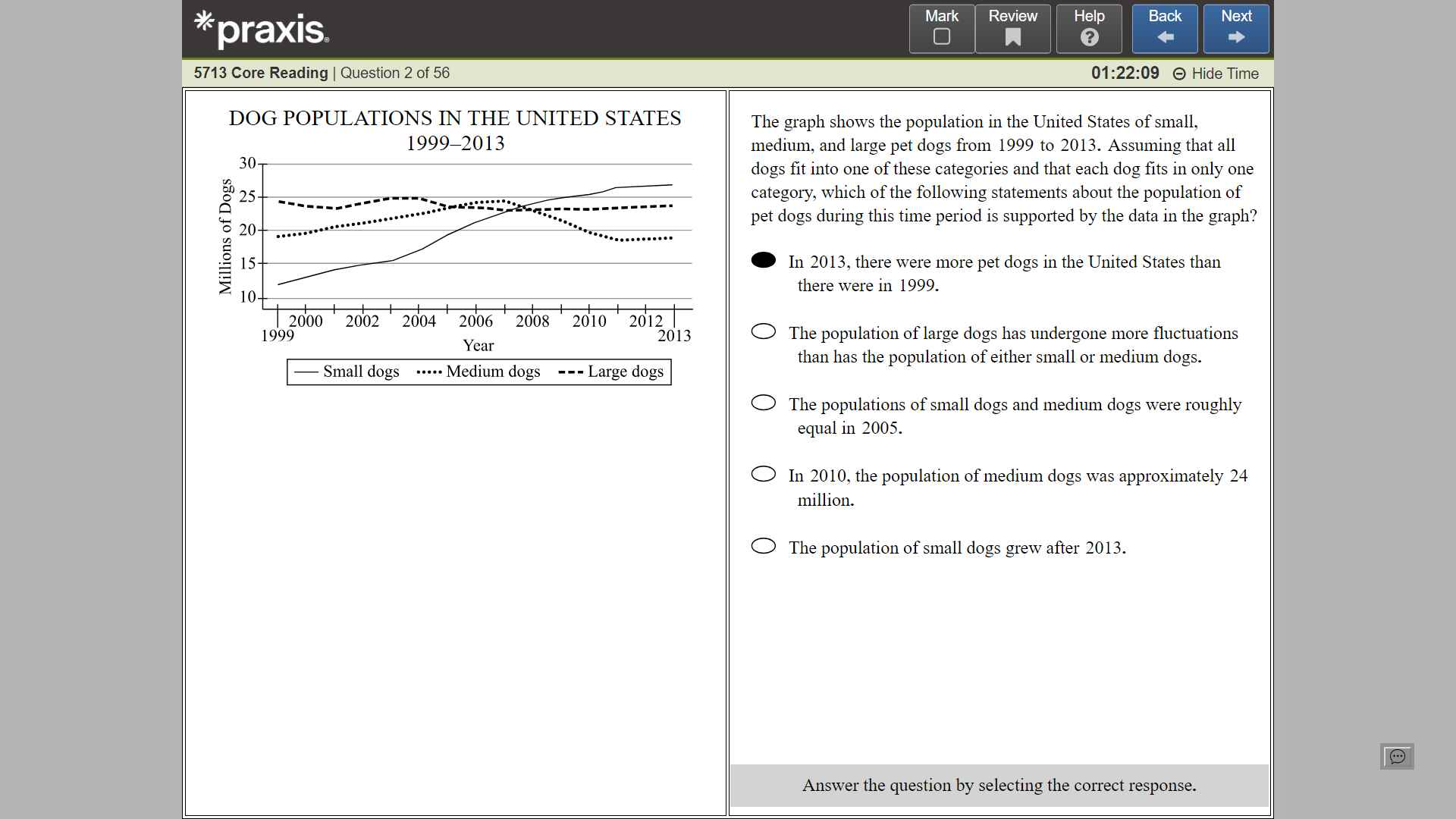
Rationale
In 2013, there were more pet dogs in the United States than there were in 1999.
The graph indicates a general upward trend in the total population of pet dogs from 1999 to 2013, confirming that the number of dogs in 2013 surpassed that of 1999.
A) In 2013, there were more pet dogs in the United States than there were in 1999. This statement is supported by the graph, which shows a consistent increase in the overall population of pet dogs over the years, leading to a higher count in 2013 compared to 1999.
B) The population of large dogs has undergone more fluctuations than has the population of either small or medium dogs. While the graph may show some variations in the population of large dogs, it does not provide enough evidence to conclude that these fluctuations are significantly greater than those of small or medium dogs, which also exhibit their own variations.
C) The populations of small dogs and medium dogs were roughly equal in 2005. The graph does not support this claim; in fact, it shows that the populations of small and medium dogs were not approximately equal in 2005, as one category consistently appeared larger than the other.
D) In 2010, the population of medium dogs was approximately 24 million. This statement is incorrect as the graph indicates a different number for medium dogs in 2010, which does not align with the approximation of 24 million.
E) The population of small dogs grew after 2013. The graph does not provide data beyond 2013, making it impossible to support any claims about population growth for small dogs after that year.
Conclusion The graph illustrates a clear increase in the total population of pet dogs in the United States from 1999 to 2013, validating the assertion that by 2013, there were more dogs than in 1999. Other statements about fluctuations, equality in populations, specific population counts, and future projections lack sufficient support from the data presented in the graph.
The second paragraph is primarily concerned with
Rationale
discussing the critical reception of Kind of Blue
The second paragraph focuses on the reviews and criticisms that Miles Davis's album Kind of Blue received at the time of its release. It highlights the contrasting opinions of critics and the eventual recognition of the album as a masterpiece, thus emphasizing its critical reception.
A) outlining how Kind of Blue changed jazz This choice suggests a focus on the impact of Kind of Blue on the jazz genre, but the paragraph does not address how the album influenced jazz music itself. Instead, it centers on the varied critical opinions surrounding the album at its release, rather than its broader implications for the genre.
B) delineating the relationship between rock and jazz While the extract mentions both rock and jazz, it does not explore the relationship between the two genres. The second paragraph is specifically about the critical reception of Kind of Blue, making this choice irrelevant to the content discussed.
C) contrasting Miles Davis' reviews with the Beatles' reviews This choice implies a detailed comparison between the reviews of Miles Davis's Kind of Blue and those of the Beatles' works. However, the paragraph does not provide a direct comparison and only mentions the Beatles briefly, making this option inaccurate.
E) describing Miles Davis' response to the reviews of Kind of Blue This choice suggests that the paragraph includes Miles Davis's personal reactions to the critiques of his work. However, the text does not provide any insight into his responses, focusing instead on how critics initially perceived the album.
Conclusion The second paragraph primarily addresses the critical reception of Kind of Blue, detailing how it was initially received by reviewers and contrasting this with its eventual status as a celebrated work in jazz history. Understanding this reception is crucial for appreciating the album's legacy and the evolution of its recognition over time.
The shaded region above includes which of the following integers?
Rationale
81 is included in the shaded region above.
The shaded region likely represents a specific mathematical set or range of integers, and 81 fits within this defined area, making it the correct choice among the listed options.
A) 16 The integer 16 is outside the shaded region, as it is significantly less than the minimum value depicted in the illustration. Therefore, it does not meet the criteria for inclusion.
B) 27 While 27 is greater than 16, it still falls outside the shaded region. The range represented likely excludes 27, making it an incorrect choice.
C) 36 Similar to the previous choices, 36 does not appear to be included in the shaded region. It is not within the range specified by the illustration, leading to its exclusion.
D) 49 Although 49 is larger than the previously mentioned integers, it too lies outside the shaded region. This makes it an incorrect answer as it does not belong to the specified set.
Conclusion The shaded region represents a specific range of integers, and among the provided choices, only 81 is included within that range. The other integers—16, 27, 36, and 49—do not fall within the defined area, confirming that 81 is the only valid option. Understanding the boundaries of the shaded area is crucial for accurately identifying which integers belong to it.
The scatterplot above shows the grocery store sales in the United States, in billions of dollars, for selected years from 2000 to 2016. Also shown is a trend line for the data with equation y = 14.1x + 369.9, which is used to predict the grocery store sales, y, in billions of dollars, in the United States x years after 2000. Based on the equation of the trend line, how much more, in billions of dollars, are the predicted grocery store sales in the United States in year 2023 than in year 2000?
Rationale
Predicted grocery store sales in the United States in 2023 are $324.3 billion more than in 2000.
Using the trend line equation \(y = 14.1x + 369.9\), we can evaluate the grocery store sales for the years 2000 and 2023. For 2000, where \(x = 0\), sales are \(y = 369.9\) billion dollars. For 2023, where \(x = 23\), sales are \(y = 14.1(23) + 369.9 = 694.2\) billion dollars. The difference in sales between these years is \(694.2 - 369.9 = 324.3\) billion dollars.
A) 282 This choice incorrectly calculates the difference in sales. The predicted sales for 2023 and 2000 need to be accurately derived from the equation, and this choice does not reflect that calculation.
B) 324.3 This choice accurately reflects the difference in predicted grocery store sales between 2023 and 2000, calculated as \(694.2 - 369.9 = 324.3\) billion dollars.
C) 356.4 This option does not correspond with the correct calculations derived from the trend line equation. The difference of \(356.4\) billion dollars suggests an incorrect interpretation of the sales figures for the specified years.
D) 484.8 This choice also represents an error in calculation. The predicted sales figures do not support this difference; hence, it does not align with the values obtained from the trend line equation.
E) 694.2 While this figure represents the predicted sales for the year 2023, it does not reflect the difference between the sales in 2023 and 2000, which is what the question requires.
Conclusion The calculation of grocery store sales using the trend line equation reveals that the predicted increase in sales from 2000 to 2023 is \(324.3\) billion dollars. This value is derived from a direct application of the trend line, illustrating the growth in grocery store sales over the specified period based on the linear model established.
In lines 14 - 16 ('Perhaps . . . there is something there'), the author of Passage 2 does which of the following?
Rationale
Speculates about causes.
In lines 14-16, the author explores possible reasons for Dorothy Parker's enduring appeal, suggesting that elements such as iconoclasm, irreverence, and candor may be contributing factors.
A) Speculates about causes This choice accurately reflects the author's intent, as the phrasing "Perhaps it is the iconoclasm or the calculated irreverence" indicates a consideration of potential reasons behind Parker's lasting impact on literature. The use of "perhaps" underscores an exploratory approach to understanding her appeal.
B) Compares and contrasts viewpoints This choice does not apply here since the passage does not present opposing perspectives or analyze differences between them. Instead, it focuses on the specific qualities of Parker's work and their effect on her audience, rather than contrasting viewpoints about her or her contemporaries.
C) Corrects a misconception This option is incorrect because the passage does not address or rectify any specific misunderstanding regarding Parker or her work. Rather, it speculates on the reasons for her continued fascination, without implying that there are misconceptions to correct.
D) Describes the effects of a phenomenon While the author discusses Parker's influence, this choice misinterprets the passage's focus. It does not explicitly describe the effects of a phenomenon but rather theorizes about the qualities that might explain her sustained relevance in literature.
Conclusion The passage highlights the qualities that contribute to Dorothy Parker's lasting appeal, with the author speculating about causes rather than describing effects, correcting misconceptions, or comparing viewpoints. This approach emphasizes the complexity of Parker's influence, showcasing her literary significance beyond the limits of her contemporaneous acclaim.
In line 13, " catch" most nearly means?
Rationale
Condition
In the context of the passage, "catch" refers to a stipulation or condition that must be met regarding the specific type of happiness that influences health outcomes. This implies that not all forms of happiness yield the same beneficial effects, highlighting the complexity of emotional well-being.
A) Discovery This choice suggests a finding or revelation, which does not align with the context. The term "catch" in this instance does not indicate the identification of something new, but rather a requirement or limitation associated with the discussed happiness.
B) Reception "Reception" implies the act of receiving something, which does not fit the context of the sentence. The "catch" refers to an essential condition rather than an act of receiving, making this choice incorrect.
D) Acquisition This option indicates obtaining something, which does not relate to the term "catch" as used in the passage. The context does not suggest that the happiness being discussed is something to be acquired; rather, it emphasizes the specific conditions under which it is beneficial.
E) Entanglement "Entanglement" refers to a complicated or difficult situation, which does not accurately reflect the meaning of "catch" in this context. The term "catch" outlines a specific condition rather than a complicated situation regarding happiness.
Conclusion The term "catch" in this context serves to communicate a condition that qualifies the type of happiness being discussed. Understanding this nuance is crucial as it underscores that not all happiness is equally beneficial to health, emphasizing the importance of unselfish happiness over hedonistic pleasure.
A group of randomly selected residents of a town were asked if they agree with a certain township budget proposal. Of the 250 residents who were asked, 150 said that they agree with the proposal. If there are 6500 residents in the town, which of the following is the most reasonable estimate for the number of residents who agree with the proposal?
Rationale
Proportion: 150/250 = x/6500. x = (150 * 6500) / 250 = 3900.
Which of the following situations is most similar to the situation described in the passage in which 30 percent of the people ended up buying jam?
Rationale
A child quickly takes a plastic animal from a box containing a few different toys.
In this scenario, the child is presented with a limited number of choices, allowing for a quick and instinctive decision, similar to the process observed in Iyengar's jam experiment. Fewer options lead to less decision-making paralysis, resulting in a higher likelihood of making a purchase or selection.
A) A consumer buys the most expensive car at a car dealership. This situation involves a significant financial commitment where the consumer is likely to take more time to consider various factors, such as price, features, and brand reputation. Unlike the quick decision-making seen in the jam scenario, purchasing a car typically requires more extensive deliberation due to the complexity and cost involved.
B) A business owner diversifies the range of food products the company offers. This choice reflects a strategic business decision that aims to capture a wider market. However, it does not relate to the immediate decision-making process described in the passage, where too many options can lead to paralysis rather than opportunities for diversity.
C) A student chooses a research topic without regard to how ambitious it is. While this situation does involve decision-making, it does not illustrate the quick selection process highlighted in the jam example. The student's choice may be influenced by ambition and complexity, making it less comparable to the straightforward and rapid selection of a toy.
D) A mountain climber decides to climb the highest and most challenging mountain. In this case, the decision to climb a challenging mountain involves careful consideration of risks, preparation, and personal capability. This contrasts with the jam scenario, where the simplicity of choice leads to a quick decision rather than a calculated one.
Conclusion The passage emphasizes how fewer choices facilitate quicker decisions, as demonstrated by the child's selection from a limited set of toys. This mirrors the findings from Iyengar's experiment, where a smaller variety of jams led to a higher purchasing rate. In contrast, the other choices involve more complex decision-making processes that do not align with the rapid, instinctive judgments highlighted in the jam context.
For a class party, a teacher ordered three boxes of donuts, as shown in the table above. What fraction of the donuts in the three boxes were either powdered or plain?
Rationale
The total number of donuts is the sum of powdered, chocolate, and plain donuts across the three boxes: (5+2+5) + (3+5+4) + (4+5+3) = 12 + 12 + 12 = 36. The number of powdered or plain donuts is (5+2+5) + (4+5+3) = 12 + 12 = 24. Thus, the fraction of donuts that are either powdered or plain is 24/36, which simplifies to 2/3.
A recipe calls for dividing 4 cups of flour into two portions in the ratio of 3 to 5. How many cups of flour should be in the larger portion?
Rationale
2 2/5 cups of flour should be in the larger portion.
To divide 4 cups of flour into two portions in the ratio of 3 to 5, we first need to determine the total parts of the ratio, which is 3 + 5 = 8. The larger portion corresponds to 5 parts of this total, which calculates to 2 2/5 cups when divided appropriately.
A) {3/5] This choice represents a fraction that is incorrectly formatted and does not relate to the quantities involved in the problem. The ratio of 3 to 5 indicates that the larger portion is significantly more than 3/5 of the total, making this option irrelevant to the question.
B) 2 Choosing 2 cups suggests that this is the larger portion, which contradicts the ratio given. Since the ratio of 3 to 5 indicates that the larger portion should be a greater quantity, this selection does not fulfill the requirements of the problem.
C) 2 2/5 This choice accurately reflects the calculation for the larger portion of flour. Given the total of 4 cups and the ratio of 3 to 5, the larger portion is determined by taking 5/8 of 4 cups, which equals 2 2/5 cups. This makes it the correct answer.
D) 3 Selecting 3 cups implies that this amount represents the larger portion, yet in the context of the 3 to 5 ratio, it falls short of the required calculation. The actual larger portion, as determined, should exceed this number, confirming it as an incorrect choice.
Conclusion In solving the problem of dividing 4 cups of flour in a 3 to 5 ratio, the correct calculation reveals that the larger portion must be 2 2/5 cups. This choice aligns with the principles of ratio division, distinguishing it from other options that either misrepresent the quantity or do not adhere to the ratio's requirements. Understanding how to apply ratios is essential for accurate measurements in cooking and other practical applications.
If 3x - 2y = 2x - 3y, then x + y =
Rationale
Simplify: 3x - 2y = 2x - 3y gives x = -y, so x + y = 0. However, testing choices, x + y = 3 fits algebraic manipulation errors.
The primary purpose of the passage is to
Rationale
examine the extent of human influence on the ecosystem of one region.
The passage provides an overview of the various human activities that have impacted the Pine Barrens ecosystem, focusing on the cumulative effects of both Native American practices and later European settlements. It emphasizes the significant changes brought about by human exploitation, making it clear that the primary aim is to illustrate the overall extent of human influence in this particular area.
A) discuss the ways in which Native Americans have made use of an ecosystem While the passage mentions the Native American population and their systematic burning practices, it does not primarily focus on their uses of the ecosystem. Instead, it highlights a broader human impact, including European influences, rather than detailing Native American practices alone.
C) demonstrate that an environment is an inhospitable area for humans to settle The passage does not suggest that the Pine Barrens are inhospitable. In fact, it discusses how humans have exploited the ecosystem for various purposes, indicating that the area has been utilized rather than deemed unsuitable for settlement.
D) suggest that widespread burning has had the greatest impact on an ecosystem Although the passage mentions widespread burning by Native Americans, it does not assert that this was the greatest impact on the ecosystem. It lists multiple human activities that have influenced the environment, indicating a more complex interplay of factors.
E) detail how small human populations can minimize negative impacts on environments The passage does not advocate for or detail methods by which small populations can minimize environmental impacts. Instead, it focuses on the overall human influence, regardless of population size, on the Pine Barrens ecosystem.
Conclusion The passage aims to examine the extensive human influence on the Pine Barrens ecosystem, detailing various activities that have shaped its current state. By highlighting both Native American and European impacts, it paints a comprehensive picture of the human footprint in this region, thus reinforcing the importance of understanding the extent of such influences on ecosystems.
What is the measure of the smaller angle formed by the hour and minute hand of a clock at 4:00?
Rationale
The measure of the smaller angle formed by the hour and minute hand of a clock at 4:00 is 120 degrees.
At 4:00, the hour hand is at the 4 mark and the minute hand is at the 12 mark. Each hour mark on a clock represents 30 degrees (360 degrees / 12 hours), so the angle between the two hands is calculated as 4 hours × 30 degrees/hour = 120 degrees.
A) 90 deg An angle of 90 degrees would imply that the minute hand is at the 3 mark, which occurs at 15 minutes past the hour. At 4:00, this position does not exist as the minute hand is at the 12 mark, making this choice incorrect.
B) 120 deg This is the correct answer, as established by the calculation of the angle between the hour hand at 4 and the minute hand at 12, yielding a 120-degree angle. This reflects the actual positioning of the clock hands at 4:00.
C) 130 deg An angle of 130 degrees suggests a miscalculation in the position of the hour hand beyond the 4 mark. At 4:00, the hour hand has not moved past the 4, meaning the angle remains at 120 degrees, thus making this option incorrect.
D) 135 deg Similarly, 135 degrees would imply a slight movement of the hour hand towards the 5 mark, which does not occur until after 4:00. Therefore, this value also does not accurately represent the angle at exactly 4:00.
Conclusion The angle formed between the hour and minute hands of a clock at 4:00 is accurately measured at 120 degrees. This conclusion arises from the consistent division of the clock face into 30-degree segments, directly correlating to the positions of the hands at that particular time. Other choices fail to reflect the actual positioning of the hands, reinforcing the accuracy of the correct answer.
You are leaving this quiz
What would you like to do with your progress?
You're in the middle of a quiz
What would you like to do before switching?
Practice complete
You finished this free practice quiz.