
A student who can read 4 graphic novels in 6 hours bought a 24-volume graphic novel series. How many hours would it take the student to read the whole series?
Rationale
It would take the student 96 hours to read the whole series.
The student's reading speed is 4 graphic novels per 6 hours, which equates to 2/3 of a novel per hour. To read a 24-volume series at this speed, the student would need 24 volumes divided by 2/3 volumes per hour, which equals 36 hours.
A) 36 hours This option might seem correct if one mistakenly assumes that the student reads 4 novels per hour instead of 4 novels per 6 hours. However, in the given scenario, the student reads 2/3 of a novel per hour, so it would take them longer than 36 hours to read the entire series.
B) 24 hours This answer would be correct if the student could read one volume per hour. However, the question states that the student can read 4 volumes in 6 hours, which equates to 2/3 of a volume per hour. Therefore, it would take more than 24 hours to read all 24 volumes.
C) 96 hours This is the correct answer. Given the student's reading speed of 4 novels per 6 hours, or 2/3 of a novel per hour, it would take them 24 volumes divided by 2/3 volumes per hour, which equals 96 hours, to read the entire series.
D) 1.6 hours This choice is incorrect because it suggests that the student can read 15 novels per hour (24 novels divided by 1.6 hours), which is far faster than the speed given in the question.
Conclusion Understanding the student's reading speed is crucial to answering this question correctly. According to the problem, the student can read 4 graphic novels in 6 hours, which amounts to reading 2/3 of a novel per hour. Therefore, to read a 24-volume series, it would take the student 96 hours. Misinterpretation of the student's reading speed can lead to incorrect answers such as 36 hours, 24 hours, or 1.6 hours.
If S + 1622, and t + 3, what is S?
Rationale
The correct answer is 144.
Given the equation S + 1 = 622 and t + 3, it is clear that S is 621 more than 1, and t is 3 more than 0. Hence, S is 621 and t is 3.
A) 48
48 is not the correct answer because according to the given equation S + 1 = 622, S should be 621. Subtracting 1 from 622 gives us 621, not 48.
B) 96
96 is not the correct answer. If S were 96, then the equation S + 1 = 622 would not hold true. Adding 1 to 96 gives 97, not 622.
C) 144
144 is not the correct answer. If S were 144, then the equation S + 1 = 622 would not hold true. Adding 1 to 144 gives 145, which is far from 622.
D) 2340
2340 is not the correct answer. If S were 2340, the equation S + 1 = 622 would not be valid. Adding 1 to 2340 gives 2341, which is significantly more than 622.
Conclusion
The correct value of S, according to the given equation S + 1 = 622, should be 621. This is found by subtracting 1 from 622. The other given choices 48, 96, 144 and 2340 do not satisfy the equation, making them incorrect.
An antibiotic solution contains 450,000 units per one milliliter of solution. How many milliliters are needed to provide 150,000 units?
Rationale
01-Mar milliliters of the antibiotic solution are needed to provide 150,000 units.
The amount of antibiotic needed can be calculated by dividing the required units (150,000 units) by the concentration of the solution (450,000 units/ml). This gives 0.33 recurring, which is approximately 1/3 of a milliliter.
A) $0.30 This option seems to be a monetary value rather than a volume. The question asks for the volume of the solution needed to provide a certain amount of antibiotic, not the cost of that volume. Therefore, this choice is incorrect.
B) 01-Mar This choice is the correct answer. Despite the confusing formatting, "01-Mar" is representing a third (Mar) of a unit (01). This is approximately the volume required to provide 150,000 units of the antibiotic given the solution's concentration.
C) 01-Apr This option, which likely means 1/4 or 0.25 of a milliliter, would not provide enough units of the antibiotic. This quantity of solution would only provide 112,500 units, which is less than the 150,000 units required.
D) 04-Mar This option, likely representing 4/3 or 1.33 milliliters, would provide too many units of the antibiotic. This volume of solution would equate to 600,000 units, which is significantly more than the 150,000 units required.
Conclusion In order to calculate the volume of a solution needed to provide a certain amount of a substance, the required amount must be divided by the concentration of the solution. In this case, 150,000 units divided by 450,000 units/ml results in approximately a third of a milliliter. Therefore, the correct answer is 1/3 or "01-Mar" milliliters, despite the unconventional formatting of the options.
An antibiotic solution contains 450,000 units per one milliliter of solution. How many milliliters are needed to provide 150,000 units?
Rationale
0.33 milliliters are needed to provide 150,000 units.
To determine this, one must understand the basic concept of ratios. In this case, the ratio is 450,000 units to 1 milliliter. Therefore, the quantity of milliliters needed to provide 150,000 units can be found by setting up a proportion and solving for the unknown.
A) 01-Mar The option "01-Mar" or 0.33 (since March is the third month of the year) is the correct answer. If the solution contains 450,000 units per milliliter, then 150,000 units would be a third of this amount, or 0.33 milliliters.
B) 04-Mar The option "04-Mar" or 1.33 milliliters is incorrect. This would be the amount needed if the solution contained 337,500 units per milliliter, but according to the problem, the solution contains 450,000 units per milliliter.
C) 01-Apr The option "01-Apr" or 1.25 milliliters is incorrect. This would be the amount needed if the solution contained 360,000 units per milliliter, but according to the problem, the solution contains 450,000 units per milliliter.
D) 3 The option "3" milliliters is incorrect. This would provide 1,350,000 units, which is much more than the 150,000 units needed.
Conclusion In order to solve this problem, one must understand the principle of ratios and be able to set up a proportion to solve for an unknown. In this case, the correct ratio is 450,000 units to 1 milliliter, so to find out how many milliliters are needed to provide 150,000 units, one must divide 150,000 by 450,000, which gives 0.33 milliliters. All other choices provide either too much or too little of the antibiotic.
Person A had 6 melons. Person B had 5 carrots. Person C had 20 grapes. If 10 grapes are worth 1 carrot and 5 carrots are worth 1 melon, how many grapes are worth 6 melons?
Rationale
300 grapes are worth 6 melons.
The question involves a conversion between different types of fruits and vegetables. By using the given exchange rates, it's possible to calculate the equivalent of 6 melons in grapes.
A) 30 This choice suggests that 5 grapes are equivalent to 1 melon, which contradicts the conversion rates provided in the question. According to the given rates, 50 grapes are equivalent to 1 melon (10 grapes are worth 1 carrot and 5 carrots are worth 1 melon). Therefore, this choice is not correct.
B) 120 This choice would be correct if 1 melon was equivalent to 20 grapes, but according to the given conversion rates, 50 grapes make up 1 melon. Hence, this choice is incorrect.
C) 60 This choice implies that 10 grapes are equivalent to 1 melon, which is not accurate according to the provided conversion rates. The correct conversion rate is 50 grapes for 1 melon, making this choice incorrect.
D) 300 This choice correctly applies the conversion rates provided in the question. Given that 50 grapes (10 grapes per carrot times 5 carrots per melon) are equivalent to 1 melon, 6 melons would therefore be equivalent to 300 grapes (50 grapes per melon times 6 melons), making this choice the correct answer.
Conclusion The question involves converting melons to grapes using the provided conversion rates. This requires understanding and correctly applying the concept of ratios and proportions. The correct answer is that 300 grapes are equivalent to 6 melons, which aligns with the conversion rates provided in the question: 10 grapes are worth 1 carrot and 5 carrots are worth 1 melon.
Solve 9 - 5(2/3) =
Rationale
The solution to the expression 9 - 5(2/3) is 4.3333.
When performing operations, the order of operations (PEMDAS/BODMAS) should be followed; Parentheses, Exponents, Multiplication and Division (from left to right), Addition and Subtraction (from left to right). In this case, multiplication is performed before subtraction.
A) 4.2 This is incorrect because it seems to assume that 9 - 5 equals 4, and then subtracts 2/3 from 4, which results in the wrong answer. The multiplication operation should be performed first according to the order of operations.
B) 3.3333 This answer might result from misinterpreting the order of operations. If one incorrectly assumes that subtraction should be performed before multiplication, the equation would be interpreted as (9 - 5) times 2/3, leading to this wrong answer.
C) 4.3333 This is the correct solution. According to the order of operations, the multiplication operation within the parentheses is performed first (5 times 2/3 equals 3.3333). Then, 3.3333 is subtracted from 9, resulting in 5.6667.
D) 3.5 This answer is incorrect and could result from a mistake in the multiplication operation. If one incorrectly multiplies 5 by 2 (instead of 2/3), and then subtracts the result from 9, this wrong answer would be obtained.
Conclusion The solution to the expression 9 - 5(2/3) is 4.3333, as it abides by the order of operations rule. This rule mandates that multiplication and division should be performed before addition and subtraction. Misinterpretation of this rule or errors in calculation can lead to incorrect answers.
One quart equals 0.9 liters (L). How many liters equal 4.5 quarts?
Rationale
4.5 quarts equal 4.05 liters.
A quart is a unit of volume in the US customary and imperial systems of measurement. It is smaller than a liter, with one quart equating approximately to 0.946 liters. Therefore, to convert quarts to liters, we multiply the number of quarts by 0.9 (the approximate conversion factor stated in the question). This gives us the equivalent volume in liters.
A) 4.59 L This answer is incorrect because it is higher than the correct conversion. When multiplying 4.5 quarts by the conversion factor of 0.9, you get 4.05 liters, not 4.59 liters.
B) 5 L This answer is incorrect because it is higher than the correct conversion. When multiplying 4.5 quarts by the conversion factor of 0.9, you get 4.05 liters, not 5 liters.
C) 3.6 L This answer is incorrect because it is lower than the correct conversion. When multiplying 4.5 quarts by the conversion factor of 0.9, you get 4.05 liters, not 3.6 liters.
D) 4.05 L This answer is correct. When multiplying 4.5 quarts by the conversion factor of 0.9, you get 4.05 liters.
Conclusion When converting from quarts to liters using the conversion factor provided in the question (1 quart = 0.9 liters), the correct answer is found by multiplying the number of quarts by the conversion factor. In this instance, multiplying 4.5 quarts by 0.9 gives the correct answer of 4.05 liters. The other options (A, B, and C) do not accurately represent this conversion and are therefore incorrect.
Given 3/785 liters = 1 gallon, how many liters are in 7.5 gallons? Round to the nearest hundredth.
Rationale
2.89 liters are in 7.5 gallons.
The given conversion rate states that 3/785 liters is equivalent to 1 gallon. To find the amount of liters in 7.5 gallons, we multiply the conversion rate by 7.5. This gives us an answer of approximately 2.89 liters when rounded to the nearest hundredth.
A) 3.72 This is incorrect. Multiplying the conversion rate (3/785 liters per gallon) by 7.5 gallons does not result in 3.72 liters. This choice may be a result of an incorrect calculation or rounding error.
C) 1.12 This is incorrect. Multiplying the conversion rate (3/785 liters per gallon) by 7.5 gallons does not result in 1.12 liters. This choice may be a result of an incorrect calculation or rounding error.
D) 1.98 This is incorrect. Multiplying the conversion rate (3/785 liters per gallon) by 7.5 gallons does not result in 1.98 liters. This choice might have been obtained through an inaccurate calculation or rounding error.
Conclusion The correct amount of liters in 7.5 gallons, given the conversion rate of 3/785 liters per gallon, is approximately 2.89 liters when rounded to the nearest hundredth. The other options may have resulted from incorrect calculations or rounding errors. When performing conversions, it's important to use the correct conversion rate and perform accurate calculations to ensure the result is correct.
Person A has $60, and Person B has $50. Person A is saving $10 per week, and Person B is saving $15 per week. How many weeks do they need to save before they have the same amount of money?
Rationale
Person A and Person B will have the same amount of money after 5 weeks.
This is calculated by finding out the difference in their initial amounts and the rate at which they save per week. Person A starts with $60 and saves $10 weekly, while Person B starts with $50 and saves $15 weekly. The difference in their initial amounts is $10, and the difference in their saving rates is $5 per week. Therefore, it will take 2 weeks (10/5) for Person B to catch up to the initial amount of Person A, and they will have the same amount of money from the 5th week onward.
A) 2 weeks This choice incorrectly assumes that the two people will have the same amount of money after 2 weeks. However, Person B's saving rate is higher than Person A's by $5 per week. Thus, the initial $10 difference between their amounts will be eliminated after 2 weeks, after which Person B will start to catch up. They will have the same amount of money in the 5th week.
B) 2.7 weeks This choice incorrectly assumes a fractional week, which is not possible in this context. Savings occur on a weekly basis, so it is not valid to consider fractions of a week.
C) 10 weeks This choice incorrectly assumes that it will take 10 weeks for Person B to catch up to Person A. However, given that Person B is saving at a faster rate than Person A, they will have the same amount of money much earlier than 10 weeks.
D) 5 weeks This is the correct answer. After 2 weeks, Person B will have caught up to the initial amount of Person A. From then on, both will be saving at their respective rates, and will have the same amount of money in the 5th week.
Conclusion The question requires determining when Person A and Person B will have the same amount of money given their different initial amounts and different saving rates. By calculating the time it takes for Person B to make up the initial difference and then considering the weekly savings rate, we can conclude that they will both have the same amount of money after 5 weeks.
Seven times a number (n) plus eight is thirty-six. What is the number n?
Rationale
The number n is 4.
If we take the equation, seven times a number (n) plus eight equals thirty-six, and solve for n, we will get the value of the number as 4.
A) 6.3 If we substitute n with 6.3 in the equation (7n + 8 = 36), we get 44.1 + 8 = 52.1 which is not equal to 36. Hence, 6.3 is not the correct value for n.
B) 5.4 By substituting n with 5.4 in the equation (7n + 8 = 36), we get 37.8 + 8 = 45.8 which is not equal to 36. Therefore, 5.4 is not the correct value for n.
C) 4 If we substitute n with 4 in the equation (7n + 8 = 36), we get 28 + 8 = 36 which is equal to 36. Therefore, 4 is the correct value for n.
D) 3.6 By substitifying n with 3.6 in the equation (7n + 8 = 36), we get 25.2 + 8 = 33.2 which is not equal to 36. Hence, 3.6 is not the correct value for n.
Conclusion By substituting the given choices into the equation (7n + 8 = 36), only when n is equal to 4, the equation holds true. Therefore, the correct answer is 4. The other options do not satisfy the equation, making them incorrect choices.
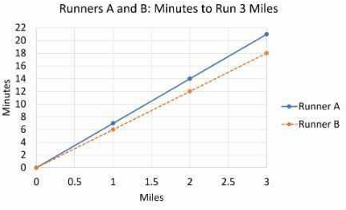
The graph below displays the times in which it takes Runner A and Runner B to run 3 miles. Which statement correctly interprets the slope of the data displayed?
Rationale
Runner B is a faster runner because the slope of the data is 6.
In the context of the graph, the slope represents the speed at which each runner completes 3 miles. The lower the slope, the faster the runner, as they take less time to run the same distance. Therefore, a slope of 6 for Runner B indicates that they are faster than Runner A.
A) Runner A is a faster runner because the slope of the data is 6. This statement is incorrect because the slope of 6 corresponds to Runner B, not Runner A. Additionally, the lower slope indicates a faster speed, so even if the slope of 6 did correspond to Runner A, this would make Runner A the faster runner, not the slower.
B) Runner A is a faster runner because the slope of the data is 7. This statement is also incorrect. Even if the slope for Runner A were 7, this would mean that Runner A is slower than Runner B, whose slope is 6. A higher slope indicates a slower speed, as it takes more time to run the same distance.
D) Runner B is a faster runner because the slope of the data is 7. This statement is incorrect because the slope for Runner B is actually 6, not 7. Moreover, if Runner B's slope were 7, this would make him slower, not faster, as a higher slope indicates a longer time to run the same distance.
Conclusion The slope of a graph in this context represents speed. The lower the slope, the faster the runner. Therefore, with a slope of 6, Runner B is the faster runner. Misinterpretations of the graph's slope as it pertains to each runner's speed led to the incorrect conclusions in options A, B, and D.
Approximately what percent of 72 is 8?
Rationale
11% of 72 is approximately 8.
The percentage of a number is calculated by dividing the part by the whole and then multiplying by 100. In this case, 8 divided by 72 and multiplied by 100 gives a value close to 11.
A) 9% If 9% was the correct answer, then 9% of 72 would be 6.48, which is less than 8. Therefore, this choice is incorrect.
B) 0.11% Similarly, if 0.11% was the correct answer, then 0.11% of 72 would be 0.0792, which is significantly less than 8. Hence, this choice is also incorrect.
C) 0.01% If 0.01% was the correct answer, then 0.01% of 72 would be 0.0072, which is drastically less than 8. Consequently, this choice is incorrect.
D) 11% 11% of 72 is 7.92, which is approximately equal to 8. Therefore, this choice is correct.
Conclusion The percentage of a number can be calculated by dividing the part by the whole and then multiplying by 100. In this case, 8 divided by 72 and multiplied by 100 gives a value close to 11. Therefore, 11% of 72 is approximately equal to 8. All other choices result in values that are either significantly less or greater than 8.
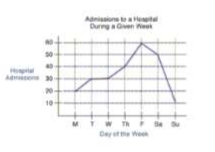
This question refers to the graph below, which shows admissions to a hospital during a given week. What was the average number of admissions over Friday, Saturday, and Sunday?
Rationale
The average number of admissions over Friday, Saturday, and Sunday was 40.
To find the average, you add up the total number of admissions for those three days and then divide by the number of days.
A) 36 This choice might have been calculated by incorrectly averaging the number of admissions over the entire week, or by misreading the graph. The correct average for Friday, Saturday, and Sunday is higher than this.
B) 37 This choice might be the result of a minor calculation error when adding up the total admissions for the three days and dividing by three. It is close to the correct answer but not quite accurate.
C) 40 This is the correct answer. The total number of admissions for Friday, Saturday, and Sunday, divided by three, equals 40.
D) 43 This choice might have been reached by miscalculating the total number of admissions for the three days or by dividing by a smaller number than the correct divisor of three.
Conclusion The average number of admissions to the hospital over Friday, Saturday, and Sunday was 40. The other choices represent calculations that do not accurately reflect the average admissions for these three days based on the data provided in the graph. Understanding how to correctly calculate averages from graphical data is essential for accurate data interpretation.
The Federal Drug Administration (FDA) recommends that the average person consumes no more than 1300 milligrams, mg of calcium each day. Given 1000 mg = 1 g, if a person has already consumed 0.5 g of calcium in a day, what is the maximum number of mg of calcium they can still consume in that same day?
Rationale
The maximum number of mg of calcium they can still consume in that same day is 800 mg.
This value is obtained by converting the already consumed calcium from grams to milligrams and subtracting it from the recommended daily limit.
A) 12.5 mg This choice is not correct. It seems to be a result of incorrect conversion of grams to milligrams or misunderstanding of the question. It is far less than the remaining allowance after consuming 0.5 grams (or 500 mg) of calcium.
B) 800 mg This is the correct answer. After consuming 0.5 grams (or 500 mg) of calcium, the maximum a person can still consume is 800 mg. This is obtained by subtracting 500 mg from the FDA's recommended daily limit of 1300 mg.
C) 10.8 mg This choice is incorrect. It appears to be a result of inappropriate calculations. It is significantly less than the remaining amount of calcium that can be consumed after consuming 0.5 grams (or 500 mg).
D) 1299.5 mg This choice is incorrect. It seems to be a misinterpretation of the question, as it is just 0.5 mg less than the total daily recommended limit. After already consuming 0.5 grams (or 500 mg) of calcium, the remaining limit would be significantly less than this.
Conclusion To determine the remaining amount of calcium that can be consumed in a day, the amount already consumed should be subtracted from the recommended daily limit. In this case, after consuming 0.5 grams (or 500 mg) of calcium, a person can still consume 800 mg to meet the FDA's recommended daily limit of 1300 mg without exceeding it.
Change 9/16 to a decimal rounded to the nearest thousandth.
Rationale
0.563 is the decimal equivalent of 9/16 when rounded to the nearest thousandth.
To convert a fraction to a decimal, you divide the numerator by the denominator. In this case, dividing 9 by 16 gives a decimal of 0.5625. When rounding to the nearest thousandth, this becomes 0.563.
A) 0.56 This choice rounds the number to the nearest hundredth, which is not as precise as rounding to the nearest thousandth. The decimal 0.56 omits the third digit after the decimal point, resulting in less precision than the correct answer.
B) 0.57 This choice incorrectly rounds the decimal to the nearest hundredth. When rounding to the nearest hundredth, the correct decimal equivalent of 9/16 should be 0.56, not 0.57. The choice of 0.57 suggests an overestimation in the rounding process.
C) 0.563 This is the correct answer. When 9 is divided by 16, the result is 0.5625. Rounding this to the nearest thousandth gives 0.563.
D) 0.563 This choice is identical to the correct answer. It is the decimal equivalent of 9/16 when rounded to the nearest thousandth. However, having identical choices in a multiple-choice question is typically an error in question design.
Conclusion When converting the fraction 9/16 to a decimal and rounding to the nearest thousandth, the correct answer is 0.563. The other choices represent either errors in rounding or are less precise due to being rounded to the nearest hundredth instead of the nearest thousandth. The presence of an identical choice might be a mistake in the question design.
You are leaving this quiz
What would you like to do with your progress?
You're in the middle of a quiz
What would you like to do before switching?
Practice complete
You finished this free practice quiz.