
Change 4/17 to a decimal rounded to the nearest thousandth.
Rationale
0.236 is the decimal equivalent of 4/17, rounded to the nearest thousandth.
In decimal form, 4/17 equals approximately 0.23529411764705882352941176470588. When rounded to the nearest thousandth, this value becomes 0.236.
A) 0.236 This is the correct answer. When 4/17 is converted to a decimal and rounded to the nearest thousandth, the result is 0.236.
B) 0.23 This choice incorrectly rounds down to the nearest hundredth instead of the nearest thousandth. The correct decimal equivalent, rounded to the nearest thousandth, is 0.236.
C) 0.24 This choice incorrectly rounds up to the nearest hundredth instead of the nearest thousandth. The proper rounding of 4/17 to the nearest thousandth is 0.236, not 0.24.
D) 0.285 This choice is not a correct rounding of 4/17 to any decimal place. It may have been calculated using a different fraction or rounded incorrectly.
Conclusion When converting a fraction to a decimal and rounding to the nearest thousandth, it's essential to carry out the division operation with precision and then apply appropriate rounding rules. In the case of 4/17, the correct decimal equivalent, rounded to the nearest thousandth, is 0.236. All other choices either round to the incorrect decimal place or represent inaccurate calculations.
The graph presents the travel data for four different cars showing the distance they are from home (in miles) over time (in hours). Which car has the highest rate of speed?
Rationale
Car A has the highest rate of speed.
The speed of a car is determined by the distance it travels over a certain period of time. In the graph, car A covers the greatest distance in the shortest amount of time, indicating the highest speed.
A) Car A Car A covers the greatest distance in the least time compared to the other cars. The steep incline of its trajectory on the graph indicates a higher rate of speed.
B) Car B While Car B also covers a significant distance, the slope of its graph is less steep compared to car A, indicating it travelled at a slower speed.
C) Car C Car C's trajectory on the graph is even less steep than that of car B, indicating it travelled at an even slower speed.
D) Car D Car D's trajectory on the graph is the least steep of all four cars, indicating it travelled at the slowest speed.
Conclusion Even though all four cars are moving, the rate of speed differs for each car. Car A has the highest rate of speed because it covers the greatest distance in the least amount of time. The other cars, B, C, and D, cover less distance in the same amount of time, indicating slower speeds. The steepness of a car's trajectory on the graph is an indicator of its speed, with steeper lines indicating higher speeds.
Given that area = length x width and a rectangle's length and width are 4 cm and 6 cm, what is 1/2 the area of this rectangle?
Rationale
The half area of the rectangle is 12 cm^2.
The area of a rectangle is given by the formula length x width. In this case, the length is 4 cm and the width is 6 cm. So, the area of the rectangle is 4 cm x 6 cm = 24 cm^2. Half of this area is 24 cm^2 / 2 = 12 cm^2.
A) 12 cm^2 This is the correct answer because it represents half the area of the rectangle. The total area of the rectangle with length 4 cm and width 6 cm is 24 cm^2. Therefore, half of this area is 12 cm^2.
B) 10 cm^2 This answer is incorrect because it does not represent half the area of the rectangle. To find half the area, the total area (24 cm^2) should be divided by 2, which equals 12 cm^2, not 10 cm^2.
C) 24 cm^2 This answer is incorrect because it represents the total area of the rectangle, not half the area. Half the area of the rectangle is 24 cm^2 divided by 2, which equals 12 cm^2.
D) 20 cm^2 This answer is incorrect because it does not represent half the area of the rectangle. Half the area of the rectangle with length 4 cm and width 6 cm is 12 cm^2, not 20 cm^2.
Conclusion The area of a rectangle is calculated by multiplying its length and width. Given a rectangle with a length of 4 cm and a width of 6 cm, the total area is 24 cm^2. Half of this area is 12 cm^2. Therefore, the correct answer is 12 cm^2. The other choices incorrectly calculated half the area of the rectangle.
Which expression represents four more than a number is 12?
Rationale
A) X+4=12 is the correct expression.
In the context of the question, 'four more than a number' refers to the operation of addition where 4 is added to a certain variable, represented by 'X'. The statement 'is 12' indicates that the result of this addition operation equals 12. This relationship is correctly represented by the equation X+4=12.
A) X+4=12 This option correctly represents the given statement. The equation X+4=12 depicts that when 4 is added to a certain number (X), the sum equals 12. This is the exact translation of the phrase 'four more than a number is 12'.
B) X+12=4 This choice incorrectly interprets the given statement. The equation X+12=4 suggests that when 12 is added to a certain number (X), the sum equals 4. This is contrary to the statement 'four more than a number is 12', which signifies that adding 4 to the number yields 12, not 4.
C) X+8=12 This option inaccurately represents the given statement. The equation X+8=12 indicates that when 8 is added to a certain number (X), the sum equals 12. This does not align with the statement 'four more than a number is 12', which specifies that adding 4 (not 8) to the number results in 12.
D) 4X=12 This choice is also incorrect. The equation 4X=12 implies that multiplying a certain number (X) by 4 yields 12. This is a misinterpretation of the given statement, which involves addition (not multiplication) of 4 to the number to get 12.
Conclusion The expression 'four more than a number is 12' implies an addition operation where 4 is added to a certain number, and this sum equals 12. The only choice that accurately translates this statement into an equation is A) X+4=12. The other choices misrepresent the statement by either suggesting incorrect operations (addition with wrong numbers or multiplication) or yielding incorrect results.
An antibiotic solution contains 450,000 units per one milliliter of solution. How many milliliters are needed to provide 150,000 units?
Rationale
0.33 milliliters (or 01-Mar in the given format) of the antibiotic solution are needed to provide 150,000 units.
This is determined by dividing the required units (150,000) by the concentration of units per milliliter (450,000) in the antibiotic solution. The result is approximately 0.33 milliliters.
A) 01-Mar This choice is correct because it represents 0.33 in the given format. To provide 150,000 units from a solution containing 450,000 units per milliliter, only a third of a milliliter (0.33 mL) is needed.
B) 04-Mar This choice represents 0.75 in the given format and is incorrect. This would provide more units than required, around 337,500 units, using a solution with 450,000 units per milliliter.
C) 01-Apr This choice represents 0.25 in the given format. This would provide fewer units than required, around 112,500 units, using a solution with 450,000 units per milliliter.
D) 3 This choice is incorrect because 3 milliliters of the solution would provide 1,350,000 units, which is far more than the required 150,000 units.
Conclusion To find the volume of solution needed to provide a specific number of units, you divide the required units by the concentration of units per milliliter in the solution. For this antibiotic solution, providing 150,000 units requires 0.33 milliliters, or 01-Mar in the given format. The other choices all provide the wrong number of units, either too few or too many.
A 14-inch piece of wood is going to be cut so that one of the pieces is 4 inches shorter than the other. How long is the shorter piece?
Rationale
The shorter piece of wood is 5 inches long.
The problem can be solved by setting up the equation: x + (x - 4) = 14, where x represents the length of the shorter piece of wood. After combining like terms and solving for x, you get x = 5. Therefore, the shorter piece of wood is 5 inches long.
A) 5 inches The shorter piece is indeed 5 inches long. This was obtained by solving the equation x + (x - 4) = 14, which represents the total length of the wood (14 inches) being divided into two pieces, where one piece (x) is 4 inches shorter than the other.
B) 9 inches A 9-inch piece would not be 4 inches shorter than the other cut. If the shorter piece was 9 inches, the other piece would be 5 inches, making the shorter piece 4 inches longer, not shorter.
C) 4 inches A 4-inch piece would not meet the condition that one of the pieces is 4 inches shorter than the other. If one piece is 4 inches, the other piece would be 10 inches, making the shorter piece 6 inches shorter, not 4.
D) 10 inches A 10-inch piece would not be 4 inches shorter than the other cut. If one piece is 10 inches, the other piece would be 4 inches, making the shorter piece 6 inches longer, not shorter.
Conclusion The correct answer to the problem is that the shorter piece of wood is 5 inches long. This answer was obtained by setting up and solving an equation that represents the conditions given in the problem. The other choices do not satisfy the condition that one piece is 4 inches shorter than the other.
Given that 3 feet (ft) = 1 yard (yd) and 3.281 ft = 1 meter, approximately how many meters is 1 yd?
Rationale
A) 1.09 meters is the approximate conversion of 1 yard into meters.
The conversion of yards to meters involves two steps. First, the yards must be converted into feet using the ratio 1 yard = 3 feet, and then the feet must be converted into meters using the ratio 3.281 feet = 1 meter.
A) 1.09 meters This is the correct answer. One yard is equivalent to 3 feet, and 3 feet is approximately equivalent to 0.9144 meters (3/3.281), which rounds to 0.91 meters or approximately 1.09 meters.
B) 3.657 meters This answer takes the conversion ratio of 3.281 feet = 1 meter and incorrectly applies it to the yard without first converting yards to feet. This results in a much larger value than the correct answer.
C) 3.0 meters This answer incorrectly assumes that 1 yard is equivalent to 3 meters. However, this is not correct because the conversion ratio from feet to meters is not 1:1.
D) 0.94 meters This answer is close to the correct answer, but it is not correct. This may be a result of rounding errors in the conversion process.
Conclusion To convert yards to meters, it's necessary to first convert the yards to feet, then convert the feet to meters using the appropriate conversion ratios. In this case, 1 yard (which equals 3 feet) is approximately 1.09 meters, not 3.657, 3.0, or 0.94 meters. This question underscores the importance of using the correct conversion factors and performing each step of the conversion process accurately.
At Grain House, the bulk price for the grain Amaranth is $2.50 per pound, with a minimum purchase of 20 pounds (lbs). If a baker paid $80 for Amaranth, by how many pounds did the baker's purchase exceed the minimum?
Rationale
The baker's purchase exceeded the minimum by 32 pounds.
The bulk price for Amaranth at Grain House is $2.50 per pound, and the minimum purchase is 20 pounds. If the baker paid $80, they bought 32 pounds of Amaranth more than the minimum required.
A) 12 This is incorrect because by multiplying 12 by the price per pound ($2.50), we get $30. This would mean that the baker only paid $30 for the purchase which is less than $80.
B) 40 This is incorrect because it suggests that the baker bought 40 pounds of grain in total. However, since the price per pound is $2.50, 40 pounds of grain would have cost the baker $100, not $80.
C) 24 This is incorrect because it suggests that the baker bought 24 pounds of grain in total. However, since the price per pound is $2.50, 24 pounds of grain would have cost the baker $60, not $80.
D) 32 This is the correct answer. If the baker paid $80 for the grain, and the price per pound is $2.50, that means the baker bought 32 pounds of grain in total. Since the minimum purchase is 20 pounds, the baker's purchase exceeded the minimum by 12 pounds.
Conclusion The baker's purchase exceeded the minimum by 32 pounds. The other choices do not correctly calculate the total pounds of grain the baker could have bought with $80 at the price of $2.50 per pound. Therefore, they do not accurately represent the amount by which the baker's purchase exceeded the minimum.
A person wants to download episodes of a favorite TV show to their cell phone. Each 20-minute episode will use about 0.3 Gabybytes (GB) of space. There are 9 GB of space available on the cell phone. At most, how many minutes of the show can be downloaded?
Rationale
A person can download 600 minutes of the show.
Given that each 20-minute episode uses about 0.3 GB, and there are 9 GB of available space on the cell phone, the person can download 30 episodes. Since each episode is 20 minutes long, this equates to 600 minutes of the show.
A) 600 minutes This is the correct answer. Given 9 GB of available space and the fact that each 20-minute episode uses 0.3 GB, the person can download 30 episodes. 30 episodes times 20 minutes per episode equals 600 minutes.
B) 50 minutes This is incorrect. If each 20-minute episode uses 0.3 GB, then 50 minutes of the show would only require about 0.75 GB. This is far less than the 9 GB of space available on the cell phone.
C) 30 minutes This is also incorrect. With 9 GB of available space, the person can download more than just one and a half episodes of the show (which would be 30 minutes). In fact, they can download 30 full episodes, each of 20 minutes length, giving a total of 600 minutes.
D) 500 minutes This is incorrect. With 9 GB of space, the person can download more than 500 minutes of the show. Specifically, they can download 600 minutes of the show.
Conclusion Given the available space of 9 GB and the fact that each 20-minute episode requires 0.3 GB, the person can download 30 episodes of their favorite TV show. As each episode is 20 minutes long, this equates to 600 minutes of content. The other options underestimate the amount of content that can be downloaded with the available storage space.
A 120 milliliter (mL) solution contains a mixture of water and acid. The acid makes up 40% of the solution. How many mL of water make up the solution?
Rationale
72 mL of the solution is made up of water.
The question tells us that the total solution is 120 mL and that acid makes up 40% of the solution. Therefore, if we want to find out how much of the solution is water, we need to subtract the amount of acid from the total solution.
A) 40 mL This would be the amount of acid in the solution, not the amount of water. This is calculated by taking 40% of the total volume (120 mL), which gives 48 mL. This answer confuses the percentage of the solution that is acid with the volume of water in the solution.
B) 60 mL This choice would be correct if the solution were 50% acid and 50% water. However, the question clearly states that the solution is 40% acid, which means it is 60% water. Therefore, 60% of the total 120 mL solution equals 72 mL of water, not 60 mL.
C) 72 mL This is the correct answer. It is calculated by determining what volume makes up 60% of the solution. Since the solution is 40% acid, the remaining 60% is water. 60% of 120 mL equals 72 mL.
D) 48 mL This is the volume of acid in the solution, not the amount of water. It is calculated by determining what volume makes up 40% of the solution. Since the solution is 40% acid, 40% of 120 mL equals 48 mL.
Conclusion When dealing with percentages in a solution, it's important to understand that the percentage refers to the volume of the component in relation to the total volume of the solution. Therefore, if a solution is 40% acid, the remaining 60% is water. In this case, 60% of the total 120 mL solution equals 72 mL of water, not 60 mL or any other volume. The other choices confuse the volume of acid with the volume of water or misinterpret the percentages.
An athlete is competing in the following races: 100m, 200m, 400m, 800m, 1500m, 5000m, 10,000m. Given 1000 m = 1 kilometer (km), how many km would the athlete run in total?
Rationale
The athlete would run a total of 18 kilometers.
To compute the total distance, the lengths of all the races are added together. These distances are then converted from meters to kilometers using the conversion factor 1000 meters = 1 kilometer.
A) 17,000 km This answer is incorrect because it greatly overestimates the total distance the athlete would run. Even if the distances of all the races were in kilometers instead of meters, the total would still not reach 17,000 kilometers.
B) 18 km The total distance of all the races (100m + 200m + 400m + 800m + 1500m + 5000m + 10,000m) is 18,000 meters. Because 1 kilometer equals 1000 meters, the 18,000 meters convert to 18 kilometers. Hence, the total distance run by the athlete is 18 kilometers.
C) 18,000 km This answer incorrectly assumes that the distances of all races are already given in kilometers, not meters. However, the distances are actually in meters, so they must be converted to kilometers by dividing by 1000.
D) 18,000,000 km This answer is incorrect because it greatly overestimates the total distance the athlete would run. Even if the distances of all the races were in kilometers instead of meters, the total would still not reach 18,000,000 kilometers.
Conclusion The total distance the athlete would run in all the races is 18 kilometers. This is found by summing the lengths of all the races, which are given in meters, and then converting that total to kilometers. All other answer choices significantly overestimate the total distance the athlete would run.
A bottle of juice is $4.25. The store is offering a 15% discount on all items. After applying the discount, there is a 6% sales tax. What is the final price for the juice?
Rationale
The final price for the juice is $3.83.
The original price of the juice is $4.25. First, a 15% discount is applied, reducing the price to $3.61. Then, a 6% sales tax is added, bringing the final price to $3.83.
A) $34.00 The price of the juice cannot be $34.00 because this amount is significantly higher than the original price. Even with the application of a sales tax, the final price should be lower than the original price due to the 15% discount.
B) $4.00 The price of the juice cannot be $4.00 because this amount doesn't accurately reflect the 15% discount and the subsequent 6% sales tax. A 15% discount on the original price of $4.25 would reduce the price to $3.61, and a 6% sales tax on this discounted price would increase it to $3.83.
C) $3.61 The price of the juice cannot be $3.61 because this amount only accounts for the 15% discount and not the subsequent 6% sales tax. After applying the 15% discount, the price is indeed $3.61. However, we must then add a 6% sales tax, which brings the final price to $3.83.
D) $3.83 This is the correct answer. After applying the 15% discount to the original price of $4.25, the price becomes $3.61. Then, a 6% sales tax is added to this amount, resulting in a final price of $3.83.
Conclusion The final price of the juice, after applying a 15% discount and a 6% sales tax, is $3.83. The other options either do not account for both the discount and the sales tax, or they result in a price that is higher than the original price, which is not possible given the conditions of the problem.
What percent of 40 is 8 ?
Rationale
20% of 40 is 8.
This calculation can be done by dividing 8 (the part) by 40 (the whole), then multiplying the result by 100 to convert it into a percentage. The result is 20%.
A) 8% This is incorrect because 8% of 40 is 3.2, not 8. To calculate the percentage, we need to divide the part (8) by the whole (40) and then multiply by 100.
B) 2% This is also incorrect because 2% of 40 is 0.8, not 8. The process of calculating the percentage is the same as above.
C) 20% This is the correct answer. 20% of 40 is 8. These values suit the formula for calculating a percentage, which is (Part/Whole)*100%.
D) 0.05% This option is incorrect because 0.05% of 40 is 0.02, not 8. The percentage calculation remains the same - divide the part by the whole and then multiply by 100.
Conclusion The percentage of a number is calculated by dividing the part by the whole and then multiplying by 100. In the context of this problem, 20% of 40 equals 8, making option C the correct answer. Options A, B, and D provide incorrect percentages of 40 and are therefore incorrect.
A nurse has just transferred to a new hospital and is still getting used to working in pounds instead of kilograms. Given that 1 kilogram (kg) = 2.2 pounds (lb), what does a 176 lb patient weigh in kg?
Rationale
The patient weighs 80 kg.
To convert pounds to kilograms, the weight in pounds is divided by the conversion factor of 2.2. Therefore, a weight of 176 pounds would be approximately 80 kilograms when converted.
A) 178.2 kg This is incorrect because to convert pounds to kilograms, the weight in pounds should be divided by 2.2, not multiplied. Multiplying would result in a weight that is larger than the original, which is not correct in this case.
B) 387.2 kg This is incorrect because it suggests that the conversion factor used was significantly higher than 2.2. Using the correct conversion factor of 2.2, the weight in kilograms should be much less than 387.2 kg.
C) 80 kg This is the correct answer. To convert 176 pounds to kilograms, the weight in pounds is divided by the conversion factor of 2.2, which gives a result of approximately 80 kilograms.
D) 38.72 kg This is incorrect because it indicates that the conversion factor used was less than 2.2. Using the correct conversion factor of 2.2, the weight in kilograms should be higher than 38.72 kg.
Conclusion The correct conversion from pounds to kilograms involves dividing the weight in pounds by the conversion factor of 2.2. In this case, a patient weighing 176 pounds would weigh approximately 80 kilograms. The other options represent incorrect conversions, either by using a conversion factor that was too high, too low, or by applying the conversion factor in the wrong direction (multiplying instead of dividing).
The Venn diagram shows the number of people who ate each of the meals at a picnic. There were two groups of 30 people each. How many people ate only hot dogs?
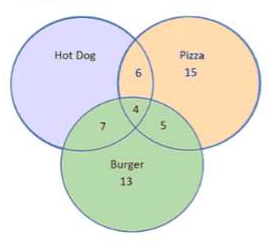
Rationale
5 people ate only hot dogs.
The Venn diagram shows the distribution of people who ate each meal at a picnic. The number of people who ate only hot dogs can be determined by analyzing the specific sector of the diagram that represents only hot dogs, excluding the areas where hot dogs overlap with other meals.
A) 27 This choice may result from a misunderstanding of the Venn diagram. 27 people might be the total number of people who ate hot dogs, but this would include those who also ate other meals. The question specifically asks for the number of people who ate only hot dogs, which necessitates excluding those who ate hot dogs in combination with other meals.
B) 5 The correct answer. This represents the number of people who ate only hot dogs, as indicated by the standalone sector for hot dogs on the Venn diagram. These individuals did not consume any other meals at the picnic.
C) 10 This answer could be a misinterpretation of the Venn diagram, possibly confusing the number of people who ate only hot dogs with those who ate hot dogs and another meal, or those who ate only another specific meal.
D) 17 This choice could be a result of incorrectly adding the number of people who ate only hot dogs with those who ate hot dogs and another meal. This does not answer the question, as it does not solely represent people who ate only hot dogs.
Conclusion The Venn diagram provides a clear representation of the distribution of people who ate each meal at the picnic. From this, it can be determined that 5 people ate only hot dogs, ruling out the other options which may have been derived from misinterpretations or miscalculations based on the Venn diagram. It's important to understand that in a Venn diagram, each segment represents a different group, and in this case, the question was specifically about the group of individuals who ate only hot dogs.
You are leaving this quiz
What would you like to do with your progress?
You're in the middle of a quiz
What would you like to do before switching?
Practice complete
You finished this free practice quiz.